¶ Diesel Particulate Filter: Design, Types and Materials
¶ Key points
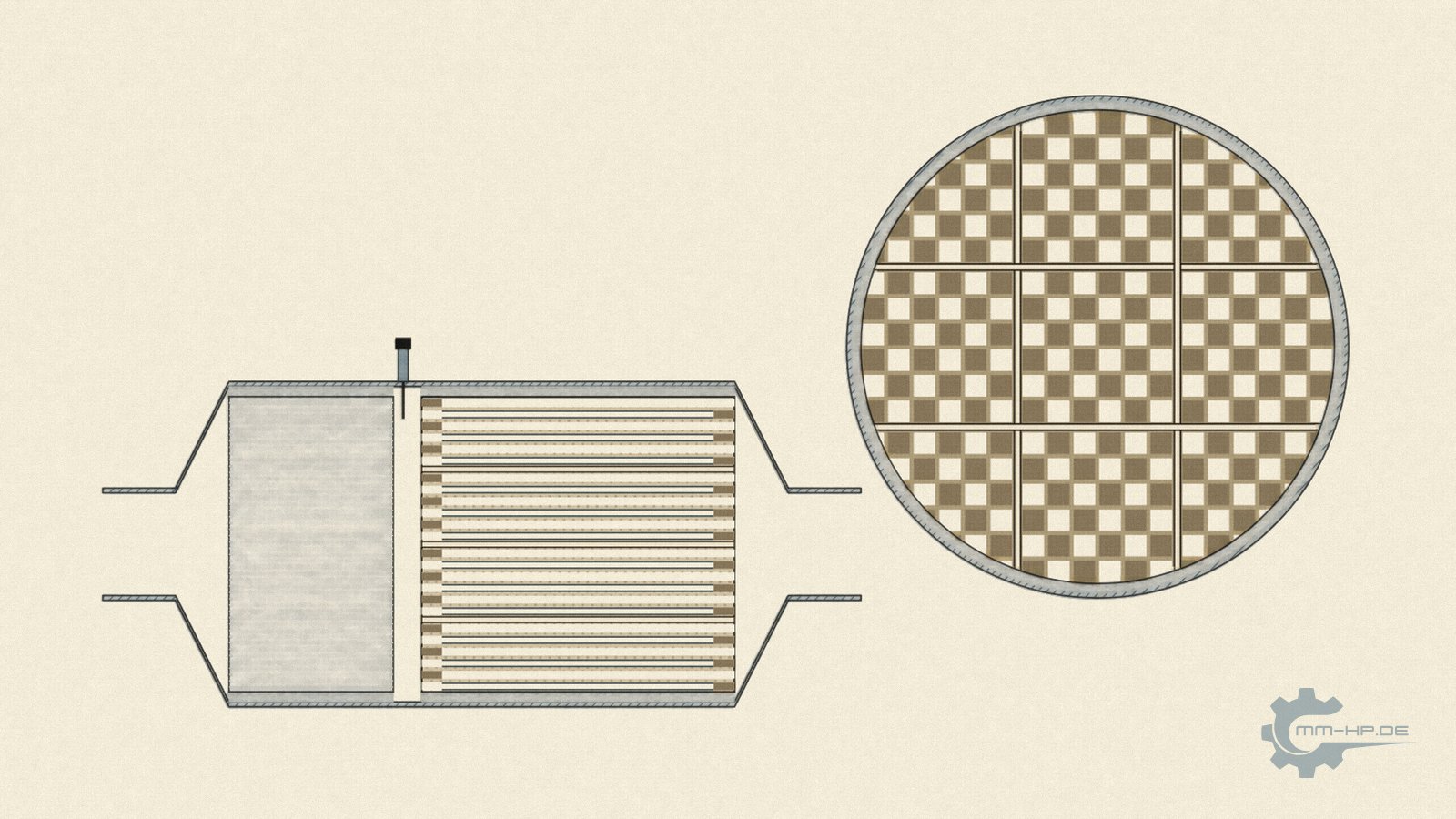
In a passenger car, a diesel particulate filter (DPF) is almost always a honeycomb body made of porous ceramic. Its fine channels are plugged alternately at the front or the rear. The exhaust gas therefore has to pass through the channel wall into the neighboring channel, and the soot stays stuck to the wall. This design is called a wall-flow filter. By weight it retains 70 to 95 percent of the particulate mass, depending on its condition, and by particle count mostly over 90 percent, over 99 percent according to the industry association. A fresh, clean filter catches the least.
Three ceramics are used as the material. Cordierite is inexpensive and hardly expands, but it melts at around 1,450 °C (2,640 °F). Silicon carbide tolerates much more heat but expands more, which is why it is bonded together from individual segments. Aluminum titanate lies in between. Which ceramic a particular car has is rarely stated openly: for the VW 2.0 TDI, the European training document names silicon carbide, while the US version for the same engine names aluminum titanate.
An oxidation catalyst usually sits in front of the filter, and the filter walls themselves are coated at German manufacturers. This coating helps burn the soot at a lower temperature. PSA took a different route with the FAP, in series production in passenger cars since 2000: an additive in the fuel, Eolys, lowers the ignition temperature of the soot.
The filter is monitored by a pressure sensor that measures the pressure difference before and after the filter, and by temperature sensors. From these the control unit estimates how much soot is in the filter and decides when to burn it off. Besides the soot, ash from the engine oil collects, which does not burn and fills the filter over the years.
What determines the service life is therefore less the material than what goes in: how much soot the engine produces, whether the regenerations finish and how much oil it burns. What that means in everyday driving is explained in the article on DPF regeneration (See also).
That was the short answer. If you want to understand how soot gets stuck in a ceramic wall, why a filter is built from segments and how the technology has developed since the first attempt in 1985, the long version starts here.
¶ How a Diesel Particulate Filter Works: The Wall-Flow Filter in Cross Section
According to DieselNet, the plugged channel ends are there "to force the diesel aerosol through the porous substrate walls." Seen from the front, a particulate filter therefore looks like a checkerboard. Half of the channels are open, the other half is closed with a plug of ceramic paste, typically 5 to 20 millimeters (0.2 to 0.8 in) deep according to Corning's patents. At the rear it is the other way around. A channel that is open at the front ends blind at the rear, and the exhaust gas that flows in has only one way out again: through the porous wall into one of the neighboring channels that are open at the rear.

The dimensions are small. A typical passenger car filter, as a master's thesis at MIT describes it as a reference, has a diameter of about 14 centimeters (5.5 in), a length of 15 centimeters (5.9 in) and 200 cells per square inch with a wall of 0.3 millimeters (0.012 in). That gives a channel width of just under 1.5 millimeters (0.06 in). The channels take up a good two thirds of the front face, and because every second one is plugged, only about a third is open to the exhaust gas at the inlet. The wall itself is about half void space, and the pores average 10 to 20 thousandths of a millimeter (10 to 20 micrometers) in size.
Worldwide, ceramic wall-flow filters are the most common design at about 70 percent, according to the same MIT thesis. In passenger cars they are practically the only one.
In the VW 2.0 TDI with common rail, the oxidation catalyst and the particulate filter sit one behind the other in a shared housing, with the catalyst at the front in the direction of flow. According to VW self-study program 403, the catalyst has a metal substrate, and the walls of the filter are coated with aluminum oxide and cerium oxide and, on top of that, platinum.
¶ Depth Filtration and Cake Filtration: How the Soot Gets Caught
A new filter works differently from a loaded one. First the soot particles penetrate the pores of the wall and stay lodged there. This is called depth filtration. It narrows the pores, and the pressure loss rises quickly. Once the pores at the surface are clogged, a layer of soot, the soot cake, grows on the wall. From then on the cake does the filtering itself, and the pressure rises only slowly. DieselNet and the MIT thesis describe this sequence in agreement.

The particles are held in three ways. Very small particles zigzag because of the thermal motion of the gas molecules and hit the pore wall on the way. Larger ones fly straight ahead because of their inertia, where the gas turns. And some simply graze the wall in passing. According to a dissertation at MIT, soot particles are about 30 to 500 nanometers in size, so much smaller than the pores. That they still get caught is down to these mechanisms and to the thick wall: a particle has to pass many pores in a row.
How well a filter separates depends strongly on how you count and on the state it is in. By mass, DieselNet gives 70 to 95 percent of the total particulate mass, and the MIT thesis gives 95 to 99.9 percent for solid particles. By number, the value for particles over 20 nanometers is 90 to 99.9 percent according to the German Wikipedia, and the European industry association AECC names over 99 percent. A fresh, clean filter is the worst, before a cake has formed. With some soot and also some ash, the separation efficiency rises, and DieselNet names less than 2 grams of ash per liter of filter volume for this.
For type approval, the particle number has counted since Euro 5b. A passenger car may emit at most 6.0 × 10¹¹ particles per kilometer (about 9.7 × 10¹¹ per mile), counting particles over 23 nanometers (Regulation 715/2007). In the German emissions inspection, a limit of 250,000 particles per cubic centimeter has applied to Euro 6 diesels since July 2023. Good filters are around 10,000, according to the ADAC.
¶ Wall-Flow, Partial-Flow, Metal Fleece, Sintered Metal: The Designs
Besides the ceramic wall-flow filter, there are designs that work differently. The most important distinction is whether all of the exhaust gas has to pass through a filter medium or only a part of it.

The partial-flow filter consists of corrugated steel foils with small vanes and layers of sintered metal fleece. The vanes direct part of the exhaust gas through the fleece, and the rest flows through open longitudinal channels. One well-known design is the PM-Metalit from the manufacturer Emitec. It never clogs completely: when the fleece is full, more gas flows past it. That is also its weakness. The figures for its separation efficiency vary widely, from 30 to 40 percent by mass through about 60 percent to over 80 percent in test cycles for construction machinery. An independent test of four systems on cars and trucks (SAE 2009-01-1087) found 63 percent for the best one, while three stayed well below the expected 30 percent or failed. The study does not name the manufacturers tested.
Sintered metal filters, by contrast, are true full-flow filters. Their filter medium consists of layers of sintered metal fibers, for example from an iron-chromium-aluminum alloy, 1 to 1.5 millimeters (0.04 to 0.06 in) thick and about 85 percent void. The manufacturer HJS builds pockets from them through which all of the exhaust gas has to pass. Such filters are wall-flow filters made of metal, not partial-flow filters. According to the MIT thesis, they account for about 4 percent of the market, mainly in commercial vehicles and retrofits.
German Wikipedia clears up a common mix-up. Whether a system is called "closed" or "open" says nothing yet about the design. What matters is whether all of the gas has to pass through the filter medium. The Bavarian environment ministry gives over 90 percent for closed systems and 30 to 50 percent for open ones.
¶ Cordierite, Silicon Carbide, Aluminum Titanate: The Filter Materials
A particulate filter has to do two things at once. It has to be fine enough to hold soot, and it has to withstand heat shocks when hundreds of degrees run through it within minutes during a regeneration. The three common ceramics solve this differently.
| Property | Cordierite | Silicon carbide |
|---|---|---|
| Channel width | 1.3 to 2.1 mm (0.05 to 0.08 in) | 1.0 to 1.6 mm (0.04 to 0.06 in) |
| Wall thickness | 0.3 to 0.5 mm (0.012 to 0.020 in) | 0.3 to 0.8 mm (0.012 to 0.031 in) |
| Mean pore size | 13 to 34 µm | 8 to 17 µm |
| Porosity | 45 to 50 % | 42 to 58 % |
| Melting temperature | about 1,450 °C (2,640 °F) | 1,800 to 2,400 °C (3,270 to 4,350 °F) |
The source of the table is Folino's MIT thesis (2015), and DieselNet confirms the melting temperature of cordierite. Two values stand out. Cordierite melts 350 to 950 degrees Celsius (630 to 1,710 degrees Fahrenheit) earlier than silicon carbide, and DieselNet names a practical limit in use of only about 1,200 °C (2,190 °F), mainly because of reactions with the ash. And silicon carbide has finer pores on average.

Cordierite is a magnesium aluminum silicate ceramic and the classic, made for example by Corning, NGK and Denso. It hardly expands when heated and therefore tolerates temperature changes well. Its weakness is the low melting point. If a regeneration with too much soot runs out of control, cordierite can melt locally.
Silicon carbide tolerates much more heat and conducts it away better. But it expands more. A large block would crack from the temperature differences during a regeneration. A silicon carbide passenger car filter is therefore built from individual segments, according to a study by NGK (SAE 2006-01-1527) each 35 by 35 millimeters (1.4 by 1.4 in), bonded with a cement that absorbs the stresses. The block is then ground round and the outer skin coated. You can see the bonding joints on every front face as a grid. Since the mid-2000s, silicon carbide has been widespread in passenger cars.
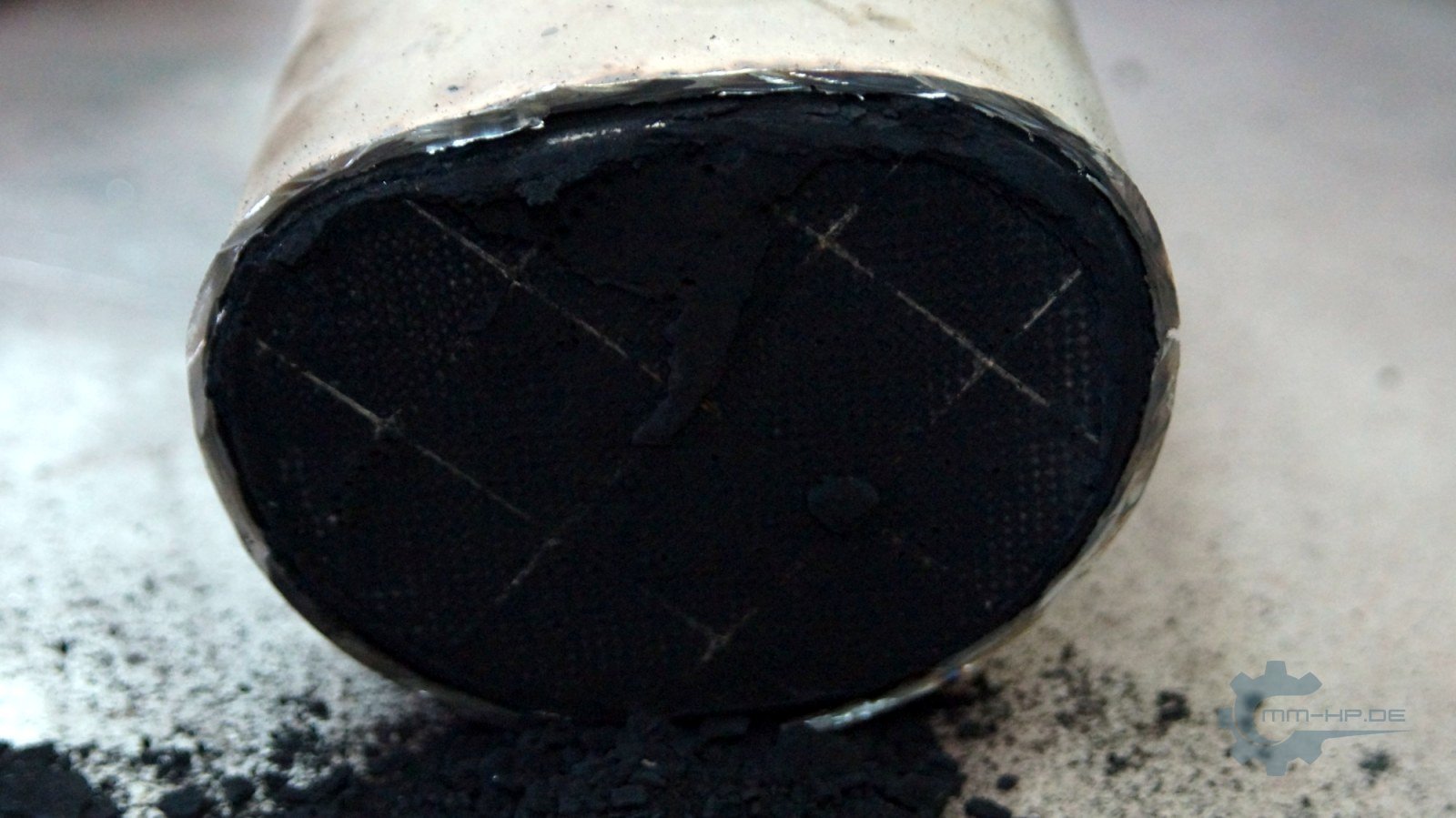
Front face of a filter made of segments. The lines are the bonding joints.
Aluminum titanate was introduced by Corning in 2005 as DuraTrap AT, mainly for passenger cars. According to Corning's patents, it expands so little that it needs no segments, and it tolerates more heat than cordierite. Corning has also built such filters with unequal channels: the inlet channels are larger than the outlet channels. More room on the inlet side means more room for ash. Corning gives 65 percent more ash capacity up to the same pressure limit (SAE 2007-01-0042).
A 2013 study (SAE 2013-24-0160) shows a disadvantage of the two lighter materials: at the same soot loading, cordierite and aluminum titanate get locally hotter than silicon carbide during regeneration.
Which material is in your own car is often hard to find out. For the VW 2.0 TDI with common rail, the European self-study program 403 names silicon carbide, and the US version 826803 for the same engine names aluminum titanate. The documents do not say which version applies to which vehicles.
¶ Coating and Oxidation Catalyst: Why Soot Can Burn at 250 °C
Soot burns with oxygen only at about 550 °C (1,020 °F). With nitrogen dioxide it works from about 250 °C (480 °F). Almost every system today rests on this chemistry, and it explains why an oxidation catalyst almost always sits in front of the filter.
The catalyst manufacturer Johnson Matthey described the basic idea in the 1990s as the CRT, Continuously Regenerating Trap. An oxidation catalyst in front of the filter converts part of the nitrogen monoxide in the exhaust into nitrogen dioxide. This burns the soot in the filter at temperatures that occur in normal operation (SAE 970182 and 2002-01-0428). The prerequisite is low-sulfur fuel, otherwise the catalyst is poisoned. The system was originally intended for trucks, whose exhaust is hotter. According to DieselNet, the vast majority of systems today work with passive regeneration based on this principle.
In passenger cars, the filter wall is additionally coated. This is then called a catalyzed soot filter, or CSF. According to German Wikipedia, German manufacturers use only coated filters. In VW's EA189, the coating consists of aluminum oxide and cerium oxide with platinum on top, according to self-study program 403. It is meant to burn the soot at a lower temperature and to convert carbon monoxide and hydrocarbons produced during regeneration.
Newer engines go one step further. In the US version of the EA288, the particulate filter itself carries an SCR coating based on copper zeolite, according to the Audi training document. SCR stands for selective catalytic reduction: with urea solution (AdBlue, known in the US as diesel exhaust fluid), nitrogen oxides are converted there to nitrogen. One component then traps soot and breaks down nitrogen oxides. In the EA288, the oxidation catalyst and the filter sit close to the engine so that they warm up quickly.
¶ Fuel-Borne Catalyst Systems: FAP and Eolys
After Mercedes-Benz's brief attempt in the USA from 1985, the particulate filter did not go into series production in Europe until 15 years later, and not from Germany. PSA brought it out in May 2000 in the Peugeot 607 HDi, announced in April 1999, with a silicon carbide filter and an oxidation catalyst in front of it (SAE 2004-01-0071). PSA called it the FAP, Filtre à particules. The special feature was an additive in the fuel.

A small second tank dispenses a metered amount of additive into the fuel when you fill up, in the first system 25 parts per million of cerium. The manufacturer of the additive, Rhodia, today Solvay, called it Eolys. The cerium burns along with the fuel in the cylinder and is deposited, finely distributed, in the soot. There it acts as a catalyst: according to a patent from the catalyst manufacturer Umicore, that is, a supplier of the competing solution, the soot ignites with oxygen alone at 550 °C (1,020 °F), and with the cerium additive already at 450 °C (840 °F). The remaining degrees are provided by a post-injection that, according to the same patent, raises the exhaust temperature by 200 to 250 degrees Celsius (360 to 450 degrees Fahrenheit).
The price is ash. The additive does not burn but stays in the filter as a metal oxide. According to the Umicore patent, about two thirds of the ash in such filters comes from the additive. The first system therefore had to be refilled every 80,000 kilometers (50,000 mi) and the filter washed later, and a 2002 technical publication names more than 120,000 kilometers (75,000 mi). Newer generations work with iron instead of cerium alone and get by with 3 to 5 milligrams of metal per kilogram of fuel. Solvay brought out this version in 2010 for Euro 5.
Ford, Volvo, Mazda and others have used additive systems. Opel expressly declined to in 2003, and the German manufacturers bet on coated filters. According to DieselNet, additive systems are rarely used for new vehicles today. No additive system is documented at VW.
¶ Housing, Mounting Mat and Sensors
The ceramic body does not sit directly in the sheet metal. Between the two is a mounting mat made of fiber material. It holds the body in place, seals the gap so that no exhaust gas flows past on the outside, and compensates for the steel housing expanding by about an order of magnitude more than the ceramic as it heats up (3M patents). The gap between the two therefore grows with every drive and shrinks again. The patents of Ibiden, 3M and Unifrax give mounting densities of 0.1 to 0.6 grams per cubic centimeter. The gap dimension of the VW housings has not been published.
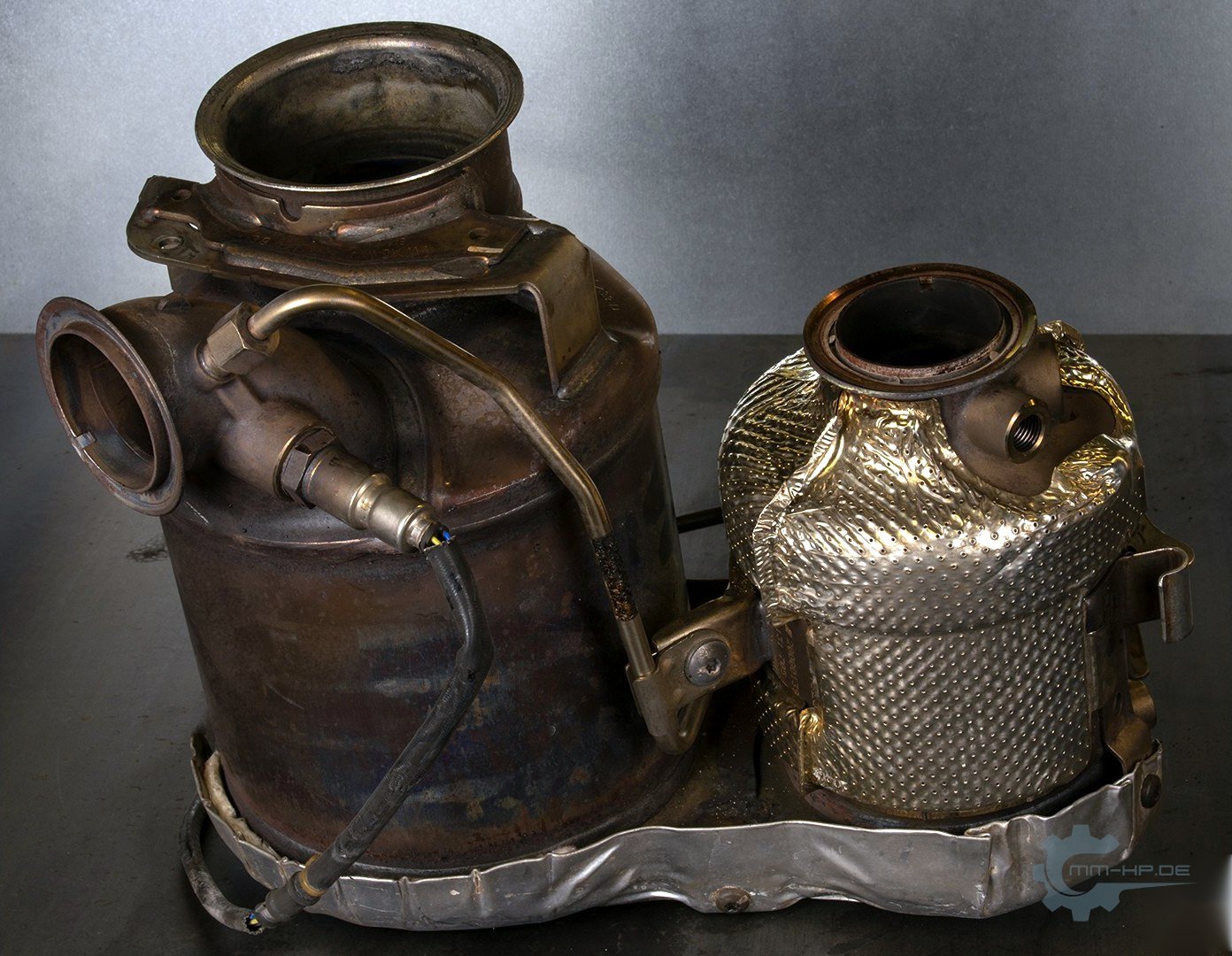
Diesel oxidation catalyst and particulate filter with oxygen sensor and pressure line.
So that the control unit knows how the filter is doing, it measures at several points. In the VW 2.0 TDI with common rail, according to self-study program 403, these are:
| Component | Location | Job |
|---|---|---|
| Exhaust pressure sensor 1 (G450) | two lines, one at the filter inlet, one at the outlet pipe | Flow resistance of the filter, from which the measured soot amount is derived |
| Exhaust temperature sensor upstream of the turbocharger (G235) | upstream of the turbocharger | Protection of the turbocharger, control |
| Exhaust temperature sensor directly upstream of the filter (G495) | at the joint between catalyst and filter | Control of the regeneration temperature |
| Exhaust temperature sensor downstream of the filter (G648) | in the outlet | Monitoring (function not described in the text) |
| Wideband oxygen sensor (G39) | upstream of the filter | Mixture, exhaust gas recirculation, soot model |
From these signals the control unit keeps two soot values, a calculated one from driving profile, temperature and lambda, and a measured one from the flow resistance. Both appear separately in the live data. How the two work together and what happens when they drift apart is explained in the article on DPF regeneration. In the EA288, VW introduced a dedicated differential pressure sensor (G505), according to the Audi document.
Since September 2011, new vehicles have had to monitor the filter for total failure and removal under Regulation 692/2008. Some manufacturers use a dedicated particulate sensor downstream of the filter for this, which measures soot directly. Bosch gives a service life of up to 250,000 kilometers (155,000 mi) for its sensor. For the VW engines EA189 and EA288, no such sensor is described in the documents we read.
No sensor measures ash. DieselNet states explicitly that the pressure loss says nothing about the total amount of ash. The control unit counts the ash using a model.
¶ Soot and Ash: Where the Particles Come From
Soot forms in the combustion chamber, where fuel burns locally with too little oxygen. According to an MIT dissertation, the particles are about 30 to 500 nanometers in size, often clumped into chains and flakes. For the filter, short-trip driving is the main problem. Self-study program 403 names it explicitly: the exhaust gas then does not reach a high enough temperature. After a cold start, the engine therefore heats the catalyst and filter with a post-injection.
Ash is something different. It comes mainly from the additives in the engine oil, which burns along in small amounts in the combustion chamber. According to the MIT thesis, it makes up only about 1 percent of the mass flowing into the filter. The particles are tiny at first, 10 to 100 nanometers. In the filter they grow together with every regeneration into grains of 1 to 10 micrometers and into larger lumps. Because they do not burn, they collect over the years at the end of the inlet channels. How much ash a filter can take and what that means for oil consumption is covered in the article on DPF regeneration. That is why diesels with a particulate filter require low-ash oils, with more in the article Which Oil for the 2.0 TDI? Approval Beats Brand.
¶ History: From the First Passenger Car Filter in 1985 to Euro 6
Particulate filters are older than the emission standards that force them today. Underground in mining, soot filters were already common in the 1970s. In passenger cars the road was bumpy.
| Year | Event | Source |
|---|---|---|
| 1985 | Mercedes-Benz S-Class (W 126) for the US market with a particulate filter, discontinued in 1987 because of durability problems | Wikipedia DE/EN |
| 1989 to 1991 | Buses in Athens run with a cerium additive and filter | Rhodia 1999 |
| April 1999 | PSA announces the FAP: silicon carbide, oxidation catalyst, cerium additive | DieselNet |
| May 2000 | Peugeot 607 HDi with FAP, in series production since May 2000 according to an SAE study | SAE 2004-01-0071 |
| 2003 | Toyota presents a system with a nitrogen oxide storage layer on the filter, without an additive. Ford uses Eolys, Opel announces filters without an additive | Toyota, Wards, just-auto |
| 2004 | more than 500,000 vehicles with a particulate filter | SAE 2004-01-0071 |
| 2005 | Euro 4 for new types: 25 mg of particulates per km. Corning introduces aluminum titanate | DieselNet |
| 2006 | about 2 million vehicles with an Eolys filter | FISITA 2006 |
| 2009 to 2011 | Euro 5a: 5.0 mg per km, one fifth of the Euro 4 value | Regulation 715/2007 |
| 2011 to 2013 | Euro 5b: in addition 6.0 × 10¹¹ particles per km. On-board filter monitoring becomes mandatory | Regulations 715/2007, 692/2008 |
| 2014 to 2015 | Euro 6 with the same particulate limits | Regulation 715/2007 |
| July 2023 | German emissions inspection counts particles on Euro 6 diesels, limit 250,000 per cm³ | ADAC |
Two lines run through this table. One is the competition between two paths, additive versus coating. PSA was early and successful with the additive, the German manufacturers bet on coated filters, and in the long run the coating prevailed. The other is the tightening of the standards. With Euro 5 the permitted particulate mass dropped to a fifth, with Euro 5b particle counting was added, and since 2023 the emissions inspection counts too.
¶ See also
- DPF Regeneration Signs: What It Does to Oil and Oil Pressure
- DPF Cleaning: What Works Without Removal and What Doesn't
- Oil Consumption 2.0 TDI: A Chain Reaction Ending in the DPF
- Which Oil for the 2.0 TDI? Approval Beats Brand
Transparency note: MMHP has been developing, testing and manufacturing its own products for the automotive industry for over 25 years, including solutions for the oil supply of VW TDI engines. We do not sell particulate filters, additives or cleaning services. The statements rest on VW and Audi training documents, patents and publications from the filter and catalyst manufacturers, SAE studies, theses at MIT, the EU regulations and technical portals, and the sources are given at the relevant sentence. Several sources come from manufacturers with a stake in their own technology, and we point this out at the relevant place. The animations are schematic.