¶ DPF Cleaning: What Works Without Removal and What Doesn't
¶ Key points
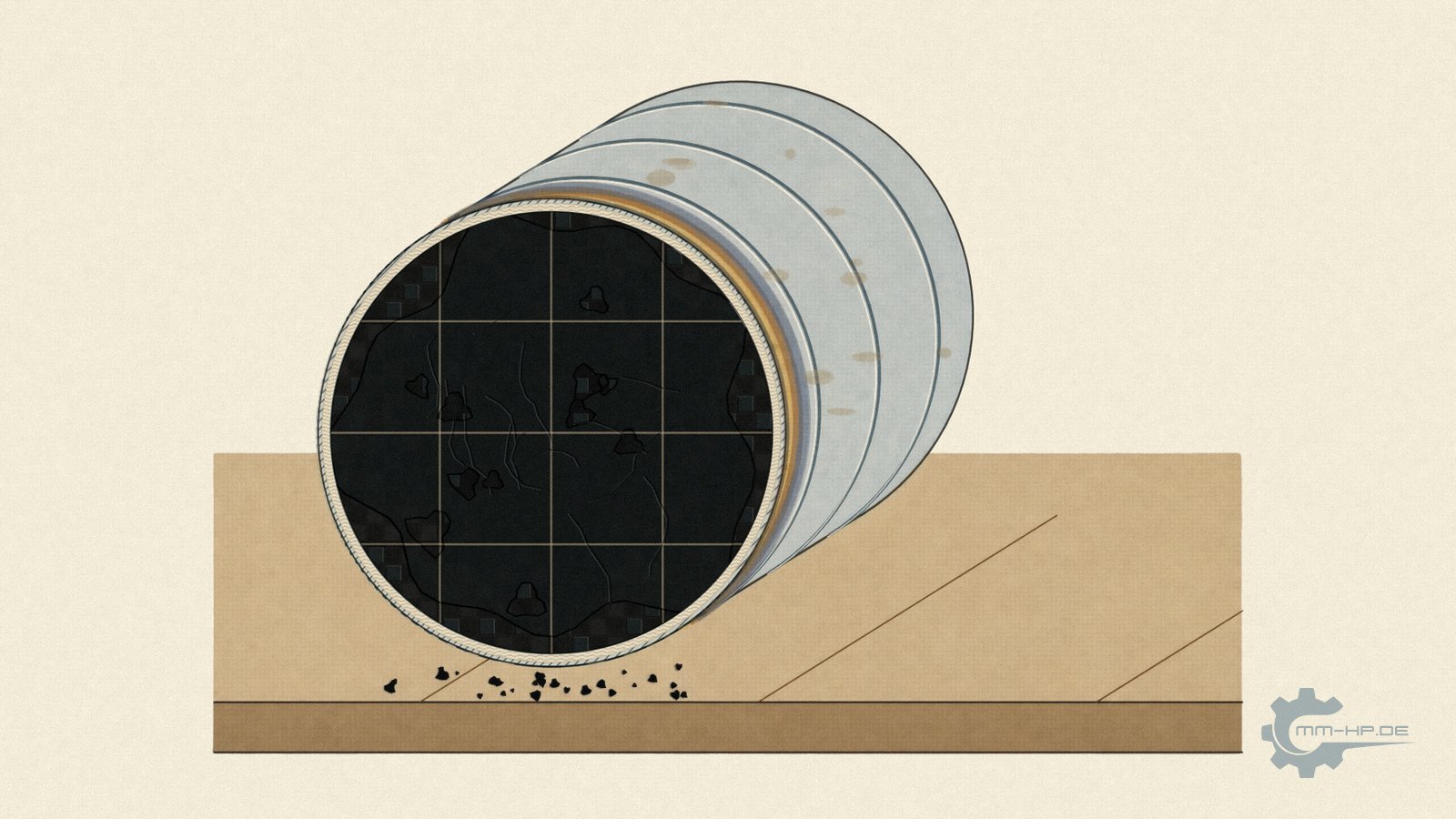
Without removing the filter, you can only treat soot on a diesel particulate filter, not ash. Soot is carbon, and it burns off during a regeneration. Ash is the incombustible residue of the additives in the engine oil. It does not burn off in any regeneration and stays in the filter until the filter is removed and cleaned. Before thinking about cleaning, it is therefore worth asking what the filter is full of. The live data (measuring value blocks) in the control unit shows it.
Spray cleaners that are injected into the filter through a sensor opening dissolve soot deposits, according to their manufacturers, and the soot then burns off in the next regeneration. They do not remove ash. According to the US Environmental Protection Agency (EPA), ash only leaves the filter by removal and cleaning, and a major manufacturer of such cleaners admits itself that its cleaning does not help when there is too much ash. If the cause of the excess soot has not been fixed, for example a leak in the charge air system or constant short-trip driving, the filter is full again soon after every cleaning. Once removed, however, a filter can also be cleared of ash, for example by flushing it against the direction of flow. Then soot and ash take the same path back out that they came in.
Gutting the filter is not a shortcut. In Germany it voids the vehicle's type approval, and since 2023 the emissions inspection counts the particles in the exhaust of Euro 6 diesels.
How quickly a filter fills with ash depends mostly on how much oil the engine burns. An engine with high oil consumption therefore needs a cleaning or a new filter sooner. Gasoline particulate filters in gasoline engines are wall-flow filters as well.
MMHP does not clean particulate filters and does not take inquiries about it. This article is meant to inform, not to sell. The experience behind it comes from more than 15 years in which a former subsidiary, now sold, cleaned filters professionally.
That was the short answer. If you want to understand how to tell soot from ash, what is in a spray cleaner and why lower back pressure does not yet mean the filter is clean, the long version starts here.
¶ Soot or Ash: What Is the Filter Full Of?
A filter that reports "full" can have two very different problems, and each calls for a different remedy.
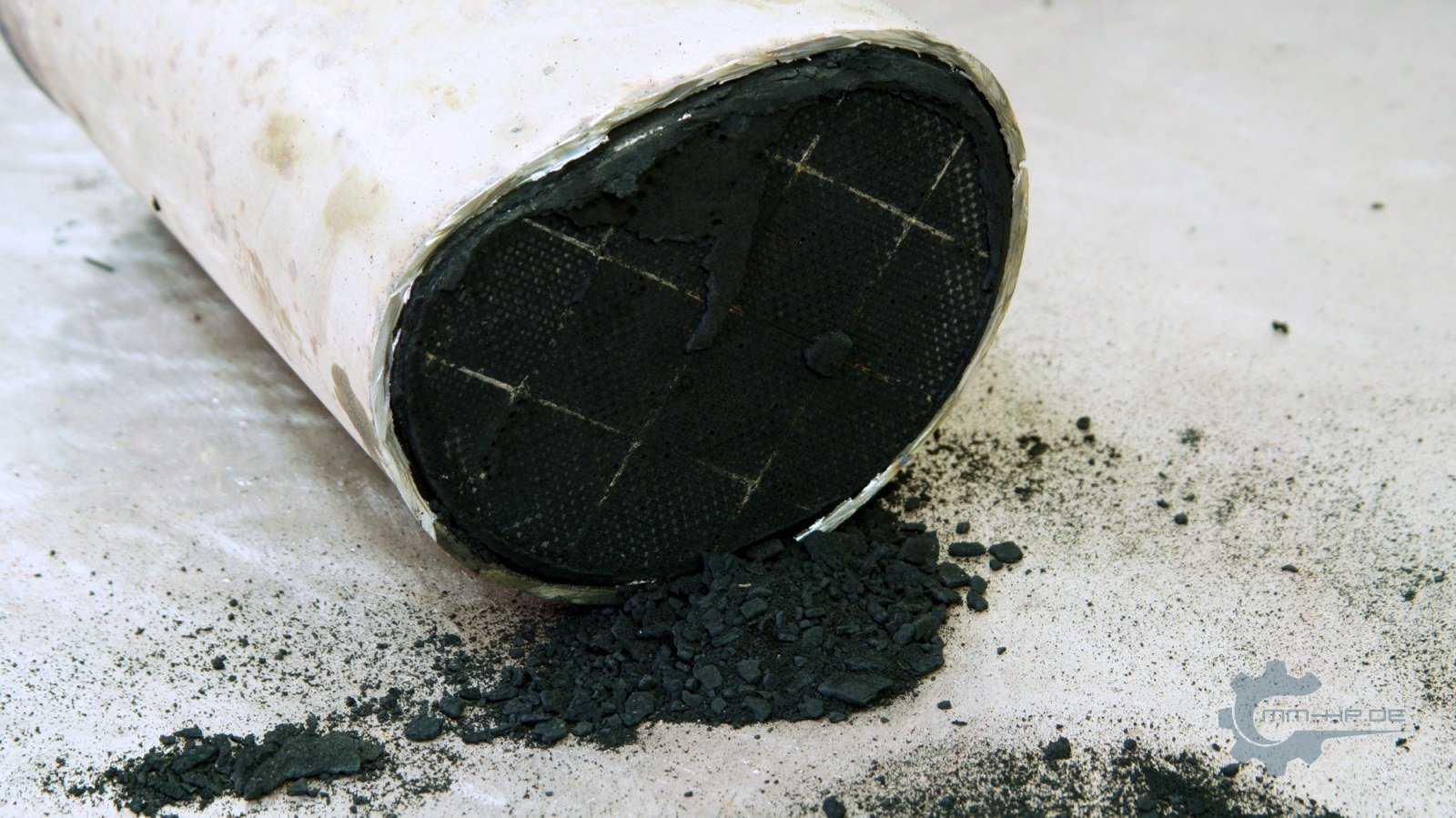
Front face of a filter overloaded with soot. The lines are the bonding joints between the segments.
Soot overload occurs when more soot goes in than the regenerations burn off. Typical causes are short trips on which a regeneration never finishes, injectors that drip, a wrong mixture from a faulty sensor, a leak in the charge air system or high oil consumption. The filter fills in a short time. Above a certain soot mass the control unit blocks the automatic regeneration, in the VW 2.0 TDI from 40 grams. The block probably protects the filter above all: with that much soot, the burn-off would run uncontrolled and far too hot. High back pressure also loads the turbocharger, as the supplier Melett describes. According to the experience of the former subsidiary, the block also protects the engine from long periods of extra injection and heat.
Ash overload is the end of the service life. After every regeneration a little less room is left for soot, because the ash collects at the rear of the inlet channels. The intervals between regenerations get shorter, and at some point the control unit reports "particulate filter full." Regenerating no longer helps, because ash does not burn. In its US training document 820433, VW puts it briefly: "This 'oil ash' cannot be removed", meaning by regeneration.
You can tell the two cases apart in the live data (measuring value blocks) of the control unit. A high calculated soot mass in a young filter points to soot. High mileage, a high ash value and regenerations at ever shorter intervals point to ash. How regeneration works and how the control unit counts soot and ash is explained in the article on DPF regeneration.
¶ Cleaning Without Removal: What Spray Cleaners Can Do
There are cleaners on the market that are sprayed into the installed filter through the opening of a temperature sensor or the pressure sensor line. What they do can be read from their own manufacturers' documents, and it is less than advertising often suggests.
According to their safety data sheets, they are aqueous solutions, two products are alkaline with a pH around 11, others are neutral. One manufacturer describes the principle like this: the soot deposits are loosened and distributed in the filter, where they burn off in the next normal regeneration. And further: the cleaner and the loosened soot remain in the filter afterward. So the cleaner does not remove the soot, it makes it more accessible to the regeneration.

Ash: no. In its fact sheet on filter operation, the EPA writes that incombustible ash from lubricating oil collects in the filter and has to be removed by taking the filter out and cleaning it. The German automobile club ADAC reached the same result in 2025. One of the large suppliers of such cleaners writes on its own page for repair shops that cleaning does not help when the filter is loaded with too much ash. The physics is simple. With the filter installed, a liquid can only pass through the filter in the direction of flow. But the ash sits at the rear of the inlet channels in front of the plug, exactly where the flush pushes it. Other suppliers still advertise that they dissolve ash deposits. We could not find an independent measurement that proves it.
Soot: in individual cases. For soot overload, the manufacturers describe a plausible path: loosen, distribute, then regenerate. Whether that is enough in a given case depends on how much soot is in the filter and why it got there. If the cause has not been fixed, the filter is soon full again.
¶ What the Manufacturers Themselves Name as a Risk
The instructions for use contain clear limits. The filter must not be hot when you spray, at most 40 or 50 °C (104 or 122 °F) depending on the manufacturer. Liquid must not get into the combustion chamber, and the lines have to be blown out afterward. The manufacturers give no reason for the temperature limit. The obvious guess is that cold liquid on hot ceramic creates stresses, but that is not proven. Liquid in the combustion chamber can damage the engine.
There is also an experience from the cleaning practice of the former subsidiary, not a study. Liquid introduced through a sensor opening puts additional strain on the filter for a while. The exhaust back pressure rises, and with it the load on the differential pressure sensor and the turbocharger, especially if the engine is then driven at high revs to clear the filter.
The same practice occasionally showed another picture. Some filters that had been treated with spray cleaner beforehand had spots where residues had stuck together with soot and ash and hardened, and at a few such spots the ceramic had melted in later regenerations. That is an observation, not a study. It cannot tell us whether the cleaner was the cause, and it does not apply to every product.
¶ Cleaning Off the Vehicle: Flushed Against the Flow
Ash only comes out when the filter is removed. A common method is to flush it against its direction of flow. The ash then comes out of the rear end of the inlet channels the same way it came in, through the open front face. For this the EPA describes compressed air with extraction. There are also thermal processes, in which the soot is burned off in a furnace under control, and aqueous processes. A 2023 SAE study compared several of these systems. The best removed up to 96 percent of the deposits.
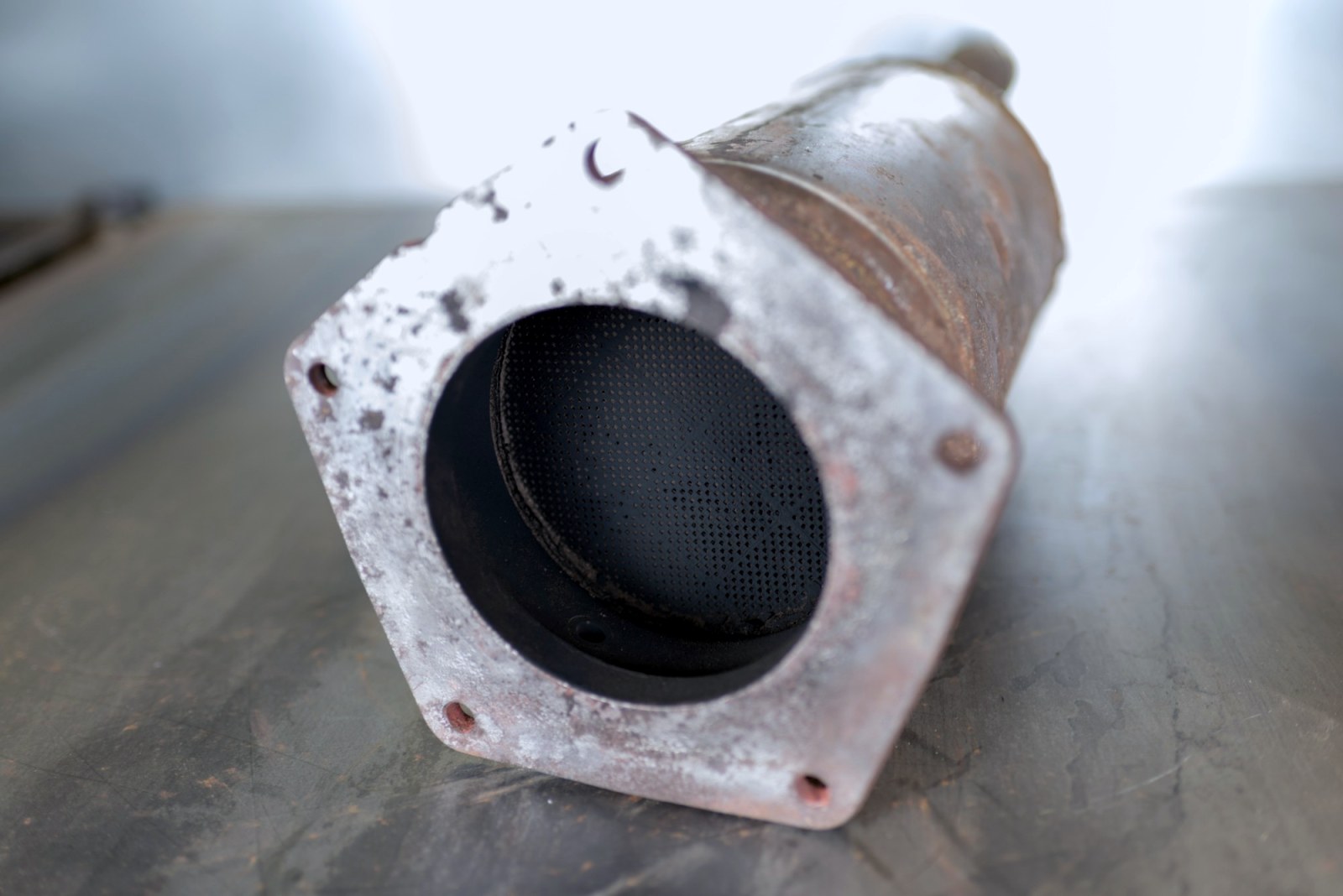
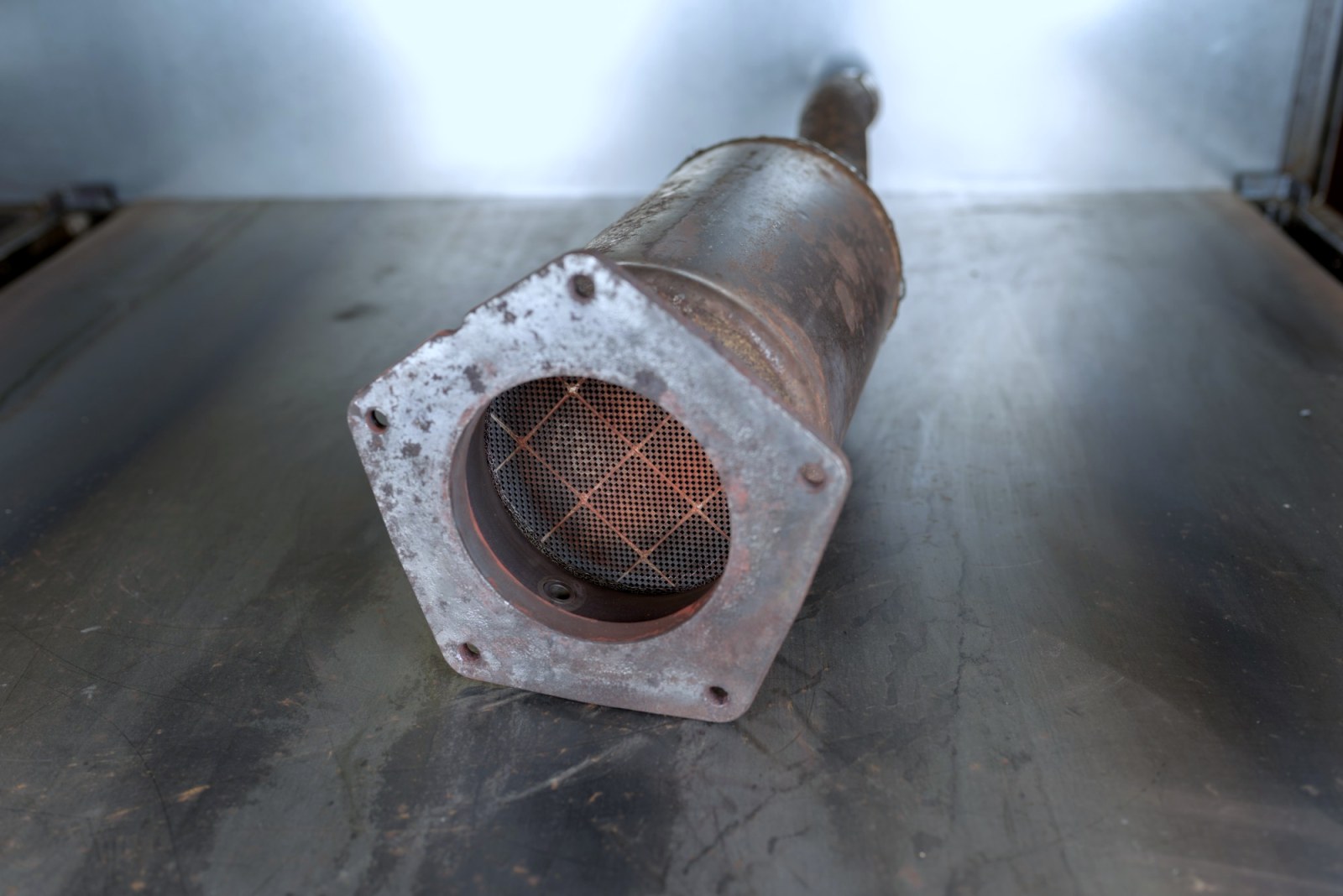
Before and after: cleaning by a former subsidiary that has since been sold.
How thorough a cleaning was cannot be read from the back pressure alone. In 2019, Fox and colleagues showed on 34 filters from commercial fleets that the back pressure can drop after cleaning while considerable amounts of ash are still in the filter.
For full disclosure: for over 15 years, MMHP had a subsidiary that cleaned diesel particulate filters professionally. It has been sold. MMHP has nothing to do with it any more and gains no advantage from it. We do not clean filters and do not take inquiries.
¶ Gutting the Filter and the Law
Rules differ by country. In Germany the vehicle's type approval lapses (§ 19 StVZO). Removing the ceramic element from the housing and refitting the empty pipe is not a gray area in Germany. Under § 19 paragraph 2 of the German Road Traffic Licensing Regulations (StVZO), the type approval lapses if a modification worsens the exhaust behavior. Under paragraph 5, the vehicle may then no longer be operated on public roads, and § 69a makes both an administrative offense.
It can also show up at the emissions inspection. Since July 1, 2023, the German inspection (AU) counts the particles in the exhaust of diesel vehicles from Euro 6 on, with a limit of 250,000 particles per cubic centimeter. For older vehicles of Euro 4 and Euro 5, the opacity of the exhaust continues to be measured, and for vehicles with an on-board diagnostic system, reading out the vehicle diagnostics is added (StVZO Annex VIII).
Other countries have other rules. What is written here concerns Germany.
Gasoline particulate filters in gasoline engines work on the same wall-flow principle. Limits and inspection rules differ.
¶ See also
- DPF Regeneration Signs: What It Does to Oil and Oil Pressure
- Diesel Particulate Filter: Design, Types and Materials
- Oil Consumption 2.0 TDI: A Chain Reaction Ending in the DPF
- Diesel Oil Dilution: How to Spot Fuel in Your Engine Oil
Transparency note: MMHP has been developing, testing and manufacturing its own products for the automotive industry for over 25 years, including solutions for the oil supply of VW TDI engines. We do not sell or broker particulate filters, cleaners or cleaning services. The practical observations come from the work of a former subsidiary that has since been sold and with which there is no connection today. The other statements rest on documents from the US Environmental Protection Agency (EPA), manufacturer information and safety data sheets from the cleaner manufacturers, technical publications and the text of the law, and the sources are given at the relevant sentence.