¶ DPF Regeneration Signs: What It Does to Oil and Oil Pressure
¶ Key points
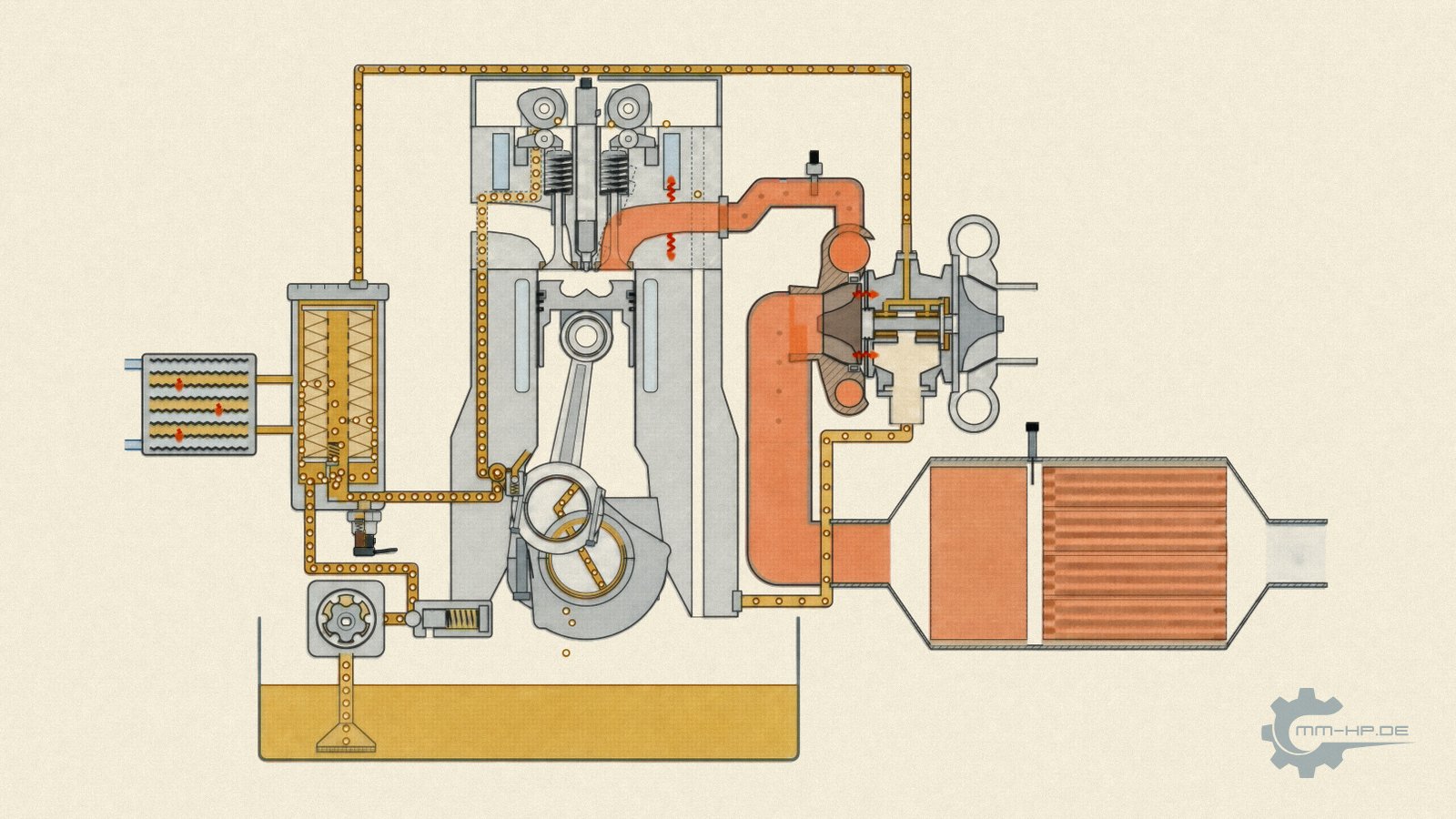
An active regeneration, often called "burn-off," burns the soot that has collected in the diesel particulate filter (DPF). To do this, the control unit heats the exhaust gas, in the VW 2.0 TDI mainly with fuel that is injected additionally and late. This is not a fault. It is the filter's built-in protection.
Regeneration does two things to the oil. Part of the additionally injected fuel hits the cylinder wall and ends up in the oil. This is measured: after eight hours of uninterrupted regeneration on a test bench, the oil contained 7.8 percent fuel. A regeneration in a car, however, lasts minutes, not hours. Second, the exhaust gas up to the turbocharger gets much hotter, and the oil picks up heat there. How much varies from case to case. Both make the oil thinner. What that means for oil pressure depends on the oil pump. According to the model calculation, an unregulated pump loses pressure with the viscosity at hot idle, though this has not been measured. A regulated one holds the pressure as long as it delivers enough.
How you can tell a regeneration is under way: raised engine speed, a fan that keeps running after shutdown, a little odor. Only a diagnostic tool shows it for sure. According to drivers' reports, inconspicuous vehicles regenerate about every 150 to 350 kilometers (93 to 217 mi), and VW forces a regeneration at the latest every 750 to 1,000 kilometers (470 to 620 mi). Whether an interval is unusual, however, is decided by the soot mass at which the regeneration starts (a value in the engine control unit). As a driver, you help by driving a regeneration to the end, planning a longer trip now and then and watching the oil level on the dipstick. If the DPF light comes on, drive on a highway or country road, for about 15 to 40 minutes depending on the model (table below). If it is still on after that: repair shop. If an engine regenerates constantly, too much soot is coming in, the measurement is wrong, the regenerations do not finish or ash is taking up space.
For the repair shop, an order of checks applies. If the red oil pressure warning is on, stop immediately and shut off the engine. Without the warning, 0.7 bar (10.2 psi) at hot idle is not proof of a defect by itself: first clarify oil temperature, engine speed, measuring point and regeneration status. If an engine regenerates more often after a repair than before, first check the differential pressure lines at the particulate filter, which carry the pressure before and after the filter to the sensor, and the sensor itself.
And the ash from burned oil does not burn off in any regeneration. It only comes out by removal and cleaning. According to MMHP's experience on a T5 and many cases followed, about 50 liters (53 quarts) of burned oil are enough to fill a filter. There is no test record for this.
That was the short answer. If you want to understand how hot it really gets in the filter, how much fuel goes into the oil and comes out again, and why an oil pressure reading without its conditions proves nothing, the long version starts here: with the figures from test bench trials on the VW engine, the data from VW documents and the relationships that forums mostly mix up.
¶ Low Oil Pressure During Regeneration? What One Reading Proves
First, what needs no discussion. If the red oil pressure warning comes on while driving, the engine must be shut off at once. What the light means and when it switches is covered in the article on the oil pressure warning light. Conversely, a dark light at idle proves little. A forum post on the T5 gives 0.6 bar (8.7 psi) at 2,000 rpm for the oil pressure switch, saying it does not switch at all at idle. That is a single statement with no manufacturer source, but it shows the principle: a dark light is not an all-clear.
The situation at issue here usually looks like this. An engine has been rebuilt, everything is new, and the retrofitted gauge shows 0.7 bar (10.2 psi) at hot idle. Suspicion falls on the pump at once. Before anyone removes it, four checks are worth doing, which together take less than an hour.

Check 0, one minute: oil level and smell. If the oil is above the MAX mark or smells of diesel, fuel in the oil is likely. How that happens and how to recognize it is explained in the article on oil dilution. If the oil is clearly above MAX, do not keep driving and have the oil changed. Too much oil in the engine is a risk of its own, regardless of pressure. Then clarify the cause, usually frequent regenerations (chapter "Constant Regeneration" below).
Check 1: the conditions under which the value applies. The VW repair manuals check oil pressure at an oil temperature of about 80 °C (176 °F). For the related Touran 1.6 TDI CR, the manual, as a driver portal reproduces it, requires at least 0.6 bar (8.7 psi) at idle and at least 1.0 bar (14.5 psi) at 2,000 rpm. Measurement is taken at the point the manual names, not at just any branch. Why the measuring point matters so much is shown in the article on the oil pressure measuring point. We also recommend that no regeneration is running and that the last one has finished. That is not a VW requirement, but without this detail two measurements cannot be compared. The minimum values apply per engine, and the Touran value is an example.
Check 2: change oil and filter, then measure again. If the engine has been through many regenerations, send an oil sample to the lab first. Then measure again under the same conditions. If the value rises, the oil was the explanation, not the pump.
Check 3: differential pressure lines and sensor. If the engine has been regenerating more often since the repair than before, it is likely that a pressure line at the particulate filter is kinked or swapped, or that the sensor was not adapted after replacement. Forums document both cases. More on this in the chapter "What You Can Do When the DPF Regenerates Often."
Three more questions are worth a half sentence each. Is the gauge calibrated, and how accurate is it in the lower part of the scale? Was there a reference value before the repair? Is the oil pickup screen in the oil pan free?
To put the starting case in perspective: two forum posts on the T5 2.0 TDI give 0.7 to 0.8 bar (10.2 to 11.6 psi) at 80 °C (176 °F) at idle on stock engines, with gauge and measuring point unknown. A third post in the same thread gives about 1 bar (14.5 psi) at 90 to 95 °C (194 to 203 °F) and 0.7 to 0.8 bar only at 110 °C (230 °F). So the values already scatter among drivers. 0.7 bar (10.2 psi) is therefore no proof of a defect by itself, but no acquittal either. It is a value that still lacks its conditions.
¶ DPF Regeneration (Burn-Off): How the Soot Disappears
A diesel particulate filter is a honeycomb body made of porous ceramic with thousands of fine, parallel channels. The channels are plugged alternately at the front or the rear. The exhaust gas therefore has to pass through the wall from one channel into the next, and the soot stays behind as a layer on the wall. With every drive this layer gets thicker and the resistance rises. Regeneration means burning this layer off before the filter gets too dense.
What material the filter is made of cannot be said across the board for VW. The European training document for the 2.0 TDI with common rail (self-study program 403) names silicon carbide, and the US version for the same engine names aluminum titanate. Which one is in the T5 is not documented. Design, types and materials are explained in a separate article on the diesel particulate filter.
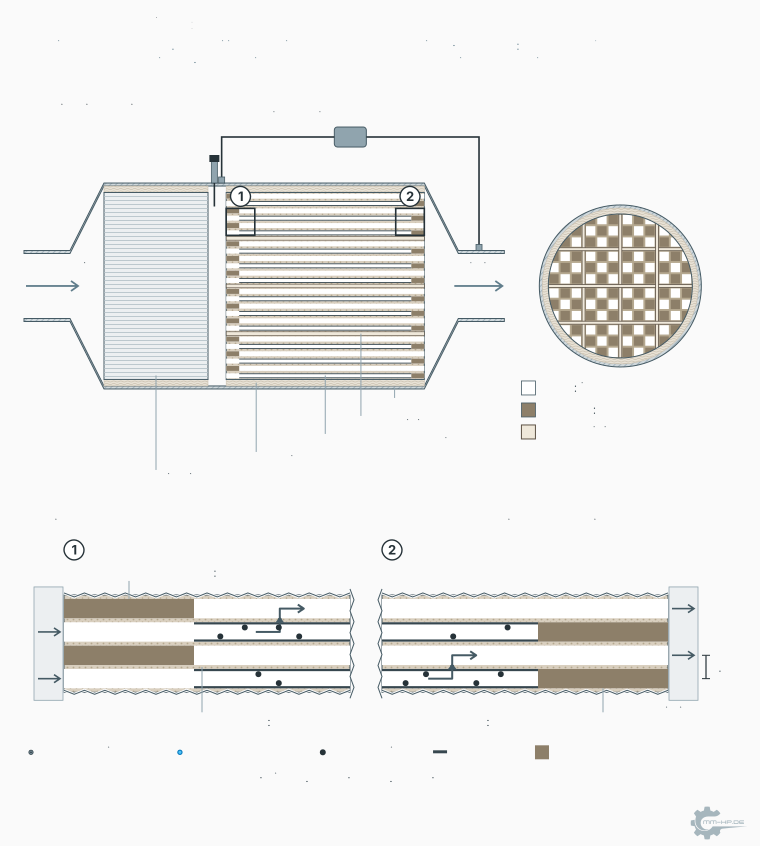
Still image. The animation showing the path of the exhaust gas through the wall is in the basics article.
➜ How a wall-flow filter is built and works
¶ Passive and Active Regeneration
Soot burns in two ways, and the two need very different temperatures. The first works with nitrogen dioxide, which the oxidation catalyst in front of the filter forms from the exhaust gas. According to studies by Johnson Matthey and others, this reaction starts at about 250 °C (480 °F), and at VW it typically runs in operation between 350 and 500 °C (660 and 930 °F) (self-study program 403). It is called passive regeneration because it runs alongside without any intervention by the control unit, on the highway all by itself.
The second way is the one with oxygen. For this, the soot needs 550 to 650 °C (1,020 to 1,200 °F) according to VW. A diesel runs with excess air, so there is residual oxygen in the exhaust. Only the temperature is missing. At high load, 2,000 rpm and 250 Nm (184 lb-ft), close to 80 percent of maximum torque, about 425 °C (800 °F) was present downstream of the filter without post-injection on the test bench at the University of Magdeburg. That is not enough. So the control unit helps out, and that is called active regeneration.
How hot it gets depends on where you measure. The following table separates measuring points and sources on purpose, because otherwise they seem to contradict each other.

| Measuring point | Temperature during active regeneration | Source |
|---|---|---|
| upstream of the turbocharger | about 690 °C (1,270 °F), previously 283 °C (540 °F) | Test bench, low load, per control unit (University of Magdeburg) |
| upstream of the filter, target | approx. 620 °C (1,150 °F) (German version), approx. 650 °C (1,200 °F) (US version) | VW self-study program 403 and its US version |
| upstream of the filter, test bench | 640 °C (1,180 °F) | Test bench, per control unit |
| upstream of the filter and upstream of the turbocharger, in the vehicle | mostly 800 to 900 °C (1,470 to 1,650 °F), rarely only 600 to 700 °C (1,110 to 1,290 °F) | Our own readings on several vehicles, sensor and scan tool via the engine control unit, no test record (as a design limit for the sensor upstream of the filter, Hella names monitoring against more than 700 °C, 1,290 °F) |
| in the filter during burn-off | typically 800, sometimes 900 °C (1,470, sometimes 1,650 °F) | Our own practice with a thermocouple in the filter and that of a former subsidiary, no test record |
| downstream of the filter | 590 °C (1,090 °F) per control unit, 557 to 568 °C (1,035 to 1,055 °F) with the test bench thermocouple | Test bench, low load |
| Live data (measuring value blocks) on the scan tool | 350 to 600 °C (660 to 1,110 °F), measuring point not named | VW Technical Tip 26-11-01 |
| without post-injection | about 425 °C (800 °F) downstream of the filter | Test bench, high load |
Three values from this table deserve a second look. The test bench figures come from a low-load point of about 7 kW. In the vehicle, the sensors upstream of the filter and upstream of the turbocharger usually show much more, 800 to 900 °C (1,470 to 1,650 °F). We read these values ourselves on several vehicles, at the sensor and with a scan tool via the engine control unit. There is no test record for them. The supplier Hella describes how the system is designed: in its repair shop guide, the sensor upstream of the filter monitors the temperature so that 700 °C (1,290 °F) is not exceeded. The control unit regulates the temperature itself: it reads the exhaust temperature sensors upstream of the turbocharger, upstream and downstream of the filter and decides whether it has to produce more heat.
The second value is the one in the filter. With a thermocouple in the filter, that is, in the middle of the honeycomb body, typically 800, sometimes 900 °C (1,470, sometimes 1,650 °F) were present according to the practice of MMHP and a former subsidiary. There is no test record for this. The burn-off started at about 550 °C (1,020 °F), in line with the VW figure. That it gets hotter in the filter than in the gas ahead of it is no surprise: the soot burns there and gives off its own heat. This heat leaves with the exhaust gas, not back into the engine.
The third thought concerns the target of the control. In our assessment, the control unit wants to reliably reach about 650 °C (1,200 °F) in the filter, including at the filter end. Heat is lost through the housing on the way, so it has to run hotter upstream of the filter. A VW training document on the older coated filter (self-study program 336) names 600 to 650 °C (1,110 to 1,200 °F) for the soot burn-off, and the supplier Hella names the same range for the filter in its repair shop guide. VW does not publish a target figure for the filter of the 2.0 TDI with common rail, the documents only name the target upstream of the filter. And besides temperature, the burn-off always needs one thing: oxygen. The soot burns with the residual oxygen in the exhaust to carbon dioxide, as the same VW document describes.
¶ Where the Heat Comes From: Post-Injection or Exhaust Injector
The VW 2.0 TDI produces the heat with the fuel it has anyway. Self-study program 403 names the measures: exhaust gas recirculation switched off, adapted throttle valve, early and late post-injection. How this looks in detail is shown by test bench reports from the University of Magdeburg, funded by UFOP, the association for the promotion of oil and protein plants, which advocates biodiesel. In normal operation the injector there injects three times per working cycle, in regeneration six times. The main injection drops from 6.0 to 4.0 milligrams per stroke, and the post-injections together deliver 14.4 milligrams. At the same test point the fuel flow rose from 2.2 to 4.0 to 4.1 kilograms per hour.

The early post-injections still burn in the cylinder and make the exhaust hotter. Even this preheating stage without the late post-injection brought 686 °C (1,267 °F) upstream of the turbocharger. The late post-injection no longer burns in the cylinder. It goes as fuel vapor to the oxidation catalyst and burns there, directly in front of the filter. For the oil, something else counts: from about 30 degrees of crank angle after top dead center, the spray hits the cylinder wall according to the Magdeburg report, and in this engine both early post-injections already lie beyond this limit. Accordingly, on the test bench even the preheating stage without the late post-injection brought almost as much fuel into the oil as the full regeneration, and the report calls the differences not significant. In normal operation without regeneration, by contrast, the fuel in the oil in an earlier trial on the same test bench was below the detection limit after 80 hours at two operating points and 0.7 to 0.8 percent at a low-load point. What sticks to the wall is scraped into the crankcase by the piston rings.
Some manufacturers therefore take a different route. They do not inject the fuel in the cylinder but directly into the exhaust upstream of the filter with a dedicated nozzle. Renault introduced this on the 1.5 dCi from 2006 and explicitly justified it with a marked increase in oil dilution from post-injection. Ford and PSA use it on the 2.2-liter diesel, with the supplier Pierburg providing the parts. No manufacturer puts a number on how much less fuel ends up in the oil this way. The flip side: the nozzle sits in hot, sooty exhaust and can coke up, in which case no regeneration takes place at all. A repair shop bulletin from Mack for trucks describes exactly that. The VW 2.0 TDI uses post-injection.
¶ Recognizing Regeneration: How You Can Tell
According to the VW training document, performance is not noticeably changed during regeneration (translated). The owner's manual of the T6 still describes what you may notice (translated): during regeneration, noises, a slight odor and raised engine speeds can occur, and the radiator fan can run on while driving and after shutdown. The engine management can also give a gear recommendation that exceptionally asks for a higher engine speed. There is no warning light for this: during a normal, periodic regeneration, the yellow light expressly does not come on.

What drivers additionally report is less certain but common. In the T6 forum, idle rises from about 800 to 1,000 rpm during regeneration, and the stop-start system does not switch off. The extra fuel consumption is real: on the test bench the fuel flow at the low-load point rose by 82 to 86 percent. Over a whole trip this is less dramatic, because the regeneration lasts only part of the distance. Jaguar Land Rover also points to higher consumption in its owner's manuals, without naming a figure.
Smoke is a special case. With sulfur-containing fuel, a white cloud can appear at the start of a regeneration. Toyota has studied the mechanism, and Land Rover describes it in the owner's manual. In Europe with low-sulfur diesel this should be rare. Other causes of smoke during a regeneration have not been studied, and persistent smoke belongs in the repair shop.
You can only see a regeneration for certain in the live data (measuring value blocks) of the control unit. There you find the soot mass, the distance since the last regeneration and the regeneration status. This takes a diagnostic tool or an app that reads the VW-specific values. Plain standard apps for exhaust diagnosis usually do not show these values, according to forum experience.
¶ Driving Through a Regeneration: How Long It Takes
The honest answer first: there is no manufacturer figure for the typical duration of an automatic regeneration. What there is, are three different situations with their own numbers, and forums constantly mix them up.
The automatic regeneration. A driver with a diagnostic tool documented the soot mass falling from 17.7 to 9.0 grams in 20 minutes and 12.3 kilometers (7.6 mi). A 2017 dissertation names 15 to 45 minutes without saying where the figure comes from. On the test bench the whole process, including heating up, took about four minutes for 8.4 grams of soot. In a car, however, the regeneration starts at more soot, in the US 2.0 TDI at 18.9 grams according to VW, in the T6 at 24 to 30 grams according to drivers' reports. When the tank is in the reserve range, VW interrupts the regeneration.
The repair shop triggers it by driving. For fault P2463, a VW repair shop instruction for US vehicles requires highway driving at about 60 miles per hour (97 km/h) for "20 minutes or more." The diagnostic tool maker Ross-Tech names 10 to 15 minutes for the driving regeneration started with the scan tool.
The DPF light is on. Then the manufacturers require a particular way of driving, and the figures differ by model and market.
| Model, market | What the manual requires | Source |
|---|---|---|
| VW Golf VI (2008 to 2013), EU edition | approx. 15 minutes in 4th gear or drive position D, at least 70 km/h (43 mph) | Owner's manual |
| VW T6, Europe | 50 to 120 km/h (31 to 75 mph). If the light is still on after about 30 minutes: repair shop | Owner's manual, p. 244 |
| VW, Australia | above 60 km/h (37 mph) at 2,500 to 3,000 rpm for about 25 to 30 minutes, then keep driving for 10 minutes, tank at least a quarter full | Importer |
If the light is still on after the required drive, we recommend a repair shop instead of the next short trip. Only the T6 manual says so explicitly. With every interrupted drive the soot mass keeps growing until the control unit blocks the automatic regeneration (section "Soot Mass in Grams" further down). The driver does not have to watch any temperature. The control unit regulates the temperature. The driver only has to make sure it pulls evenly for long enough.
¶ Constant Regeneration: Why the DPF Regenerates Too Often
First, a clarification that takes the edge off many discussions: the regeneration itself is not the problem. It is the filter's protection, and an engine that regenerates regularly is doing exactly what it was built for. It only gets interesting when it does so conspicuously often.
"Constant regeneration" means three things here. First, very short intervals between complete regenerations. Second, regenerations that keep aborting and starting over. Third, an engine that runs in regeneration mode almost constantly. For the oil, the second case is the most unpleasant, because every restart brings new fuel into the oil without the filter ever being emptied.

The causes can be sorted into five families, and for each there is evidence from manufacturer documents.
More soot comes in. Short trips are at the top of practically every manufacturer document, at BMW, GM, Ford and VW. A leak in the charge air system makes the engine run richer, as VW describes in a Technical Tip for the 3.0 TDI and GM in a bulletin for the Cruze 2.0-liter diesel. Defective glow plugs, a stuck exhaust gas recirculation valve, wrong sensor values and injectors that drip belong here too (Pierburg and Hella describe the relationships). And oil that burns is a double source: it brings soot and ash into the filter. An SAE study (SAE 2016-01-0928) shows that the ash in the filter comes almost entirely from the additives in the engine oil.
The measurement is wrong. The control unit also estimates the soot amount from the pressure difference across the filter. If one of the two measuring lines is kinked or they are swapped, or if the sensor was not adapted after a replacement or after work on the engine, it calculates with wrong numbers. Forums document both cases, each with a conspicuous soot mass shortly after the start of a drive.
The regeneration does not finish. Short trips are the most common cause here too. Add an engine that does not warm up, for example with a stuck-open thermostat. BMW writes in a service information that the exhaust gas then does not reach operating temperature. Every abort means: the soot is still there, and the next regeneration comes sooner.
Passive regeneration is missing. Anyone who never drives long distances gives up the free burn-off with nitrogen dioxide. The filter then has to burn everything actively.
Ash takes up space. Ash does not burn. It fills the end of the inlet channels and reduces the area where soot can deposit, and the intervals between regenerations get shorter. More on this in the chapter on ash.
¶ How Often Does a DPF Normally Regenerate?
The VW 2.0 TDI has a fixed upper limit. Regardless of the soot amount, the EA189 regenerates at the latest every 750 to 1,000 kilometers (470 to 620 mi) according to self-study program 403. The successor EA288 does so after about 465 mi (750 km) without a successful regeneration (US training document 820433). With short trips it regenerates more often, because soot collects faster. In forums, owners of inconspicuous vehicles name intervals of about 150 to 350 kilometers (93 to 217 mi).

The distance alone says little, though. What matters is at what soot mass the regeneration starts, and that is in the live data. If it starts at the usual soot mass of the model series, only after a short distance, a lot of soot is coming in. Then you look for soot sources and the driving profile. If it starts far below the usual value, or the display jumps, the measurement is suspect. A documented forum case shows exactly this picture. The often-read rule of thumb that anything under 100 kilometers (62 mi) is unusual is a forum figure with no source.
¶ Interrupted Regeneration: What Happens at Shutdown
If the engine is shut off in the middle of a regeneration, nothing is lost. The control unit resumes or restarts at the next opportunity. What happens to the fuel in the oil in the meantime is explained in the article on oil dilution.

One detail concerns the turbocharger. It sits in the hottest part of the exhaust line, and its shaft runs in plain bearings that are lubricated and cooled by the engine oil. As long as the engine runs, oil flows through the bearing housing and carries heat away. When it is shut off, this flow stops, and the heat from the turbine housing soaks into the bearing. Oil standing there can coke at such temperatures. The T6 manual names the fan running on after shutdown as normal. VW does not name an idle time after a drive. Letting the engine idle for a long time while parked is not a good idea anyway, the VW importer in New Zealand advises against it, and if a regeneration is running, the warning box on stationary regeneration further down applies.
¶ What You Can Do When the DPF Regenerates Often

For the driver, there are three things. Drive a regeneration under way to the end if possible, so do not shut off shortly before arriving. Plan a longer trip with even load now and then. And watch the oil level on the dipstick: if it rises between two oil changes, fuel is going into the oil.
For the repair shop, it starts with the live data. Calculated and measured soot mass, the soot mass at the start of the last regenerations and the intervals between them usually already give the direction. After that, check the charge air system for leaks, the differential pressure lines for kinks and correct connection, and the sensor for offset. After work on the engine and after every filter replacement, the sensor offset has to be adapted again. A forum case shows what happens otherwise: the new filter regenerates like a full one. And change the oil according to the manufacturer's specification, sooner with a lot of short-trip driving.
What does not help are spray cleaners "against constant regeneration." They do not change the cause. What they can actually do about soot and ash is covered in the article on cleaning the DPF.
¶ Heat and Fuel: What Regeneration Does to the Oil
The question whether regeneration burns oil comes up often. Directly, it does not. But it brings fuel into the oil, and it heats parts of the engine through which oil flows. These are two paths with two very different time scales. The heat acts immediately and is over when the regeneration ends. The dilution acts gradually and stays until the fuel evaporates again or the oil is changed. And oil that actually burns, for example past the piston rings, leaves ash in the filter. The chapter on ash deals with that.
¶ Heat All the Way to the Turbocharger: The Thermal Load of Regeneration
On the test bench at the University of Magdeburg, the exhaust temperature upstream of the turbocharger rose during regeneration from 283 to about 690 °C (from 540 to 1,270 °F) according to the control unit. This heat runs through the exhaust port in the cylinder head and through the turbine housing of the turbocharger. At both places oil flows: in the head past the ports, in the turbocharger directly through the bearing. The oil also picks up heat via the piston crown and the ring zone, which are cooled by the spray oil.

How much of it arrives in the oil pan varies from case to case. On the test bench at low load, the oil pan did not get measurably warmer during regeneration. Under load there is no measurement. The oil cooler works against it, giving heat to the coolant. At high load, the oil on the test bench was already 15 degrees Celsius (27 degrees Fahrenheit) above the coolant without regeneration, 117 against 102 °C (243 against 216 °F). Where the limit of the stock cooler lies has not been published.
Why every degree counts is shown by the physics of the oil. Recalculating the data sheets of four 5W-30 oils, the oil loses about 16 to 20 percent of its viscosity per 10 degrees Celsius (18 degrees Fahrenheit), and the less so the hotter it already is. How oil temperature and viscosity relate in general is explained in the article on oil temperature (See also). What viscosity means for oil pressure follows in the chapter on hot idle.
¶ Fuel in the Oil (Oil Dilution): How Much Goes In and Comes Back Out
The second path is measured. In an endurance trial at the University of Magdeburg, a VW engine ran for eight hours straight in regeneration mode at a low-load point, on B7 diesel as sold at German filling stations (EU B7 means up to 7 percent biodiesel, US ULSD contains up to B5), mixed in the lab. Afterward the oil contained 7.8 percent fuel, and the rise was linear over the eight hours. When the late post-injection was split into two smaller ones, about 20 percent less fuel went into the oil. The report itself puts it in perspective: a single regeneration of the filter in the vehicle is considerably shorter (translated).

What do eight hours mean in a car? If a regeneration lasts 15 to 30 minutes, eight hours correspond to 16 to 32 regenerations. For an inconspicuous vehicle that regenerates every 150 to 350 kilometers (93 to 217 mi), that is several thousand kilometers. For an engine in constant regeneration with intervals of 30 to 100 kilometers (19 to 62 mi), the same amount of fuel is reached, by our calculation, after a fraction of that distance, at least 1.5 times and up to almost twelve times sooner. This is an order of magnitude, not a measurement, and it assumes that nothing evaporates again.
The oil quantity counts too. The test engine had 3.6 liters (3.8 quarts) of oil. An engine with twice as much oil would end up with only a little over half the share from the same amount of fuel.
From vehicles there are two further measurements. The National Renewable Energy Laboratory in the USA ran a VW Jetta on a chassis dynamometer in the highway cycle, chosen for its low oil temperature and frequent regeneration, with US diesel. After about 4,000 miles (6,400 km), the oil contained 4.1 percent fuel. And Wolak examined five oil fills in 2018 on a single BMW 520d, mostly in city traffic: the samples contained 26 to 37 percent fuel. That is one vehicle, not a statistic, but it shows where it can go in the unfavorable case. Simulations (SAE 2011-01-1844) suggest that up to 30 percent of the late post-injection ends up as a film on the cylinder wall.
The fuel also comes back out, though. In the second Magdeburg trial, pre-diluted oil ran at high load, 117 °C (243 °F) oil temperature and without post-injection. The share of fossil diesel fell from 13.5 to 1.4 percent in 32 hours. The biodiesel share, by contrast, almost stood still, from 1.5 to 1.3 percent, so that the total fuel fell from about 15 to 2.7 percent. The viscosity at 100 °C (212 °F) recovered in 64 hours from about 8 to 11.2 mm²/s, and the fresh oil had 11.6. Biodiesel therefore comes out much less readily, presumably because it boils higher.
That leaves a common misconception: that diesel evaporates from the oil from 55 °C (131 °F). 55 °C is the minimum flash point under the European diesel standard EN 590, that is, the temperature from which an ignitable mixture forms above the fuel. Diesel boils at roughly between 180 and 360 °C (356 and 680 °F), and the standard requires at least 95 percent to have evaporated by 360 °C (680 °F). A hot, long drive drives part of it out again, but not all of it and not in a quarter of an hour. How the diesel gets into the oil in detail is explained in the article on oil dilution.
¶ Diluted Oil Acts Like Hotter Oil
As far as viscosity goes, diluted oil is like fresh oil at a higher temperature. This conversion makes tangible what percentages alone do not say.

The oil from the Magdeburg endurance trial was, after eight hours of regeneration at 100 °C (212 °F), as thin as fresh oil that is about 15 degrees (27 °F) hotter. Depending on the run, the value lies between 12 and 19 degrees (22 and 34 °F), and the choice of reference oil and calculation method shifts it by a few degrees. Wolak's vehicle samples with 26 to 37 percent fuel lost 34 to 45 percent of their viscosity at 100 °C (212 °F). That corresponds to 22 to 33 degrees (40 to 59 °F) more.
For the bearings, what really counts is the viscosity at high temperature and high shear, the HTHS measure at 150 °C (302 °F). Wolak measured it for the same samples: it fell by about a quarter, the viscosity at 100 °C (212 °F) without shear by a third to almost a half. Both measures come from different measurements at different temperatures and cannot be converted into degrees.
A rule of thumb helps with classification. On the test bench, with fuel and operation combined, every percent of fuel cost 3 to 4 percent of viscosity, a little more with little fuel. A pure laboratory mixture of oil and diesel lost only about 2 percent per percent. Why engine operation costs more is open.
¶ What This Means for Oil Changes
The manufacturer's specification remains the standard. Anyone who does a lot of short-trip driving and regenerates often is better off changing sooner, even with a flexible service interval. The reason is dilution.
A manufacturer document shows how seriously manufacturers take this, and at the same time where its limit lies. In a 2015 repair shop bulletin for US Audis with the EA288 diesel, Audi of America writes that the oil level can rise above the MAX mark through dilution, especially in stop-and-go traffic and with biodiesel: "This is normal engine operation." In this range, no oil should be topped up. That applies to these vehicles, not to the T5 and not to the EA189, and it is no all-clear for other engines. Too much oil in the engine is a problem of its own, and an oil level clearly above MAX needs to be clarified (Check 0 above). A calculation model in the control unit that estimates dilution has not been published for VW.
¶ Oil Pressure at Hot Idle: Where the Reserve Is Smallest
In our assessment, the pressure reserve is smallest not during the regeneration but after it. That is an inference from engine speed, temperature and dilution, not a measurement. The typical situation: a long highway drive with regeneration, then a traffic jam or an exit, the engine runs at normal idle, the oil is hot and diluted by the many regenerations. A long hot drive does drive part of the fuel out again, but not immediately.

During a regeneration at standstill triggered with a scan tool, the control unit raises the idle speed, as Ross-Tech describes. Drivers report it with the automatic regeneration too. With higher engine speed the pump delivers more and the pressure rises. Only when the regeneration ends and the speed falls to normal idle does the real reserve show.
An important distinction almost always missing from discussions: oil pressure tells you whether enough oil reaches the bearings. Whether the oil film in the bearing carries the load is decided by the viscosity together with speed and load. A study at the University of Nottingham (Mansoor 2018) showed this on plain bearings. So pressure is the supply, viscosity the load capacity. How high the pressure is at hot idle is determined by two things: how much the pump delivers at idle speed and how much resistance the bearings put up against the oil. Thinner oil flows more easily through the bearing clearances, and the pressure drops. More delivery raises it, a reduction stage lowers it on purpose.

What that means in concrete terms depends on the pump of the engine in question. In the T5 2.0 TDI with engine codes CFCA and CAAC, the stock pump is regulated, and a mechanical control valve switches a reduction stage. At hot idle it lowers the pressure on purpose. Viscosity only takes effect there when the pump can no longer keep adjusting. The EA288 has a two-stage regulated pump, which the Audi documents describe. Which designs exist and how they regulate is shown in the article Understanding the Oil Pump: Function, Limits, Weak Points.
With a pump without pressure regulation, the oil pressure at hot idle falls by the model calculation roughly with the viscosity, somewhat more or less depending on the engine: at 110 instead of 90 °C (230 instead of 194 °F) to about 60 to 80 percent. This has not been measured on this engine. Regulated pumps hold the pressure as long as they deliver enough.
Deliberately, no manufacturer-documented switching threshold of the oil pressure switch and no opening pressure are given here. These values differ per engine and are not published for the EA189. For your own judgment, the principle from the first chapter is enough: a value without oil temperature, engine speed, measuring point and regeneration status is not a finding.
¶ Full or Clogged DPF: Symptoms and How the Control Unit Monitors It
A full filter, also often called clogged, announces itself at VW in a fixed order. First the yellow DPF light comes on. The driver should then drive a stretch with even load (table in the chapter "Driving Through a Regeneration"). When the soot mass reaches 40 grams, the glow plug light also comes on according to self-study program 403, and the display tells you to visit a repair shop. Without a gram figure, the VW importer in Australia describes in its customer text a limp-home mode with reduced power, and GM names the same picture in its bulletins under "DPF is full." If you keep driving up to 45 grams, the filter must be replaced.
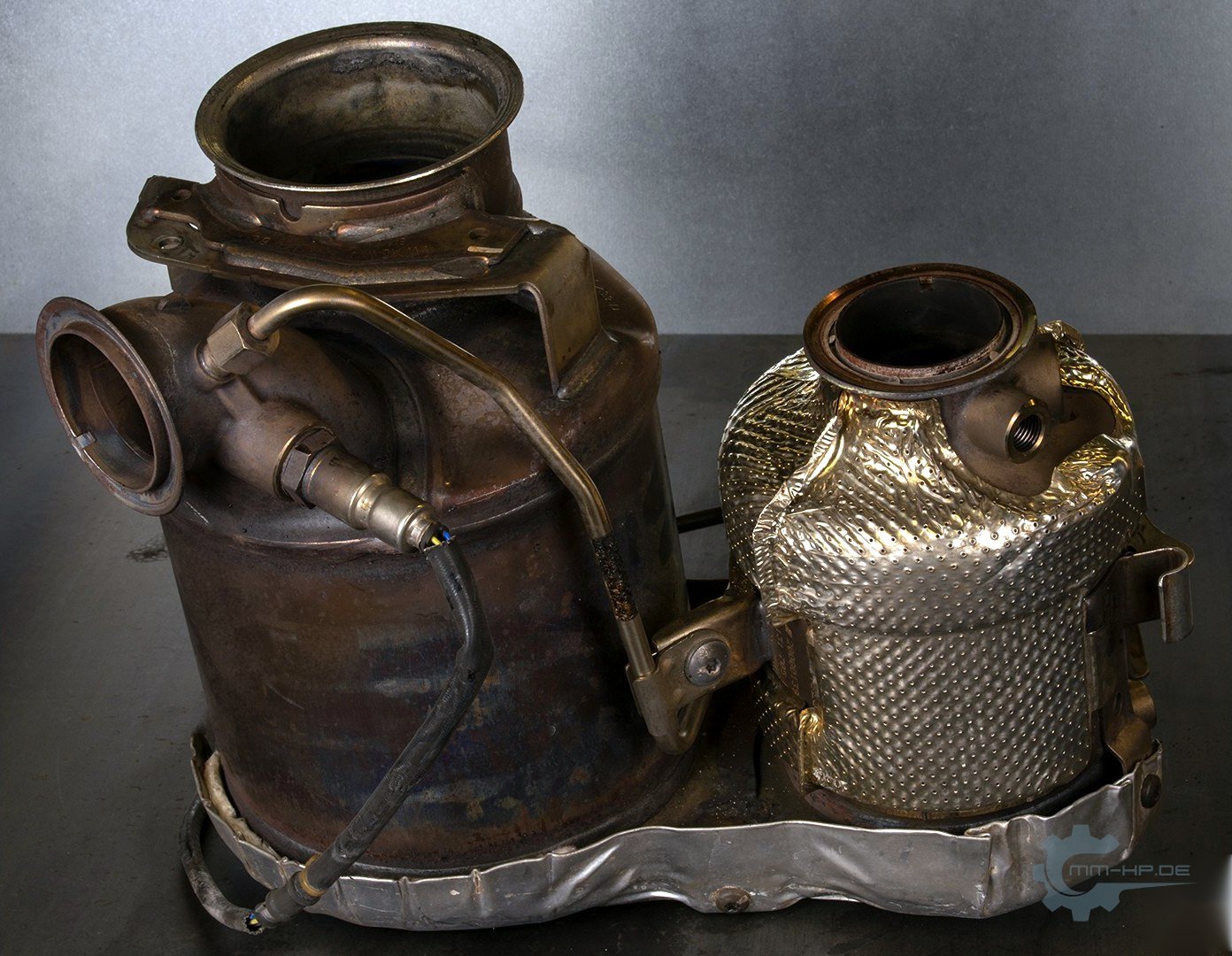
Oxidation catalyst and particulate filter with oxygen sensor and pressure line: this is where the control unit measures.
¶ Differential Pressure and Two Calculation Models
The control unit keeps two values for the soot. One is calculated, from driving profile, exhaust gas temperatures and the oxygen sensor signal. The other is measured, from the pressure difference before and after the filter together with exhaust gas temperature and air mass (self-study program 403). Both appear separately in the live data, as the US training document 820433 states explicitly. How the control unit weights them is not published by VW. If they deviate strongly from each other, it sets a fault. A 2015 VW repair shop bulletin for the EA288 describes fault P2463 as "Deviation between the calculated and the actual soot mass." Repair shop forums report that whichever value reaches the threshold first triggers it. That is not documented.

Measurement is done with pressure sensor G450. One line sits upstream of the filter, the other behind it, as self-study program 403 and the ETKA parts catalog show. What differential pressure is normal depends strongly on engine speed and load, which is why there is no general limit value.
| Operating state | Differential pressure | Source, level |
|---|---|---|
| Idle after a regeneration | 10 to 15 mbar (0.15 to 0.22 psi) | Forum case with live data |
| Maximum while driving, same case | about 300 mbar (4.4 psi) | ditto |
| Hint to replace | over 200 mbar (2.9 psi), no operating point | Hella, supplier |
The first two rows come from a single documented vehicle. The Hella figure names no operating point and is therefore only good as rough orientation. For ash, VW keeps its own value with a limit in the live data and writes: "This 'oil ash' cannot be removed, even during active regeneration".
¶ Soot Mass in Grams: What Works at Which Load
With the soot mass, what is still possible at all changes. The limits are well documented for the VW 2.0 TDI.

| Soot mass | What is possible | Source |
|---|---|---|
| below the start value | nothing needed | |
| Start value of the normal regeneration | US 2.0 TDI (CBEA, CJAA) 18.9 g, T6 (EA288) about 24 to 30 g | VW Technical Tip 26-11-01, drivers' reports |
| up to 40 g | automatic regeneration | VW self-study programs 403 and 820433 |
| 30 to 40 g | regeneration at standstill with the scan tool possible (fire hazard, see warning below) | Ross-Tech, EA189 CR-TDI |
| 40 to 45 g | no active regeneration any more, only service regeneration with the scan tool, as a drive according to the tool maker | VW, Ross-Tech |
| from 45 g | replacement | VW self-study program 820433 |
Why VW no longer regenerates from 45 grams is stated verbatim in the US training document: "because the risk of destroying the filter is too high." With that much soot, the burn-off would run out of control. The stage in between, 40 to 45 grams, blocks the automatic regeneration, presumably for the same reason, and leaves the decision to the repair shop.
¶ Stationary Regeneration: When It Works, When It Doesn't
⚠️ DANGER, Stationary regeneration. During a stationary regeneration the filter becomes glowing hot, and the airflow that cools housing and surroundings is missing. The waste heat can ignite nearby components, underbody protection, leaves, dry grass or oil and fuel residues. Repair shop practice knows of vehicles that burned down this way. Consequence: vehicle fire. Measure (Toyota and the diagnostic tool maker Delphi require the first point, the diagnostic tool maker Ross-Tech names the second as a prerequisite, the rest is our recommendation, Ford gives the hot period after the end):
- only outdoors on a non-flammable surface, nothing under, beside or behind the exhaust line
- parking brake set, transmission in neutral or P
- supervise the vehicle during the entire regeneration and afterwards until the exhaust line has cooled down. It stays very hot for several minutes after the end, as Ford states for its commercial vehicles.
- keep a fire extinguisher for oil and fuel fires within reach. A bucket of water helps with leaves and grass, never with burning oil or fuel.
The warning does not stand alone. Toyota Australia requires for manual regeneration an outdoor spot "free of any flammable material (including long grass and vegetation)" and warns that otherwise a fire can start. The diagnostic tool maker Delphi writes for the service regeneration that nothing flammable may be under or behind the vehicle, and Ross-Tech warns that an overloaded filter can make the car burn down during regeneration. The Canadian occupational safety agency WorkSafeBC reports several vehicle fires that apparently trace back to the heat of particulate filter systems, and the US Forest Service noted on its service vehicles that systems with stationary regeneration are more likely to ignite dry vegetation. Both agencies refer mainly to commercial vehicles and machinery.
Some control units allow a regeneration at standstill to be started with the engine scan tool. In the EA189 with common rail, this is possible at 30 to 40 grams of soot according to Ross-Tech. The tool raises the idle speed and requires conditions: coolant above 70 °C (158 °F), tank at least a quarter full, hood closed. The process "may take up to 30 minutes." Drivers of the T6 with EA288 report that an automatic regeneration at idle aborts after about five to ten minutes. The stationary regeneration can only be started with a diagnostic tool or in the repair shop.
Why it ends at 45 grams also depends on the material. For the EA189, VW names silicon carbide, the US version aluminum titanate, and for the T5 it is not documented. In an uncontrolled burn-off, silicon carbide is more likely to crack from the temperature gradient in the filter. Cordierite, another filter material, melts earlier, at about 1,450 °C (2,640 °F), according to studies at MIT and DieselNet. Which materials exist and how they behave is covered in the article on the diesel particulate filter.
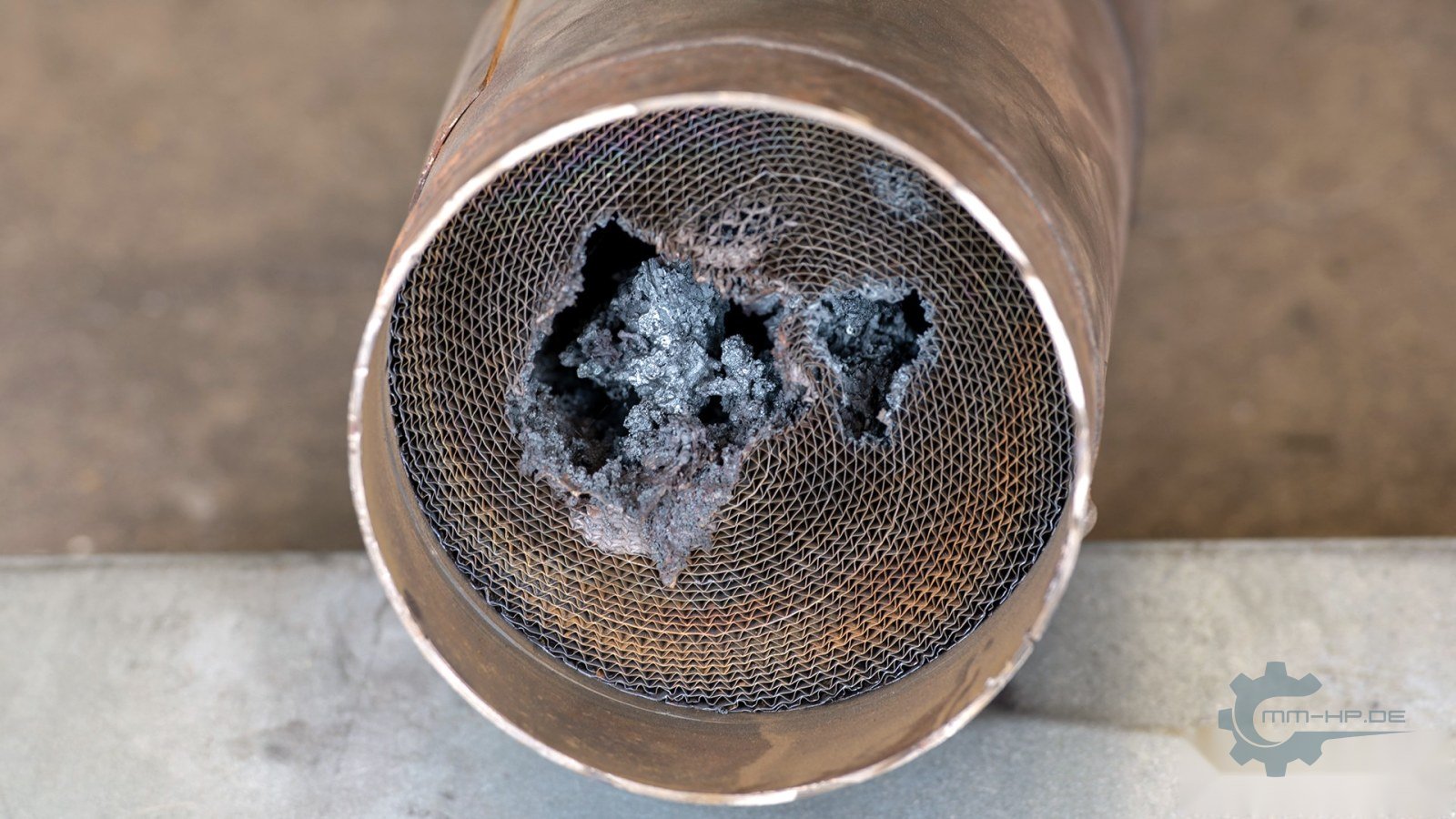
Not a particulate filter, but a catalyst with a metal substrate, melted through.
The picture shows what temperature in the exhaust line is capable of. A metal substrate melts only far above the values of a normal regeneration. Uncontrolled burn-off of large amounts of soot or unburned fuel that afterburns in the catalyst are the known paths to it.
¶ Ash and Soot: The Part That Never Burns
Soot is carbon and burns in every regeneration. Ash is the remainder that does not burn. It comes almost entirely from the additives in the engine oil, mainly from calcium, zinc, magnesium and phosphorus (SAE 2016-01-0928). Every bit of oil that burns in the combustion chamber leaves it in the filter. That is why diesels with a particulate filter require low-ash oils, so-called low-SAPS oils, at VW for example under the standard VW 507 00.

Ash first deposits as a plug at the end of the inlet channels and grows from there toward the front. The area on which soot can lie gets smaller. Studies at MIT (Sappok, SAE 2010-01-0811) and by Tanaka 2023 show the consequence: the intervals between regenerations get shorter as ash grows.
Added to this is an effect that sits in the control unit. No sensor measures the ash content, the control unit counts it. For the older unit injector generation, the formula is documented, and it calculates from fuel consumed. For the common rail engine this is not published, but a value read out fits this calculation. A counter that calculates from fuel does not see high oil consumption. In an engine that burns oil, there is then more ash in the filter than the counter assumes. The control unit interprets the additional back pressure as soot and regenerates sooner.
¶ How Much Ash a DPF Can Take
In our experience on a T5 and many cases followed, about 50 liters (53 quarts) of burned oil are enough to fill a filter with ash. There is no test record for this. A cross-check shows that the figure is not physically impossible. Per liter of low-ash oil, roughly 2 to 4 grams of ash end up in the filter. A filter of 2.5 liters is considered full, judging by differential pressure, at roughly 40 to 140 grams of ash. This calculation is an estimate, it scatters over an order of magnitude and can neither confirm nor refute the 50 liters.
VW does not publish the limit value in the control unit. Repair shop forums name 70 grams for the 1.6 and 2.0 CR-TDI, and 80 grams of ash in the live data for some engines. Some older models had fixed replacement intervals of 120,000 to 180,000 kilometers (75,000 to 110,000 mi), according to the ADAC. Today the ash limits the service life, and VW checks the ash limit value with the scan tool. A figure like "lasts 200,000 kilometers (125,000 mi)" therefore does not exist. It depends mainly on how much oil the engine burns.
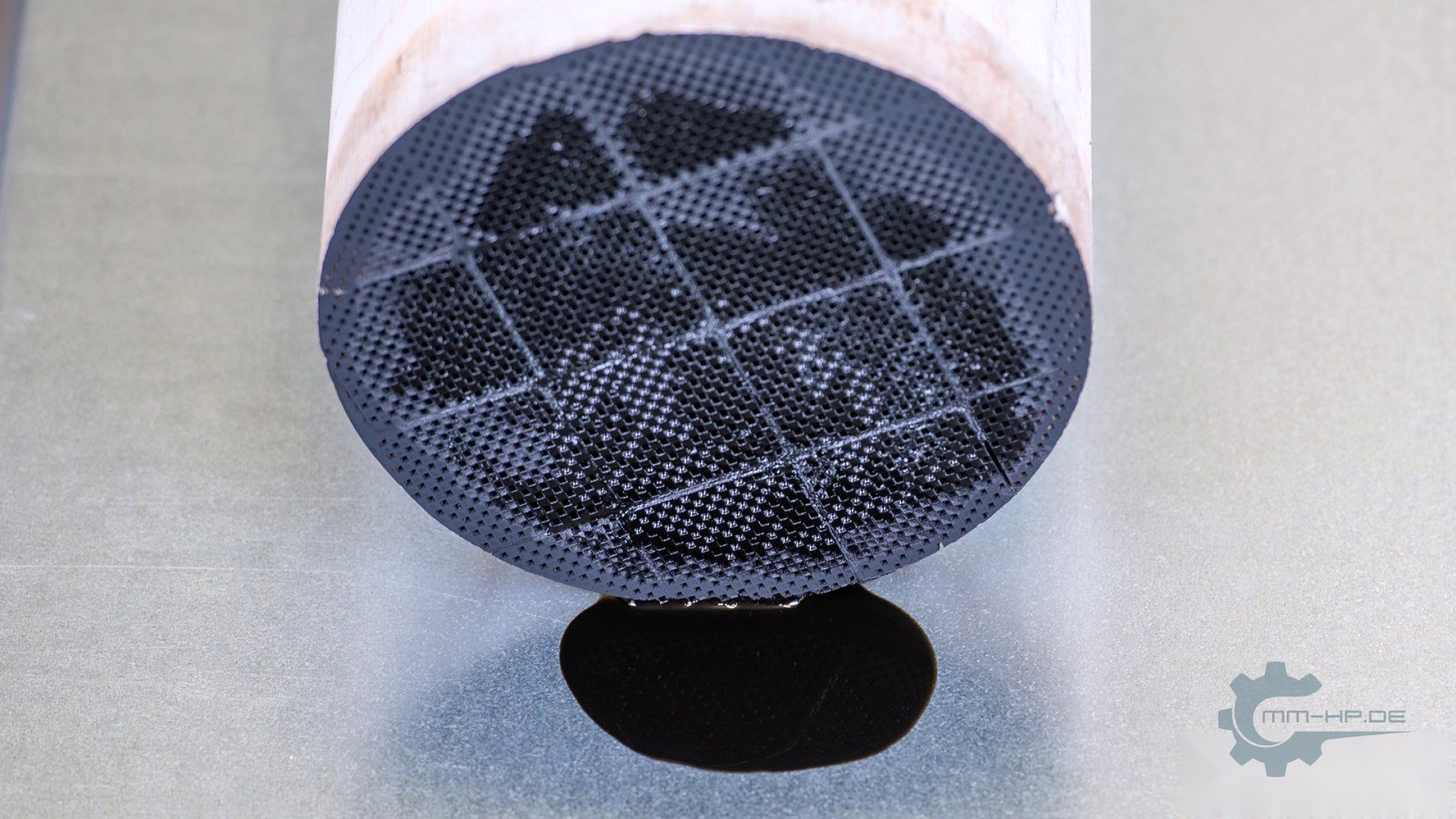
Filter element with oil, removed.
Oil in the filter is a sign that oil arrives in considerable quantity in the exhaust. Possible paths are a turbocharger that lets oil through, piston rings that no longer scrape, or oil mist from the crankcase ventilation. The chain reaction from blow-by to the full filter is described in a separate article (See also).
¶ Cleaning a DPF: What Works and What Doesn't (Short Version)
Whether a filter can be cleaned is decided by the question what it is full of. If it is soot, a complete regeneration helps, if need be with a scan tool. If it is ash, no regeneration helps, and no independent measurement proves that an additive helps. The US Environmental Protection Agency (EPA) writes in a fact sheet that ash only comes out by removal and cleaning, and even the maker of a spray cleaner admits that its product does not remove ash.
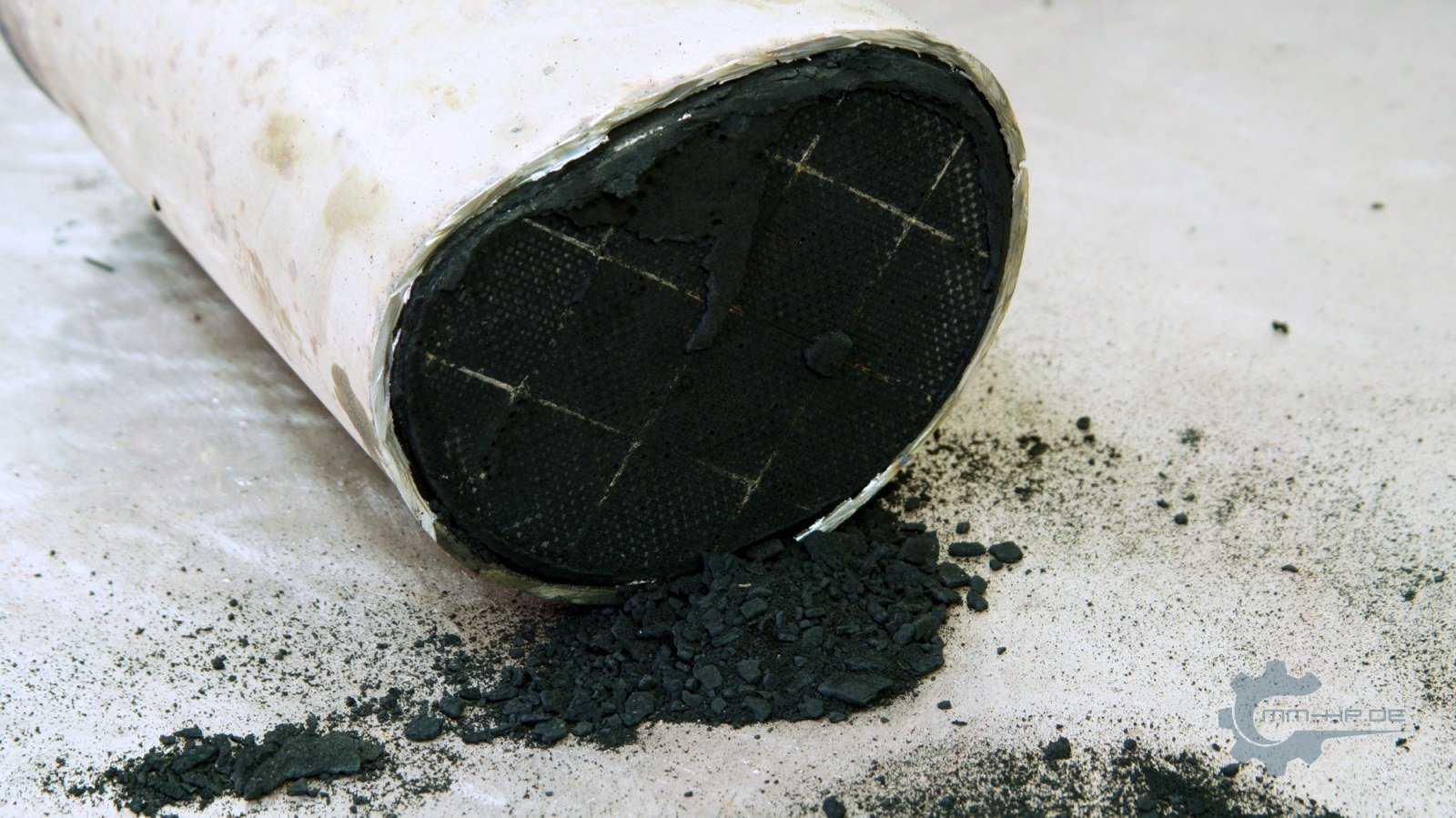
Front face of a filter overloaded with soot. The lines are the bonding joints between the segments.
Ash only comes out when the filter is removed. A common method is to flush it against the direction of flow, so that ash and soot take the way back that they came, and there are also thermal and wet methods. How thoroughly that succeeded is not proven by lower back pressure alone. Fox and colleagues showed in 2019 that the pressure can fall when only part of the ash is out. Simply gutting the filter element is no solution. Rules differ by country. In Germany the vehicle's type approval lapses (§ 19 StVZO).
We do not clean particulate filters, neither for diesel nor for gasoline engines, and we do not take inquiries about it. What works without and with removal, what role spray cleaners play and what the law says is covered in detail in the article on cleaning the DPF.
On the scope of this article: the figures come from the VW 2.0 TDI (EA189 and EA288). The mechanism applies generally, thresholds and driving recommendations differ by manufacturer. Gasoline particulate filters in gasoline engines are wall-flow filters as well.
¶ See also
- Diesel Particulate Filter: Design, Types and Materials
- DPF Cleaning: What Works Without Removal and What Doesn't
- Diesel Oil Dilution: How to Spot Fuel in Your Engine Oil
- Oil Consumption 2.0 TDI: A Chain Reaction Ending in the DPF
- Oil Temperature: Why Hot Oil Ages Your Engine Faster
Transparency note: MMHP has been developing, testing and manufacturing its own products for the automotive industry for over 25 years, including solutions for the oil supply of VW TDI engines. The chapter on oil pressure at hot idle touches on this topic. We do not sell or offer particulate filters or their cleaning. The temperatures in the filter and the 50 liters to a full filter are our own practical values and those of a former subsidiary that has since been sold, not a test record, with more in the article on cleaning the DPF. The test bench figures come from reports by the University of Magdeburg, funded by UFOP, the association for the promotion of oil and protein plants, which advocates biodiesel. The other statements rest on VW training documents, owner's manuals, repair shop bulletins, standards and technical publications, and the sources are given at the relevant sentence. Values from forums and from repair shop practice are marked as such. The animations are schematic.