¶ Diesel Oil Dilution: How to Spot Fuel in Your Engine Oil
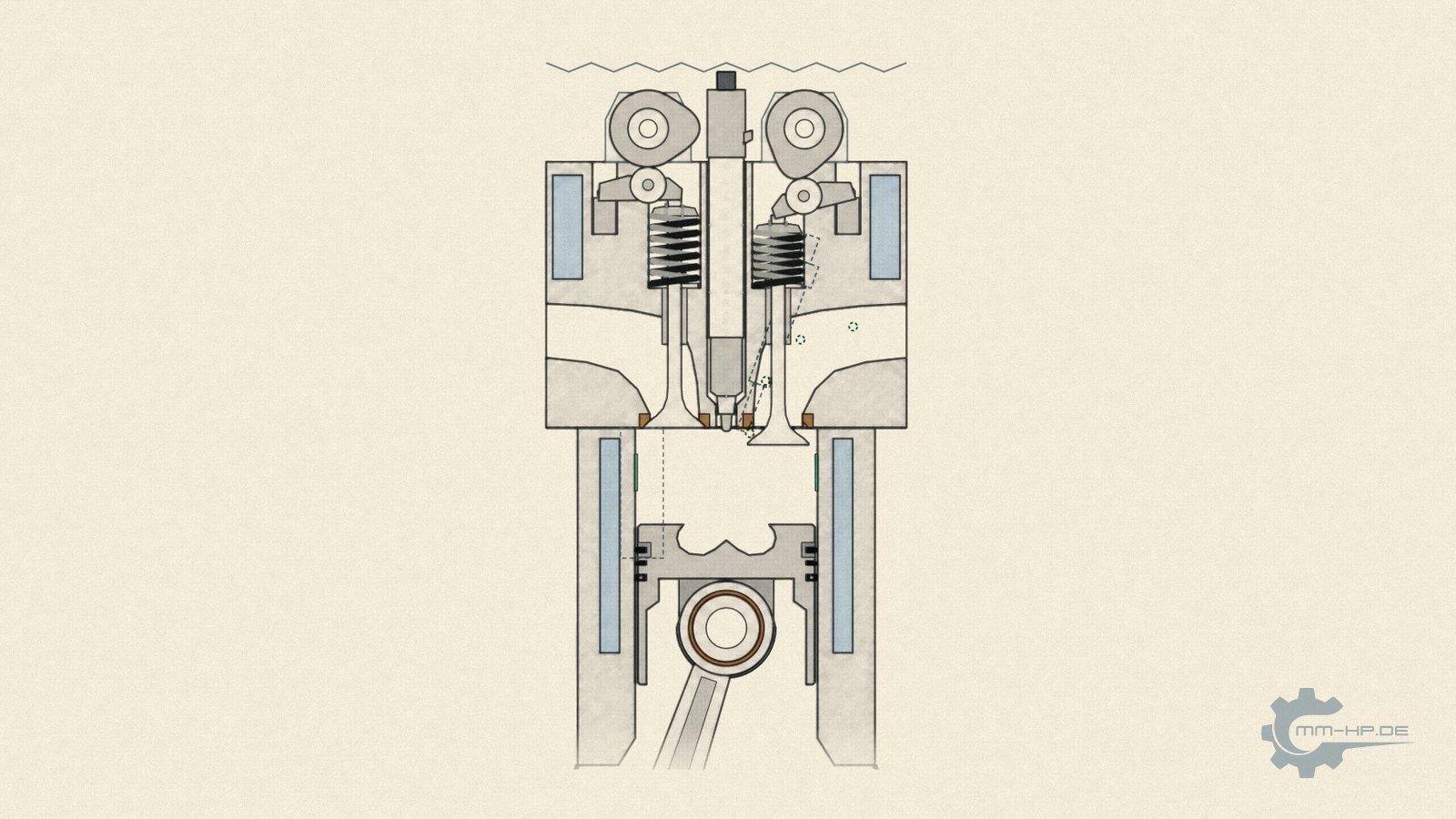
Schematic. The animation is further down in this article.
¶ The key points at a glance
In every diesel with a particulate filter, a gradual swap takes place that no service plan mentions: engine oil is progressively replaced by diesel fuel. The mechanism is built into the design. To actively regenerate the particulate filter, the control unit injects additional fuel late into the cylinder; some of it doesn't combust, settles as a film on the cylinder wall, and gets scraped into the oil by the piston rings. Every active regeneration dilutes the oil a little, and every aborted regeneration — the classic case in short-trip driving — makes it worse, because the next attempt comes sooner.
Diluted oil is thinner oil with a weakened additive package. The consequences run through the entire engine: less oil pressure at every station of the supply chain, thinner lubricating films in the bearings, faster oil ageing. The technical literature treats around eight percent fuel content as the critical order of magnitude. The insidious part: from the outside, the condition is almost invisible. The most revealing warning sign is, of all things, a rising oil level on the dipstick, which many drivers mistake for good news.
The good news is the price of the remedy: nothing helps against oil dilution in the form of an additive product or thicker oil — only your driving profile and a consistently shortened change interval do. An oil change is the only complete reset, and it's the cheapest measure in this entire topic.
The long version explains the mechanism in detail, shows why short trips are the biggest accelerant, what exactly happens inside the engine, how you can recognise dilution, and why we run into this topic at every oil-pressure measurement after a conversion.
¶ A swap nobody ordered
Imagine someone took a small sip of engine oil out of the sump every week and replaced it with diesel fuel. No single sip would be dramatic. But after months, you'd have a fluid in the engine that still looks like oil, still lubricates like oil on good days, but is measurably thinner, protects less well, and ages faster. Nobody ordered this swap, nobody noticed it, and it doesn't show up on any invoice.
Exactly this swap runs in millions of diesel vehicles, and it has a precise technical name: oil dilution through fuel entry. We've touched on it as a supporting factor in our articles on the CFCA special case and the blow-by chain reaction. It deserves an entry of its own, because it's one of the most underrated influences on oil pressure — the very thing everything here revolves around.
¶ Where the diesel in the oil comes from
The main path runs through a component that at first glance has nothing to do with the oil circuit: the diesel particulate filter. The DPF collects soot, and that soot has to be burned off regularly, or the filter clogs. There are two ways to do this:
| Regeneration type | When | Filter temperature | Mechanism |
|---|---|---|---|
| Passive | continuously during brisk driving | approx. 250 to 500 °C | soot reacts continuously with the nitrogen dioxide in the exhaust |
| Active | initiated by the control unit once soot loading reaches the threshold | approx. 600 to 700 °C | an additional late post-injection deliberately heats up the exhaust |
Passive regeneration is inconsequential for the oil — it just needs load and distance. The dilution path begins with the active kind: to bring the exhaust up to regeneration temperature, the control unit injects fuel so late in the working stroke that part of it only reacts in the exhaust tract. This late injection has an unavoidable side effect. Some of the diesel doesn't combust at all, but condenses as a liquid film on the cylinder wall. And what clings to the cylinder wall gets scraped off by the piston rings on the next downstroke — downward, into the crankcase, into the oil.

Schematic, not to scale. One working cycle in slow motion: whatever the post-injection leaves on the wall, the rings wipe into the oil on the next downstroke.
You have to picture the quantities involved: per regeneration, it's only grams. But an active regeneration is due every few hundred kilometres depending on driving profile, and an oil-change interval can run 15,000 to 30,000 kilometres. The entry adds up over dozens of regeneration cycles, and within the interval, the oil has no opportunity to fully get rid of the diesel again. During extended hot driving, some of the lighter fuel fractions do evaporate back out of the oil, but the heavier ones stay put. Dilution is a one-way street with an occasional hard shoulder.
¶ Short trips: the accelerant
The mechanism really becomes dynamic with a driving profile that's everyday life in Germany: short distances, cold engine, city traffic. Here, three gears mesh at once.
First, the aborted regeneration. An active regeneration needs continuous driving time at sufficient load, typically a quarter of an hour or more. Anyone who arrives after eight minutes cuts it short. The soot is then only partially burned off, the filter flags up again soon, and the control unit starts the next attempt from scratch, with the complete post-injection procedure. Short-trip drivers thus accumulate not fewer, but considerably more post-injection minutes per thousand kilometres than long-distance drivers, and every one of those minutes feeds the wall film.

Example, schematic: every interrupted regeneration starts again with heating up at the next trip.
Second, the cold engine. Fuel condenses especially readily on a cold cylinder wall, and cold oil can't evaporate off the fuel and condensation water it has taken on. Short-trip operation means: maximum entry with minimum self-cleaning.
Third, the long interval. Flexible LongLife intervals were calculated for forgiving long-distance profiles. In short-trip operation, they precisely extend the time during which dilution, condensation water, and oil ageing are allowed to accumulate undisturbed. The combination of short trips and a fully stretched interval is the worst of both worlds for the oil.
Key takeaway: Oil dilution isn't a defect or an isolated case — it's a function of the driving profile. The same engine design can stay unremarkable for a commuter with a motorway share and produce measurably degraded oil within a single interval for a city driver.
¶ What diluted oil does inside the engine
Diesel is an excellent fuel and a miserable lubricant. Every percent of fuel in the oil shifts the mixture's properties in the same direction: thinner, more volatile, less protective.
Oil pressure drops. Diluted oil has lower viscosity, escaping more readily through every bearing clearance. With the same pump and the same engine, that means less pressure at every station of the supply chain — and first of all exactly where the margins are smallest anyway: at hot idle. Anyone familiar with our articles on pump sizing will recognise the pattern: dilution attacks the system at its weakest point.
The lubricating film gets thinner. In highly loaded plain bearings, only the oil film separates metal from metal, and its load-bearing capacity depends directly on viscosity. Dilution lowers exactly the characteristics the oil specification is meant to guarantee for long-term durability. In effect, after significant dilution you're no longer running the oil listed in the service book, but an unspecified mixture of your own.
The additive package gets stretched thin. Wear protection, acid buffering, and cleaning action are dosed for a defined oil volume. The diesel that enters brings none of that with it — it simply dilutes the protective agents. At the same time, fuel entry accelerates oil ageing, which in any case runs faster with every degree of oil temperature. This affects the timing chain too. Aged oil diluted with fuel or water can increase chain wear more than tenfold, according to a review by the University of Győr (Paulovics et al., 2022). The measurements behind this are in our article on the timing chain.
When does it become critical? Modern diesel engine control units internally calculate the degree of dilution, and the technical literature treats around eight percent fuel content as the mark beyond which the oil is considered compromised. More important than the exact figure is the insight that the damage doesn't only start at that mark. It grows continuously with every percent — the eight is merely the point at which even the engineers no longer call it normal operation.
¶ The reinforcing loop
If dilution were an isolated phenomenon, it could be filed away as a maintenance topic. But it's part of a cycle we've described in detail in the blow-by chain reaction, and it plays a key role there: diluted oil protects the piston ring zone less well, more wear on rings and cylinder bores increases blow-by flow, more blow-by carries more oil mist into the intake, more burnt oil means more soot and ash in the particulate filter, a filter that fills up faster demands more frequent active regenerations, and more frequent regenerations dilute the oil further. The circle closes, and it spins faster on its own.
The particulate filter is where the loop tightens. The filter can burn off soot from combustion during regeneration. The additives in the engine oil burnt along with it, however, leave ash that does not burn and stays in the filter. With every load of ash there is less room for soot, the filter fills up faster and regenerations come ever more often; some vehicles end up in a kind of continuous regeneration. Each one brings fuel back into the oil. More on this in the article on the blow-by chain reaction.

Schematic. Each station drives the next: with every lap regenerations come more often, up to continuous regeneration.
That's why we're more persistent on this topic than an "oil issue" might seem to deserve at first glance: oil dilution is one of the few points where the driver can personally intervene in this cycle, with trivial means, and before the spiral picks up speed.
¶ How to recognise dilution
The nasty thing about oil dilution is its invisibility. It has no warning light, no noise, and no loss of performance you'd notice day to day. There are, however, four indicators, and the most important one is routinely read backwards.
| Indicator | What you observe | What it means |
|---|---|---|
| Oil level on the dipstick | level rises over weeks instead of falling | textbook case: something is being added, and that can only be fuel (or coolant) |
| Smell | oil on the dipstick smells distinctly of diesel | direct sign of fuel content |
| Laboratory oil analysis | fuel content in percent, viscosity at 100 °C | the only exact measurement, worthwhile if you suspect dilution |
| Control unit | internal dilution counter, regeneration frequency (readable via diagnostics) | reveals the engine's history more honestly than any test drive |
The rising oil level deserves a paragraph of its own, because it's so counterintuitive. An engine normally consumes oil, and the level slowly falls. When it rises instead, many drivers find that reassuring — finally, a car that doesn't need oil. In fact, a rising oil level on a DPF diesel is one of the clearest alarm signals there is: the sump is filling up with something that doesn't belong there. On top of that comes a mechanical risk we flag as a warning box in the blow-by article and repeat here:
⚠️ WARNING — take an oil level above maximum seriously: If the oil level rises above the max mark due to dilution, the rotating crankshaft can strike the oil. The consequences range from oil foam the pump can no longer deliver, to oil being drawn in through the crankcase ventilation. Don't just watch a level that has risen above max — resolve it promptly with an oil change, and never top up past the max mark in the first place.

Schematic, not to scale. The level rises instead of falling: on a diesel with a particulate filter that isn't good news, it's fuel in the oil.
¶ How exposed is your driving profile? A self-test
Because dilution is a function of driving profile, your own risk can be assessed remarkably well on your own. Five questions are enough:
| # | Question | increases risk if... |
|---|---|---|
| 1 | How long is your typical single trip? | under about 15 minutes, the engine rarely gets properly warm |
| 2 | How high is your share of city and short-trip driving? | predominantly city, many cold starts per day |
| 3 | Do longer stretches occur regularly (country road/motorway from ~30 minutes)? | no, or only rarely — regenerations get aborted often |
| 4 | Do you run on the LongLife interval? | yes, combined with a high share of short trips |
| 5 | Do you track your oil level over time? | no — a rising level would go unnoticed |
Anyone landing in the right-hand column three times or more is running a high-risk profile for oil dilution, entirely independent of how healthy the engine is today. The good news is already in the table itself: four of the five points can be directly influenced, from squeezing in a weekend country-road drive to switching to the fixed interval. Only the commute is usually what it is — and that's exactly the profile the shortened change interval is designed for.
Incidentally, your vehicle does its own math too: modern diesel control units run an internal estimation model for the degree of dilution, fed by counted regenerations, aborts, and operating data, and some vehicles therefore request an oil change well ahead of the regular interval. This early request isn't a fault or a workshop sales trick — it's the control unit that has done exactly the maths in this article. It's worth following.
¶ The silent twin: water in the oil
Diesel isn't the only foreign substance that accumulates in the oil during short-trip operation. Its silent twin is water, and it forms the same way at the same time. Every combustion event produces water vapour, some of which enters the crankcase as blow-by, and on cold internal engine surfaces it condenses into liquid water that mixes with the oil. An engine driven up to full temperature evaporates this water off without issue, since its oil temperature sits well above the boiling point. An engine that never gets properly warm accumulates it instead.
The consequences resemble fuel dilution and reinforce it: water degrades lubrication, accelerates oil ageing together with combustion acids, and in stubborn cases forms the notorious yellowish emulsion found as a foamy coating on the oil cap or dipstick. Worth noting for context: a light sheen on the oil filler cap after a short-trip winter is common and, on its own, not an alarm signal; larger amounts of emulsion, on the other hand, should be looked into, not least because they need to be distinguished from coolant entry. For our topic, what counts is the commonality: short trips fill the sump with two diluents at once, and both disappear with the same measure — a regular, extended warm-up drive and a not-too-long change interval.
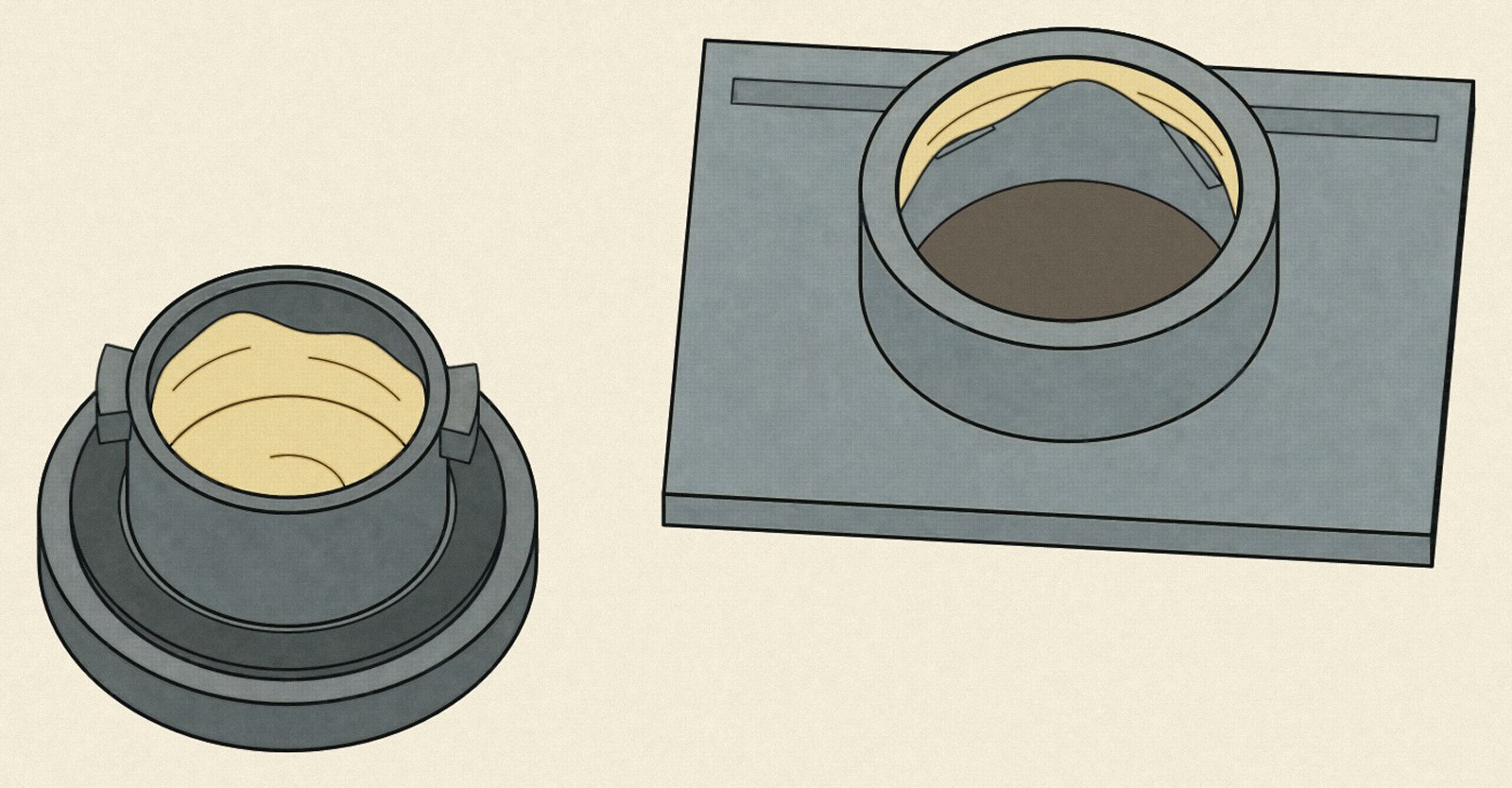
Water-in-oil emulsion on the filler cap and in the neck. A light film after a winter of short trips is common; larger amounts should be looked into.
¶ Oil analysis: the blood test for your oil
For anyone who wants to know for certain, there's a tool that's used surprisingly rarely in everyday passenger-car life, even though the commercial-vehicle and industrial world has treated it as standard practice for decades: laboratory oil analysis. For a double-digit euro amount, a specialist lab examines a sample of the used oil and delivers a finding strikingly similar to a blood panel.
Three items on the lab report are relevant to the dilution topic. Fuel content in percent answers the core question directly and objectively — this is the figure this entire article revolves around. Viscosity at 100 degrees shows how far the oil has drifted from its target grade; a 30-grade oil that measures like a 20-grade after 20,000 kilometres tells its own story. And water content exposes the silent twin from the previous chapter. As a side benefit, the analysis also provides a look at the condition of bearings and running surfaces via wear metals (iron, lead, copper, aluminium) — exactly the components whose protection the diluted oil weakens.
Two honest caveats belong here. First, every analysis is a snapshot: it describes the oil on the day of sampling, not the trend, and it only unfolds its full value with repeated use, for instance at every change. Second, it doesn't replace a diagnosis of the engine itself — it provides clues, not a repair recommendation. In two situations, though, it's almost always worth the money: when massive dilution is suspected, because it turns suspicion into a number, and when buying a used DPF diesel with an unclear history, where a single sample reveals more about the previous owner's habits than any sales conversation.
¶ What helps, and what only looks like it helps
The effective countermeasures against oil dilution are unspectacular, cheap, and entirely within the driver's control.
Shorten the interval. With predominantly short-trip driving, the flexible LongLife interval is the wrong mode of operation. A fixed, short interval simply denies dilution the time to accumulate. The oil change is the system's only complete reset, and measured against what it prevents, the cheapest insurance in this entire topic.
Let regenerations finish. Anyone who notices their vehicle is actively regenerating — raised idle speed, changed fan behaviour, briefly elevated consumption — does the oil a big favour by continuing the drive for another quarter hour instead of cutting the process short. Regular country-road or motorway stretches also give the filter a chance at passive regeneration, which doesn't burden the oil in the first place.
Treat the oil level as a measurement. Pulling the dipstick once a month and noting the level costs a minute. Only the trend turns the single value into a diagnosis, in either direction.
And what doesn't help: thicker oil. The idea of countering thin oil with a more viscous grade seems obvious. It treats the symptom while missing the point, because the fuel stays in the oil and dilutes the thicker base too, while the wrong viscosity grade brings its own problems, from cold-start behaviour to a voided approval. Why this and similar reflexes lead you astray is something we cover collectively in the oil myths fact-check, and what role the oil specification actually plays, in the article Which oil?.
¶ Why we run into this topic with every measurement
Finally, the reason why, of all businesses, a manufacturer of oil-pump conversions is writing this article. Oil dilution is one of the four major unknown variables that determine a specific engine's oil pressure, alongside manufacturing variance, wear condition, and usage profile. It accounts for part of the spread we encounter in customer measurements: the same conversion can show different idle pressures in two externally identical vehicles, if one is measured with fresh oil and the other with a diluted, late-changed oil. Anyone wanting to compare measurements before and after a conversion has to take oil condition seriously as a confounding factor, something we've written up systematically in the article on the comparability of measurements. And anyone weighing up the choice between two pump stages will find in dilution another argument from the category "reserves for conditions nobody can predict": the oil your engine runs on for the next few years isn't always the oil from the datasheet.
¶ See also
- Oil consumption in the 2.0 TDI: the blow-by chain reaction
- VW T5 2.0 BiTDI (CFCA): the special case
- More delivery volume, cooler oil
- Why measurements before/after a conversion aren't comparable
- Why more delivery rate is always the better choice
Transparency note: we develop and sell solutions for the oil supply of 2.0 TDI engines. The regeneration and dilution mechanisms in this article reflect the state of the technical literature; the eight-percent mark is established there as an order of magnitude. Driving-profile recommendations don't replace manufacturer maintenance requirements.