¶ Oil Myths Fact-Checked: Thicker Oil, Additives, Flushes
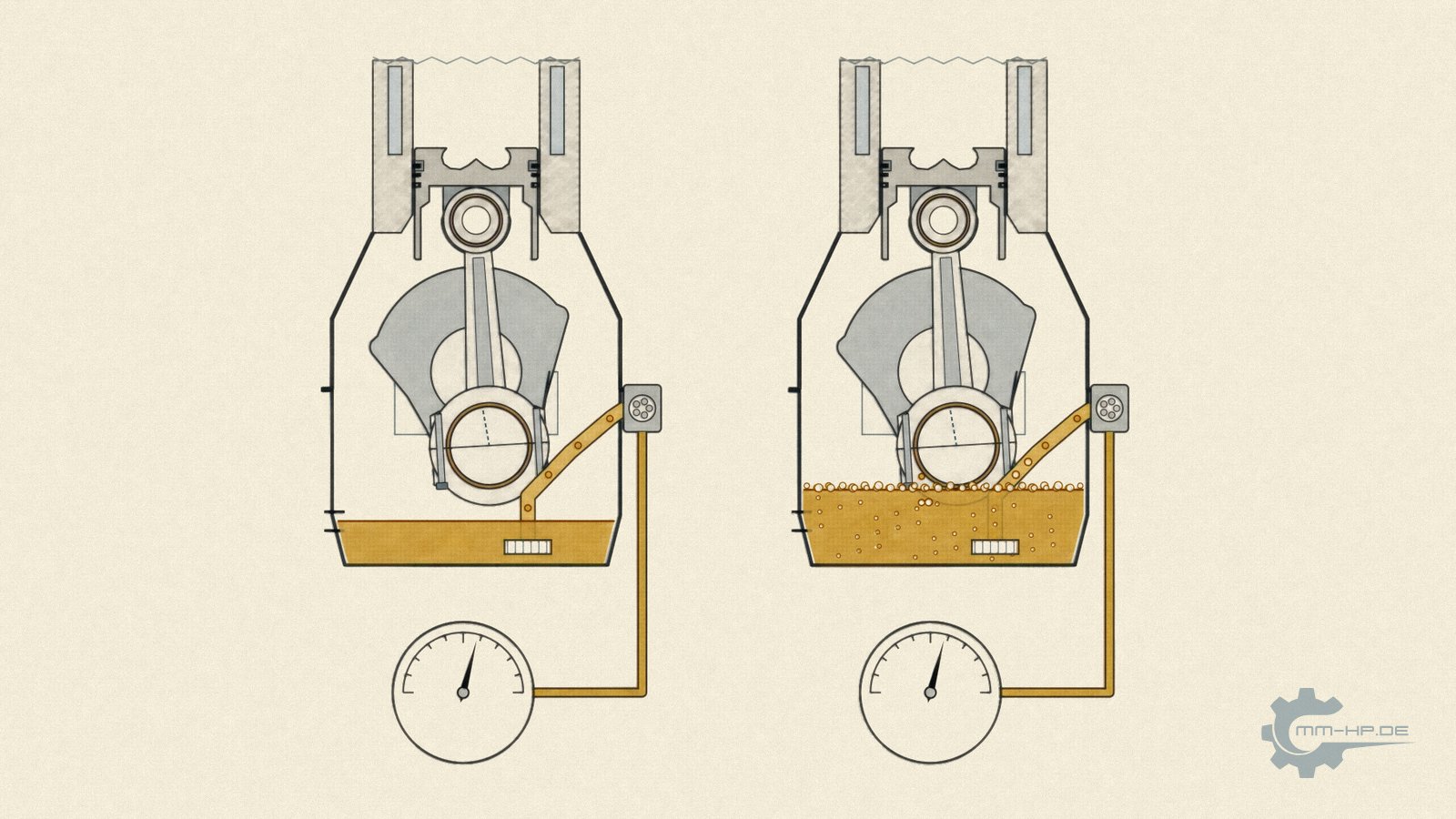
Schematic. The animation is further down in this article.
¶ The key points at a glance
More legends surround engine oil than any other consumable, and the five most stubborn ones come up regularly in our support enquiries: thicker oil is supposed to cure low oil pressure, miracle additives are supposed to stop wear, engine flushes are supposedly always beneficial, one litre of oil consumption per thousand kilometres is "normal according to the manufacturer", and if oil is good, a bit more oil must be even better. All five sound plausible, all five contain a grain of truth, and all five lead you in the wrong direction in practice.
The fact check turns out to be fairly drastic in places. The US Federal Trade Commission (FTC) took action against seven brands of engine treatment, among them the two best-known additives in history: for one, the advertised protective coating was never formed at all, for the other, the tests the vendor itself had commissioned showed more than double the bearing corrosion compared with no product at all. Thicker oil does raise the pressure reading, but only masks wear and makes cold starts worse. An engine flush can, in a heavily sludged engine, trigger exactly the kind of particle migration we warn about in our oil strainer article. The famous "normal" litre per thousand kilometres was a manufacturer's legal safeguard clause, technically normal passenger car oil consumption is orders of magnitude lower. And overfilling isn't a safety buffer, it's a damage risk in its own right.
The long version takes on each of the five myths individually: where they come from, what's true about them, what the facts say, and what actually helps instead.
¶ Why oil myths are so persistent
Before we take the individual legends apart, a word on why they exist at all. Oil myths survive because almost all of them are based on real observations. Anyone who fills in thicker oil really does see more pressure on the gauge. Anyone who does an engine flush really does see dark sludge drain out. The observation is correct, only the conclusion is wrong, and that combination is exactly what makes a myth immortal: it appears to confirm itself.
On top of that there's a market that thrives on uncertainty. Additives, flushes and special products promise simple solutions to complex problems, and simple solutions sell better than the truth, which is usually: diagnose the cause, fix the cause. Our knowledge section exists precisely to counter that, and this article is its collected volume.
¶ Myth 1: "Thicker oil fixes low oil pressure"
The observation is correct. Anyone who switches from a 30-grade to a 40-grade oil in an engine with low oil pressure really does see higher readings on the gauge. The physics behind it is simple: low oil pressure in high-mileage engines mostly results from enlarged bearing clearances, through which the oil escapes too easily. Thicker oil flows more slowly through the same clearances, back-pressure rises, the reading climbs.
The conclusion is wrong. Because what has actually improved? The bearing clearances are as large as before, the wear is as advanced as before, the pump is as tired as before. Only the measured value has changed. That's not a repair, it's painting over a warning light. The engine keeps running with the same mechanical problems, just without anyone noticing.

Same pump, same clearance: the thicker oil simply backs up more. The reading rises, the bearing stays as it is.
And the price is real. An oil's cold-weather class determines how quickly it reaches the bearings through empty channels at start-up, and the first few seconds after a cold start are the most wear-intensive phase in an engine's life. A thicker oil extends exactly this phase. On top of that, you leave the manufacturer's approval behind, along with everything that comes with it, from the calibrated HTHS design target to any goodwill claims. So you're trading a cosmetically better warm reading for genuinely worse cold protection.
What actually helps: finding the cause. Low oil pressure has a manageable list of possible reasons, and it can be worked through systematically, we have a dedicated guide for that. If the reason is an ageing factory-spec supply, the engineering answer is more delivery rate, not more thickness.
Rule of thumb: thicker oil raises the displayed pressure, not the health of the engine. It treats the thermometer, not the fever.
¶ Myth 2: "Oil additives noticeably reduce wear"
Hardly any shelf in the accessories trade is as colourful as the one for oil additives: ceramic, molybdenum, PTFE, nanoparticles, every product with advertising images of gleaming metal surfaces. The question is an old one, and for once there are hard, documented answers, because the US Federal Trade Commission has officially looked into the two most famous representatives of the category.
Case one: Slick 50, the PTFE additive marketed for decades as the epitome of engine protection. In July 1996 the FTC issued a complaint. The charge: the advertising portrayed engines as having little or no wear protection at cold start without the product, and as commonly dying of premature wear, and that was false, because premature engine failure caused by wear is uncommon in any case. For the promised benefits, less wear, longer engine life, more power, better fuel economy, the vendor had no adequate substantiation, and Slick 50 does not coat engine parts with a layer of PTFE at all. One detail matters for reading this correctly, and it is routinely missed: an FTC complaint is not a finding or a ruling, it opens the proceeding. No ruling was ever reached, because the two sides settled. In December 1997 that settlement became binding, and it barred the companies from making any claim about the performance of an engine treatment without competent and reliable evidence, along with a duty to notify resellers of the restrictions. It contains no redress payment. The FTC merely reserved the right to go to court itself if the private class actions then under way did not deliver at least ten million dollars in redress to consumers. The familiar ten million is therefore a benchmark for other people's lawsuits, not a payment the vendor committed to.
Case two: zMax. Here the story is uglier than the short version suggests. In February and March 1997, four years before any lawsuit, the vendor had an independent laboratory run two CRC L38 tests, one on motor oil alone and one on the same oil treated with zMax. That test protocol is an accepted industry standard for exactly one property: how well a motor oil protects bearings against corrosion. The result went against the product, and clearly so. With the additive the bearings lost 185.7 milligrams of weight, without it 74.1 milligrams, so more than twice the damage with the protective product in the oil. The FTC's charge was accordingly not about a clumsy defence but about something else: according to the complaint filed on 31 January 2001, the defendants fabricated a single "report" out of the two test reports, cut out the bearing corrosion results and all other detrimental data, kept the laboratory's cover sheet and letterhead on every page, and used that document as a sales tool, among other places in an infomercial that ran at least thirteen thousand times. The three products in the range each consisted, according to the complaint, of 100% mineral oil with no active chemical additives, merely tinted a different colour. In March 2003 a federal court approved a settlement, expressly without any admission of a law violation, with refunds capped at one million dollars in the aggregate. Individual buyers received 12.31 dollars against a purchase price of 39.95 dollars. There was a sequel, too: the vendor did not pay out the whole fund as the order required, but sat on the remainder for nearly fifteen years.
Two cases don't prove that every additive is ineffective, a fact check has to be that honest. But there aren't two. In the very announcement of the zMax lawsuit, the FTC lists the engine treatments it had already acted against: Dura Lube, Motor Up, Prolong, Valvoline, Slick 50 and STP. STP and its parent company paid an 888,000 dollar civil penalty in 1995 over false and unsubstantiated claims for their engine treatment. Seven brands in one product category within a few years is not coincidence, it is a pattern, and the pattern explains why the oil and additive industry itself holds the clearest counter-position: an approved branded oil is a fully balanced chemical package, developed by a handful of specialised additive manufacturers, tuned to the approval standard and validated in engine tests. The wear protection the additive adverts promise is already in there.
How much of it is in there is written into the standards, and first of all from below. The current API categories SP and SQ require at least 0.06 percent phosphorus in every viscosity grade, because too little of it measurably means more wear. A ceiling of 0.08 percent, by contrast, does not apply everywhere. It applies to the grades that are kept on a short leash for the sake of exhaust aftertreatment, that is the common low-viscosity oils such as 0W-20 or 5W-30, and to every oil carrying the "Resource Conserving" designation. For the other eligible viscosity grades the API standard sets no maximum at all. "Modern branded oil" is therefore not a single category on this point: there is a floor everywhere, but not a ceiling. Incidentally, the same tables dispose of a widespread story. The much-quoted reduction of zinc content has not continued for over twenty years. The 0.08 percent has stood since the GF-4 generation, which succeeded GF-3 in spring 2004, and it stands unchanged in GF-7, effective March 2025.
It is worth looking at how this wear protection actually works, because this is precisely where our own earlier description had fallen behind the research. The classic wear-protection agent is ZDDP, a zinc salt that contains sulphur alongside zinc and phosphorus, and all three elements are needed. The idea that the agent drifts about in the oil and only becomes active at a metal contact is obsolete. It adsorbs onto the surfaces immediately, and even a low concentration is enough for a complete molecular layer. Out of that layer the protective film then grows in several stages: at the bottom a few nanometres of iron sulphide from the sulphur, above it the phosphate film, which starts out soft and long-chained and, during operation, converts into a short-chain, nanocrystalline and considerably more wear-resistant form. This film does not form under rubbing alone. Above roughly 140 degrees it forms from temperature by itself, including on parts that never rub against anything. And what drives it where rubbing does occur is not the pressure in the contact but the shear stress, the sliding of the surfaces against one another. This is not a matter of wording but of measurement: in pure rolling, where nothing slides, no film forms, and pressure slightly slows the reaction rather than driving it. All of that is chemically elegant, in use since the 1940s, and still the wear protection on which practically every passenger car engine oil is built, and it is exactly the effect the miracle additives sell as their own invention.

Schematic. The protective film grows from the additive in the oil: a few nanometres of iron sulphide at the bottom, phosphate above it that converts into a more wear-resistant form in service.
The difference: in an approved oil, the active ingredient is present at the dosage tested for compatibility with exhaust aftertreatment and the oil's remaining chemistry. And that compatibility hangs on the dosage. The tribology review literature puts it in just those terms: ZDDP is remarkably tolerant of the other additives, as long as they are present at the concentrations generally used in engine oils. An added-on additive can at best fail to disturb this balance, at worst it shifts it, and in DPF vehicles there's the additional ash question, since extra metal compounds in the oil end up as extra ash in the filter.
So why does the additive market still boom? Because it sells a feeling, not a component. For most people an engine is a black box they worry about, and a poured-in additive is an action against that worry, visible, immediate, and without a workshop appointment. There's nothing wrong with the underlying need, only with where it's directed: the same worry, invested in an earlier oil change instead, buys proven rather than felt protection.
What actually helps: putting the money into shorter change intervals with approved oil. That's the same investment in wear protection, just with proven effect.
¶ Myth 3: "An engine flush before an oil change is always good"
Engine flushes are chemical cleaners added to the old oil before an oil change, meant to dissolve deposits. The ritual has loyal followers, and the logic sounds compelling: a cleaner engine, a better start for the fresh oil.
The genuine core: in a moderately dirty engine, with the right product applied as directed, a flush isn't the devil's work. There are use cases, for example after years of short-trip driving or neglected change intervals, where workshops deliberately use them.
The problem is the word "always". Because a flush does exactly what it promises: it dissolves deposits. And dissolved deposits don't vanish, they go on a journey through the oil circuit. Anyone who has read our article on the oil strainer and particle pathways knows the route: coarse chunks can clog the pump's intake strainer, fine ones migrate through the pump, and with a loaded filter, the bypass valve opens a path around the filter paper. In a heavily sludged engine, then, a vigorous first flush can trigger exactly the oil starvation it's meant to prevent. There's a second, uncomfortable effect in old engines too: deposits sometimes act as an unintentional sealant on tired gaskets, and anyone who removes them chemically occasionally discovers why the gasket was actually overdue for replacement long ago.
Incidentally, you look in vain for an official manufacturer position on flushing, it simply doesn't appear in maintenance schedules. That's a statement in itself: no manufacturer considers it necessary in normal operation, because approved oil already contains cleaning and dispersant additives that keep the engine permanently clean through regular changes.
What actually helps: not letting it get sludged up in the first place. Regular changes with approved oil are the flush, just in slow motion and without the risk. For a genuinely sludged engine with an unknown history, the decision belongs in a workshop's hands, and the sensible approach there is, tellingly, the opposite of "one vigorous flush": with high mileage and unclear maintenance history, work is done in stages, first a cautious pass with a reduced dose and short dwell time plus an immediate oil change, then possibly a regular second pass some thousand kilometres later. The reason for this caution is exactly the mechanism from this section: you want to dissolve years of accumulated sludge in doses the strainer and filter can handle, not in an avalanche. Anyone who finds this same caution even among the vendors of these products knows what to make of "always good".
¶ Myth 4: "One litre per thousand kilometres is normal, the manufacturer says so"
This sentence comes up in every oil-consumption discussion, and it does have a documented origin: similar wording appeared for years in major manufacturers' owner's manuals as the limit up to which oil consumption is not grounds for a warranty claim.
Except that was never a technical statement, it was a legal one. An owner's manual is also a warranty document, and the consumption limit stated there is the line behind which a manufacturer protects itself against claims. It describes the worst still-acceptable case, not the normal one. The technical reality looks different, and it's quantified: engine-building reference literature puts normal oil consumption in modern passenger cars at under 0.05% of fuel consumption. At eight litres of diesel per hundred kilometres, that's around 0.04 litres of oil per thousand kilometres, with roughly 0.4 litres regarded as the technical maximum. So the proverbial litre is two and a half times the technical maximum and twenty-five times the normal value.

Schematic, fill height to scale with volume. The proverbial litre is 2.5 times the technical maximum and 25 times the normal value.
Anyone who genuinely tops up a litre per thousand kilometres doesn't have a thirsty engine, they have a symptom. The question then isn't whether that's "still normal", but where the oil is going, and we've described the most common answer to that question in a dedicated flagship article: via the blow-by path, atomised oil is carried into the intake and co-combusted, with the particulate filter as the silent casualty. High oil consumption is almost always a wear or system signal, and the owner's-manual sentence is the most thoroughly misunderstood reassurance in automotive history.
Rule of thumb: the litre limit in old owner's manuals was a liability line, not a clean bill of health. Technically normal in a passenger car is a fraction of that.
¶ Myth 5: "More is better: better to fill in a bit extra oil"
The last myth is the most sympathetic one, because it springs from pure care: if oil starvation kills engines, surely an extra splash must be a safety reserve. The Max mark looks like a recommendation you're allowed to interpret generously.
But the mark isn't a recommendation, it's a design limit, and above it a whole new failure pattern begins. If the oil level is too high, it reaches the rotating parts of the crank drive, first the big ends of the connecting rods at bottom dead centre and, as the level rises further, the crank webs too, which act on the oil surface like a whisk: the oil gets whipped into foam. Foam is nearly worthless as a lubricant, the load-bearing film in the bearings breaks down, and the oil pump, designed as a liquid pump, can no longer reliably deliver the air-oil mixture. The supposed reserve turns into starvation lubrication with a brim-full pan. With diesel engines there's an extreme additional risk, which we cover in detail in the blow-by article: heavily overfilled or foamed oil can enter the intake tract via crankcase ventilation, and a diesel that discovers its own engine oil as fuel can no longer be stopped with the ignition key.

Above MAX the crank drive reaches the oil. It beats in air, the pump draws in bubbles, and oil pressure drops every time.
⚠️ WARNING, don't just "keep driving" with an overfill: an oil level clearly above Max needs correcting before the engine sees load again, by suction or draining at a workshop. That applies doubly if the level rose on its own, because then the cause is usually fuel entering the oil, and the diluted contents of the pan are due for a change regardless.
What actually helps: filling exactly to spec, checking on level ground, and treating the dipstick for what it is, a measuring instrument with a defined target range. Between Min and Max there's about a litre of margin in a passenger car, that's reserve enough.
¶ Bonus myth: "The oil's gone black again, it must be no good"
A sixth misconception deserves brief treatment, because it runs in the opposite direction: it turns a good sign into a bad one. Many diesel drivers are alarmed when freshly changed oil turns deep black again after just a few hundred kilometres, and conclude that the oil is inferior or the engine is unwell.
In fact, the opposite is true. A diesel engine produces soot by design, and some of it ends up in the oil via blow-by and the cylinder wall. Modern oils contain dispersant additives whose sole job is to keep exactly these soot particles finely suspended so they don't clump together and settle as sludge in channels and the pan. Black oil is proof that these additives are working: the dirt is in the oil, where it leaves the engine at the next change instead of staying on the components. A diesel oil that was still honey-coloured after a thousand kilometres would either be working in a miracle soot-free engine or not doing its job. The colour of the oil simply isn't a useful quality indicator, in either direction. What counts is approval and change interval, not the shade on the dipstick.
¶ How to read oil marketing: three warning signs
From the five big myths and the small bonus one, a recognition framework can be distilled that carries beyond any single product. Three patterns keep showing up in dubious oil claims:
First: the product promises an effect the base oil supposedly doesn't already provide. For wear protection that claim is demonstrably false, and the cases above are what it runs into. For the other jobs an engine oil does, cleaning, holding soot in suspension, buffering acids, reducing friction, the evidence looks different but no better for the additives. Those agents are in the approved oil as well, and the tribology literature shows that they interfere with one another: dispersants strip zinc out of the wear-protection film and, depending on type and dose, can raise the wear rate by a factor of two to eight, overbased detergents compete with the wear protection for the same surface, aminic friction modifiers lower friction while removing the protective film. None of that is an argument against those substances, they are indispensable. It means the dose decides the effect, and that a finished oil was tested at precisely that ratio. An add-on product claiming to "finally do one of these jobs properly" shifts the ratio, and implicitly claims that the engine manufacturers' test programmes and the additive industry's development work are incomplete. That's a strong claim, and strong claims need strong evidence.
Second: the evidence is demonstrations rather than measurements. Sparking friction rigs at trade shows, gleaming metal samples, before-and-after videos. Such demonstrations are impressive and say nothing about a real engine with an oil film, filter, and thousands of operating hours. The gold standard is standardised engine tests and independent testing institutes, and those are conspicuously often missing from this product category. The two FTC cases in this article show what happens when an authority actually demands the evidence.
Third: the promise bypasses diagnosis. Any serious approach to oil consumption, pressure loss, or engine noise starts with the question of the cause. Any dubious product starts with the promise that you're allowed to skip that question: pour it in, problem gone. Wherever a product offers to replace diagnosis instead of supporting it, scepticism is the best substitute additive.
These three check questions cost nothing, work equally well on the accessories shelf and in the online shop, and don't age, because product names change, the patterns stay the same.
¶ The five myths at a glance
| Myth | True core | Facts | What actually helps |
|---|---|---|---|
| Thicker oil against pressure loss | reading really does rise | masks wear, worsens cold start, leaves the approval behind | diagnose the cause, restore oil supply |
| Miracle additives | individual active ingredients are real (and already in the oil) | FTC cases against seven brands, among them Slick 50 and zMax; additive package is factory-dosed at a tested ratio | approved oil, shorter intervals |
| Engine flush always good | sensible in individual cases | dissolved sludge can clog strainer and channels | regular changes, flush only when targeted |
| "1 l/1,000 km is normal" | this is what owner's manuals used to say | legal limit, technically normal is ~0.04 l | look for the cause (blow-by path) instead of topping up |
| More oil = more safety | oil starvation really is dangerous | overfilling creates foam and its own damage | fill exactly to spec |
If you take away a single thought from this article, let it be this: every one of these myths replaces a diagnosis with a product or a rule of thumb. The counter-strategy is always the same, and it runs through our entire knowledge section: understand what the engine actually has first, then act. It's less convenient than a miracle cure off the shelf. It's also the only thing that works.
¶ See also
- Which oil? Why we don't give a blanket recommendation
- Oil dilution: the invisible oil exchange for the worse
- Oil consumption in the 2.0 TDI: the blow-by chain reaction
- Oil pressure too low after a conversion? The most common causes
- Why more delivery rate is always the better choice
Transparency note: we sell neither oil, nor additives, nor flushes. The FTC cases are publicly documented via the agency's press releases, complaints and settlements, the oil consumption figures come from engine-building reference literature (MS Motorservice). The account of wear-protection chemistry follows the review by H. Spikes, "Mechanisms of ZDDP, An Update", Tribology Letters 73 (2025), the phosphorus limits come from API 1509, 23rd edition (2025). Individual mechanisms (wear masking, overfill consequences) are physically derived workshop consensus, identified as such in the text.