¶ Oil Pump Stage 1 or Stage 2? Why More Is Always Better
¶ The key points at a glance
This article covers our conversion systems for the VW EA189 diesel engine. The conversion removes the entire factory oil supply unit: the balance shaft module together with the oil pump mounted on it (whether first or second generation), the drive dog and the drive gear on the crankshaft. From the crankshaft, a new drive is built up that drives a brand-new MMHP high-performance oil pump directly. This pump comes in two versions: Stage 1 with roughly 35 percent and Stage 2 with roughly 116 percent more delivery rate than the factory oil pump it replaces. The installation effort is exactly the same for both stages, the difference lies in the pump alone. Switching later from Stage 1 to Stage 2 isn't possible without repeating the entire conversion. That's why this decision is made exactly once, before you order.
Our recommendation has been the same for years: choose Stage 2. There are engines on which Stage 1 doesn't have enough reserve to lift the oil pressure safely out of the danger zone, and nobody can tell beforehand whether yours is one of them. With Stage 2, that risk no longer exists. The reason for this recommendation isn't sales tactics, it's a sober calculation involving unknown quantities. You're buying the pump for an engine whose actual condition nobody fully knows, not even a workshop. Manufacturing spread, real bearing wear, oil condition and your usage profile are four variables that can't be reliably measured from the outside. More delivery rate is the only lever that covers all four at once.
At the top end, the system is mechanically capped: the pressure relief valve (PRV) sits directly on our pump and diverts surplus oil straight back into the oil pan as soon as the pressure reaches the opening pressure. The factory maximum pressure, which other components such as the hydraulic lifters are designed for, is therefore not exceeded after the conversion either, with neither of the two stages. Every standard engine proves this itself, on every cold winter morning. The difference between the stages shows at idle and in the low and mid rev range, where the standard pump can drop to values around 0.4 to 0.5 bar at hot idle. Higher up the rev range, both stages usually reach the regulating pressure anyway.
That's the short version. If you want to understand why we recommend Stage 2 so clearly, why the engine structurally can't "feel" the bigger pump at all, and in which cases Stage 1 still remains an honest option, the full reasoning follows in the long version below.
¶ The question behind the question
Almost no decision occupies our customers before ordering as much as the choice between the two pump stages. We see that in the support enquiries we receive about it, and we understand why. The numbers sound dramatic at first: 35 percent more delivery rate for Stage 1, 116 percent for Stage 2. More than double the standard output — that raises questions.
Behind almost all these enquiries lie two considerations. The first: "Isn't the smaller stage enough?" The second, often unspoken: "Can my engine even handle the bigger one?" Both questions are legitimate, and both can be answered cleanly. That's exactly what this article does. You've already read the short answer above. The long answer begins with a characteristic of this decision that many only realise after buying.
¶ What the conversion removes, and what the stage is about
To put the stage question in the right context, first the conversion itself. It concerns the EA189 and replaces its entire oil pump unit, not just one part of it.
| Component | after the conversion |
|---|---|
| Balance shaft module | removed, never refitted |
| Factory oil pump on the module (first or second generation) | gone together with the module |
| Drive dog (hexagon coupling to the pump) | gone, there is no drive dog any more |
| Drive gear on the crankshaft, whether for chain drive or spur gear drive | pulled off, gone |
| Pump drive | rebuilt, directly from the crankshaft |
| Oil pump | new MMHP high-performance oil pump, Stage 1 or Stage 2 |
From the factory, the module came with two different drives and two pump generations. For the stage choice this no longer matters, because none of these parts remain in the engine after the conversion. The stage describes the new pump alone. Why the module has to come out in the first place is explained in the article on the balance shaft module.
This wiki deliberately doesn't keep a list of the matching engines and vehicles; it's maintained in the shop and on our product pages. You can find out there whether your engine is covered:
- In the shop, click "Select vehicle" at the top. The vehicle search lets you choose by manufacturer and model or search by engine code.
- The oil pressure solution finder matches your engine code to the right conversion and includes the full vehicle list.
The conversion itself is described on our page about the 2.0 TDI conversion kit.

Symbolic view without dimensions. Both stages look the same and are installed the same way; the difference lies in the fine details of the rotor set.
¶ A decision you only make once
The two stages differ in the pump itself, not in a bolt-on part. Anyone who wants to switch from Stage 1 to Stage 2 after the conversion has to repeat the entire job: oil pan off, pump and drive out again, the other pump in, everything again. The labour time spent the first time round is incurred again in full. There's no "upgrade in situ," and we tell every customer who asks this before the fact rather than after.
That's exactly why the cost ratio is worth a look. The installation effort is identical for both stages, there isn't a single additional work step. The difference lies in the component alone, and measured against the total cost of a conversion including workshop labour, the Stage 2 surcharge is a small item. The reserve you buy with it is only available this cheaply at this one point. Later, it costs an entire second conversion.
| Stage 1 | Stage 2 | |
|---|---|---|
| Extra delivery rate vs. standard | approx. +35% | approx. +116% |
| Installation effort | identical | identical |
| Later switch to the other stage | only via complete repeat conversion | not applicable (highest stage) |
| Approved for VW T5 2.0 BiTDI (CFCA) | not supplied by us | mandatory |
Two rows in this table deserve a second look. The installation-effort row explains why the decision is economically so one-sided: with Stage 2, you're paying purely for the component, not for labour. And the last row isn't a footnote, it's lived practice: for the twin-turbo CFCA engine in the VW T5, we do not supply Stage 1 at all. Why we leave no choice for this particular engine has its own article. The short version: the CFCA is the thermally most heavily loaded variant in this engine family, and for it, the large reserve is, in our view, not an option but a prerequisite.
For completeness: the same staging logic also applies to the second EA189 family. Our conversion for the EA189 variants without a balance shaft module, whose oil pump is factory-driven off the wet timing belt (belt-in-oil), also comes in two performance stages — technically related, but sold as a separate product with its own selection options per engine and vehicle type. The recommendation in this article carries over one to one: there too, the highest stage is the safest answer to the unknown variables. And the same design principle applies to all our systems, summed up in one sentence: we narrow the window in which oil pressure swings between its minimum and its maximum, from below, without ever exceeding the maximum.
¶ You're buying for an engine nobody fully knows
Now to the heart of the matter. Why do we recommend the bigger pump so persistently? The answer starts with an uncomfortable truth about used engines rarely mentioned in car industry advertising: nobody knows the actual condition of your specific engine. Not you, not your workshop, and not us either.
That's not a platitude, it can be substantiated point by point. Four factors determine how much oil pressure ultimately reaches the bearing points in your engine, and not one of them can be reliably determined from the outside.
Manufacturing spread. Two engines with an identical part number, built on the same day in the same plant, are not identical. Manufacturing tools wear over the production run, bearing clearances move within the permitted tolerance bands, surface roughness varies from engine to engine. An engine whose bearing clearances happen to sit at the upper end of tolerance lets oil escape more easily and needs a higher flow rate for the same pressure than its twin from the next station on the line. How large this spread actually is, and why it's structurally unavoidable, we've described in detail in the article Every engine is a one-off. For pump selection it means: strictly speaking, even two brand-new engines wouldn't need the same pump. Your used one, even less so.
Real wear condition. After 150,000 or 250,000 kilometres, bearing clearances have grown. By how much, nobody knows without disassembling the engine. A compression test says nothing about it, nor does a smooth-running engine. Enlarged bearing clearances act on the oil circuit like additional open drains: oil escapes faster, pressure drops, and first where the pump delivers least — at hot idle. The engine you're buying the pump for is, in this respect, a black box. You're choosing the pump for a wear state you'd only find out about once it's too late.
Oil condition. Not all oil is equal, and the same oil doesn't stay equal over the entire change interval. In diesel engines with a particulate filter, fuel enters the engine oil during regeneration cycles and dilutes it. Diluted oil is thinner, escapes more easily through bearing clearances, and further reduces the achievable pressure. How this mechanism relates to the blow-by cycle, and why it can be self-reinforcing, is described in our article on the blow-by chain reaction. For pump selection what matters is: oil condition fluctuates constantly in everyday use, and the pump has to cover the bad days too.
Usage profile. City traffic with long idle phases in summer traffic jams stresses the oil circuit at its weakest point, hot idle. Towing, motorway full load and short oil-change intervals shift the picture again. You yourself don't know your usage profile five years from now. Perhaps a caravan gets added, perhaps a move to the city, perhaps a trailer for work.
| Factor | Measurable from outside? | Effect on oil pressure |
|---|---|---|
| Manufacturing spread (bearing clearances, roughness) | No, only by disassembly and measurement | Varies from engine to engine, even for new parts |
| Real wear condition | No, mileage is only a rough indicator | Enlarged clearances lower pressure, first at hot idle |
| Oil condition (dilution, ageing, shear) | Only via lab analysis, and only as a snapshot | Thinner oil escapes faster, pressure drops |
| Future usage profile | Not at all | Determines how often the critical operating point occurs |
This table is really the heart of the article. Read the middle column from top to bottom: four times "no," or "only to a limited extent." Anyone who has to design for four unknown factors has exactly two options. They can hope all four turn out favourably for their engine. Or they can build in a reserve that covers all four at once. More delivery rate is exactly that reserve. It's the only lever in the system that works against all four unknowns simultaneously.
Key point: anyone who knew their engine's condition exactly could choose the pump exactly to match. Since nobody does, the reserve isn't a luxury, it's the technically sound answer to incomplete information.
¶ What "35 percent" and "116 percent" really mean
The percentage figures describe the pump's delivery rate, not the pressure in the engine. This distinction matters, and it's so often misunderstood that we've dedicated a separate article to bar values. Here's the short version of the physics behind it.
Engine oil pumps are positive-displacement pumps. They deliver a fixed oil volume per revolution, so delivery rate rises linearly with engine speed. A pump with 116 percent more delivery rate shovels roughly double the standard amount into the oil circuit at every engine speed. What pressure results from that is then decided by the engine: its bearing clearances, its gallery cross-sections, the oil temperature, the oil viscosity. The same pump produces two different pressure curves in two different engines. That's why we don't promise bar values, and why the percentage figures are the more honest metric: they describe what we actually control, namely the pump.
What matters now is where in the operating range the extra delivery rate lands. The answer: exactly where the standard pump is weakest.
The most critical operating point of an oil circuit isn't full load at high engine speed. It's hot idle, for example in a traffic jam on a summer day after brisk motorway driving. Three effects push down on oil pressure at the same time there. First, the engine turns slowly at idle, so the pump delivers correspondingly little. Second, the oil is hot and thin, escaping especially easily through every bearing clearance. Third, wear enlarges these clearances further over the years. All three effects add up at exactly the moment the pump is delivering the least anyway.
What this means in figures, we see regularly in our measurement practice: the standard oil pump of the 2.0 TDI can drop to values around 0.4 to 0.5 bar at hot idle. For reference: in our view, values approaching 2 bar would be desirable at idle. Even the stronger pump doesn't fully reach this ideal at hot idle either — that's part of being honest about it. But it holds pressure significantly higher in this critical window, and the engine is thereby taken out of the range where every tenth of a bar counts. That's the real benefit of the extra output: it works low down in the map, where it hurts. Not up top, where there's already enough pressure anyway.
This leads to a point that is often overlooked: the choice between Stage 1 and Stage 2 is decided at idle and in the low and mid rev range. In the upper rev range, both stages reach the regulating pressure in most cases anyway, meaning the point at which the pressure relief valve opens. How early that happens depends on oil temperature and oil quality. Where the standard pump didn't reach this point at the top end, the new pump reliably reaches it after the conversion, without exceeding it.

Delivery rises with engine speed, pressure only up to the opening pressure. At hot idle Stage 2 lifts the pressure clearly, but does not quite reach the desirable value.
Key point: the extra output of the bigger pump doesn't arrive as a higher peak pressure, but as higher pressure at hot idle. It raises the weakest link, not the strongest.
¶ The built-in ceiling: the pressure relief valve
That leaves the second concern: "116 percent more, can the engine handle that?" Some customers ask more specifically whether the oil filter's plastic housing can withstand the pressure, or whether the engine electronics will flag excessive oil pressure as a fault. The answer to all these variants is the same, and it lies in a component every oil pump needs and that our pump also carries built in: the pressure relief valve (PRV).
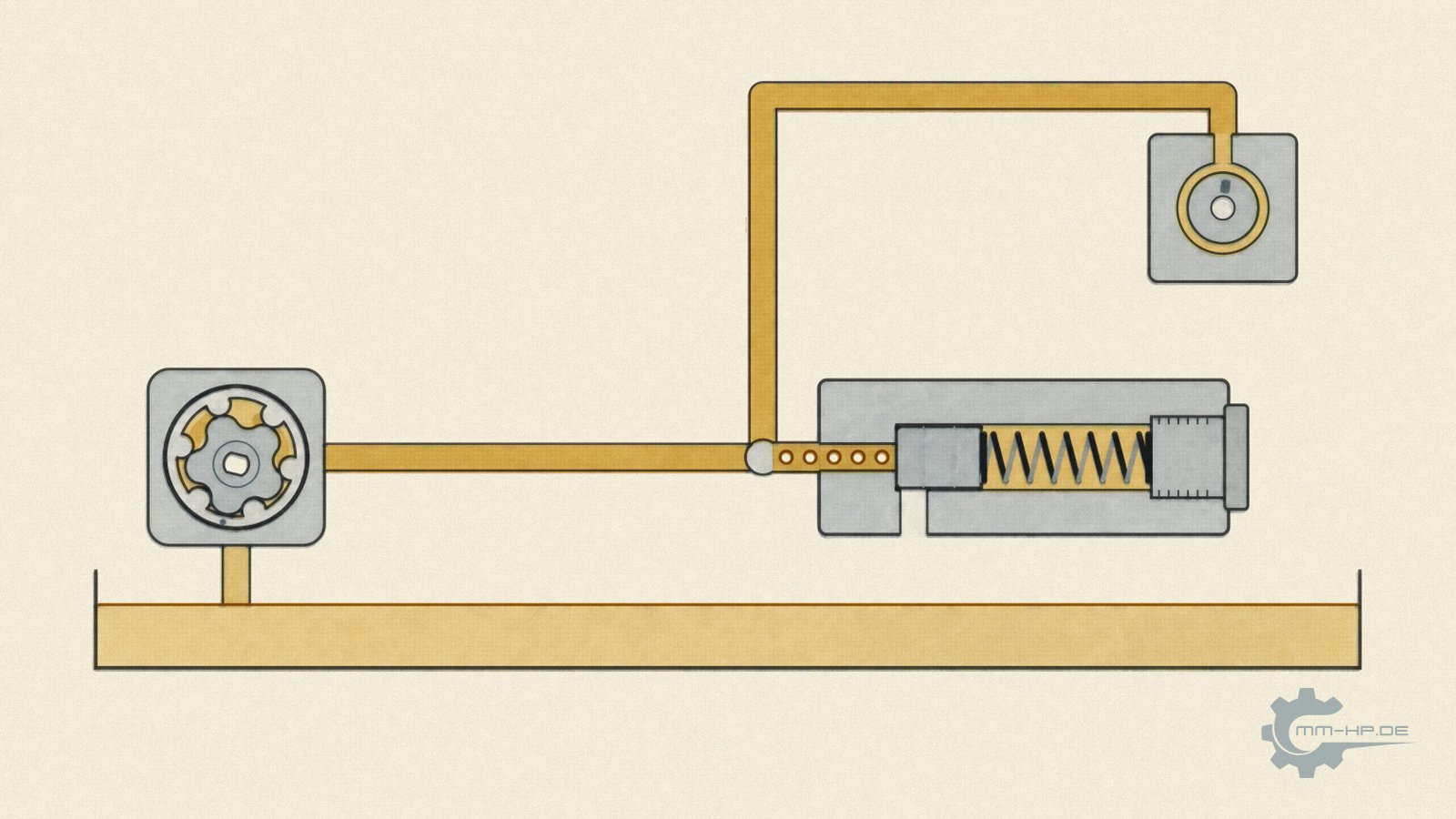
The principle is beautifully simple. A spring-loaded piston sits in the oil circuit, holding a return channel to the oil pan closed. If oil pressure rises above the set threshold, it pushes the piston open against the spring, and the excess flows immediately and directly back into the oil pan. No control unit, no electronics, pure mechanics that acts the instant the pressure arises. The system structurally barely exceeds its threshold, no matter how much the pump could theoretically deliver.
This fundamentally changes the original question. "Can the engine handle the bigger pump?" assumes that more delivery rate arrives at the components as higher pressure. It doesn't. Everything the engine doesn't need at a given engine speed is regulated off above the threshold and returned. The bigger pump only shifts the point at which the valve starts working: it reaches the regulated pressure sooner and holds it across a wider operating range. For the components in the circuit, the maximum pressure looks identical with both pump stages — it's simply the valve's threshold.
What matters is what this threshold is based on. The manufacturer specifies a maximum pressure for the engine, and it isn't arbitrary: other components in the oil circuit are matched to it, above all the hydraulic lifters that compensate valve clearance hydraulically. A permanently higher pressure would push them out of their working range. That's why the valve on our pump is designed so that this factory maximum pressure is not exceeded after the conversion either, with Stage 1 just as with Stage 2. The bigger pump raises the pressure where it's missing, low down. The maximum stays where the manufacturer wants it.
The oil filter housing isn't the bottleneck here. Industry testing practice backs this up impressively: automotive oil filters are endurance-tested to ISO 4548 with pressure pulses up to 35 bar and subjected to burst tests up to 100 bar, against typical operating pressures of just a few bar. The much-discussed plastic filter housing is therefore designed and tested for loads orders of magnitude above anything ever present in the engine. Burst oil filter caps caused by a stronger pump belong in the realm of forum legend.
The electronics question resolves the same way. The oil pressure monitoring on the 2.0 TDI watches for pressure that's too low, because that's the real danger to the engine. An oil pressure that's "too good," below the valve threshold, is simply a healthy engine as far as monitoring is concerned. A state the control unit could flag as excessive pressure is one the pressure relief valve physically cannot allow to occur.
Key point: at the top end, the oil circuit is capped by the pressure relief valve, with any pump. The question is never whether the engine gets "too much." The question is only whether it gets enough at the worst possible moment.
¶ Winter proves it every morning
If the valve explanation feels too theoretical, we can offer proof that has played out millions of times on every car park for decades: the cold start in winter.
Cold oil is thick. At temperatures around freezing, engine oil is many times more viscous than at operating temperature. The pump delivers its fixed volume in proportion to engine speed, but the thick oil barely drains through the tight bearing clearances. The result: pressure shoots up to the threshold already at idle speed, the pressure relief valve opens and regulates it down. Your standard engine runs at full regulated pressure on every cold winter morning, often for minutes, until the oil warms up. With the original pump, from the factory, since its very first winter day.

Standard engine, cold idle in time-lapse: the thick oil pushes the piston against the spring and the surplus runs into the oil pan. As the oil warms up, the valve closes.
Hold onto this thought, because it's the clinching argument: the operating state some fear with the Stage 2 pump — "pump delivers more than the engine can take, valve regulates continuously" — is exactly the state every single standard engine runs in regularly. Not as an exception, but as completely normal winter routine. And far from running unscathed, it's actually the state with the best oil supply the engine ever experiences: full pressure everywhere, the valve routing off the excess in an orderly fashion, exactly what it was designed for.
After the conversion, this job is done by the pressure relief valve on our pump. With cold, thick oil in particular, the pump builds pressure very easily, and that's exactly when the valve opens, releases the surplus immediately and keeps the pressure behind the pump at its level. The stronger pump merely produces this long-proven state across a larger part of the operating range. What the engine copes with every winter during cold running without issue, it also copes with when warm. The valve doesn't distinguish why the pressure sits at the threshold. It simply regulates, just as on every winter morning.
¶ Why half of all engines are worse than average
A logical error crops up repeatedly in customer conversations, usually unspoken: "The standard pump was enough for millions of engines, so a moderate improvement should be enough for mine too." The sentence sounds reasonable and contains two problems at once.
The first problem: the standard pump precisely didn't suffice for everyone. The oil-pressure failure history of this engine family, from the hexagon drive dog in the balancer shaft module to the oil-starvation failures of the CFCA, is the reason our products exist at all and why you're reading this article. The standard design was optimised for packaging and cost, with little margin to spare. Our pumps recover exactly that missing margin.
The second problem is statistical in nature, and it's worth thinking through properly. Every series design targets the population: it has to supply the typical engine under typical conditions. But your engine isn't "the population." It's a single unit with a specific combination of tolerance position, mileage, oil history and usage profile. Purely logically, half of all units sit on the less favourable side of the average, some of them significantly. Whether yours is among them, you can't know, see above. A design that's "sufficient on average" is therefore, for the individual, a coin toss with an unknown weighting.
Add the time dimension: even if your engine sits on the good side today, it drifts continuously toward the bad side over its remaining service life. Bearing clearances grow, surfaces don't smooth back out, the oil circuit becomes more "permeable" with every passing year. The pump you choose today doesn't have to supply today's engine, but the day-after-tomorrow's. A conversion meant to pay off is ultimately built for the next 100,000 or 200,000 kilometres.
Anyone designing the way it's taken for granted everywhere else in mechanical engineering designs for the unfavourable end, not the average. No engineer sizes a crane hook for the average load. Suddenly betting on "it'll probably be about average" when it comes to your own engine's oil supply is a wager where the stake is the engine and the prize would be a small surcharge.
¶ The thermal dividend
The bigger pump pays out a second dividend alongside pressure, one often overlooked: oil temperature. More circulated oil volume means the oil passes through the factory oil cooler more often per minute, and heat is carried away from hot zones more efficiently. From the feedback campaign among our customers with an oil temperature display, we know: after the conversion, oil temperatures run on average 10 to 15 degrees lower, depending on driving profile and ambient temperature.
What this difference means for oil ageing, coking tendency in the piston ring zones, and ultimately for the oil consumption cycle, we've derived in detail in the article More flow rate, cooler oil, including the rule of thumb that oil ageing speed roughly doubles with every 10-degree step. For the stage decision, it's enough to note here: this effect also scales with delivery rate. The bigger pump cools better, and cooler oil stays thick enough for longer to hold pressure. The two benefits reinforce each other.
¶ What Stage 1 delivers and where its limit lies
An article that only knows one direction would be advertising. So, to be clear here: Stage 1 isn't a bad product, and there are customers who deliberately choose it. Our recommendation is still Stage 2, for a simple reason: there are engines on which Stage 1 doesn't bring enough reserve to lift the oil pressure safely out of the danger zone. You can't tell beforehand which ones they are. Stage 2 brings so much reserve that this risk no longer exists. Stage 1 is also a substantial improvement over the standard pump. 35 percent more delivery rate noticeably lifts hot idle out of the most critical range, and for a young engine with low mileage, a complete maintenance history and a gentle usage profile, that's a solid design choice.
What we ask customers to consider: of the four unknown factors from the table above, a good history only defuses the second one, wear condition, and even that only partially. Manufacturing spread, oil condition and future usage profile remain open. Anyone choosing Stage 1 is betting that these three remaining factors turn out favourably for their engine. That can work out, and for many it will. It's just important to understand that you're taking this bet, and that it can't be corrected afterwards without repeating the conversion.
The CFCA remains excluded: for the VW T5 2.0 BiTDI, we don't supply Stage 1. For this engine, the information situation isn't uncertain, it's clear-cut — its failure history speaks plainly, and we've decided not to allow any wishful thinking there. Details in the CFCA article.
And because the question comes up regularly in support: anyone who has already ordered and wants to switch to Stage 2 before shipping can do so at any time, a short message to support is enough. Once installed, as described above, it's only possible via a complete second conversion.
¶ Three engines, three decisions
How this trade-off feels in practice is shown by three typical scenarios from our customer conversations, condensed and anonymised, but each stands for dozens of real cases.
The T5 camper. A family van with twin-turbo CFCA, 180,000 kilometres, spending summer weeks touring southern Europe with a roof tent and bikes. Mountain passes, traffic jams before the border tunnel at 34 degrees, then full load on the motorway. This vehicle spends its life at exactly the operating points that stress the oil circuit hardest, and it also carries the most sensitive engine in the family. Here the stage question doesn't even arise, and we've formally answered it for this engine too: Stage 2 is mandatory. The case is interesting nonetheless, because it shows the pattern in its purest form — a pattern that applies, in weaker form, to every other engine as well.
The high-mileage Passat. 240,000 kilometres, motorway commuter, patchy history because the car came from a third owner. The owner knows neither the previous owners' oil-change discipline nor the engine's tolerance position. Of the four unknown factors from our table, all four are genuinely unknown here. The Stage 2 surcharge, in this case, insures against the entire unknown history, and the high mileage makes it highly likely that hot idle is already a sore point today. This is the classic Stage 2 case, not because something is known about the engine, but precisely because nothing is.
The young used car from a single owner. 95,000 kilometres, full service history at the same dealer, retired previous owner, mostly country roads. Here the information situation is as good as it can possibly be for a used car, and an owner who deliberately chooses Stage 1 is making a defensible decision: the engine is young, the history is documented, the profile is gentle. What we still ask such customers to consider is the time horizon. The conversion should still hold up at 250,000 kilometres, and the engine at that point can't be consulted today. Most customers, after this thought, choose Stage 2 after all, and that's what we recommend here too. Anyone who sticks with Stage 1 isn't making an unreasonable choice in this scenario, but should know that they carry the remaining risk themselves.
If you recognise your own situation in one of these three pictures, you probably already have your answer. For everyone else, the short version follows as a checklist.
¶ Common practical questions before ordering
Three questions come up in support often enough that they belong here.
"Can I still change my order to Stage 2?" Yes, any time up until shipping, a short message is enough. Once installed, as above, it's only possible via a complete second conversion.
"How many litres per hour does the pump deliver?" This figure would be worthless without stating engine speed, oil temperature and back-pressure, which is why we don't quote it as a catalogue value. The percentage figure describes the ratio to the standard pump across the entire speed range and is therefore the more honest metric — the full reasoning is in the oil pump article.
"Is installing Stage 2 really no more work?" Really not. Both stages are installed the same way, there's no additional work step, no special tool and no different instructions. The difference lies exclusively in the component.
¶ Decision aid: four questions for your engine
To wrap up, here it is as a self-check. Answer the four questions honestly; the evaluation follows below.
| # | Question | Favours Stage 1 | Favours Stage 2 |
|---|---|---|---|
| 1 | Do you know the engine's complete history (mileage, oil changes, prior damage)? | Yes, fully documented | No, or only partially |
| 2 | Engine mileage? | Low (young engine) | Medium to high, or unknown |
| 3 | Usage profile: traffic jam and idle share, towing, full load, hot summers? | Mostly relaxed | Mixed, variable or demanding |
| 4 | Engine code CFCA (VW T5 2.0 BiTDI)? | Stage 2 is mandatory, we don't supply Stage 1 |
The evaluation is unspectacular: even a single answer in the right-hand column is a good argument for Stage 2, because exactly one unfavourable unknown is enough to push the leaner design to its limit in everyday use. Anyone who can tick the left column four times still gets a substantial improvement over the standard pump with Stage 1. And for anyone still undecided after these four questions, here's the whole article's recommendation in one sentence: the Stage 2 surcharge is the cheapest insurance you'll ever take out for this engine, and the only one you can only buy before installation.
One last note of our own: exactly how we design the characteristic curves of our pump stages, and against which reference conditions we measure them, we deliberately keep to ourselves. This design data has grown out of years of dyno and field measurements and is part of the core of what sets our products apart from imitators. We ask for your understanding here. What we can make public, you'll find in this knowledge section, and it's considerably more than anyone else writes on this topic. An insight into our metric methodology is given in the article on the VHFI.
¶ See also
- Every engine is a one-off: manufacturing tolerances
- Why we don't promise bar values
- VW T5 2.0 BiTDI (CFCA): the special case
- More flow rate, cooler oil
- Oil consumption in the 2.0 TDI: the blow-by chain reaction
- Oil pressure too low after conversion? The most common causes
Transparency note: we develop and sell the conversion kits described here ourselves. This article sets out the technical reasoning behind our stage recommendation so you can follow and make the decision yourself. The measured values quoted come from our own measurement practice and from customer feedback; the test-standard figures come from the cited industry testing practice (ISO 4548).