¶ Timing Belt in Oil: Affected Engines, Symptoms, Interval
¶ The key points at a glance
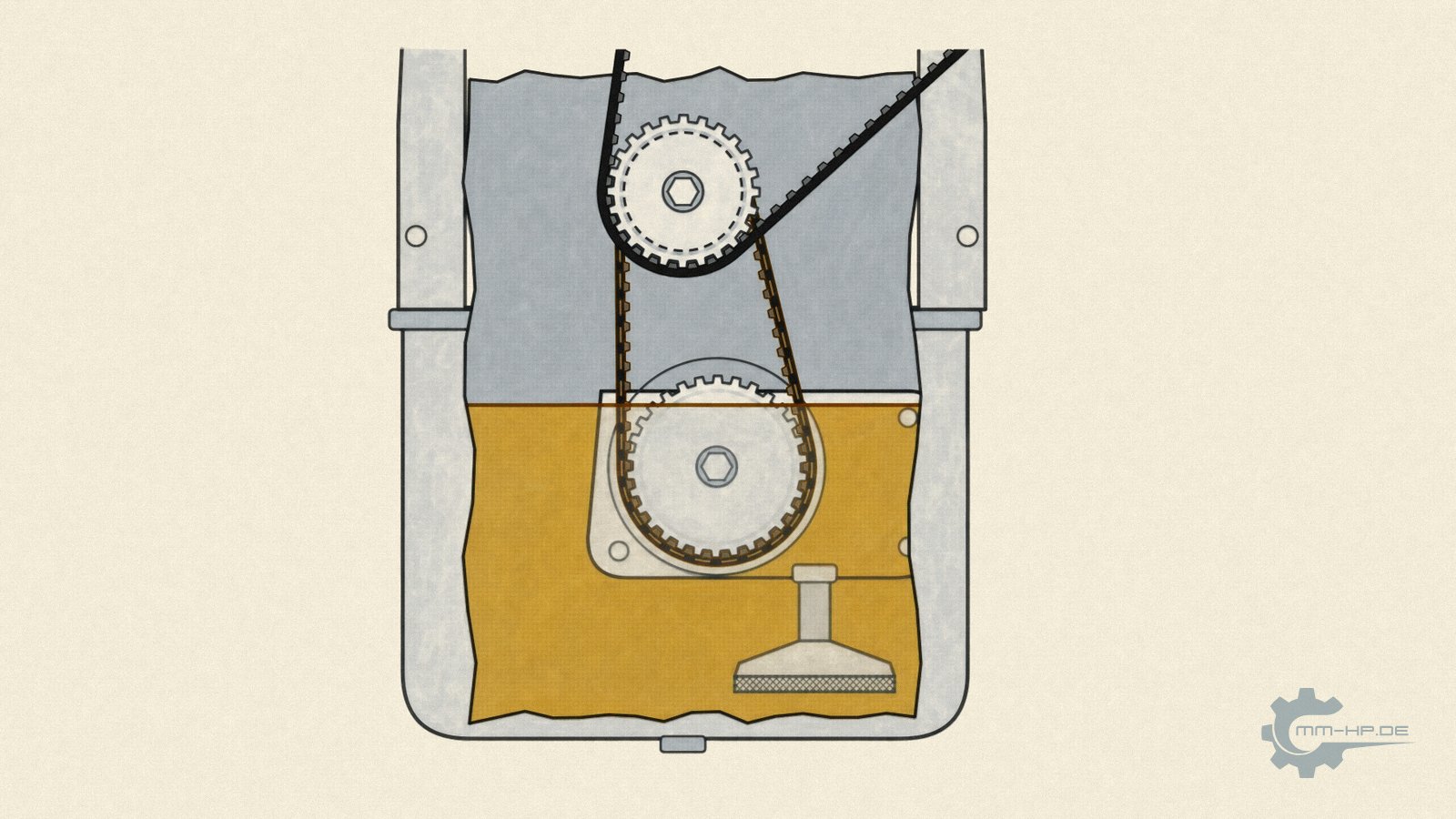
A timing belt in oil, also called a wet belt or oil-bath belt, runs permanently in the engine oil instead of dry behind a cover. In the VW Group it drives the oil pump in three diesel families: the EA189 without a balancer shaft module (1.6 and 2.0 TDI), the EA288 (1.6 and 2.0 TDI) and the EA288 evo (2.0 TDI). The engine codes that belong to them are listed in full in a table further down. Outside VW, Ford's 1.0 EcoBoost and 2.0 EcoBlue, among others, and the 1.2 PureTech from Stellantis have a belt in oil.
The problem is the material. Engine oil attacks the rubber of the belt, and every belt running on two gears sheds debris from the first day. The debris ends up where it does the most harm: at the oil pump's suction strainer, in the pump itself and, as soon as the bypass valve of the oil filter opens, unfiltered throughout the engine.
For a long time you will not notice any of it. Oil pressure stays normal until the strainer is sufficiently clogged, and then it moves fast. On these engines the red oil-pressure warning light is a signal to stop immediately. Before that, the belts only give themselves away when someone looks, at the strainer with the sump removed or as fibres in the used oil.
VW specifies no replacement interval for the oil-pump belt and calls it maintenance-free. A new belt would only reset the clock anyway, because the debris starts again on the first day. Our position is therefore unambiguous: fitting a new belt does not solve the problem, and only a drive without rubber in the oil does, that is, a chain. Ford and Stellantis have meanwhile shortened their belt intervals considerably.
That was the short answer. The long version answers the questions one by one, with all the engine codes, and then follows the debris through the engine once, station by station: from the belt through strainer and pump to the filter valve and the hydraulic tappets.
¶ Which VW engines have a timing belt in oil
In the VW Group, diesel engines are affected, in three families. In all three, the belt in oil drives only the oil pump. The camshafts hang on a second, dry timing belt on the outside of the engine. This two-belt arrangement is the most common source of misunderstanding, more on that shortly.
| Engine family | Displacement | Belt in oil drives | Built (roughly) | How to identify |
|---|---|---|---|---|
| EA189 without balancer shaft module | 1.6 and 2.0 l TDI | oil pump | common-rail generation before the EA288 | engine code (table below) |
| EA288 | 1.6 and 2.0 l TDI | oil pump | from 2012 | engine code, one-piece oil pan |
| EA288 evo | 2.0 l TDI only | oil pump | from 2019 (Golf 8, Octavia 4 and others) | engine code |
VW itself describes the belt in its training material. For the EA288, self-study programme (SSP) 514 says: "The maintenance-free toothed belt runs directly in the oil and is tensioned solely by the centre distance of the belt pulleys." (translated from the German) So this belt has no tensioner. For the EA288 evo, SSP 595 says the oil pump is driven "via a separate, maintenance-free toothed belt from the crankshaft". It is even the same belt, part number 04L 115 264 A, in both generations. The belt manufacturer ContiTech also lists the oil-pump belts of the EA288 and EA288 evo together in its workshop information.
On the EA189 the situation is more tangled, because there are two worlds there. The engines with a balancer shaft module drive their oil pump via the module and have a very different failure pattern, which we describe in the article on the balancer shaft module of the EA189. The engines without a module instead got an oil pump with a timing belt in oil, belt 03L 115 264 A. This article is about those.
On the EA288 evo the oil pump sits differently. According to SSP 595 the oil pan is in two parts there, and the pump "is bolted to the upper part from below", instead of to the cylinder block as on the EA288. This changes nothing about the belt and its problem, because it runs in the oil just the same. From the outside, however, this is not a reliable way to recognise the evo: some first-generation engines also have a multi-part oil pan with the pump still mounted on the block. The engine code is what counts.
¶ Which engine codes are affected
The following lists come from our own engine data, as of 30 September 2026. We keep them to assign replacement and conversion parts, and we check every code individually. For the evo, the assignment rests on the self-study programmes of VW and Audi and on workshop literature. A code that is missing here is not automatically free of a belt in oil. It is simply not in our data.
| Engine family | Engine codes |
|---|---|
| EA189 without balancer shaft module (32) | CAAA, CAAB, CAAC, CAAD, CAAE, CAYA, CAYB, CAYC, CAYD, CAYE, CBDB, CBDC, CDBA, CDCA, CFHB, CFHC, CFHF, CFJA, CFJB, CKTB, CKTC, CKUB, CKUC, CLCA, CLNA, CNEA, CNFA, CNFB, CSLA, CSLB, CSLC, CSNA |
| EA288 (132) | CKFB, CKFC, CLHA, CLHB, CNHA, CNHB, CNHC, CRBB, CRBC, CRBD, CRFA, CRFC, CRGB, CRKA, CRKB, CRLB, CRLC, CRLD, CRMB, CRUA, CRVA, CRVC, CSUA, CSUB, CSUD, CSUE, CUAA, CUNA, CUPA, CUUA, CUUB, CUUD, CUUE, CUUF, CUVA, CUVB, CUVC, CUVD, CUVE, CUWA, CUXA, CVCA, CXEB, CXEC, CXFA, CXGA, CXGB, CXGD, CXHA, CXHB, CXHC, CXMA, CXXA, CXXB, CYKA, CYKB, CYKC, CYLA, CZHA, CZJA, DASA, DASB, DASC, DAUA, DAUB, DAVA, DAWA, DBBA, DBGA, DBGB, DBGC, DBKA, DCXA, DCYA, DCYB, DCZA, DDAA, DDCA, DDCB, DDDA, DDYA, DDYB, DEJA, DEJB, DELA, DESA, DETA, DETB, DEUA, DEUB, DEUC, DFCA, DFEA, DFEB, DFFA, DFGA, DFGB, DFGC, DFHA, DFLA, DFLD, DFMA, DFSA, DFSB, DFSC, DFSD, DFSE, DFSF, DFTA, DFTB, DFTC, DFUA, DFVA, DGCA, DGDA, DGDB, DGMA, DGTA, DGTC, DGTD, DGTE, DJGA, DLTA, DLTC, DLUB, DMZA, DMZB, DNAA, DNAB, DNAC, DNAD, DNAE |
| EA288 evo (29) | DEZB, DEZD, DEZE, DEZF, DFBA, DSRA, DSRB, DSTB, DSUD, DTNA, DTNB, DTPA, DTPB, DTRA, DTRB, DTRC, DTRD, DTRE, DTRF, DTSA, DTSB, DTTA, DTTC, DTUA, DXPA, DXRA, DXRB, DXRC, DXRD |
Three things stand out when going through them. The boundary between EA288 and evo does not follow the alphabet: DEZB and DFBA look like EA288 codes and are evo, whereas DFFA and DFGA belong to the EA288. Anyone sorting by the first letter gets it wrong. Second, mild hybrid is not an identifying feature. There are evo engines without 48-volt technology, for example DTRC, which VW itself lists as an evo. Third, the EA288 list also contains the 1.6-litre engines (among them CLHA, CXXA, DGTA), because the 1.6 TDI exists only as an EA288, not as an evo. In SSP 595, VW states explicitly that the evo is available "exclusively with a 4-cylinder engine and a displacement of 1968 cm³".
¶ Two belts, two worlds: the dry camshaft belt and the wet oil-pump belt
Anyone searching for "EA288 timing belt interval" finds figures like 210,000 kilometres. These apply to the dry timing belt at the front of the engine, which drives the camshafts, the high-pressure pump and the water pump. It has a replacement interval, and it is replaced as a matter of course at every belt change.
The oil-pump belt is a second, small belt. It sits inside the crankcase, behind the sealing flange of the crankshaft, and runs in the oil. Nobody sees it during an ordinary timing belt change, because the oil pan would have to come off for that. So when an invoice says "timing belt replaced", it almost always means the dry belt. It says nothing about the belt in oil.

Schematic. Two toothed belts on the EA288: the timing belt runs dry in front of the engine and has a replacement interval. The oil pump belt runs in oil behind the sealing flange, has no tensioner and is maintenance-free according to VW.
¶ How to find your engine code
The engine code consists of four letters and appears in three places: in the German registration certificate (Zulassungsbescheinigung Teil I), field D.2, on the vehicle data sticker, a label in the service booklet that is usually also found in the spare-wheel well, and stamped into the engine block. Model, year of manufacture and power output are not enough for the assignment, because many models were offered in the same year with engines from two families. When in doubt, the oil pan decides on the EA288 and the evo: one piece or two pieces.
¶ Timing belts in oil outside VW: Ford, Stellantis, Honda
The belt in oil is not a VW peculiarity. In the early 2010s many manufacturers were hunting for every gram of CO2, and a belt in oil runs quieter and with less friction than a chain. The following table lists only engines for which we have reliable evidence, mostly from the manufacturer, an authority or the belt maker.
| Manufacturer | Engine | Belt in oil drives | Period |
|---|---|---|---|
| Ford | 1.0 EcoBoost (three-cylinder, petrol) | camshafts and, with its own belt, the oil pump | from 2012, later versions with a camshaft chain, the oil-pump belt remains |
| Ford | 1.1 Ti-VCT (three-cylinder, petrol) | camshafts | roughly 2012 to 2019 |
| Ford | 2.0 EcoBlue (diesel) | camshafts and oil pump | from 2016 |
| Ford | 1.8 Duratorq TDCi (diesel) | injection pump | from 2008 |
| Stellantis | 1.0/1.2 PureTech, also Opel 1.2 Turbo | camshafts | from 2014, timing chain with the third generation from 2023, some base engines still with a belt |
| Honda | 1.0 VTEC Turbo (Civic) | camshafts and oil pump | from 2017 |
Two rows deserve a second look. The Ford 1.8 TDCi of 2008 is regarded by the supplier Bilstein as the first belt in oil in the industry, and it replaced a chain there. And the 1.0 EcoBoost shows how persistent the principle is: when Ford hung the camshafts back on a chain, the oil pump stayed on the belt. That is exactly the design that is also in the VW diesel.
You often read lists that name further engines, such as the Ford 1.5 EcoBoost, VW's 1.0 and 1.5 TSI or Renault's TCe. For these engines we have found no evidence of a belt in oil. VW's petrol engines of the EA211 family have a dry timing belt. We therefore do not list them.
¶ How to tell a disintegrating oil-bath belt
The honest answer first: mostly not from the way the car drives, until it is too late. A belt that loses material makes no noise, and oil pressure stays normal for a long time. The signs fall into two groups, those you only find if you look, and those that announce themselves.
| Sign | When it shows | What it means |
|---|---|---|
| black fibres or grit in the used oil, on the oil filter or at the magnetic plug | at the oil change, if someone looks | debris is on its way, the belt is losing material |
| coated suction strainer | only with the oil pan removed | the pump is already short of suction area |
| oil-pressure entries in the fault memory, sporadic | when read out, often months before the light | pressure briefly collapses at hot idle |
| rattling or ticking from the valve train | late | hydraulic tappets receive contaminated oil or too little oil |
| yellow or red oil-pressure warning in the cockpit | very late | pressure is below the threshold, stop immediately |
| hard brake pedal, brake booster without assistance | on belt breakage, only on certain designs | the vacuum pump stops as well |
The last row needs an explanation. On the first-generation EA288, the oil pump and the vacuum pump sit in a common housing on one shaft, as VW describes it in SSP 514. If the belt breaks, it is therefore not only the oil pressure that is missing but also the vacuum for the brake booster. On the evo, the vacuum pump is a separate component. Ford started a recall on the 1.0 EcoBoost for the same reason, more on that below.
What can really be checked follows from the table. At every oil change, look at the used oil and the old filter element instead of disposing of them unseen. Have the fault memory read out even when no light is on. And if the oil pan comes off anyway, photograph the strainer. A strainer with fibres is a finding, not a suspicion.
¶ When to replace? Why there is no sensible replacement interval
For the oil-pump belt, VW gives no interval. That is what the self-study programmes say, and both call it "maintenance-free". It is meant as a component for the life of the engine, and no service schedule provides for a workshop to take it in hand.
Other manufacturers have moved away from this thinking. Ford shortened the replacement interval of its 1.0 EcoBoost from 150,000 miles to 100,000 miles or six years, after the US authority NHTSA had counted failures at an average of around 70,000 miles. For the 2.0 EcoBlue, according to reports in the fleet press, the interval is now six years or 160,000 kilometres instead of ten years or 240,000 kilometres. For the PureTech, Stellantis now specifies 100,000 kilometres or six years, as stated in the documents of the belt manufacturer NTN-SNR.
The direction is the same everywhere: shorter. That is the logical consequence when a belt in oil ages earlier than expected. It does not solve the problem, though, and the reason lies in the physics of the debris.
The debris starts on the first day, even with a new belt. Under load, the belt runs over two gears, on the crankshaft and on the oil pump. Where teeth engage in tooth gaps, debris is produced, from the first day of operation. The rubber particles are light, they do not sink to the bottom of the oil pan but hang in the oil and are drawn straight in. Added to that is the chemistry: with every kilometre the oil ages and attacks the rubber more strongly. A new belt resets this clock, it does not stop it.
That leaves three ways, and they can be compared soberly:
| Way | What it achieves | What remains |
|---|---|---|
| do nothing, look after the oil | fresh oil of the right specification slows the chemical ageing | the mechanical debris continues, the condition stays unknown |
| replace the belt | belt and surroundings visible once, old debris can be removed along with it | the debris starts again from scratch, the principle stays the same |
| drive without a belt, that is, a chain | no more rubber in the oil, no chemical ageing, no rubber debris | work on the engine, effort comparable to a belt change |
Our position is the third row. Replacing an oil-bath belt with a new oil-bath belt only postpones the problem. Anyone who opens the engine anyway should not renew the belt but remove it. Why a tensioned chain is the superior traction element at this point, we have derived in the article on the chain tensioner.
¶ An idea that looked brilliant on paper
In the early 2010s, engine developers were under one overriding mandate: CO2 fleet targets. Every tenth of a gram counted, and every source of friction in the engine came under scrutiny. The oil pump drive was one of the things that ended up in the crosshairs. A timing belt runs quieter and with less friction than a chain or gear train, and running it directly inside the crankcase additionally saves space and eliminates deflection pulleys. This is how the timing belt in oil, known in the trade as belt-in-oil, came about. Why a car's camshaft is driven by a chain or a belt at all, and what speaks for the chain, is explained in our overview of the timing chain drive.
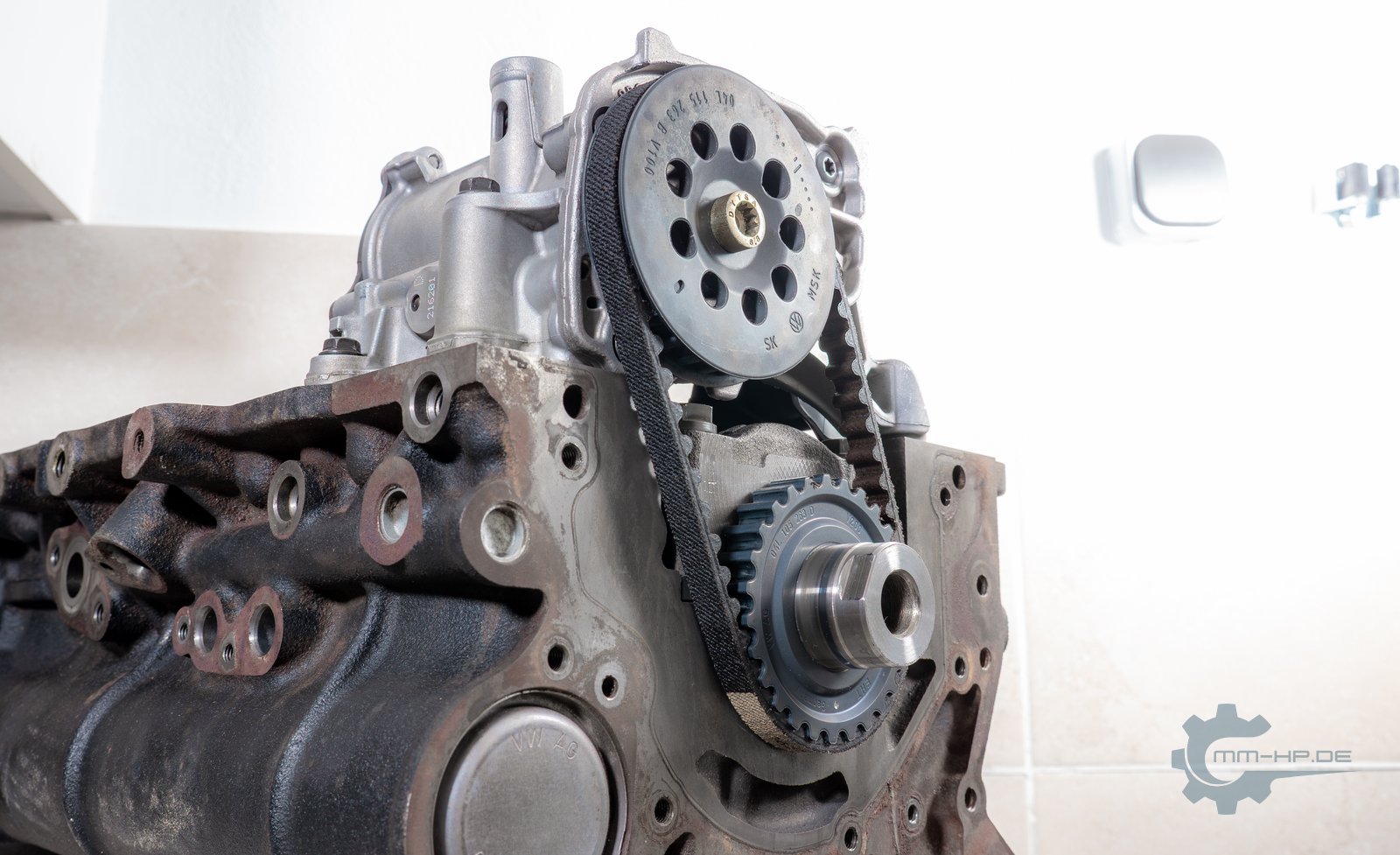
Own photo. Stock condition: the oil pump is driven by a toothed belt that runs permanently in engine oil.
At VW, "only" the oil pump runs on the oil-bath belt. That sounds like the more harmless variant, because a belt failure does not immediately send the valves into the pistons. In fact it is the more insidious one: the belt supplies the one component without which the engine dies within seconds, and it does so invisibly. With the PureTech, in turn, Stellantis switched to a timing chain with the third generation from 2023. When a manufacturer reverses a design principle after nine years, that is a statement that needs no press release.
¶ Why the belt degrades
A timing belt is a composite component: an elastomer body, tension cords made of glass fibre or aramid, a woven fabric coating on the teeth. Specially oil-resistant rubber compounds are used for use in oil, and when new, that works fine. The problem starts over time, and it has an accomplice that hardly anyone accounts for: the oil itself.
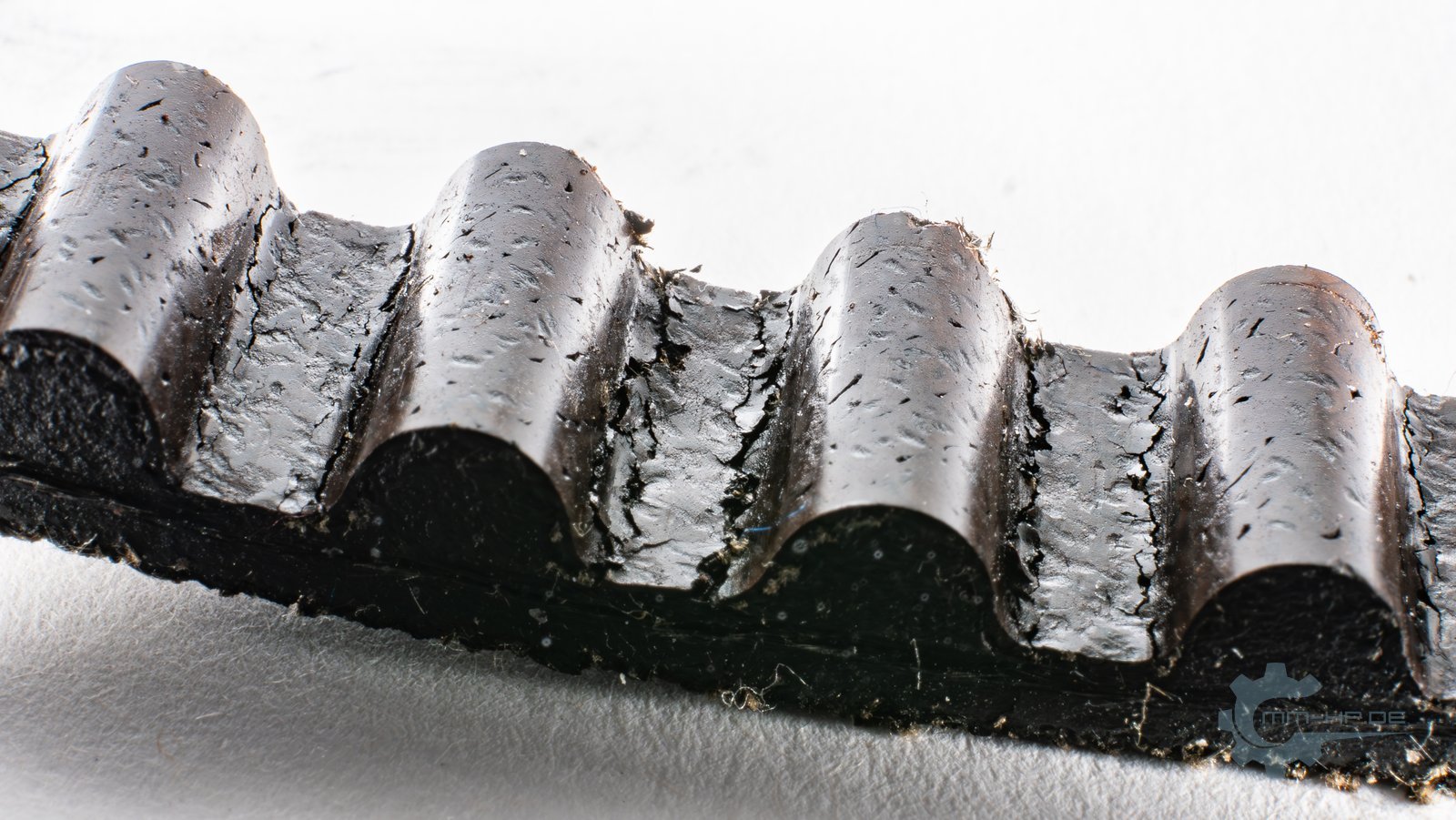
Used part, own photo. The teeth of a run-in belt: the fabric is coming away and the surface is swollen and cracked.
Fresh engine oil contains an additive package that, among other things, buffers acids and slows oxidation. As long as these additives remain intact, the oil is a comparatively benign environment for the belt. With every kilometre driven, the package is used up: acids from combustion, fuel entry, soot entry, and thermal stress consume it. Aged oil becomes chemically more aggressive, and that's exactly when it starts attacking the elastomer. The belt swells, becomes brittle, or loses its coating; teeth can detach from the backing band, and in the final stage the component genuinely frays apart. The technical literature agrees on this point: the greatest enemy of the oil-bath belt is not mileage, but an overextended replacement interval or the wrong oil. On engines with a tensioner, the belt tensioner is also affected, as it operates in the same environment, and its failure additionally endangers the belt.
That describes the first domino. From here on, it's no longer about the belt. From here on, it's about what falls off it.
¶ The Ford case: what happens when it goes wrong
You don't need to derive the chain reaction theoretically — there's a case that's officially documented, and it's worth a close look precisely because it doesn't involve VW. It shows the principle in its purest form.
Ford's 1.0-litre EcoBoost drives the oil pump and, in the first generation, the valve train as well via oil-bath belts. After years in the field, failures accumulated to the point that the US road safety authority NHTSA opened a preliminary investigation in 2025 and widened it in 2026 into an in-depth engineering analysis. According to information from these proceedings, around 135,000 vehicles in the US are affected, namely Fiesta, Focus and EcoSport. NHTSA describes the damage like this: "timing belt material may degrade and create debris that clogs the mesh oil pump pick-up screen, resulting in reduced oil pressure". That matches exactly what this article describes. On top of that, there was already a recall in 2023 (NHTSA 23V-905, Ford 23S64) for EcoSport and Focus, because the tensioner arm of the oil-pump belt can break, resulting in power loss and loss of brake booster assistance.
Two figures from these proceedings should be known to every owner of a belt-in-oil engine. Failures came on average at around 70,000 miles, and 98 percent of them occurred before the original replacement interval of 150,000 miles. That is a component that lasted less than half of the promised service life, and according to the proceedings it did so in engines with documented, regular oil changes as well.
¶ Why you can't inspect it
At this point, a technical topic turns into a psychologically uncomfortable one. For almost everything else on a car, there's a way to check it: brake pads can be measured, tyres can be looked at, a dry timing belt can be inspected by a workshop once the cover is off. The oil-bath belt evades all of that.
It runs fully enclosed in the crankcase, behind the sump. There's no inspection window and no access hatch. Anyone wanting to see it has to open the engine, and that's exactly why nobody does. Even the detour via the oil only helps to a limited extent: fine rubber debris can hardly be distinguished from normal oil ageing with the naked eye, and even a laboratory oil analysis only delivers a snapshot, which at best triggers once degradation is already under way. An incipient belt failure feels like precisely nothing while driving.
Let's note the asymmetry here, because it is the core of the problem: a component whose failure can destroy the engine within seconds is at the same time the component whose condition is the least monitorable. No interval, no visual inspection, no cockpit warning. First, then, we follow the debris on its journey through the engine, because only that journey explains why the consequential damage extends so far beyond the belt itself.
¶ Station 1: the oil strainer, a coarse rake with a side effect
The first station for any particle that ends up in the sump is the oil pump's suction strainer. Anyone picturing a filter here is way off. The strainer is a coarse-mesh metal screen with openings of up to about a millimetre. Its job is to keep the biggest chunks away from the pump while letting through as much oil as possible, because the pump can only generate a small vacuum on its suction side. A finer strainer wouldn't be an improvement — it would simply starve the pump.
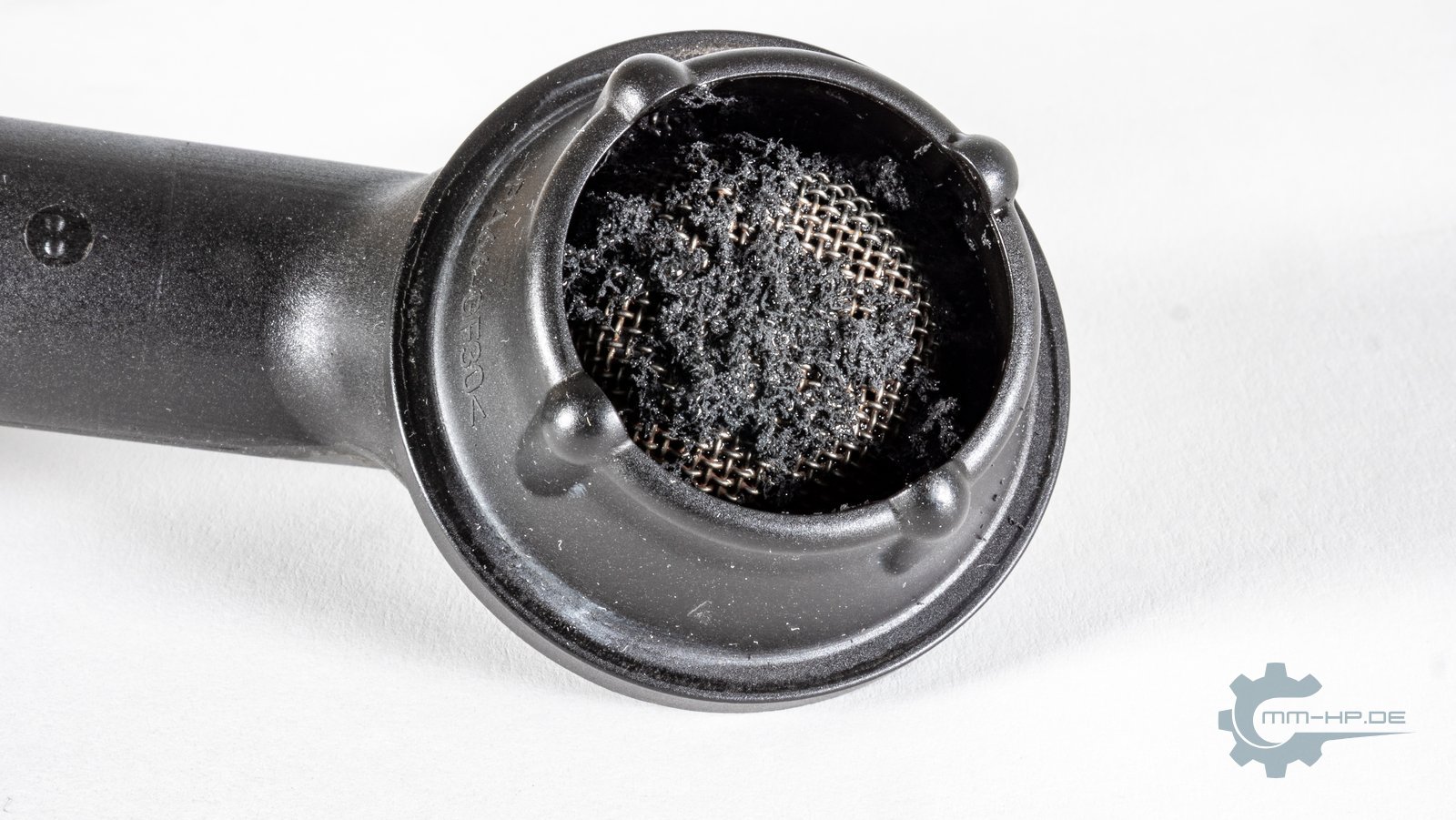
Used part, own photo. An oil strainer covered with toothed-belt debris: every fibre here takes cross-section away from the pump.
Against belt debris, this coarse rake has two weaknesses, and they work in opposite directions.
Large fragments get caught. That sounds good at first, but it's the first trap: teeth, fabric scraps, and pieces of rubber lie on the mesh and reduce the free suction area. The pump has to suck harder, the vacuum increases, and past a certain point the oil on the suction side starts to foam — vapour bubbles form, what engineers call cavitation. The consequences: collapsing oil pressure, noise, material erosion in the pump. This exact mechanism appears in the NHTSA documentation of the Ford case. What's perverse about it is the timeline: a clogging strainer quietly costs reserve capacity for a long time, then tips over quickly. The oil-pressure warning light only comes on once pressure is already below the threshold, and on a belt-in-oil engine, that's not a "check it at the next service" kind of message. Why a pickup bell with a large screen tolerates the same amount of debris much longer than a small tube screen is shown in Oil pan and pickup tube.

Schematic. Every fragment on the strainer takes suction area away from the pump. For a long time nothing shows, then the vacuum reaches its limit: the chambers partly fill with vapour instead of oil, and the oil pressure collapses.
Fine particles pass through. Everything below the millimetre mark passes the strainer unhindered, which leads directly to the second station.
⚠️ WARNING — take the oil-pressure warning light seriously on belt-in-oil engines: If the red oil-pressure warning lights up on an engine with an oil-bath belt, stop as soon as it is safe to do so, switch off the engine and do not restart it until the cause has been found — do not continue driving to the next workshop. A clogged suction strainer can cause oil pressure to collapse completely within a short time, and every extra minute of running turns "clean the sump and strainer" into "replace the engine."
¶ Station 2: the pump, hundredths of a millimetre against rubber grit
The oil pump is the only highly loaded precision component in the engine that sits ahead of the oil filter by design, receiving its oil only coarsely pre-cleaned. Its working clearances — the gear-tooth backlash of the delivery mechanism, for instance — measure a few hundredths of a millimetre, an order of magnitude we derived in detail in the article Understanding the oil pump. Wear research has established that particles the size of the clearance are the most dangerous: they jam between the surfaces and act there like cutting grit.
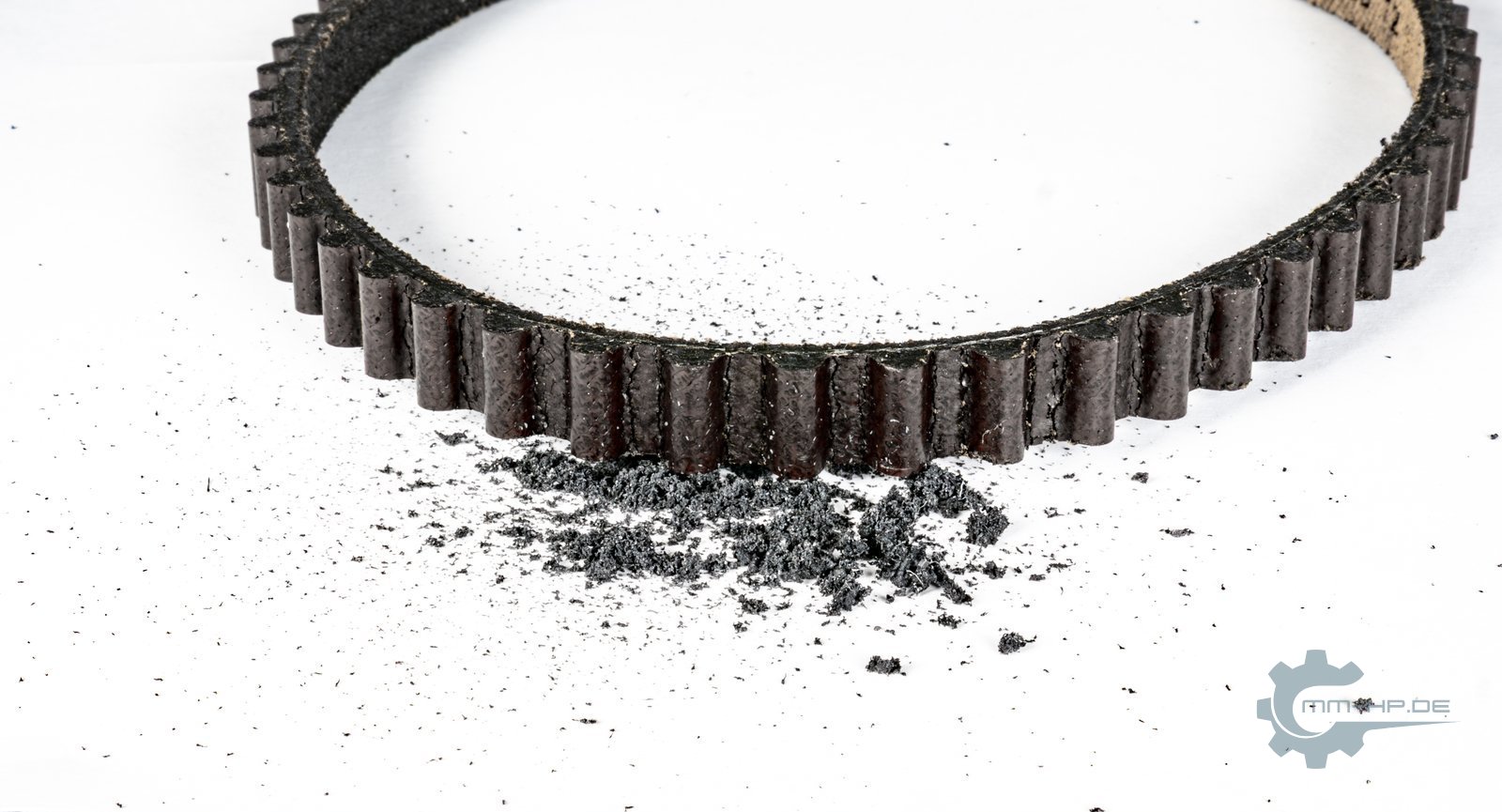
Used part, own photo. What a belt sheds in oil: grit and fibres that travel with the oil through the strainer and pump.
Belt debris is mostly elastomer and therefore softer than metal debris, but it rarely comes alone: the belt's tension cords are made of glass fibre or aramid, the tooth coating of woven fabric, and both, as fine fragments, are quite capable of scoring surfaces and clogging clearances. Any damage to the delivery mechanism increases the pump's internal leakage, and it then genuinely delivers less at the same engine speed. The result is a double hit on oil pressure: the strainer throttles the supply, wear reduces delivery capacity, and both show the same symptom — falling pressure at hot idle, already the system's weakest operating point.
¶ Station 3: the oil filter and its bypass valve
Behind the pump waits the oil filter, and here the story should really end: filter paper catches the debris, done. That it doesn't end there is down to a small valve that hardly any driver knows about, and one of the most misunderstood components in the entire oil circuit: the filter bypass valve.
The oil filter is a flow restriction. So that the engine still gets oil even when this restriction becomes too great, a spring-loaded valve sits in parallel with the filter element, responding not to oil pressure itself but to the pressure difference across the paper. Once that difference exceeds a threshold — depending on design, typically somewhere between about 0.5 and 3 bar, often in the region of 1 to 1.7 bar — the valve opens and lets the oil bypass the filter element, flowing straight into the engine. Unfiltered.
This isn't a design flaw, but a deliberate and correct trade-off: unfiltered oil might cause damage in the long run, but no oil at all destroys the engine immediately. "Better unfiltered than not at all" is entirely sound emergency logic. What matters is understanding when this emergency occurs, because it's far more routine than the word "emergency" suggests:
| Situation | Why the valve opens | How often this happens |
|---|---|---|
| Cold start, especially in winter | thick oil flows too slowly through the filter paper, differential pressure rises | regularly, at every cold start until warmed up |
| Filter clogging (overextended interval, high dirt load) | loaded paper has less free area, differential pressure rises permanently | gradual, more frequent with every kilometre beyond the interval |
| Load-change pressure spikes | brief exceeding of the threshold | sporadic |
And now let's put the stations together, because here lies the bitter punchline of the whole topic. A degrading belt continuously produces debris. This debris loads the oil filter faster than average, differential pressure rises, and the bypass valve opens earlier and more often. In plain terms: the more debris is in circulation in the oil, the more often the filter gets bypassed. The protective system is defeated by exactly the contamination it's meant to guard against, and the debris then circulates unfiltered through the entire engine. On top of that, every cold winter morning the valve is open anyway, giving everything that made it past the strainer a free pass through the circuit.

Schematic. The gauge measures the pressure difference before and after the filter. Above the red mark it pushes the valve disc open against the spring: at a cold start until the oil is warm, and again once debris starts clogging the paper.
¶ Aside: what an oil filter actually filters
Since we're on the subject of the filter, it's worth a short detour to a question that's almost always answered wrong: how fine does an oil filter actually filter? Packaging and forums circulate micron figures like "10 µm," suggesting a sharp cutoff: everything bigger is caught, everything smaller passes through. But that's not how filter paper works.
A depth filter is a tangle of fibres, not a sieve with defined holes. Whether a particle gets caught is a matter of probability, and the filter industry describes this honestly with the so-called beta value: it states what proportion of particles of a given size class is retained. A beta value of 10 at five microns, for example, means 90 percent efficiency — so one in ten five-micron particles gets through. In independent tests, particles as large as 200 microns have occasionally passed a filter nominally advertised as "10 µm." A bare micron figure without a beta value is therefore about as meaningful as a top speed without stating the vehicle.

Schematic. Filter paper does not work like a sieve: whether a particle is caught is a matter of probability. At β = 10, one in ten five-micron particles gets through.
On top of that comes a trade-off that explains why standard filters simply aren't built "finer": a finer medium has more flow resistance, reaches the bypass valve's opening differential pressure sooner, and loads up faster. In extreme cases, an overly fine filter even strips useful additive components out of the oil. Standard design is therefore a balanced compromise between fineness, flow, and service life, and it works as long as the dirt load stays within the calculated range. A degrading belt blows past this range, and that's exactly why a "better filter" doesn't help against the belt-in-oil problem — only avoiding the debris at its source does.
¶ Station 4: hydraulic tappets and the fine passages
Where does unfiltered oil flow? Everywhere, and the components with the smallest internal dimensions react most sensitively.
The hydraulic tappets. Hydraulic valve-clearance compensators are precision elements with internal pistons, tiny oil chambers, and check valves. By design, they're markedly more sensitive to contaminated oil than their mechanical predecessors. The mechanism is well described in the hydraulics literature: high concentrations of fine particles form an abrasive sludge, known in the trade as silt, which erodes mating surfaces, while larger particles block passages and can temporarily jam moving elements. A hydraulic tappet whose compensating function sticks announces itself audibly with clattering and ticking, and through the resulting incorrect valve clearance, drags the camshaft and valve train into liability along with it.

Schematic, clearances greatly enlarged. A single particle in the valve seat is enough: the chamber loses oil on every cam lift, clearance develops and the valvetrain rattles.
The drilled passages. The oil circuit doesn't end at the main bearings. It branches into ever-finer passages: supply bores for the camshaft bearings, channels to chain tensioners and camshaft adjusters, piston-cooling spray jets. The same principle applies to every one of these passages as to the strainer, just an order of magnitude finer: deposits gradually narrow the cross-section, and the supply behind it grows quieter without ever being indicated anywhere. The rule of thumb in bearing engineering states that the most dangerous particles are those the size of the lubricating clearance — for typical plain bearings, an order of magnitude of ten microns and below. Exactly the fraction, then, that passes the millimetre-scale strainer unhindered and also gets past the filter when the bypass valve is open.
And so the chain closes: a piece of ageing rubber in the sump ends up as grinding paste in the engine's finest vessels. No single link in this chain is exotic, each is documented, and taken together they explain why belt-in-oil damage so often doesn't show up in the statistics as "belt failure," but as oil pump failure, bearing failure, turbocharger failure, or a clattering valve train. By then, the culprit has long since frayed apart.
¶ Manufacturers' countermeasures and their limits
The industry has responded to the waves of failures, and the nature of the responses is telling, because it shows how seriously manufacturers take the problem internally.
Material development. Around 2020, Ford changed the EcoBoost's belt material, and suppliers now advertise improved belt-in-oil generations with expected service lives of roughly 240,000 kilometres, explicitly conditional on adherence to oil-change intervals. Whether the revised generations will keep that promise over their full service life is something nobody can seriously answer today — they simply aren't old enough yet. The small print's condition, meanwhile, confirms this article's core mechanism: the oil remains the key.
Shorter intervals. Ford with the 1.0 EcoBoost and 2.0 EcoBlue, Stellantis with the PureTech: all of them have shortened their replacement intervals considerably, with the figures in the chapter on the replacement interval above. A manufacturer that halves a service-life promise is saying what it has seen in the field.
Design retreat. Stellantis switched the PureTech to a timing chain with the third generation from 2023, and Ford hung the camshafts of the 1.0 EcoBoost back on a chain. Both are quiet admissions that the first belt-in-oil generation did not meet its service-life targets in the field. The oil pump, however, stayed on the belt at Ford as it did at VW.
Recalls and service actions. Where it became an official matter, as with Ford's recall 23V-905, it was first of all about the belt's periphery, the tensioner arm. This also fits the pattern from our chain tensioner article: drive systems rarely fail on the traction element alone, and the tensioning and guide system is almost always involved.
For owners of existing vehicles, these advances change little: the belt running in your engine is the one fitted at production, with its material state and its risk profile.
¶ Belt-in-oil when buying used
A word of its own on buying used, because that's where the lack of inspectability is most costly. Anyone buying a vehicle with an oil-bath belt is also buying a component whose condition neither the seller nor a purchase inspection can seriously assess. What can still be checked is the belt's environment, and that tells you a lot:
Oil history is the first-class maintenance document. Complete invoices with the correct oil specification and adhered-to, ideally shortened, intervals matter more with these engines than any showroom-quality detailing. Missing records aren't a minor detail — they're a pricing argument, because they mean an incalculable belt risk.
Diagnostics provide clues. A look at the fault memory and at oil-pressure and DPF data costs little at any workshop and shows whether the oil circuit has already reported anything unusual. Sporadic oil-pressure entries on a belt-in-oil engine are a reason to walk away from the purchase, or to make a belt and strainer inspection a condition of sale.
A look inside the sump as a purchase condition. For vehicles with high mileage or a patchy history, a removed sump is the only genuine way to inspect. Anyone who arranges this as part of an oil change that's due anyway gets to see the strainer and the belt's surroundings, turning the vehicle's biggest invisible risk into a documented finding.
And for anyone who has already bought: the same logic applies in reverse. A cheaply acquired belt-in-oil engine with an unclear history is a candidate for an immediate oil and filter change, short follow-up intervals, and heightened attention to the warning signs described in this article.
¶ What actually helps, and what only feels reassuring
To close, the practical question: what can you do? The honest answer has two parts — one effective, one uncomfortable.
The effective part is the oil. The belt's degradation is driven by aged oil, so fresh, correctly specified oil is the only lever with proven effect. Concretely, that means: stick to the manufacturer-approved oil specification without experiments, err on the side of shorter rather than longer intervals, change earlier if your driving is predominantly short-trip, and consistently replace the filter at every change, since a pre-loaded filter shortens the path to an open bypass valve. This is unspectacular, but it addresses the chemical root of the mechanism.
The uncomfortable part: this doesn't buy you safety. Even the best oil does nothing against the mechanical wear that begins on the first day, and the chapter on the replacement interval above explains why. Anyone having the engine opened anyway should use the opportunity: with the sump removed, the strainer and belt are, for the first time, genuinely visible. After a confirmed belt failure, it also applies that simply cleaning the strainer isn't enough. The debris by then sits throughout the entire circuit, right into the oil cooler and turbocharger, and cleaning just the strainer restarts the chain reaction with the magazine half-loaded.
The root-cause fix: removing the elastomer from the oil. Because the mechanical wear is inherent to the principle, the only complete way out lies in the design, and that's exactly where our conversions start: the timing belt running in the oil is removed entirely and replaced with a reinforced, high-performance chain along with a newly designed oil pump drive, available for the belt-driven EA189 variants as well as for the EA288. Metal instead of elastomer means: no chemical ageing in the oil, no rubber debris in the circuit, and, as a side effect, a pump design with the reserves the standard setup never had. This doesn't just address the article's symptom — it removes its protagonist.
Why are we so confident about how particles travel through the circuit? Because we don't just repair used engines and modules — we systematically disassemble and measure them. The deposit patterns in strainers, pumps, and passages are among the most revealing findings from this work, and some of what we've learned there about particle pathways feeds directly into the design of our products. As so often in this space, we're keeping the details to ourselves, and we ask for your understanding.
¶ See also
- Understanding the oil pump: what it does, where its limits lie, and what it fears
- Oil pan and pickup tube
- The balancer shaft module of the EA189
- The oil-pressure warning light: what it says and what it doesn't
- Why more delivery rate is always the better choice
Transparency note: we develop and sell conversion and reconditioning solutions for the oil supply of TDI engines, including the conversion from oil-pump belt to chain for the EA189 and EA288. The engine codes come from our own engine data, the information on VW from self-study programmes 514 and 595, on Ford from NHTSA documents and trade press, and on Stellantis and the Ford intervals from documents of the belt manufacturers. The findings on particle pathways come from our own teardown practice.