¶ Low Oil Pressure After the Conversion? The Common Causes
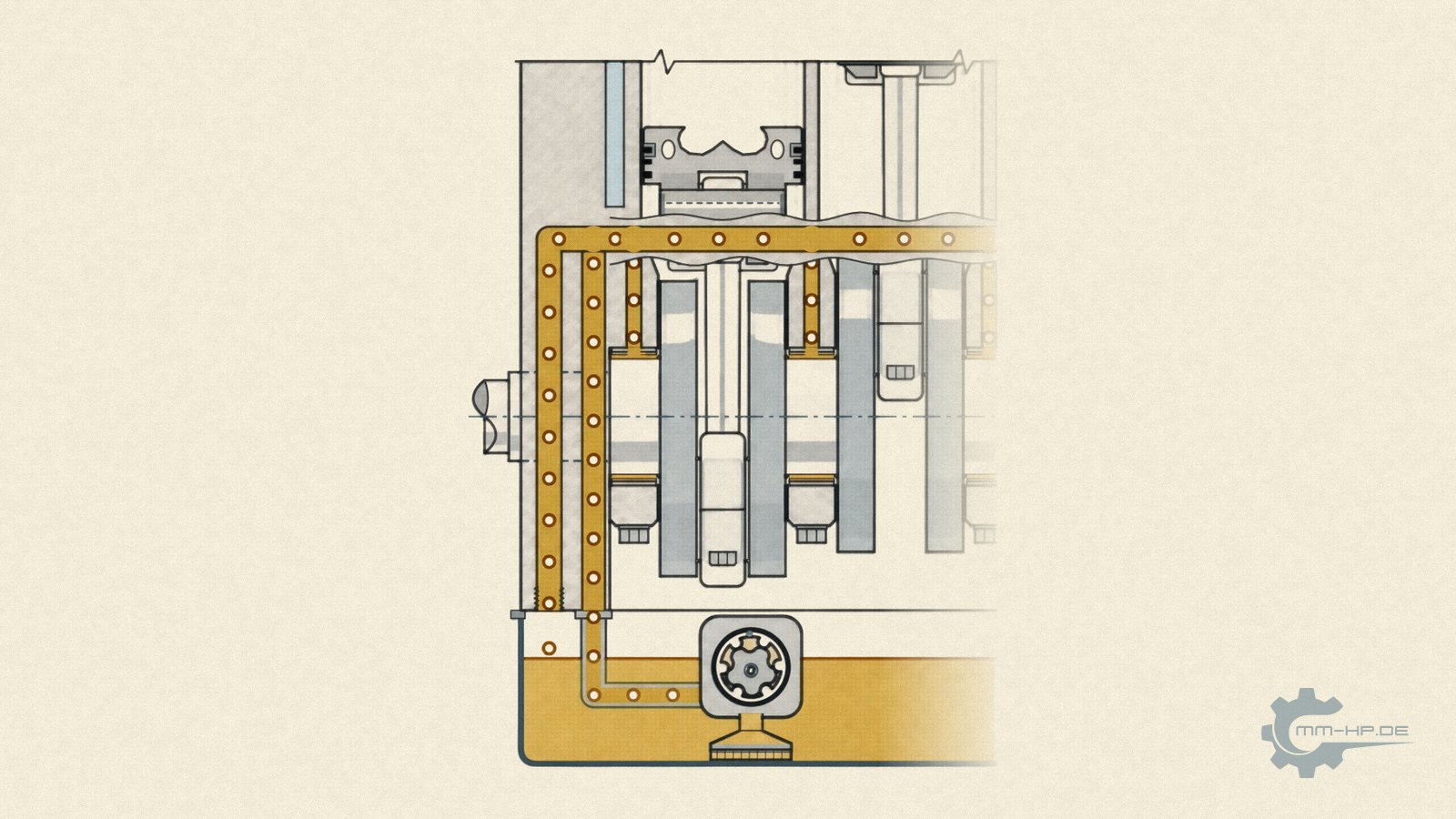
Schematic. The animation is further down in this article.
¶ The key points at a glance
The conversion is finished, the gauge shows less than hoped for, and the first suspicion falls on the new pump. We know this situation well from support, including its almost always identical ending: it was practically never the pump. In our documented case history, the trail leads to the target in this order: first, an oil passage from the module removal that hasn't been sealed, or sealed incorrectly, the built-in leak through which even the best pump delivers into nothing, with a treacherous variant where everything looks correct at a glance. Second, the engine itself, strikingly often units that were recently mechanically overhauled, where the low pressure is a symptom of the overhaul, not of the conversion. Third, the measurement itself, cold oil, an unfavourable measuring point, a sluggish instrument, wrong expectations set by forum figures. And only well behind these, the small things, from the wrong oil level to a faulty sender.
If the warning light is on, one thing comes before everything else: switch off the engine, don't keep driving. After that, work systematically instead of by suspicion: secure the measurement, check the oil level, inspect the sealing positions, and only then look toward the condition of the engine. And if you hand the case to us: with a complete measurement log and clear photos, a large share of these cases can be narrowed down remotely, without a single part being swapped on suspicion.
The long version tells the causes through real, anonymised cases from our support, including the textbook case that fooled everyone for weeks, and provides the check sequence and log that make remote diagnosis actually work.
¶ Before you suspect the pump
It's only human: a part got replaced, then something's off, so it must have been the new part. With oil-pressure reports after conversions, though, this conclusion is nearly always wrong, and we don't say that out of self-interest, we say it from statistics. Our conversion pumps leave the workshop tested, and the cases where an actual pump defect was eventually found can be counted on one hand over the years. What turns up instead fills this chapter, and it's worth knowing the causes in their real order, because every wrong suspicion costs time, money, and in the worst case the engine.
A word of context up front on why low readings after conversions are so confusing in the first place: a conversion completely changes the engine's internal pressure distribution, the value at a single measuring point can rise, stay the same, or even fall without anything being wrong, and comparing it with the before value is methodologically shaky to begin with. A "too low" reading is therefore initially a task to investigate, not a verdict. How to work through it is shown by the four suspects, sorted by likelihood.
¶ Cause one: the built-in leak
When the balancer shaft module is removed, certain oil passages in the block have to be sealed, because they previously supplied the module that's no longer there. If one of these passages is left open, the new pump pushes part of its oil straight back into the sump. The system then has a built-in leak: the pump delivers flawlessly, the circuit still isn't sealed, and the gauge stays in the basement. This is, by a wide margin, the most common real cause in our documented cases.
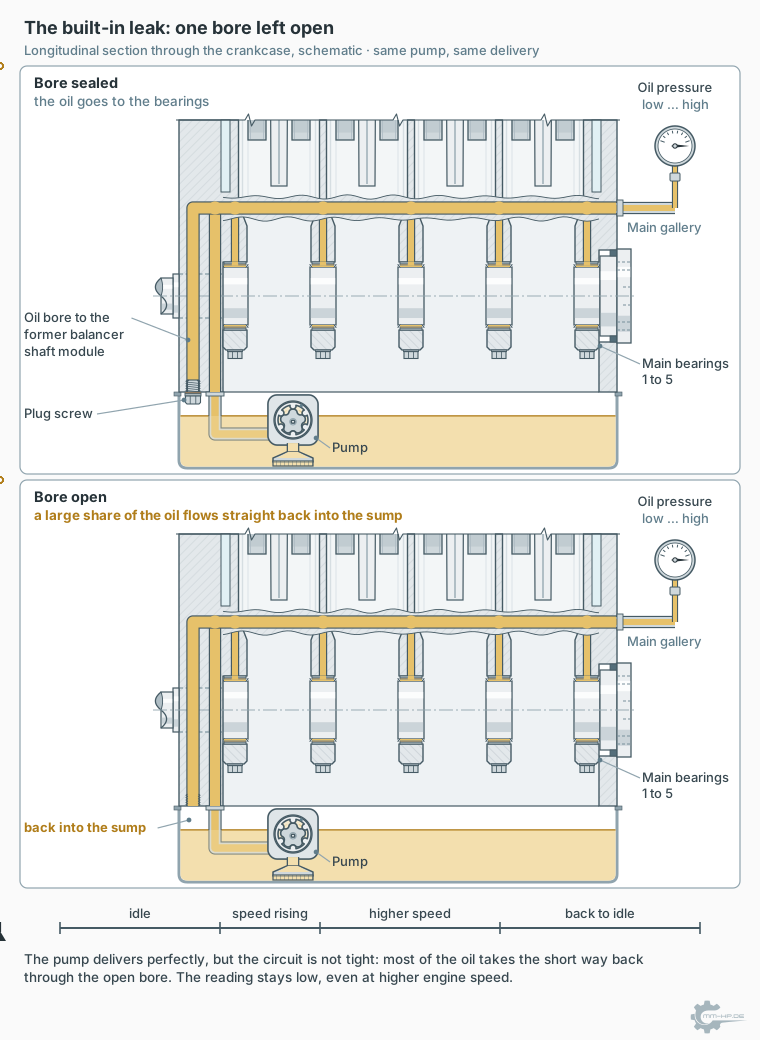
The built-in leak: the pump delivers the same amount in both pictures. With the bore open, most of the oil takes the short way back into the sump, the main bearings get less, and the reading stays low, even at higher engine speed. Schematic; the position of the bore is chosen freely.
How treacherous this can get is shown by our textbook case, told here anonymised because there's more to learn from it than from any checklist. A technically capable customer reported 0.18 bar at warm idle after the conversion, far below any expectation. Weeks of exemplary, well-documented searching followed: series of measurements, swapped instruments, oil changes, photos, all without result, trust in the product and in his own work visibly began to crack. The solution to the riddle finally turned up in a place nobody had thought of: a sealing bolt was screwed in correctly, tight and sealed, just in the WRONG hole, in a mounting thread, while the actual oil passage right next to it stood open. Visually everything looked fine, a plug was there after all. On top of that, it turned out that some of the sealing bolts fitted weren't the intended original parts. After the correction: normal pressure readings, a satisfied customer, and one more standard case in our support playbook.
The lesson for troubleshooting: unfortunately the only way to check is via the opened oil sump, a visual inspection of ALL positions to be sealed, following the instructions, position by position, including the question of whether the plug sits in the right hole and is the right part. Anyone who hesitates at the thought "wasn't there another hole there" is, by experience, usually already onto something.
¶ Cause two: the engine itself, especially after an overhaul
Second place on the frequency list surprised us too, and we now track it systematically enough that we actively collect reports of it: a striking share of low pressure readings after conversions come from engines that were mechanically OVERHAULED shortly before, reconditioned crank assemblies, new bearing shells, sometimes complete rebuilds.
That sounds paradoxical, but it's consistent. After an overhaul, every clearance in the engine has been newly set, and every mistake made in the process acts directly on oil pressure: a bearing clearance set too wide (the cube rule turns this into disproportionate oil outflow), a mismatched bearing-shell size class, an imperfectly seated gasket, an ancillary component with an assembly error. The new pump can partly compensate for a lot of this, that's part of what it's designed for, but it can't deliver indefinitely against a bottomless barrel. A low reading after an overhaul plus a conversion is therefore first a question for the overhaul, not for the pump, however uncomfortable that is for everyone involved. Helpful for telling them apart: if the engine ran with unremarkable pressure BEFORE the conversion and was ONLY converted, that points strongly to cause one. If it was overhauled at the same time, both suspects are in play, and then the oil-sump inspection decides which one gets worked through first.
¶ Cause three: the measurement itself
Before any wrenching happens, the measurement deserves a critical look, because a surprising share of "problem cases" resolve right here. The classics: measured with cold or half-warm oil and compared against an expected value for full operating temperature (or the other way round), measured at a different point than the one the comparison value came from, measured with a sluggish, uncalibrated toolbox gauge, whose tolerances alone can account for half the deviation, and compared against figures from forums produced under unknown conditions on a different one-off engine.
That's why every serious troubleshooting process starts by securing the measurement: engine at full operating temperature, oil temperature noted, measuring point defined and documented, instrument known. Anyone setting the new value against their own measurement from before the conversion should also know that the tolerances of two measurements do not cancel each other out but can add up, to as much as half a bar with the usual test kit. Only once a value taken THIS way still looks abnormal do you have a technical problem rather than just a measurement problem.
¶ Cause four: the small things with a big effect
Behind these follows the group of quickly checked candidates, small in effort, occasionally large in effect:
- Oil level, measured with the wrong yardstick. After the module is removed, the volume in the oil sump changes, the module simply isn't in there anymore. Filling should therefore be done gradually against the dipstick, and specifically against the engine's ORIGINAL dipstick, not against litre figures from tables that still assume the old configuration. A real support case revolved around exactly this confusion.
- Oil condition. Heavily diluted oil (for instance through the regeneration mechanics of modern diesels) lowers pressure system-wide, and has nothing to do with the conversion.
- Sender and switch. A faulty or wrongly rated oil-pressure switch or sender creates phantom problems, what the standard switch can actually tell you is covered here.
- The oil strainer, on engines with a timing-belt history: decomposed belt particles may have coated the strainer, a legacy of the old system that the conversion doesn't automatically remove. We've traced in full how this debris travels through the strainer, pump and filter bypass valve here.
- A recently overhauled engine as the underlying base: on overhauled engines, low oil pressure often has causes that have nothing to do with the conversion, ranging from bearing-shell sizing to old debris in the oil cooler.
¶ The right order, if it happens to you
⚠️ WARNING, active oil-pressure warning. Source of danger: without adequate oil pressure, crankshaft and connecting-rod bearings run dry within seconds. Consequence if ignored: catastrophic engine damage, regardless of how new the conversion is. Action: if the oil-pressure warning is on or flickering, stop as soon as it is safe to do so, switch off the engine and do not restart it until the cause has been found; don't "carefully drive home", have the vehicle towed and inspected instead.
Without an active warning, but with a suspicious reading, this route gets you to the answer fastest:
- Secure the measurement: engine at full operating temperature, oil temperature noted, measuring point documented, instrument known. (Done in half an hour, saves weeks of wrong turns.)
- Check oil level and oil condition: original dipstick, gradual filling, sniff test for diesel.
- Inspect the sealing positions: oil sump off, go through every position against the instructions, right hole, right part, secure fit. This is the step with the highest hit rate.
- Only then look toward the condition of the engine: bearing clearances, overhaul quality, secondary paths, this is where a workshop with engine-rebuild experience is needed.
¶ How we can help fastest
If you hand the case to our support team, the quality of the first message decides how fast the solution comes. What we need is best said in a table:
| Information | Why |
|---|---|
| Measuring point, oil temperature, engine speed, instrument | makes your reading interpretable in the first place |
| Oil grade, fill quantity, filling method (dipstick?) | rules out the classic fill-level issues |
| History: conversion only, or an overhaul too? | sorts between cause one and cause two |
| Photos of the sealing positions (daylight, overview + detail) | enables remote diagnosis of the most common fault |
| Since when, under what conditions it's noticeable | separates constant causes from dynamic ones |
With this package, a large share of cases can be narrowed down remotely, often down to the specific passage, and without a single part being swapped on suspicion. That's exactly the point of this article: that between the first shock of a bad number and the solution there aren't weeks, just one systematic hour.
¶ See also
- Oil pressure isn't just oil pressure: why the measuring position matters
- Why off-the-shelf oil-pressure gauges don't deliver reliable readings
- Why measurements before and after a conversion can't be compared
- The oil-pressure warning light: what it really tells you, and what it doesn't
- Oil consumption in the 2.0 TDI: the blow-by chain reaction
Transparency note: MMHP develops and sells the conversion systems mentioned here. The ranking of causes and the cases described come from our documented, anonymised support records of recent years.