¶ Timing Chain Guide Rails: Why the Plastic Breaks
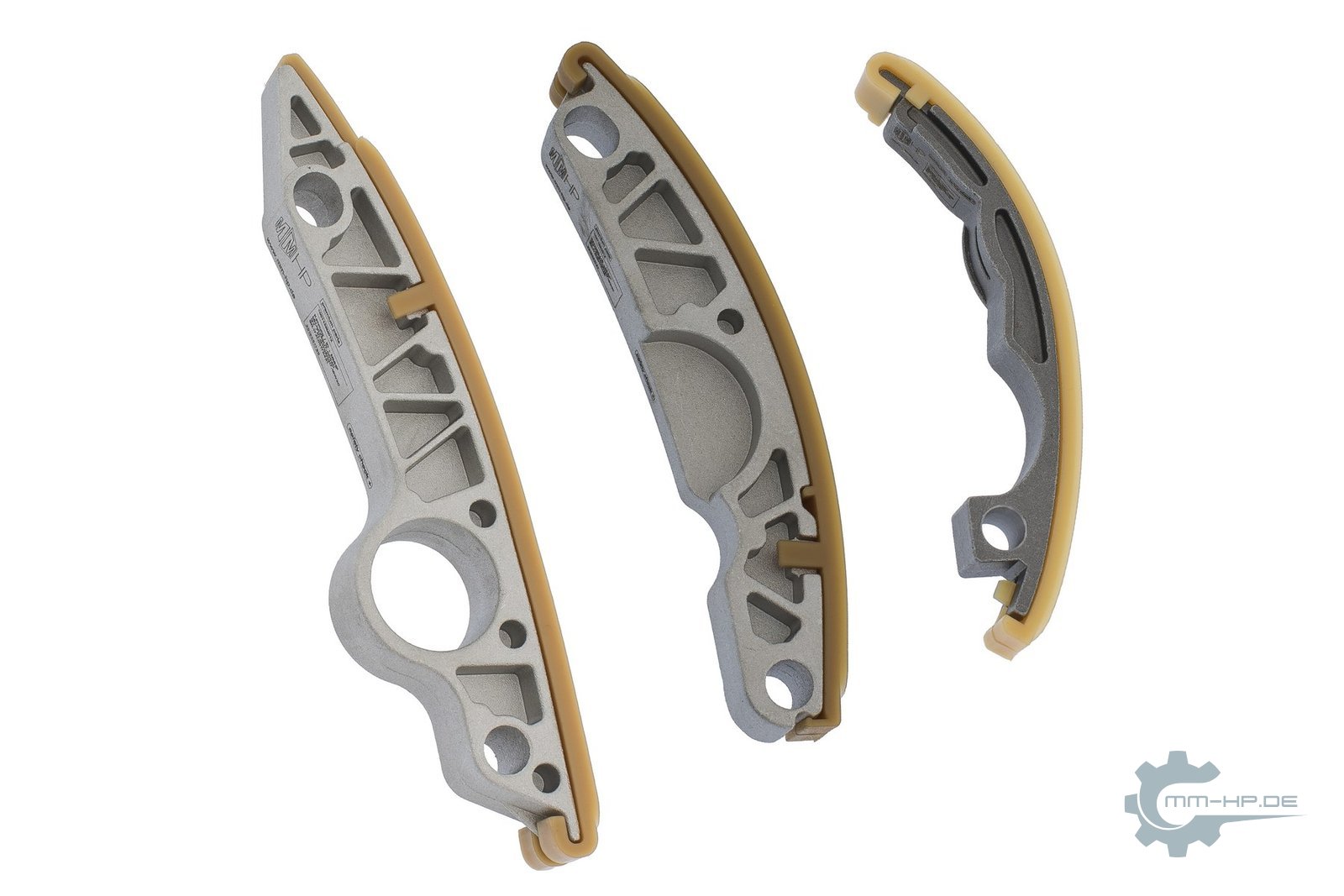
New part, own photo. Guide and tensioner rails from a chain kit. The light lining is the sliding surface for the chain.
¶ The key points at a glance
Guide rails and tensioner rails steer the timing chain and absorb its impacts. They're almost always made of polyamide, usually PA66 or PA46, often as a lining moulded onto a glass-fibre-reinforced carrier. No manufacturer tells the buyer which plastic is actually inside a given rail, neither the original equipment maker nor the aftermarket supplier.
In their patent filings, manufacturers are more forthcoming. Chain maker iwis wrote in 2012 that PA66 is mainly used because it's cheaper, and that it has a continuous service temperature around 30°C lower than PA46. Both plastics remain in series production to this day.
We consider temperature the most important property of a rail, more important than friction and wear. Heat ageing makes polyamide brittle, and that road only runs one way. On the datasheets, PA46 (Stanyl TW341) withstands heat ageing at a higher temperature than the PA66 grades we checked. How hot the oil at the timing chain actually gets in everyday driving, though, has never been cleanly measured anywhere. The figures we found range from 90 to 110°C in the sump up to 150°C as a design limit at full load.
On wear, the sources disagree. Three industry sources put PA46 ahead, one university test puts lubricated PA66 ahead. Machined blue replacement parts made of cast PA6 sit, according to their datasheet, around 40°C below PA46 from the same manufacturer. We don't consider them suitable for the timing drive.
A disintegrating rail is also a risk to the oil supply, because its debris can end up in the oil pump's intake strainer. Anyone replacing a chain kit should replace it complete, oil it before the first start, and check the used oil at the next oil change. Wherever the sources fall short, we say so explicitly in this article.
That was the short answer. Anyone who wants to understand what's really inside these unassuming plastic parts, why they age, and why almost nobody talks about it openly, will find the long version from here: with manufacturer statements, datasheet values, and the points where the sources contradict each other.
Materials referenced in this article
| Short name | Polymer | Type | Manufacturer | |
|---|---|---|---|---|
| ◆ | PA46 | Polyamide 46 | Stanyl TW341 | Envalior (formerly DSM) |
| ● | PA66 | Polyamide 66 | Ultramid A3K, Ultramid A3W | BASF |
| ▲ | Cast PA6 | Polyamide 6, cast | Nylatron MC 901, Nylatron GSM Blue | Mitsubishi Chemical |
| ■ | GF carrier | Polyamide with glass fibre | depends on the rail | mostly unknown |
Where we write "PA46", the statement applies to the plastic in general. Where it applies only to a specific grade, that grade is named alongside it.
¶ Guide rails: a part everyone replaces and nobody knows
Anyone unpacking a timing chain kit finds, alongside the chain, sprockets and tensioner, two or three long, curved plastic parts in their hand. These are the guide and tensioner rails. They steer the chain, damp its slapping, and take up the tensioner's force. If one of them fails, even the best chain is no longer any use.
You'd think a part this important would be well documented. The opposite is true. For this article we searched deliberately, through manufacturers, forums, videos and reference works, and found almost nothing that tells the buyer what their rails are actually made of.
The deepest we found is the workshop brochure "Timing Drive, Technology, Damage Diagnosis" by Schaeffler for the INA brand, so from an original equipment manufacturer. Across 56 pages, it devotes only half a sentence to the rail material: “Belag aus unverstärktem Kunststoff (Polyamide/PA)” ("lining made of unreinforced plastic (polyamides/PA)"). No grade, no manufacturer, no glass-fibre content. The German and English Wikipedia articles name the tensioner rail and guide rail, but no material. And of 23 timing-chain videos, including some with hundreds of thousands of views, whose subtitles we evaluated, not a single one names a plastic type.
So the buyer of a chain kit is buying a black box. They get a brand name, maybe the claim "OE quality", but no information they could actually check against. That's true of branded parts just as much as no-name kits. For the latter, we consider it very risky, because you simply don't know what you're getting.
This article tries to open that black box, as far as publicly available sources allow. We name plastics, grades and manufacturers, we show datasheet values, and at every point we say what's documented, what's our own assessment, and what nobody knows to this day.
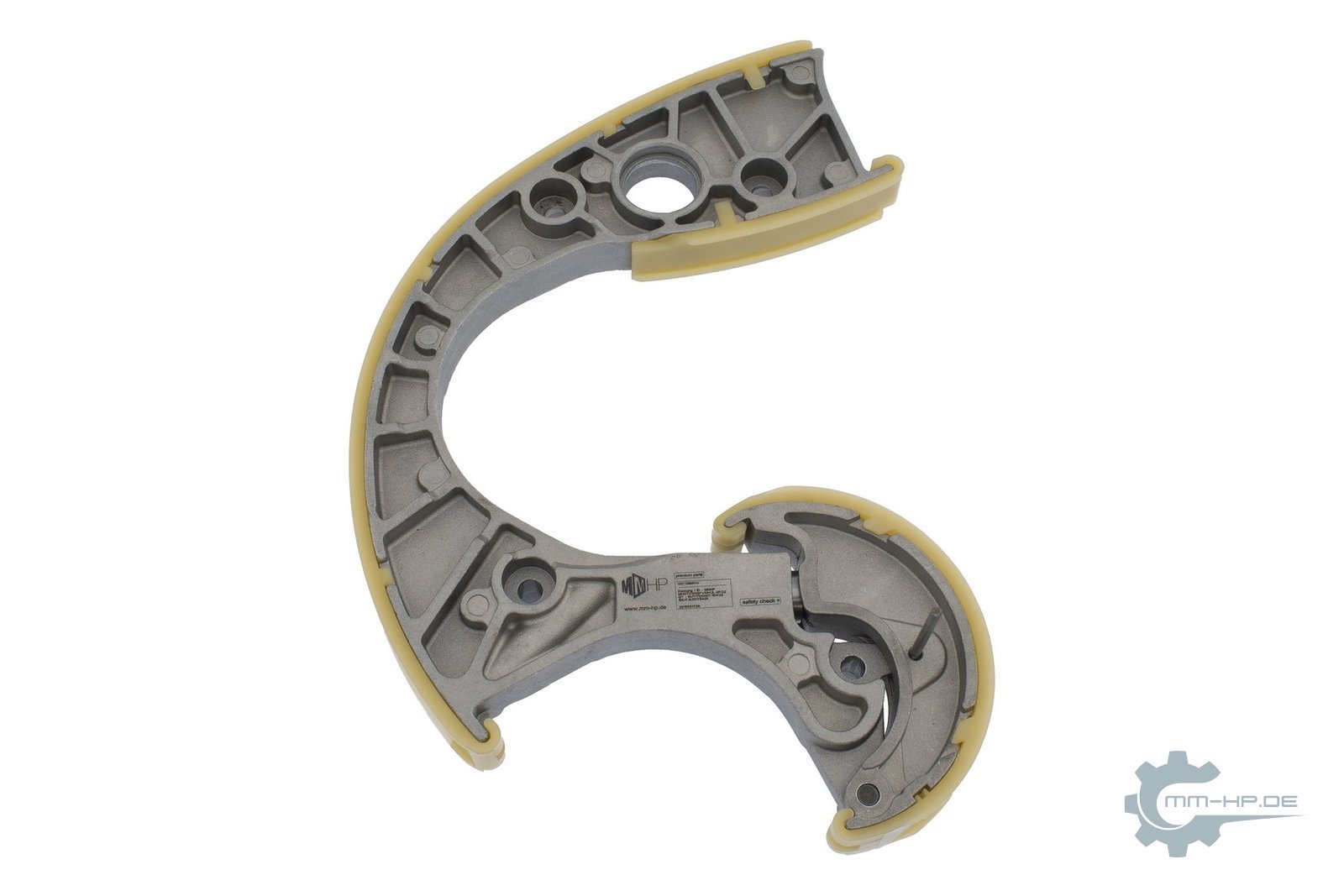
New part, own photo. This is how a tensioner rail is built: a ribbed carrier with a pivot eye, topped with a lighter-coloured lining.
¶ Guide rail and tensioner rail: where they sit and what they have to withstand
A chain only pulls in one direction. The side currently transmitting force from the crankshaft to the camshaft is taut. Schaeffler, in the brochure mentioned above, calls this the “Lasttrum” (tight span). The opposite side, where the chain runs back, is slack, the “Leertrum” (slack span). Rails sit on both sides, but they have different jobs.
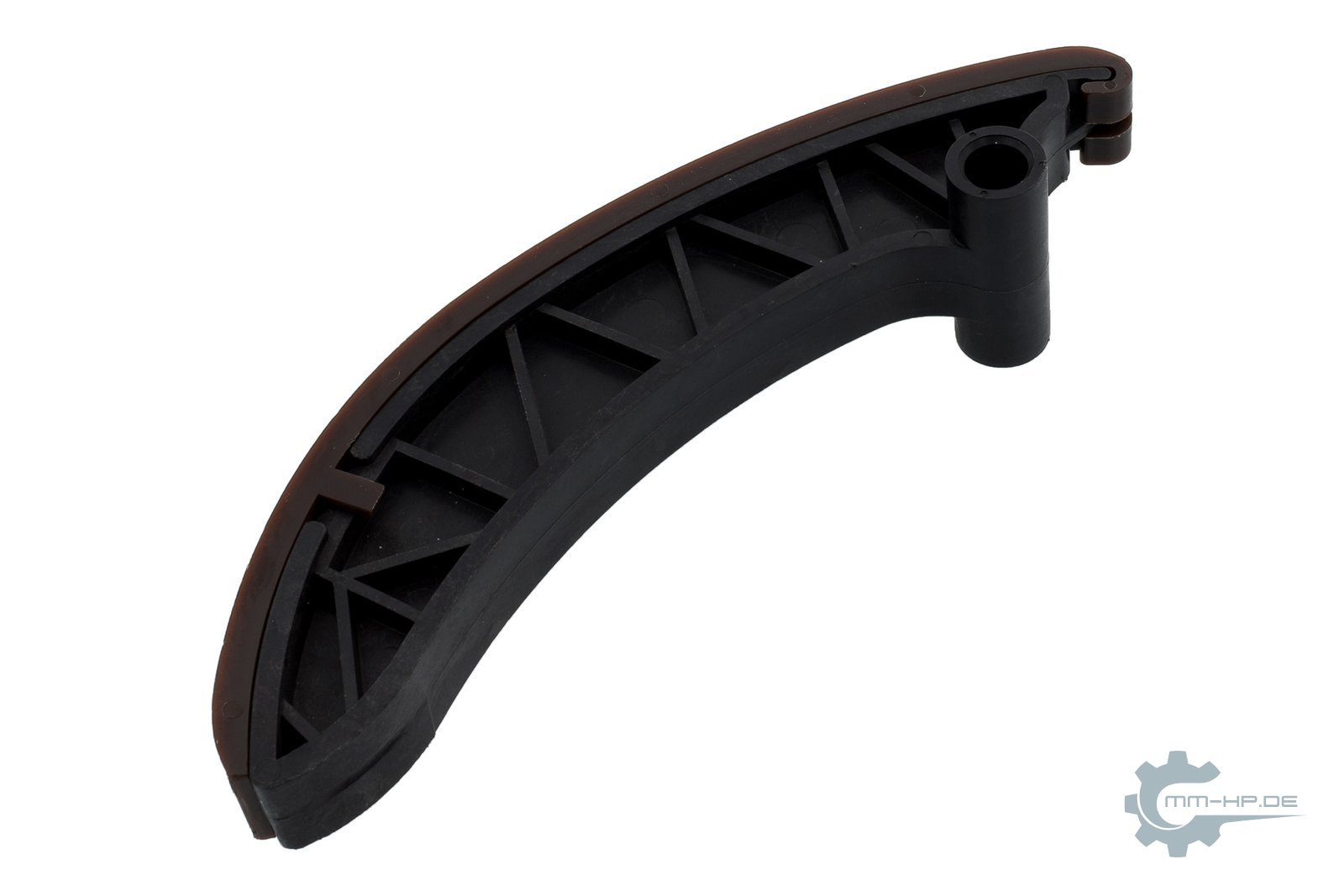
New part, own photo. A tensioner rail: it pivots at the eye, and the tensioner pushes on the other end.
The tight span usually carries a fixed guide rail. It's bolted to the engine and keeps the chain on its path. The tensioner rail sits on the slack span. It's pivoted at one end, and at the other end the chain tensioner pushes against it from behind. The tensioner rail follows every movement of the chain. It absorbs the impact when the chain slaps, and it passes the tensioner's force on to the chain.
The technical book "Kettensteuertriebe" (Chain Timing Drives) by Peter Bauer, published in 2013 with technical input from chain maker iwis, draws a clear conclusion from this: “Im Vergleich zu den Gleitschienen werden Spannschienen in der Regel stärker beansprucht.” ("Compared with guide rails, tensioner rails are generally subjected to greater loads.") They should therefore be designed with more strength, or made from tougher materials.
A second point from the same book matters in practice. Bauer names as a typical failure pattern “Gleitbelag gebrochen am Einlauf der Schiene” ("lining broken at the rail's inlet"). The inlet is the end where the chain first meets the rail. There it's forced from its free path onto the guide, and that's where it strikes first.
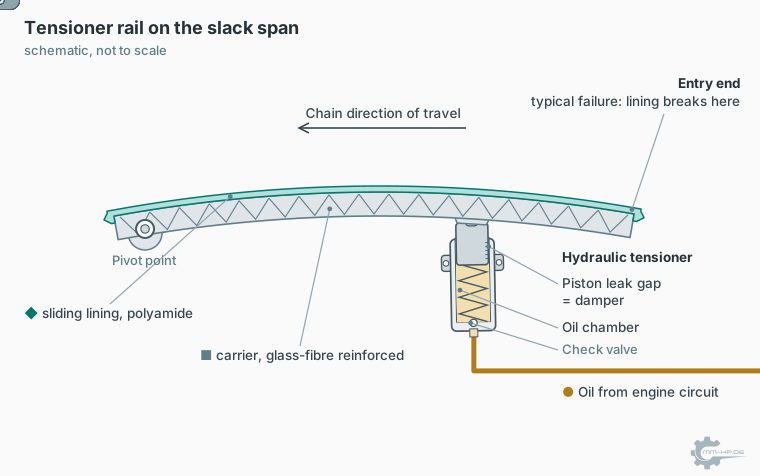
Schematic, not to scale. The chain runs in from the right. At the inlet it meets the rail, and that's typically where the lining breaks.
A modern engine has more than these two rails. Engines with two camshafts per cylinder bank add further chains, plus drives for the oil pump, the high-pressure pump or the balancer shafts. We found no freely accessible source that puts a figure on how much force presses on the plastic at each of these points. What exists is the qualitative statement that the tensioner rail has to withstand more, and that the inlet carries a particularly high load. Nothing more.
Oil isn't distributed equally at every rail either. Audi, in a workshop training document, the Self-Study Programme 327 on its own timing chain drives, describes that on the 6.0-litre W12, the chain tensioner running rails have their own oil spray ports, literally “zur Schmierung und Kühlung” ("for lubrication and cooling"). So the rail isn't just lubricated. It's actively cooled. Why that might matter is shown in the temperature section further below.
The oil pump's chain drive is a world of its own. It transmits less force, and is correspondingly simpler in construction. Bauer writes: “Auf ein hydraulisches Spannelement wird in der Regel verzichtet; zum Einsatz kommen üblicherweise mechanische Spanner mit Federvorspannung.” ("A hydraulic tensioning element is generally dispensed with; mechanical, spring-preloaded tensioners are typically used instead.") Anyone interested in this part of the engine: why our own conversions for the oil pump drive nonetheless never go without a tensioner is explained in our article on the chain tensioner.
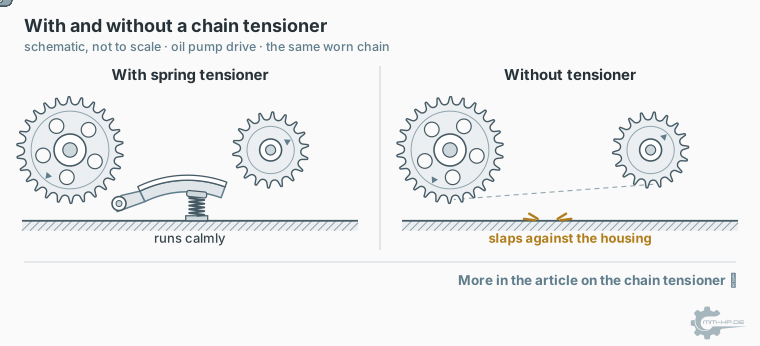
Preview from the article on the chain tensioner: the same elongated chain, once with and once without a tensioner.
➜ Why a chain drive without a tensioner destroys itself
¶ Carrier and lining: two layers, two jobs
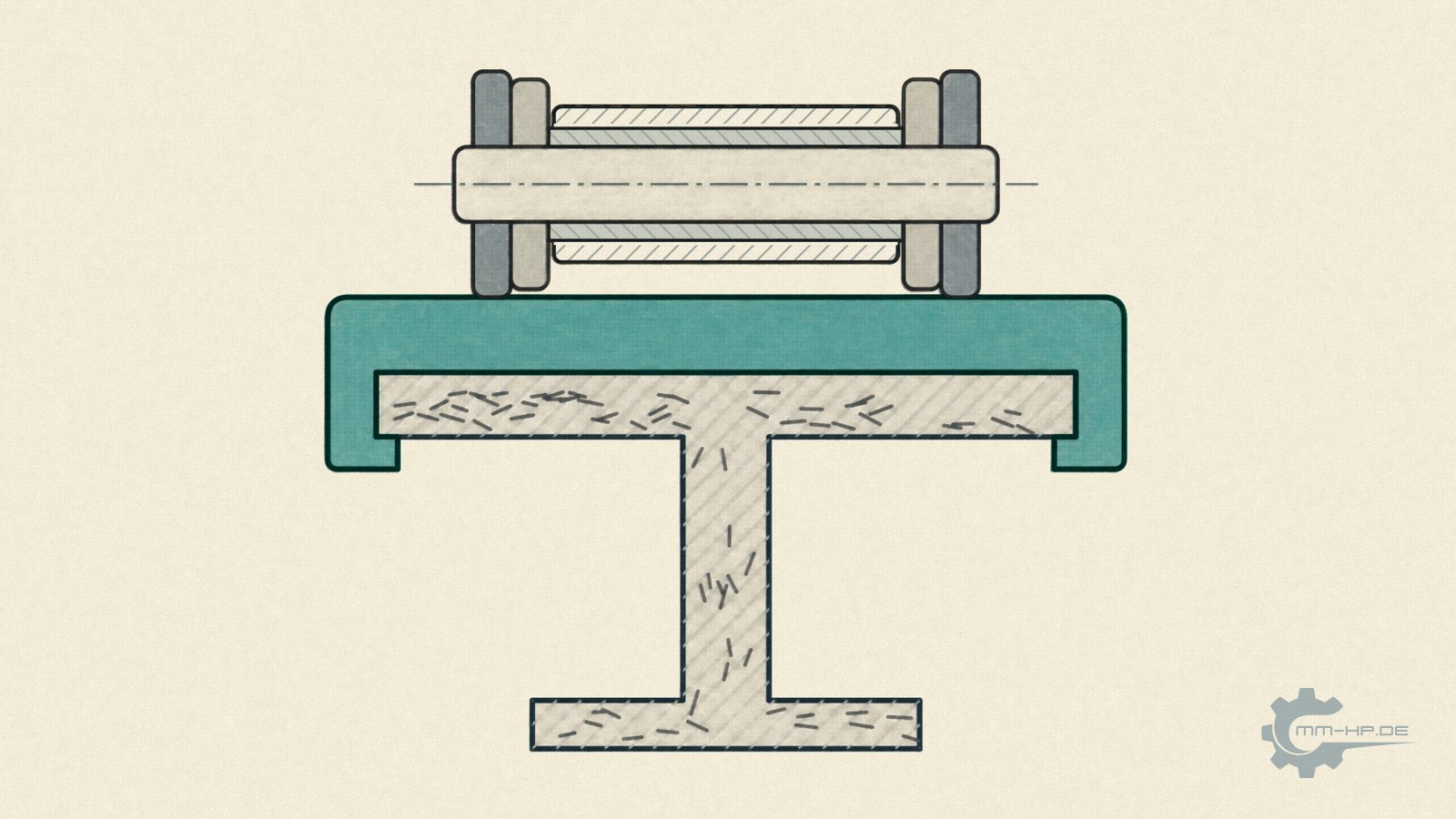
Many rails are made of two plastics that you can't tell apart at first glance. Underneath sits the carrier, on top the lining. The carrier is the load-bearing skeleton, often with ribs and a pivot eye. The lining is the thinner layer the chain actually runs on.
The idea is old, and it's well documented in patents. Chain maker Joh. Winklhofer & Söhne, today iwis, filed a rail in 1997 whose carrier is “aus gefülltem oder verstärktem, insbesondere faserverstärktem, Kunststoff” ("made of filled or reinforced, in particular fibre-reinforced, plastic") and whose lining is “aus ungefülltem Kunststoff mit guten Gleit- und Dauerfestigkeitseigenschaften” ("made of unfilled plastic with good sliding and fatigue properties") (EP 0 790 436 B1). The same year, Porsche described a carrier “aus hochbelastbarem Polyamid mit Faserzusätzen” ("made of high-strength polyamide with fibre additives") with linings “aus Polyamid ohne Faserzusätze” ("made of polyamide without fibre additives") (DE 197 19 732 C1). Japanese chain maker Tsubakimoto followed in 2004 with a rail made of a PA66 core and a PA66 running layer (US 7,326,138 B2).
The reason for the split is obvious. Glass fibre makes a plastic stiff and strong, which is what the carrier needs. On the running surface, though, hard glass fibres would act as an abrasive on the chain. A 1998 patent goes further still, claiming that glass-fibre particles released from the rail would damage the engine bearings in the oil (US 6,013,000). That's the claim of a patent applicant who wanted to sell an alternative, no more than that. But the basic rule runs through every source: reinforcement belongs in the carrier, the running layer stays unreinforced.
How does the lining stay attached to the carrier? Not by bonding. Bauer describes that, in the more elaborate design, the lining is injection-moulded onto the polyamide carrier, and warns: “Da es beim Aufspritzen zu keiner molekularen Verbindung der Kunststoffe kommt, muss sichergestellt werden, dass ein geeigneter Formschluss zwischen Gleitbelag und Träger vorhanden ist.” ("Because injection moulding the lining onto the carrier creates no molecular bond between the plastics, a suitable form fit between lining and carrier must be ensured.") So the lining holds on through its shape, through undercuts and retaining lugs, not through adhesion. There are also rails with an aluminium die-cast or sheet-steel carrier, onto which the polyamide lining is clipped. This detail becomes important again in the chapter on cold and heat.
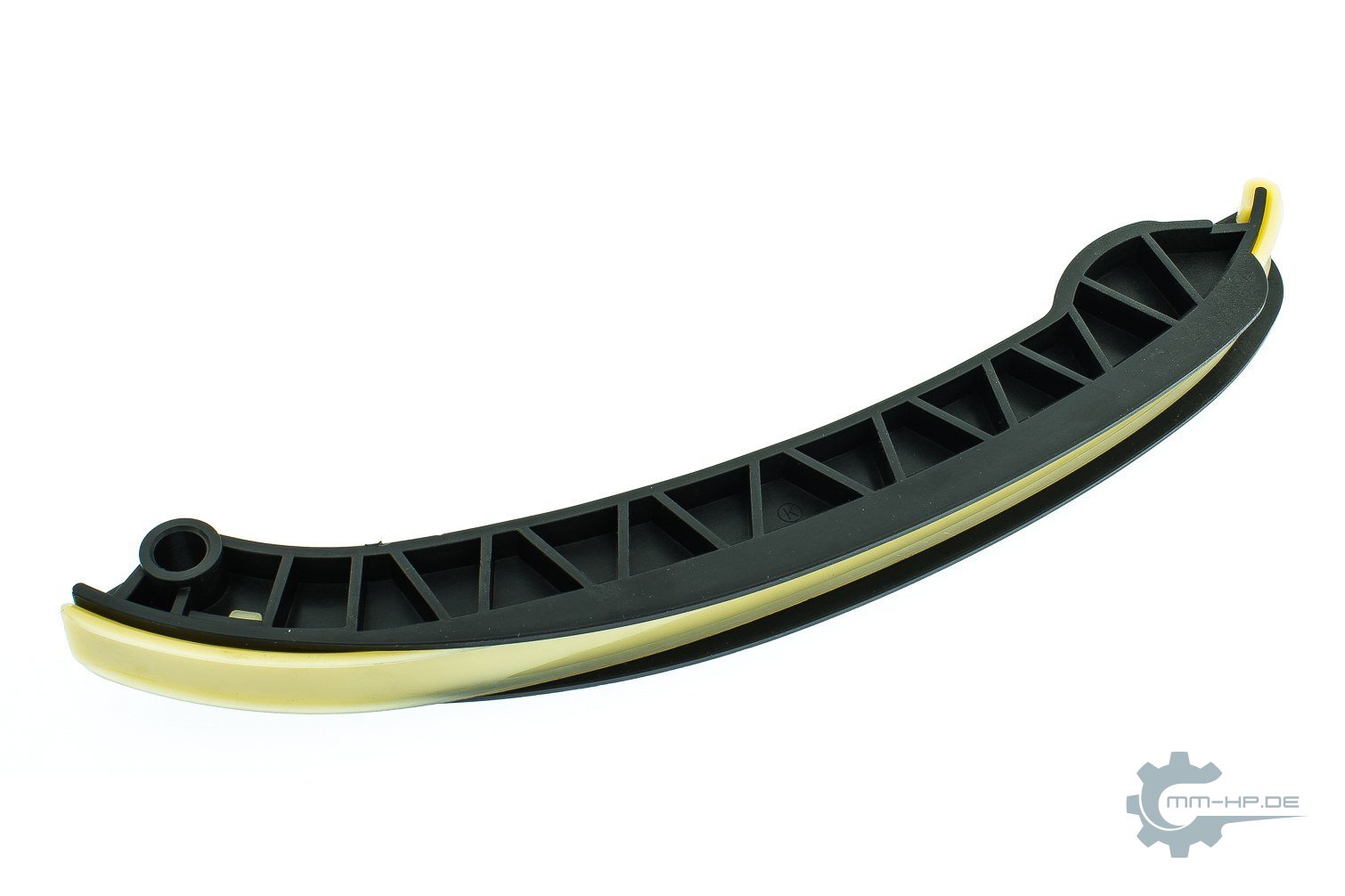
New part, own photo. The light lining wraps around the black carrier at the edge. That's how it holds, through its shape, not through bonding.
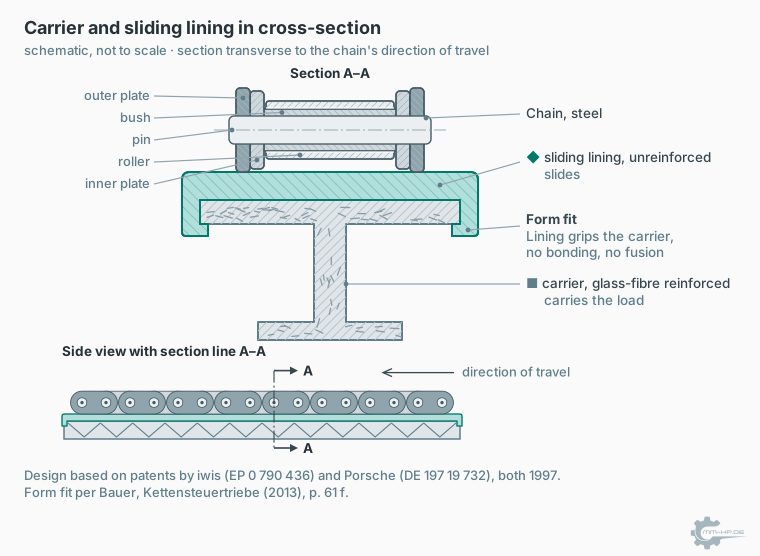
Schematic. The carrier bears the load, the unreinforced lining slides and holds through its shape.
¶ PA66 or PA46: what the industry itself says
For the lining, two plastics are mainly used in production, both from the polyamide family: PA66 and PA46. The numbers in the name describe the chemical structure, but for practical purposes something else counts. PA46 has the higher melting point and tolerates more heat. PA66 is the more common and cheaper plastic.
Which one is used in a given production run is not something manufacturers tell the buyer. In their patents, they're more forthcoming. The clearest passage comes from iwis itself, in a utility patent from 2012 (DE 20 2012 011 592 U1):
“Als Werkstoff für die Führungsschiene 19 und/oder Spannschiene 20 kommen vor allem Polyamide zum Einsatz. Hauptsächlich wird PA66 verwendet. Dieser Kunststoff ist zwar kostengünstiger als PA46, weist aber eine um ca. 30°C niedrigere Dauergebrauchstemperatur von 120°C auf.”
("The materials mainly used for guide rail 19 and/or tensioner rail 20 are polyamides. PA66 is mainly used. Although less expensive than PA46, this plastic has a continuous service temperature of 120°C, around 30°C lower.")
In three sentences, an original equipment manufacturer answers three questions. PA66 is the standard. The reason is price. And the price for that is a continuous service temperature around 30°C lower. This figure comes with no stated test conditions, so we quote it as iwis's own statement rather than as a measured value. But it comes from a company that ought to know.
Other filings confirm that both plastics represent the state of the art side by side. A further iwis utility patent from the same year names as standard materials “PA66 unverstärkt und PA46 unverstärkt” ("unreinforced PA66 and unreinforced PA46") and gives as examples a PA66 grade from DuPont and the PA46 grade Stanyl TW341 from DSM (DE 20 2012 007 568 U1). BorgWarner, in 2017, lists PA66, PA46 and both with PTFE for the running surface (US 2018/0195583 A1). And a doctoral thesis, written in 2022 at the University of Hanover in cooperation with Mercedes-Benz, names PA66 for the chain guide rail.
So we were unable to substantiate the common narrative of "PA66 in the past, PA46 today". Both are used, to this day. Which plastic is actually in a given production rail, no manufacturer reveals. That can only be determined in a lab.
PA46 is not just PA46, and PA66 is not just PA66. Within each family there are grades that differ significantly. The table below shows the materials that appear in this article.
| Material | Manufacturer | What the datasheet says about it |
|---|---|---|
| ◆ Stanyl TW341 | Envalior | PA46, unreinforced, “Heat Stabilized, Lubricated”, i.e. heat-stabilised and containing a lubricant. According to DSM 2016, “the current industry standard for engine components” |
| ◆ Stanyl HGR3-W | Envalior | PA46, heat-stabilised, tuned for wear and friction, PFAS-free, listed for timing drives |
| ● Ultramid A3K | BASF | PA66, “An easy flowing injection moulding grade”, the standard grade |
| ● Ultramid A3W | BASF | PA66, “heat aging resistant”, i.e. stabilised against heat ageing |
| ▲ Nylatron MC 901 | Mitsubishi Chemical | cast PA6, blue, sold as machining stock |
| ▲ Nylatron GSM Blue | Mitsubishi Chemical | cast PA6 with molybdenum disulphide and oil, blue, sold as machining stock |
Two things stand out in this table. First, every serious grade carries some additive relating to heat. The base plastic alone apparently isn't enough, what matters is the stabilisation, meaning additives that protect the material against ageing. Second, PA46 has recently stopped being a single-supplier material. For a long time Envalior, formerly DSM, was considered the sole manufacturer. In April 2026 the Chinese company Shenzhen Wote introduced its own, bio-based PA46 and markets it explicitly for chain tensioners. No carmaker approvals for it are known so far. For the buyer, that means: even if a part were marked "PA46", they still wouldn't know which one.
¶ Temperature: why we consider it more important than anything else
You can judge a rail material by many properties: friction, wear, toughness, price. We consider one more important than all the others, and this is our own weighting, not the sources': how long the plastic can withstand a high temperature without ageing.
The reason is simple. Friction and wear can be shifted in either direction with lubricants, surface finishes and good oil, and the measurements on this contradict each other, as we show further below. Heat ageing, by contrast, is a one-way street. A plastic that permanently runs too hot becomes brittle, no matter how well it slides. And a brittle part breaks when the chain slaps against it on a cold morning.
¶ Temperature index: the yardstick for heat ageing
How heat-resistant a plastic is over the long term is measured by manufacturers to the IEC 60216 standard. They store samples for extended periods at various temperatures and check when tensile strength has dropped to a defined residual value, at BASF that's half. The result is a temperature, the temperature index: at this temperature, the plastic has reached that residual value after the stated time, roughly 20,000 hours. So a higher index means: you have to go hotter to age the plastic to the same degree in the same time.
The values from the datasheets we read ourselves:
| Grade | after 5,000 h | after 20,000 h | Source |
|---|---|---|---|
| ● Ultramid A3K, PA66 | 118°C | 101°C | BASF, datasheet 02/2026 |
| ● Ultramid A3W, PA66 heat-stabilised | 118°C | 92°C | BASF, datasheet 04/2018 |
| ● Ultramid A3W, PA66 heat-stabilised | 147°C | 121°C | BASF, datasheet 07/2015 |
| ◆ Stanyl TW341, PA46 | 152°C | 130°C | Envalior, datasheet |
Three things are worth knowing before drawing conclusions from this. The values are measured in air, not in engine oil. The standard allows different endpoints, and Envalior's datasheet doesn't state its own. So BASF and Envalior are only comparable in direction, not to the degree. And the same BASF grade A3W appears in two datasheet revisions with quite different values. Anyone arguing from a single figure should always state the grade, the datasheet revision and the test standard.
The direction is nonetheless unambiguous. Stanyl TW341 withstands heat ageing at a higher temperature than any PA66 grade in this table. That fits iwis's statement about the roughly 30°C, and it fits what workshops observe on old rails: they go hard and break.
¶ Heat deflection temperature: the figure that's often misused online
Anyone searching this topic often comes across the claim that PA66 is "dimensionally stable only up to 75°C". The number is correct, the conclusion isn't. That 75°C is the heat deflection temperature per ISO 75, measured under a specific load. The same grade, Ultramid A3K, reaches 220°C under a lower load, and BASF states a short-term maximum temperature of 200°C. The standard itself explicitly warns against reading its values as an operating limit: they are “not intended for design analysis or prediction of the endurance of materials at elevated temperatures”. For the question of how long a rail lasts in hot oil, the temperature index is the right figure, not the heat deflection temperature.
¶ Oil temperature at the timing chain: what is known and what isn't
Here, honestly, the evidence gets thin. We found no measurement of oil temperature taken directly at the timing chain of a modern engine, with the measuring point stated. What exists are figures from various places:
| Statement | Value | Context |
|---|---|---|
| Typical operating window in the sump | 90 to 110°C | Technical literature, see our article on oil temperature |
| Audi, 4.0-litre V8 TDI | up to 150°C | Design value at full load and high ambient temperature, Audi Self-Study Programme 327 |
| DSM, manufacturer of Stanyl | 130 to 150°C, peaks 165°C | Manufacturer's figure for normal operation, measuring point not stated |
Bauer's technical book names roughly 140°C as the maximum service temperature for chain guides made of PA66 and PA46. So this figure doesn't distinguish between the two plastics, it describes an upper limit for both.
Set these figures next to the temperature index, and it becomes clear why we treat temperature as the main issue. Even the usual 90 to 110°C in the sump sit close to the PA66 grades' 20,000-hour values, in places above them. Audi's and DSM's figures reach beyond every index value in the table, even beyond that of TW341. Exactly where a given rail sits in a given engine, nobody knows without measurement. But the reserve PA46 brings here strikes us as the most honest argument in its favour.
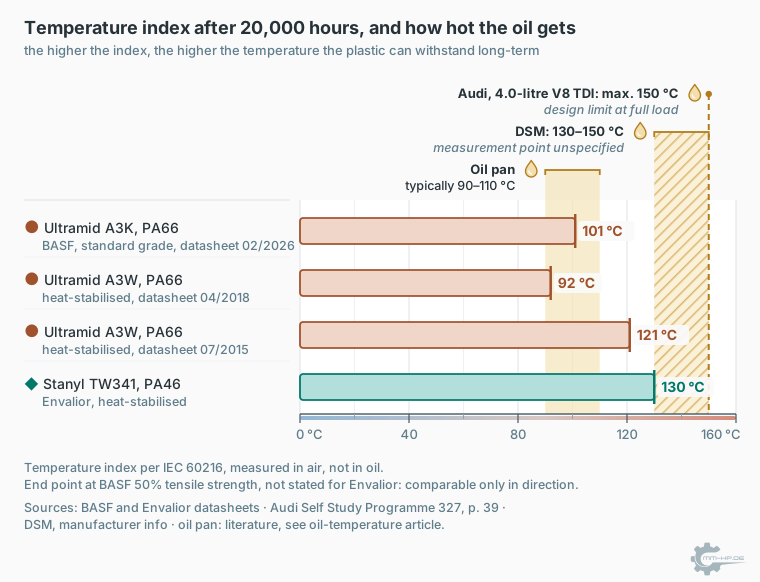
Measured in air, not in oil. The hatched figure has no known measuring point.
One more thing follows from this, and it touches our core business. Heat ageing depends strongly on temperature. A few degrees less in the oil means, for a plastic at the timing chain, more time before it turns brittle. In our own measurement campaign, oil temperature after converting to a pump with more delivery volume was, on average, 10 to 15°C lower. Whether that measurably extends a rail's service life, nobody has measured, including us. We consider it plausible, and we're stating it for what it is: a thesis.
¶ Ageing of polyamide: what happens inside the plastic, and what nobody has measured
"The rail has gone hard." We keep hearing this sentence from the workshops we work with in our development work, who trial new parts and solutions for us in everyday use. What exactly happens inside the plastic can be inferred from materials research, but only in part. We found no published investigation of broken chain rails in which someone analysed the fracture surface in a lab. We searched deliberately through trade journals, test laboratories and patents. What follows are therefore mechanisms documented for polyamide in general, not measurements taken on rails.
The first mechanism is oxygen. Heat and oxygen split the plastic's long molecular chains, and the material loses toughness. In polyamide, this attack often stays confined to a thin surface layer, because oxygen is consumed faster than it can penetrate inward. A research group at KTH Stockholm studied this together with Volvo and Scania on unstabilised PA6, aged in air at 180°C. They describe cracks forming in the aged surface layer that initially stop at the boundary with the unaged core. The part then looks unremarkable for a long time. Applied to a rail, that means: an old rail doesn't necessarily show its age. That's our conclusion drawn from a study on a different polyamide, not a measurement taken on rails.
The second mechanism is post-crystallisation. Polyamides are partially crystalline, and with prolonged heat, the crystalline fraction grows. In a study on PA12 in diesel fuel, also from KTH, it rose at 125°C within 280 hours from 23 to 32 percent, regardless of fuel type. That, too, is a different polyamide in a different medium. But it shows that a polyamide changes measurably on the inside after just a few weeks of heat, with nothing visible from the outside. Whether the same happens with PA46 or PA66 rails in engine oil, nobody has published to our knowledge.
The third point is stabilisation. Polyamides get additives against heat ageing. The classic ones are copper-halide stabilisers, which, according to a 1999 patent, are already added as a dissolved salt during manufacture (EP 1 121 388 B1). The same patent incidentally answers a question many mechanics have: why some rails are black and others are yellowish and translucent. Copper compounds in polyamides “meist eine blaue oder grünliche Verfärbung hervor” ("mostly cause a blue or greenish discolouration"), it states, “Deswegen werden solche Polyamidtypen überwiegend schwarz eingefärbt eingesetzt.” ("That's why such polyamide grades are mostly used coloured black.") So black is often a camouflage colour for the stabilisation. A yellowish, translucent lining is very likely uncoloured polyamide. But the colour doesn't reveal which grade it is, neither PA46 nor PA66 has a colour of its own. Only a lab analysis can show that.
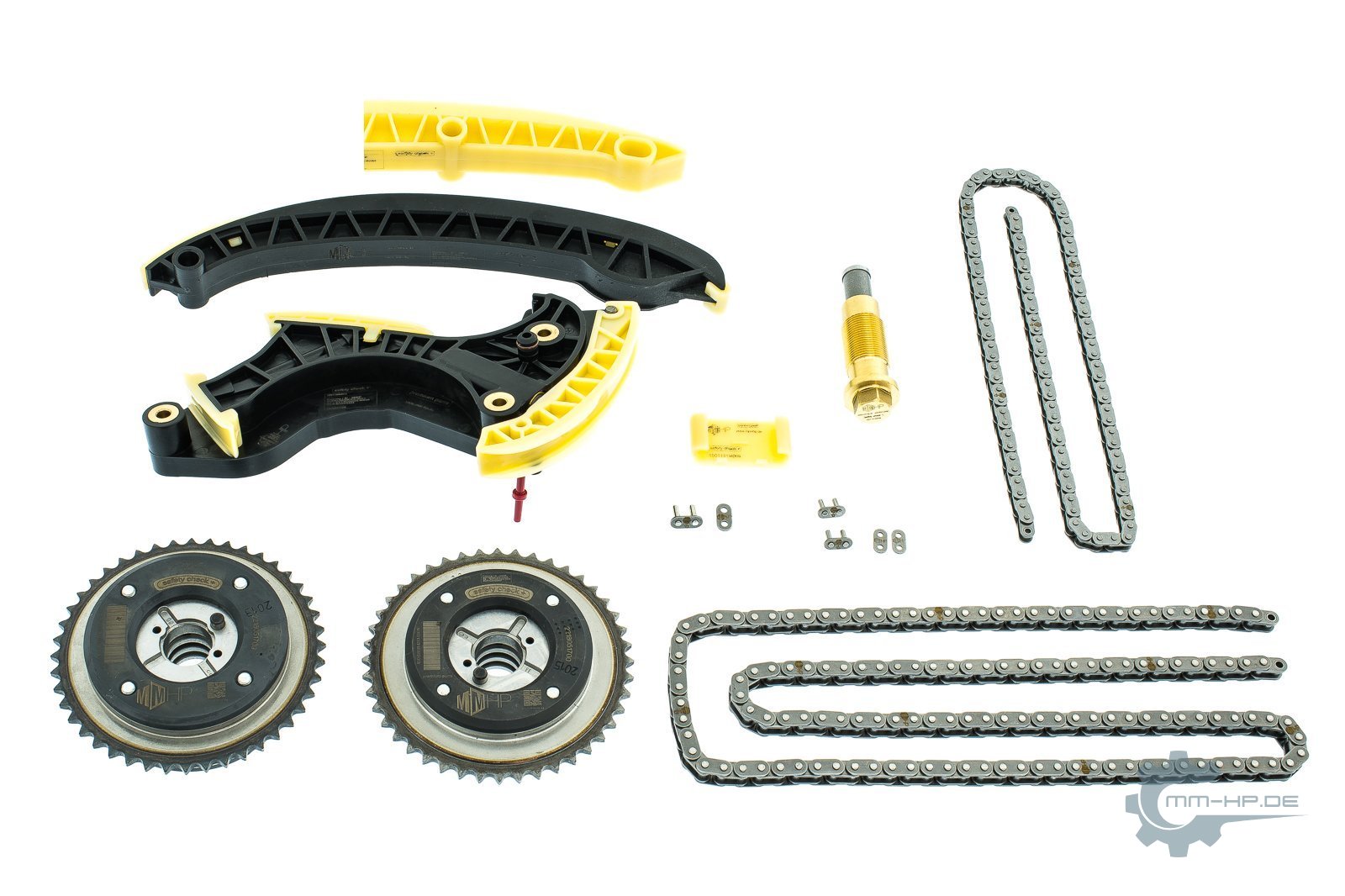
New part, our own photo. Black carrier, translucent yellowish layer: the colour does not tell you which plastic is inside.
What's missing, we say openly: we know of no long-term data on PA46 ageing in engine oil over thousands of hours, no published comparison of whether oil slows or speeds up ageing, and no fracture analysis of a production rail. The values in the temperature chapter are measured in air. So anyone holding a broken rail in their hand knows more about its cause than the entire technical literature, provided they have it examined. That's exactly where we want to pick up: where the published sources run out, we aim to carry out our own investigations with plastics laboratories. We'll publish results once we have them, not before.
¶ Cold start and cold weather: constant heat ages the rail, the cold start exposes it
Workshops keep telling the same story: an old rail holds up for years, and then it breaks, often on a cold morning. One American workshop channel sums it up by saying plastic guide rails become brittle and can crack “over time”. That's workshop experience, not a measurement. But the building blocks behind it are documented, and they fit together.
The first building block is cold. Plastics get more brittle the colder they are. The Stanyl TW341 datasheet gives the notched impact strength, meaning how much energy a notched test bar absorbs on impact, for different temperatures:
| Stanyl TW341 | at +23°C | at −30°C |
|---|---|---|
| dry | 10 kJ/m² | 4 kJ/m² |
| conditioned (with moisture) | 35 kJ/m² | 4 kJ/m² |
The second building block is water. Polyamide absorbs moisture, and only through that does it become tough. Bauer writes: “Das trockene spröde Material erhält letztlich erst durch eine Wasseraufnahme von bis zu 3 Gew.-% seine Schlagzähigkeit.” ("The dry, brittle material only actually gains its impact strength through moisture absorption of up to 3% by weight.") The table shows how strong this effect is: at room temperature, the moist sample is more than three times as tough as the dry one. At −30°C, though, the moisture no longer helps, both values sit equally low.
The third building block is ageing, the subject of the previous chapter. That polyamide becomes more brittle through prolonged heat is documented in general terms, for PA66 in air and in water-glycol mixtures. For PA46 in engine oil over thousands of hours, we found no data.
Put the three building blocks together and you get a hypothesis we consider plausible but cannot prove. So we're stating it as a thesis: constant heat ages the rail, the cold start exposes it. Month after month in hot oil, the plastic uses up its reserve. On a cold start, the impact of a not-yet-tensioned chain then hits a part that's already more brittle from the cold anyway. What still holds in summer breaks in winter.
For one design, there's even direct evidence. Tsubakimoto describes in its own patents that on rails with a lining over a carrier, large temperature swings can crack or detach the lining. The two plastics expand by different amounts under heat, and that works against the joint. For single-piece rails, we found no evidence that constant heating and cooling does more damage than steady heat.
A second question suggests itself, and we can't answer it. On short winter trips, condensate made of water and fuel accumulates in the crankcase, as the Hanover doctoral thesis mentioned above describes. More water in the oil, and polyamide reacts to water. Does that attack the rail? We researched this thoroughly and found no evidence, either for or against. It remains an open question. What short trips do to the oil itself is covered in our article on oil dilution.
¶ Wear in PA46 and PA66: the sources disagree, we show them all
Does PA46 wear less than PA66? Anyone claiming that can point to sources. Anyone claiming the opposite can too. Rather than picking one, we set them side by side, along with the conditions under which they were produced.
| Source | Statement | Condition |
|---|---|---|
| Bauer 2013, technical book with iwis | “Beläge aus PA 46 sind etwas verschleißfester als Beläge aus PA 66.” ("Linings made of PA46 are somewhat more wear-resistant than linings made of PA66.") | no test condition stated |
| DSM, brochure 2004 | “Chain tensioner wear testing: Stanyl UF outperforms PA66 UF.” | Manufacturer's figure, tested on a chain tensioner |
| DSM, communication 2016 | Wear resistance versus PA66 “can be as much as seven times higher” | Manufacturer's figure, no test condition stated |
| Lates, Velicu, Gavrila 2019, journal Materials | lubricated, PA66 wears least during running-in, PA46 with PTFE wears most | pin-on-disc, 38 HRC steel pin, oil bath up to 90°C, running-in phase only |
The first three sources come from industry, two of them from the plastic's own manufacturer. The fourth is a university test with precisely described conditions, but also with clear limits: it ran on a simplified test rig rather than on an actual chain, the pin was softer than a chain link plate, and only the running-in was measured, not long-term operation afterward. The authors themselves say the comparison under sustained operation is still outstanding.
Our reading: the tendency of the sources leans slightly toward PA46. That's not proof. And that's exactly why we base our assessment not on wear, but on temperature.
A word on PTFE, known as Teflon. There are PA46 grades with PTFE blended in as a lubricant, and they sound like the ideal guide rail. The same research group measured friction on a real chain drive at 100°C oil temperature in 2022. The difference between PTFE-PA46 and plain PA46 was under 10 percent at light to moderate loads. PA46 had at most 8 percent less friction than PA66. And in the lubricated running-in test from 2019, it was precisely the PTFE variant that wore the most. Less friction means a little less loss in the engine. A longer service life for the rail does not follow from that.
¶ Blue machined parts made of cast PA6: why we think little of them
While researching, we came across at least one supplier who machines replacement sliding shoes from a strikingly blue material, marketed as self-lubricating, and sells them as more abrasion-resistant than the original. The supplier doesn't say which plastic it is. Blue, machinable polyamides are, however, available commercially as semi-finished stock, in sheets and bars, and two of them match the description. We can't prove these exact grades are used. But we can show what this class of material can do, according to its datasheet.
Manufacturer Mitsubishi Chemical lists both blue grades alongside a PA46 stock material, and measures all of them by the same definition: the temperature at which tensile strength has dropped by roughly half after 20,000 hours in air. That's unusual, because comparisons are normally made across different test methods. Not here.
| Stock material | Material | Continuous temperature (same definition) |
|---|---|---|
| ◆ Ertalon / Nylatron 4.6 | PA46 | 130°C |
| ▲ Nylatron MC 901 | cast PA6, blue | 90°C |
| ▲ Nylatron GSM Blue | cast PA6 with molybdenum disulphide and oil, blue | 200°F, roughly 93°C |
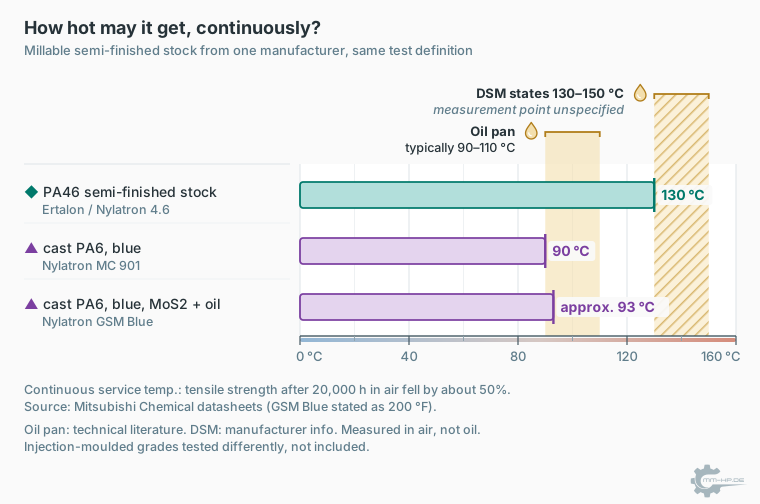
Source: Mitsubishi Chemical datasheets. Measured in air, not in oil.
So the blue materials sit around 40°C below the PA46 from the same manufacturer, and clearly below the roughly 140°C that Bauer's technical book names as the upper limit for chain guides made of PA66 and PA46. At the oil temperatures from the temperature chapter, they'd be operating above their continuous limit.
And the self-lubrication? Solid lubricants such as molybdenum disulphide and impregnated oil help where lubrication is otherwise lacking. Mitsubishi itself recommends GSM Blue for high pressure at low speed. A timing chain runs fast, and it runs in oil. How much the self-lubrication actually contributes there, nobody has measured, to our knowledge.
Our opinion on this: we found no property in this material that gives it an advantage over PA46 in the timing drive. The temperature disadvantage, by contrast, is clear to see in the datasheet. Why a supplier uses it anyway, we can only guess. Our guess is that it machines well and is widely available as stock material, which is convenient for small production runs. That's an advantage for the manufacturer, not for the engine.
In fairness, a counter-view belongs here too. At least one supplier considers PA46 itself too weak, writing that it hardens over time and breaks. They don't say which grade they mean or what that's based on. Nobody disputes that every polyamide ages over time, including us. The question is how fast, and for that, grade, installation location and temperature all matter. PA46 is no cure-all. According to the sources, it's the plastic with the greatest reserve against heat.
¶ Broken rail: where the debris travels on its way to the oil pump
A broken rail is more than a noise. Its fragments go somewhere, and in the engine there's only one way: down into the oil pan. Manufacturer Gates, in its 2025 workshop guide on chain replacement, calls plastic pieces in the oil pan “An unmistakable sign of breakage”, a clear sign of a break that must be checked immediately.
Waiting in the oil pan is the oil pump's intake side, protected by a strainer. How sensitive this part of the oil circuit is to foreign matter, we've described in detail in our articles on the oil pump and on the timing belt running in oil. With the timing belt it's abrasion debris, with the rail it's fragments, the path is the same.
One workshop, which by its own account has been comparing chain kits for the BMW diesel N47 for six years, describes exactly this sequence in a video. On an aftermarket kit, the rubbery coating on the lower rails crumbled off after around three years, especially under heat. The fragments ended up in the intake strainer, and the real danger afterward, they say, is oil starvation, not the rattling noise. A remarkable aside: according to the presenter, new genuine rails now also carry this coating, whereas a genuine kit from 2012 did not yet. So it's not simply a problem confined to cheap parts. This is the observation of a single workshop, not a statistic. But it describes a path from the timing drive to the oil supply that's worth knowing about.
The same workshop's advice is as simple as it is sound: at the oil change, run the used oil through a strainer and check for plastic fragments. Anyone who finds something there has received a warning before the strainer clogs.
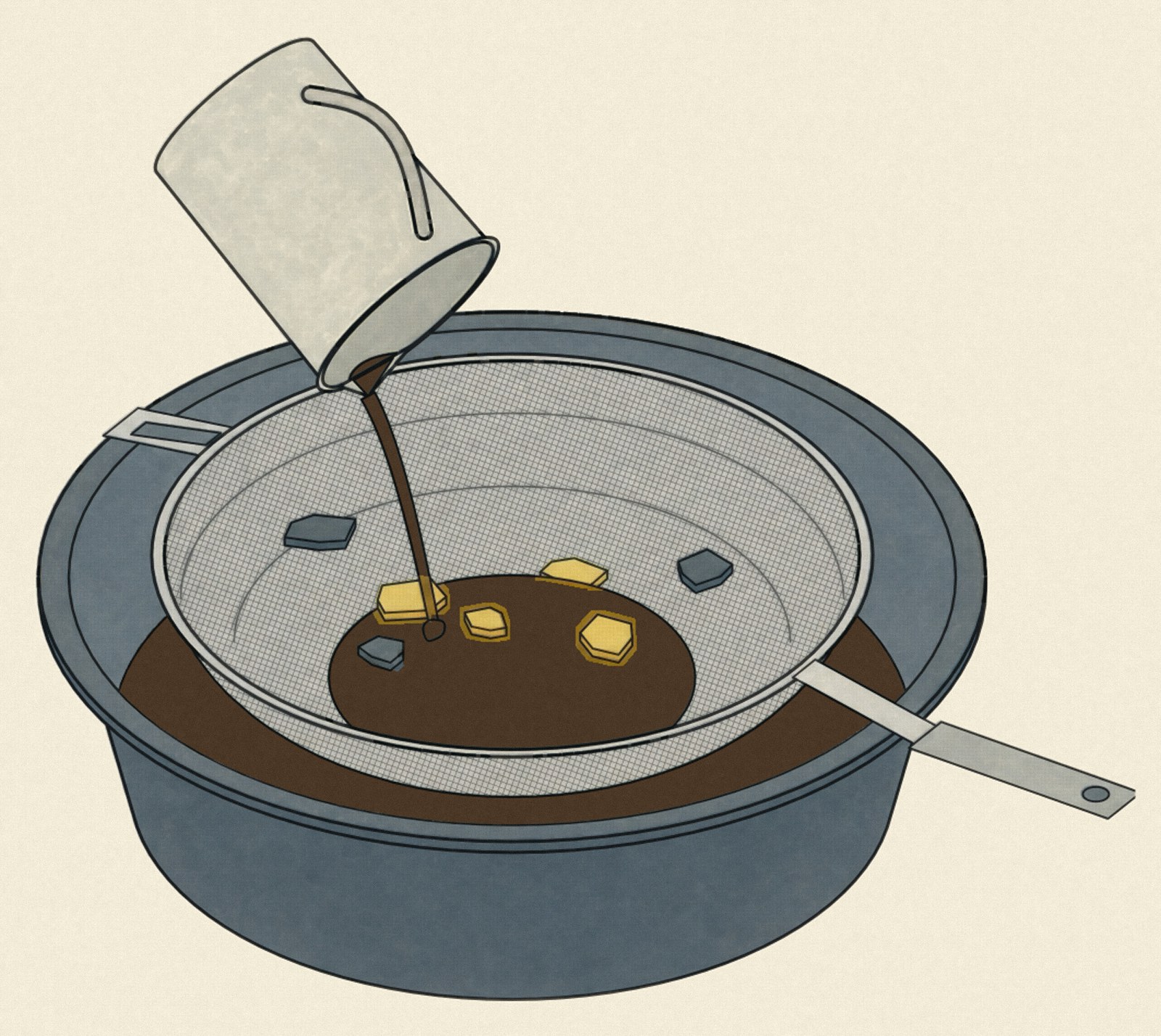
Pouring the used oil through a strainer at the oil change: plastic fragments in it are a warning sign of a broken rail.
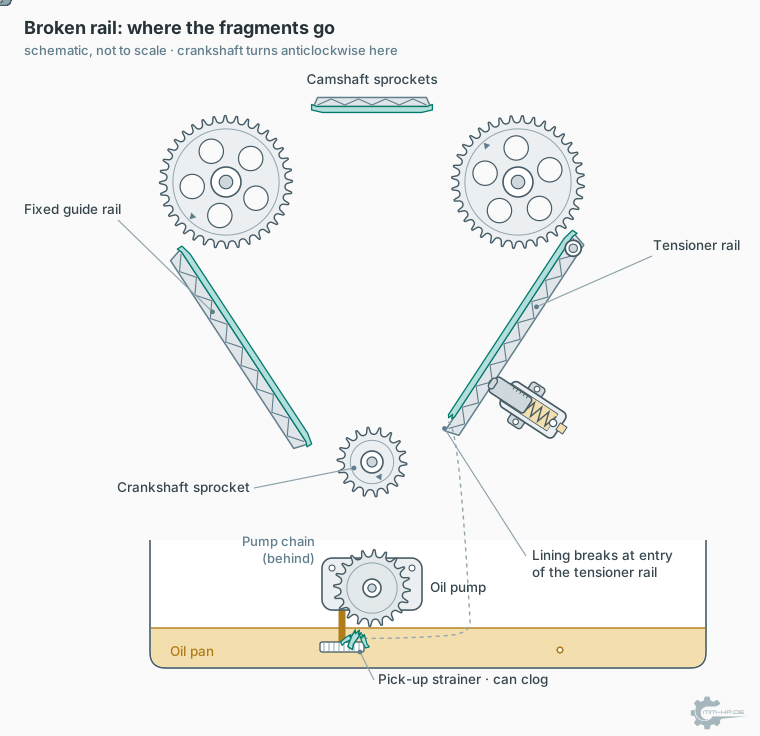
Schematic, not to scale.
¶ Buying a chain kit: what you can know, and what you can't
In the end there's the question that brought many readers here: what should I look out for when buying a chain kit? The honest answer starts with a limit. Given the current state of things, the buyer can't look up the material of their rails from any supplier, not from the original equipment maker and not from the aftermarket supplier. A lab analysis could determine the plastic family, the exact grade only by comparison against a reference sample. For a single purchase, that's not a realistic route.
What remains are three things everyone has in their own hands.
Replace the whole kit. Gates states clearly that replacing only the failed part is “a risky and unprofessional practice”. The manufacturer recommends the complete kit, sprockets included. A new chain on old, hardened rails, or a new rail under an elongated chain, simply don't work together.
Know the risk of unknown origin. With kits from no identifiable manufacturer, you simply don't know what you're getting. That doesn't mean they must be bad. It means nobody stands behind them. For a component whose failure can destroy the engine, we consider that very risky.
Think about the oil during installation. Our recommendation from practice: wet the chain, rails and tensioner with engine oil before the first start, so the first revolutions don't run dry before the oil circuit is established. And check the used oil at the first oil change after the repair.
And what we don't know, we're summarising here once more, so nobody mistakes it for settled:
- how hot the oil at the timing chain really gets in normal operation, measured with the location stated,
- how PA46 and PA66 age in engine oil over thousands of hours, rather than in air,
- whether constant temperature swings damage single-piece rails more than steady heat,
- whether water in the oil during winter short trips attacks the rail,
- which plastic is actually in a given production rail, since no manufacturer names the grade,
- how great the contact pressure is at each individual rail position.
If you have measurements or your own findings on any of these questions, write to us via Support. We'll update this article as soon as new evidence is available.
¶ See also
- More delivery volume, cooler oil: why the conversion lowers temperatures
- Understanding the oil pump: what it does, where its limits lie, and what it fears
- Timing belt in oil: the time bomb you can't inspect
- Why our chain conversion has a chain tensioner
- Glossary: technical terms on oil supply and TDI engines