¶ Oil Temperature: Why Hot Oil Ages Your Engine Faster
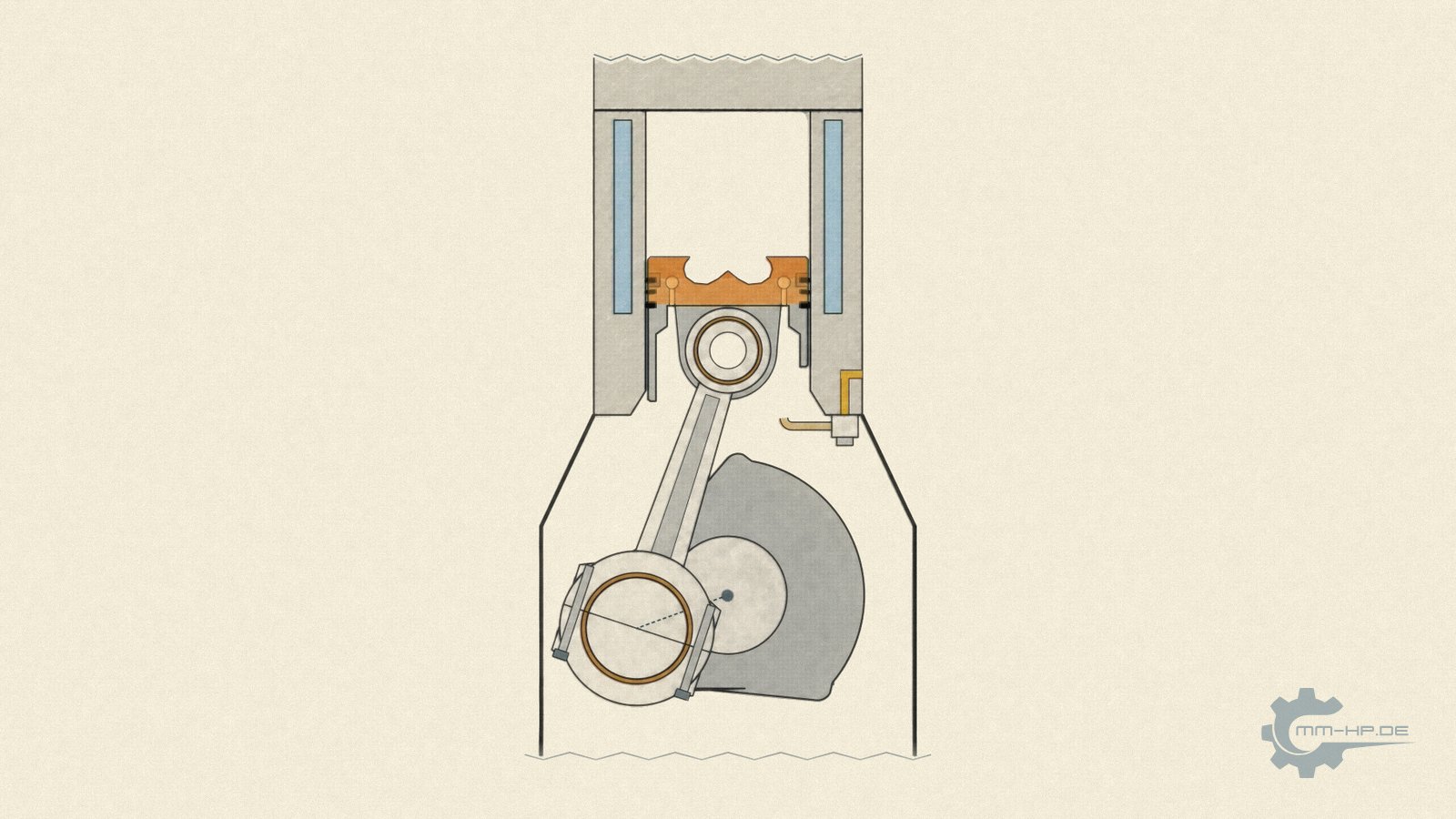
The spray nozzle cools the piston from below. How much heat it removes depends on the oil.
¶ The key points at a glance
Talk about oil pumps and people think of pressure. Yet a larger delivery volume has a second effect that matters at least as much for an engine's lifespan: it lowers the oil temperature, and with it, component temperatures. The mechanism is simple and still gets overlooked constantly: the factory-fitted oil cooler can only cool what actually reaches it. If the pump circulates significantly more oil, more oil mass passes through the cooler in the same amount of time, and on top of that, the faster flow improves heat transfer inside the cooler itself.
We didn't estimate the real size of this effect, we researched it extensively, using measurement systems on customer vehicles: on average, 10 to 15 degrees lower oil temperature under typical usage patterns. That sounds modest and is in fact enormous, because oil doesn't age linearly with temperature, it ages exponentially. As a rule of thumb in lubricant technology, the oxidation rate doubles for every 10 degrees of additional temperature, so 10 to 15 degrees less roughly means a doubling of oil service life and a markedly reduced tendency to coke at the hottest points in the engine, the piston ring zones. And that is precisely where, in these engines, the damage chain begins that we describe in a separate article as the blow-by chain reaction.
Cooler oil is therefore not a comfort footnote to the conversion, it is an attack on the first link of the chain, and as a rule this also settles the question of retrofitting an auxiliary oil cooler.
The long version walks through the complete heat balance once in full: what actually cools the oil in the engine, what temperatures the piston zone lives with, why the Arrhenius rule turns 10 degrees into a lifespan factor, and where the limits of the effect lie.
¶ The overlooked second job of engine oil
In general understanding, oil lubricates. In a real engine, that's only half the job description: engine oil is also the engine's second cooling medium, and at the most critical points, its only one.
Coolant reaches the cylinder walls and the cylinder head, but not the inside of the pistons, not the bearings, and not the shafts. There, the oil takes over heat transport, and the scale involved is considerable: in a piston without active oil cooling, up to 60% of the combustion heat introduced has to flow out through the narrow ring zone into the cylinder wall, with the rings then working as the primary heat bridge. Only oil cooling from below relieves this path. Every degree cooler the oil arrives, and every extra litre it carries past the hot spots per minute, changes the temperature landscape inside the engine.
This also makes clear why delivery volume and temperature are not separate topics: increasing oil throughput reinforces cooling system number two, without bolting on a single new component.
¶ The oil cooler can only cool what reaches it
The place where the oil sheds its accumulated heat is the factory-fitted oil cooler. Its performance is often mistaken for a fixed quantity, but in reality depends heavily on HOW it is flowed through, for two reasons.
The first is simple logistics: if the pump circulates more oil, the entire oil charge passes through the cooler more often per minute. Every single drop spends less time at the hot spots and passes by the cooling point more frequently, so more oil mass is cooled in the same amount of time.
The second reason lies in heat-transfer physics: in oil heat exchangers, the lion's share of the transfer resistance typically sits on the OIL side, not the air or water side. Higher flow velocity makes the oil flow more turbulent, the heat-releasing boundary layer at the cooling surfaces is constantly renewed, and heat transfer increases significantly; studies on piston cooling document improvements in the heat transfer coefficient on the order of a third with increased flow rate. The same cooler therefore removes disproportionately more heat at higher flow, not merely a proportionally larger amount.
For completeness, a counter-effect deserves mention, because heat engineering is rarely a one-way street: faster-moving oil also spends less time in the cooler per pass, so each individual portion of oil cools somewhat less per pass. Whether more heat is removed overall is therefore a design question, in which mass flow and improved heat transfer compete against the shorter dwell time. At the flow rates and cooler geometries relevant here, the first two effects dominate, that's what heat-exchanger fundamentals say, and above all, that's what our measurement campaign says, having captured the net effect directly on the vehicle, more on that shortly.
A pump with significantly higher delivery volume thus shifts the entire heat balance of the oil circuit downward. So how big is the effect, really? Honestly, there is no blanket figure, the reduction depends on driving style, load, and ambient temperature. We therefore researched the question broadly: customer vehicles were fitted with measurement systems, and we evaluated the readings as comparably as possible, supplemented by our own measurement series using our multi-position measurement technology, which records temperatures and pressures simultaneously. The result across typical usage patterns: on average, 10 to 15 degrees lower oil temperature after the conversion. What this unassuming figure is actually worth only becomes clear once you know what it's up against. For that, we need to go to the hottest address in the engine.
¶ Inside the oil cooler: two designs, a double life
A brief look at the component itself, because understanding it pays off here too. In the TDI, the standard oil cooler sits as an oil-water plate heat exchanger directly on the oil filter flange: thin plates through which oil and coolant flow past each other in separate gaps, exchanging heat without mixing. This design leads a double life that many people don't know about: after a cold start, the coolant in the small circuit warms up faster than the oil, so the "cooler" initially works as an oil heater, shortening the critical warm-up phase. Only once operating temperature is reached does the direction reverse, and the oil sheds its excess heat to the water. The alternative, the air-oil cooler using airflow as the cooling medium, needs considerably more surface area due to the poorer heat transfer to air, and is found mainly in motorsport and as a retrofit solution for sustained-load profiles.

Schematic. The same cooler in two roles: after a cold start the warmer coolant heats the oil, at operating temperature it takes the surplus heat out of the oil.
And what should all this regulate towards? Here, too, there are documented target values: the normal operating window for sump temperature is considered to be 90 to 110 degrees, the lowest oil ageing occurs at the lower end around 80 to 90 degrees, brief load peaks up to 120 degrees are uncritical, but this mark should not be exceeded as a sustained condition. Against this grid, the figure from our measurement campaign gains its weight: a 10 to 15 degree reduction shifts an engine that scrapes the 120-degree mark in summer driving back into the healthy window, and shifts one that was already running healthily into the range of minimal oil ageing. It's the same cooler as before. It's just being put to better use.
¶ The hottest address: the piston and its ring zone
No lubricated component in the engine lives under harsher temperature conditions than the piston. Measurements from diesel engine technical literature map out the landscape: piston crowns reach 350 to 400 degrees in operation, the topmost piston ring groove sits at 200 to 280 degrees even with functioning oil-jet cooling, and around the piston circumference, differences of more than 40 degrees can occur. For comparison: in the oil sump, the 120-degree mark already marks the sustained limit of healthy operation.
This zone is cooled from below, via the oil jet nozzles that direct a permanent jet of oil against the piston crown. Two properties of these nozzles tie the temperature topic inseparably to the oil pressure topic. First, they only open above a minimum oil pressure, their check valves are meant to prevent the bearing supply being tapped at idle, so an oil system without pressure reserves cools the pistons weakest exactly when things are already tight. Second, their cooling effect is documented to rise with flow rate, more oil per minute against the piston crown means measurably lower piston temperatures. A stronger oil system therefore works twice over here: a more stable nozzle supply AND cooler oil in the jet (where the nozzles sit in the supply chain).

The oil jet only opens above a minimum oil pressure. At idle the ball stays on its seat; as pressure rises the jet sprays, and the more oil runs through the cooling gallery, the cooler the piston crown stays.
Why this zone deserves so much attention has a name: coking.
¶ Coking: the chemistry of slow engine death
In the ring groove, oil meets temperatures it was never built for, and it responds with chemistry. Oxidation links the oil molecules into increasingly viscous lacquer and varnish layers; varnish then turns into hard carbon. The technical literature names concrete thresholds: deposit formation in the ring groove starts at around 200 degrees and accelerates drastically above roughly 260 degrees, exactly within the documented operating window of this zone. It's a race: fresh, cool oil flushes and survives, hot, aged oil burns and deposits.
If the groove loses this race, the ring eventually sticks, and then the system tips over: a seized ring no longer seals, conducts piston heat away less well (making the zone even hotter), and lets oil past. Oil consumption rises, the burning oil creates new deposits, and the process reinforces itself. Where this chain leads once the rings have seized, and why most of the oil then burns via a completely different route than everyone assumes, we've taken apart in the article on the blow-by chain reaction; it's the failure pattern that made the CFCA notorious.
That this exact temperature window is the critical zone is, incidentally, confirmed by the world of test standards in its own way: the standardised NOACK test, used to measure the evaporation tendency of engine oil, runs at a constant 250 degrees; good synthetic oils lose under ten percent of their mass in it. That the industry set its standard test right at ring-zone level, and not at sump temperature, says everything about where the real action is.
A related classic deserves its moment here too, because it shows the same mechanism in its purest form: hot shutdown of the turbocharger. After a brisk motorway or mountain stretch, the turbo shaft is glowing hot and keeps spinning at tens of thousands of rpm after you lift off the throttle. If the engine is switched off immediately in this state, oil circulation stops abruptly, the oil sitting in the bearing is effectively baked by the residual heat and cokes into hard particles that act like foreign bodies in the bearing on the next start and can clog the turbo's fine oil passages. The countermeasure costs nothing: after hard driving, let the engine idle for a minute or two so the circulating oil cools the bearing points down. It's the same lesson as the rest of this article, just in miniature: it isn't temperature alone that destroys, it's hot oil that has stopped flowing.
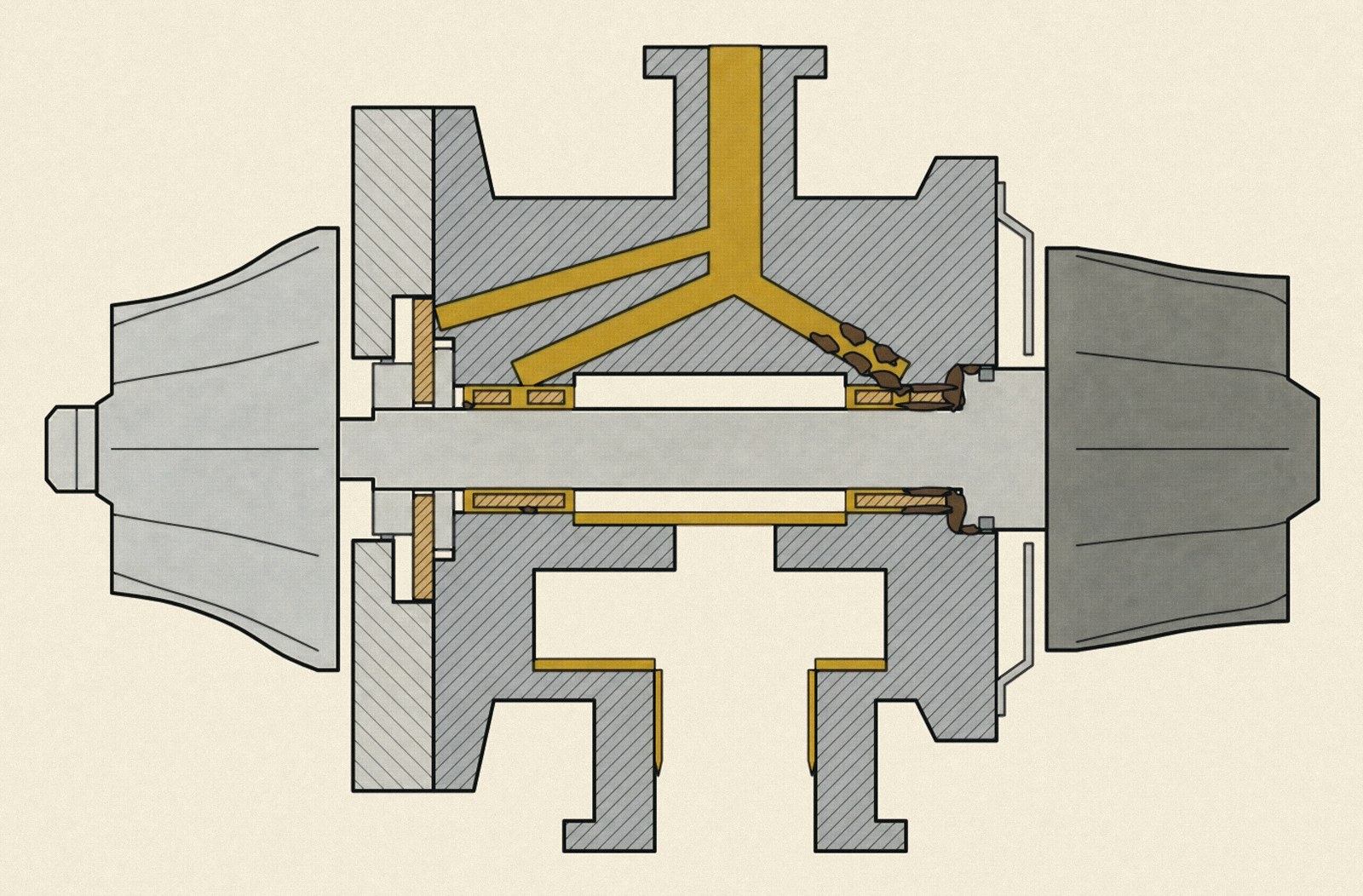
After a hot shutdown: the standing oil cokes mainly on the hot turbine side, in the bearing and in the fine feed passage.
The point for this article: the starting gun for this entire cascade is thermal. Coking isn't a question of IF, it's a question of temperature and time. Which brings us to the rule that turns 10 degrees into a factor.
¶ The Arrhenius rule: why temperature acts exponentially
Lubricant technology has worked for decades with a rule of thumb rooted in Arrhenius reaction kinetics: for every 10 degrees of higher oil temperature, the oil's oxidation rate doubles, and its usable service life halves accordingly. The technical literature works this through with an industrial example:
| Average oil temperature | Usable oil service life (example series) |
|---|---|
| 70 °C | 4 years |
| 80 °C | 2 years |
| 90 °C | 1 year |
| 100 °C | approx. 6 months |
The absolute values come from a hydraulic application and cannot be transferred one to one to engine oil, but the MECHANISM can, because it describes the chemistry of hydrocarbon oxidation itself. Incidentally, this ageing process can even be measured: the TBN figure quantifies the oil's alkaline reserve, i.e. its ability to neutralise acidic combustion residues. Fresh oil starts at values of around 7 to 10 depending on formulation, roughly half of the fresh value is considered the practical usage limit, and the hotter the oil runs, the faster oxidation eats through this reserve. So the Arrhenius rule isn't just in the textbook, it's in every oil-analysis lab report.
And it's the key to putting our measurement campaign into perspective: an average 10 to 15 degree lower oil temperature means, by this rule, roughly a DOUBLING of the time the oil can hold out, and a correspondingly slowed rate of deposit formation everywhere the oil gets hot, above all in the ring groove. In an engine whose damage pattern is half rooted in thermal overload, that's no longer a side effect, that's tackling the cause.
Rule of thumb: oil ages exponentially with temperature. That's why 10 degrees less isn't 10% better, it's roughly twice as good.
The plastic guide rails of the timing chain also age with temperature, and manufacturers state their heat resistance as a temperature index. Whether a few degrees less in the oil measurably extends their service life, nobody has measured, including us. We consider it plausible and explain why in our article on timing chain guide and tensioner rails.
¶ The whole chain in one pass
Let's pull the effect chain together in full, because it's the actual argument of this article:
More delivery volume means faster circulation and better heat transfer in the factory cooler, meaning cooler oil (measured: 10 to 15 degrees lower on average). Cooler oil and a stably supplied set of jet nozzles mean cooler pistons and ring zones. Cooler ring zones mean, by the Arrhenius rule, disproportionately slower oil ageing and coking. Less coking means freely working rings, and freely working rings are the best insurance against the blow-by chain reaction that kills this engine generation by the dozen. The temperature effect of the conversion therefore doesn't intervene somewhere in the middle of the damage chain, it intervenes at its very first link.

The chain in one pass: same engine, same cooler, only the first link differs. With more delivery volume the oil stays cooler, the ring groove cokes more slowly, and the ring keeps working freely for longer.
¶ What this means in practice, and what it doesn't
Finally, some perspective for purchasing decisions, honest in both directions.
The obvious question many customers ask is: "Should I also retrofit an auxiliary oil cooler?" In our experience, this question generally resolves itself with the conversion; the factory cooler, given the higher throughput, delivers what you'd otherwise need extra hardware for, without new hoses, fittings, and leak risks. An auxiliary cooler also only treats the symptom of "hot oil," not the insufficient delivery behind it.
The limit is just as clear: cooler oil does not repair existing coking or mechanical damage. An engine whose rings have already seized needs an overhaul, not a temperature reduction, which by then simply comes too late for that component. The ideal time for the temperature lever is before that, while the chain hasn't started running yet. And how strong the effect turns out to be in an individual case depends on the usage profile; the 10 to 15 degrees are an average across typical driving, not a promise for every scenario, blanket guarantees would be irresponsible on this topic. Incidentally, thermal behaviour also feeds equally into our overall assessment of an oil system; it's one of the building blocks of our internal comparative metric, the VHFI.
One more note for anyone logging oil pressure and oil temperature together, which everyone should, because either figure says little without the other. The temperature shown by the trip computer or an auxiliary gauge comes from a sensor at exactly one place in the circuit, and that is almost never the same place where the pressure gauge sits. The same restriction therefore applies to temperature as to pressure: it describes a location, not the whole engine. On top of that comes the tolerance of sensor and display, which appears on the readout just as little as the accuracy class appears on a test kit. Anyone wanting to know what order of magnitude such things reach, and why that limits what a single figure can tell you, will find the reasoning in our article on off-the-shelf oil-pressure gauges.
¶ See also
- Oil consumption in the 2.0 TDI: the blow-by chain reaction
- VW T5 2.0 BiTDI (CFCA): the special case
- Oil pressure is not just oil pressure: why measurement position matters
- How we measure oil pressure: our own hardware, our own software
- Why off-the-shelf oil-pressure gauges don't give you a reliable answer
Transparency note: MMHP has been developing, testing and manufacturing its own products for the automotive industry for over 25 years, including solutions for the oil supply of VW TDI engines. The thermodynamic fundamentals of this article are documented with sources in our source dossier; the 10-15-degree figure comes from our own measurement campaign with customer vehicles and describes an average, not a guaranteed value for any individual case.