¶ Chain Tensioners: Why a Chain Drive Really Needs One
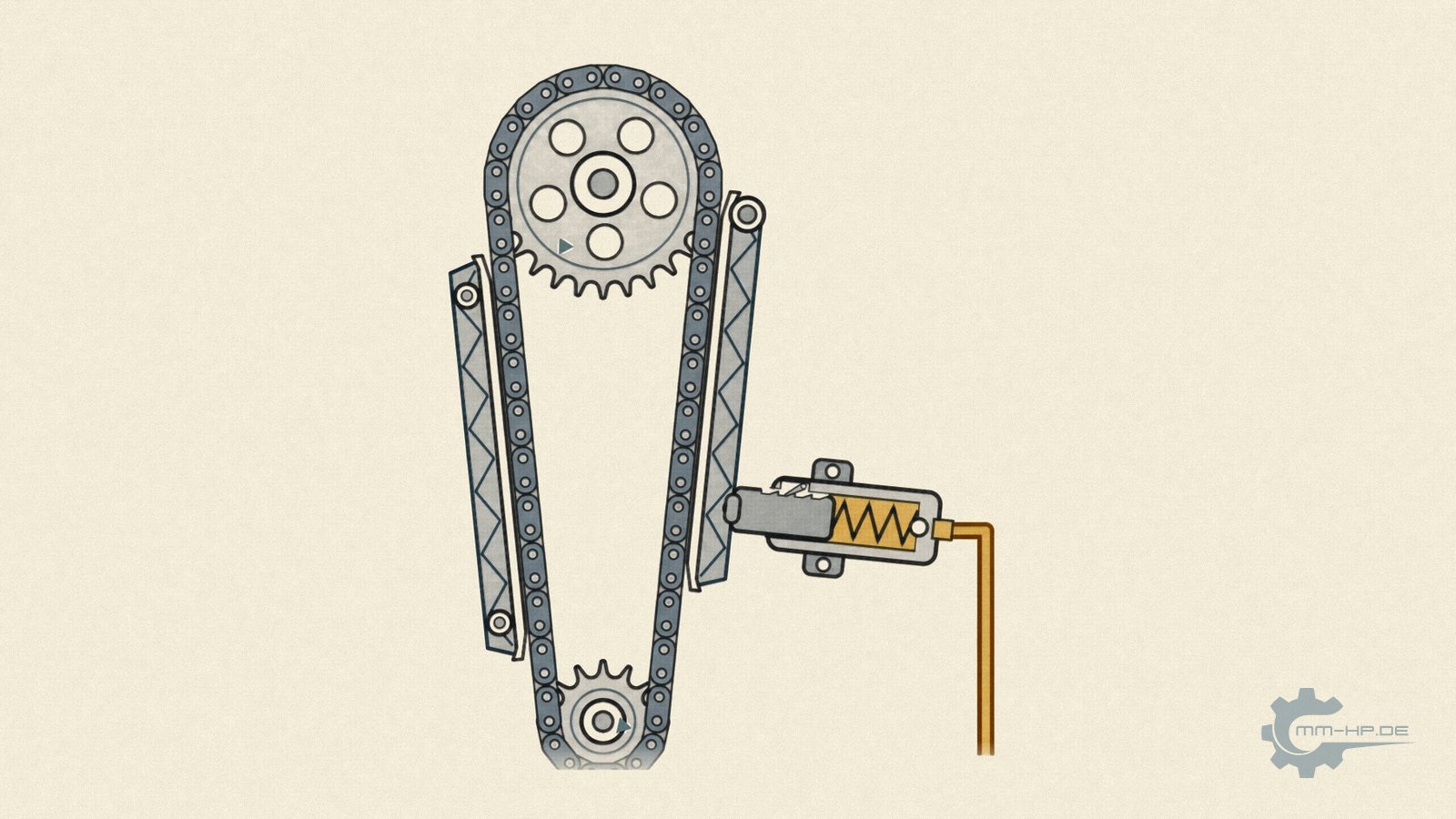
Schematic. The animation is further down in this article.
¶ The key points at a glance
A customer question that keeps reaching us: why does your chain conversion for the oil pump drive have a chain tensioner, when some solutions on the market are built without one? The short answer: because every chain elongates over its service life, because every chain drive vibrates by design, and because a chain that loses drive to the oil pump takes the engine down within seconds. A tensioner is the only component that masters all three points at once: it compensates for elongation, it damps the vibrations, and it keeps the chain exactly where it belongs for years.
Chain elongation is not a defect here, but normal joint wear: workshop data cites a rough order of magnitude of about half a percent elongation over 250,000 kilometres, and from around one percent a timing chain is considered worn. Without a tensioner, this elongation feeds straight into chain slack, and slack is the start of a wear spiral of chain slap, accelerated elongation and, in the end, a chain that jumps a tooth or breaks. The well-known chain failures in VW TSI and BMW diesel engines also show that when chains fail, the tensioner or its surrounding components are almost always involved. The answer to that is not to leave the tensioner out, but to build it robustly.
The long version explains why chains elongate at all, what the polygon effect is, how spring-loaded and hydraulic tensioners work on the inside, what the morning cold-start rattle of many engines has to do with it, and why we consider the extra cost of a tensioner non-negotiable.
¶ The question that triggered this article
It comes, in substance, from a genuine support enquiry: "I've compared conversion solutions. Yours has a chain tensioner, others don't. Is the tensioner actually necessary, or am I paying for a part that the others simply skip?" That is an excellent question, and it deserves an answer that goes deeper than "it's better this way." Behind it lies a real piece of mechanical engineering that doesn't fit into a product description, but very much belongs in a knowledge article.
To answer it, we need to understand three things: what a chain does over its life (it elongates), how it behaves while doing so (it vibrates), and what is at stake when both come together (for the oil pump drive: everything). We'll then look inside the tensioner itself, and finally at the question of why some leave it out anyway, and why we advise against it.
¶ Chains elongate. All of them. Always.
The term "chain elongation" is misleading, because it sounds as if metal were being stretched like a rubber band. In fact, almost nothing in a chain actually stretches. What grows is its joints: every chain link rotates around its pin on each revolution, and at every one of these pin-and-bushing pairings, wear removes material year after year, thousandth of a millimetre by thousandth of a millimetre. A timing chain has, depending on its length, well over a hundred such joints, and the tiny individual clearances add up over the chain's length into measurable growth. Wear multiplied by number of links — that's the whole formula.
The orders of magnitude from workshop practice, noting these are typical reference values, not standard specifications:
| Condition | Elongation | Meaning |
|---|---|---|
| New, after running-in | first measurable elongation within the first few thousand kilometres | normal, joints "bed in" |
| Used, high mileage | approx. 0.5% over roughly 250,000 km | normal wear progression |
| Wear limit | from approx. 1% | chain considered worn, replacement due |
Two things in this table matter. First, the running-in row: a chain doesn't elongate linearly, but takes an initial step as the fresh joint surfaces bed into one another. A design with no re-tensioning capability is, strictly speaking, no longer at its intended tension right after running-in. Second, the wear limit: one percent sounds negligible. On a chain half a metre long, that's five millimetres, and five millimetres of free slack in a drive that turns over a thousand times a minute is a mechanical world of its own. Modern engine management systems actually detect an elongated timing chain indirectly, via the camshaft's phase offset, because a longer chain measurably twists the camshaft relative to the crankshaft. Workshop practice cites orders of magnitude of just a few degrees for this: on BMW, depending on the model, around four degrees is treated as the tolerance limit and six degrees as critical; on VW engines, more than eight degrees of phase offset is read as significant elongation. These are diagnostic reference values from workshop sources, not official manufacturer specifications, but they show just how fine the margins are in which a chain drive lives: between "fine" and "critical" lie a few degrees of twist, arising from hundredths of a millimetre of joint wear.
A chain that elongates is not a sign of poor quality. Chain manufacturers plan for it from the outset. The German reference book “Kettensteuertriebe” by Peter Bauer, published with technical support from the chain maker iwis, gives as the usual value in the specifications of modern engines “eine gemessene Kettenlängung von 0,5 % bei einer Laufleistung von ca. 250 000 km” (a measured chain elongation of 0.5 % at a mileage of about 250,000 km). A review of test-bench studies on chain wear (Paulovics, Rohde-Brandenburger and Tóth-Nagy, FME Transactions 2022) cites 0.3 to 0.5 percent over the service life as the usual manufacturer target. The same paper describes the course for chains held by a tensioner: after a quick running-in, elongation grows steadily for a long time, and only at the end of life does it speed up again. Bauer goes a step further: inner and outer links are deliberately built with a small pitch difference that only evens out after a certain running time. Wear is therefore designed into the chain. The one percent in the table is the limit at which a workshop replaces the chain, not what a good chain reaches in normal service. More on the studies, and on what speeds elongation up, in the article The timing chain: chain types, elongation, and why oil is the biggest lever.
¶ What one percent means in millimetres
Percentages say little as long as you don't know how long the chain is. The same percentage gives several times as many millimetres on a long timing chain as on a short oil pump chain. The calculation is simple: chain length times percentage. The table shows three example lengths. 1,530 millimetres corresponds to the worked example in the review cited above, a timing chain with a 9 millimetre pitch and 170 joints.
| Elongation | 500 mm chain | 1,000 mm chain | 1,530 mm chain |
|---|---|---|---|
| 0.1 % | 0.5 mm | 1.0 mm | 1.5 mm |
| 0.3 % | 1.5 mm | 3.0 mm | 4.6 mm |
| 0.5 % | 2.5 mm | 5.0 mm | 7.7 mm |
| 1.0 % | 5.0 mm | 10.0 mm | 15.3 mm |
Even the running-in of a new chain brings a first measurable elongation; on a short chain that quickly adds up to a few tenths of a millimetre. Half a millimetre sounds like nothing. Why it still matters is shown by the next step.
¶ Why a little elongation becomes a lot of movement
The extra length doesn't spread evenly over the chain. It collects in the slack strand, the section that isn't pulling at that moment. There it doesn't lie as a straight piece but as an arc, and a shallow arc needs very little extra length to deflect a long way. For a shallow arc over a free span s, approximately: sag ≈ √(3 · s · extra length ÷ 8). We calculated the following values with this formula and cross-checked them against the exact arc length.
| Extra length in the strand | Sag with 150 mm free span | Sag with 300 mm free span |
|---|---|---|
| 0.5 mm | about 5 mm | about 7.5 mm |
| 1.5 mm | about 9 mm | about 13 mm |
| 5 mm | about 17 mm | about 24 mm |
Half a millimetre of extra length therefore becomes several millimetres of sag, roughly ten times as much. And because the strand can whip from one side to the other, the distance it travels is larger still. The values are orders of magnitude for a simple arc, not a measurement for any particular engine. How much of it arrives in a real drive depends on geometry, installation position and engine speed.
It becomes a problem as soon as the movement fills the space the chain has. Then it strikes the housing, rails or sprockets. Every strike hits the joints, elongation grows, and because sag grows with elongation, so does the strike. With a tensioner this spiral is reset with every millimetre, and elongation proceeds steadily for a long time, as the studies describe. Without a tensioner that brake is missing. In our workshop experience it then builds up within a short time until the chain jumps a tooth on the small sprocket or breaks. We have not found a published series of measurements on this course.
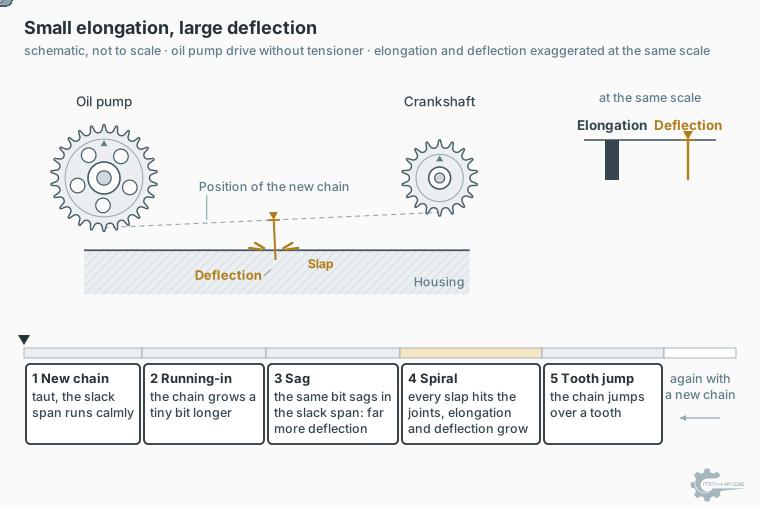
Schematic, not to scale, elongation and movement exaggerated in the same ratio. A small piece of extra length turns into a large movement, and without a tensioner nothing takes it back.
That is why every chain drive needs a tensioner, even one whose chain only elongates by a tenth of a percent.
Let's be clear: elongation is not an exceptional case you can guard against by buying a particularly good chain. It is the certified normal condition of every chain, from the first kilometre to the last. The question is never whether the chain will get longer. The only question is who compensates for it.
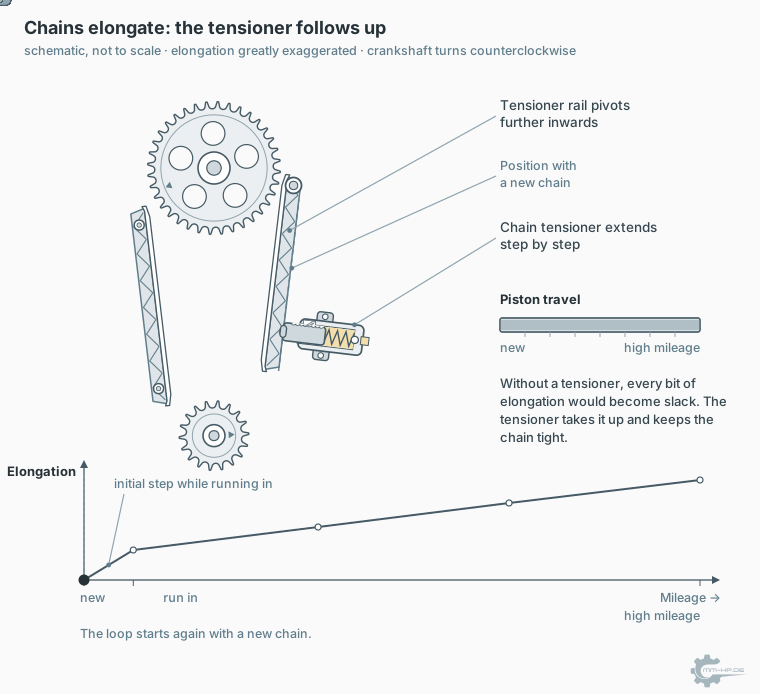
Schematic, not to scale, elongation greatly exaggerated. First a short, quick running-in, then a long, steady elongation: that is how every chain ages, including a good one. The tensioner follows and keeps it taut.
¶ The polygon effect: why chains inherently run unevenly
Alongside elongation comes a property that fundamentally sets chains apart from belts and gears: a chain doesn't run round. It can't, because it's made of rigid links. On the sprocket it doesn't sit like a belt on a circular path, but like a polygon resting on its corners, and a polygon rolling along produces a periodic speed fluctuation. This is known in the field as the polygon effect.
How pronounced it is depends on the number of teeth on the sprocket: on a small sprocket with 16 teeth, chain speed fluctuates by around two percent per revolution; as tooth count increases this improves quickly, and from around 40 teeth the effect is practically gone. Compact chain drives with small sprockets, as commonly found in the tight installation space of an engine, therefore inherently judder the most. This constant small acceleration and deceleration acts on the chain like a shaker: it excites vibration in both directions. Longitudinal vibration makes the tension in the strand pulse; transverse vibration sets long, slack sections of chain fluttering until they audibly strike guides and housings. Workshops know this sound signature as chain rattle or chain slap.
A taut chain strand can barely vibrate transversely — its fluttering section is simply too short. A slack strand, by contrast, is a tensioned guitar string under continuous excitation. And every impact of the chain against a guide or sprocket is a small hammer blow to exactly the joints whose wear drives the elongation. This closes the loop back to the previous section, and it does so as a spiral: elongation creates slack, slack allows vibration, vibration accelerates elongation. This spiral runs on its own once it starts, unless something intervenes. That something is the chain tensioner.
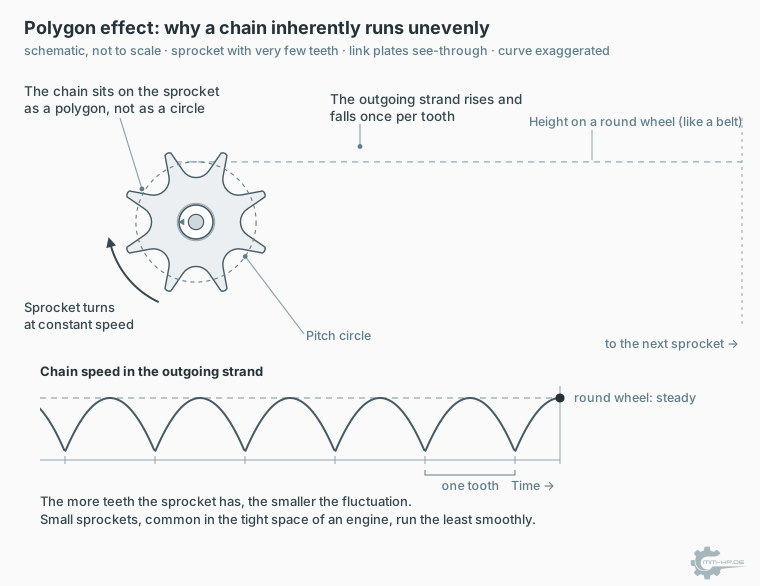
Schematic, not to scale. Every tooth lifts and lowers the leaving strand a little, and this rhythm excites the chain to vibrate.
¶ What's at stake in the oil pump drive
Here's an objection we take seriously: in a valve train's timing drive, everyone understands that a chain jumping a tooth is a catastrophe, because valves then meet pistons and the cylinder head is finished. But an oil pump chain doesn't time anything. Whether the pump sits a tenth of a revolution "wrong" is completely irrelevant to it. Does a drive like that really need the same level of care?
Our answer: more of it. Because what the oil pump chain lacks in precision requirements, it makes up in consequence. In a valve train, a dying chain usually announces itself — with rattling, with phase-offset fault codes, with noticeably rough running. The oil pump drive has no such early-warning system on the dashboard. It has only two states: it runs, or it doesn't. If the chain jumps or breaks there, the oil pump stops, and with it ends the supply to every bearing in the engine — at full driving speed, without warning, with the oil-pressure warning light as the last signal of a failure that has already happened. We described the anatomy of this scenario for the factory drive via the hexagon drive dog in the balancer shaft module article, and the lesson from there applies here just the same: the oil pump drive is the one place in the engine where a small component failure turns into total engine failure with no intermediate stage.
Anyone designing a chain drive for precisely this location therefore has, in our view, no room for judgement calls on whether the chain stays cleanly tensioned over 200,000 kilometres. The only choice is how.
¶ Spring-loaded or hydraulic: the two schools
Chain tensioners come in two basic types, and both are mature technology, proven millions of times over.
The spring-loaded tensioner is the robust school: a spring permanently presses a tensioner shoe or rail against the slack strand of chain. It needs no oil pressure, works from the very first degree of crankshaft rotation, has no chambers that can run empty, and no valve that can leak. Its damping comes from spring characteristics and friction.
The hydraulic tensioner is the sensitive school: here too a spring provides the base tension, but the actual work is done by engine oil. The tensioner piston sits in a cylinder that is filled from the oil circuit via a small check valve. When the chain pushes against the piston with a sudden impact, the oil can only escape slowly through a defined leak gap; at that moment the tensioner is practically rigid and absorbs the shock. When chain tension eases, the spring pushes the piston forward, the check valve lets oil flow back in, and the new position is hydraulically backed up. Many designs also carry a mechanical ratchet that locks the piston against slipping back if oil pressure is missing.
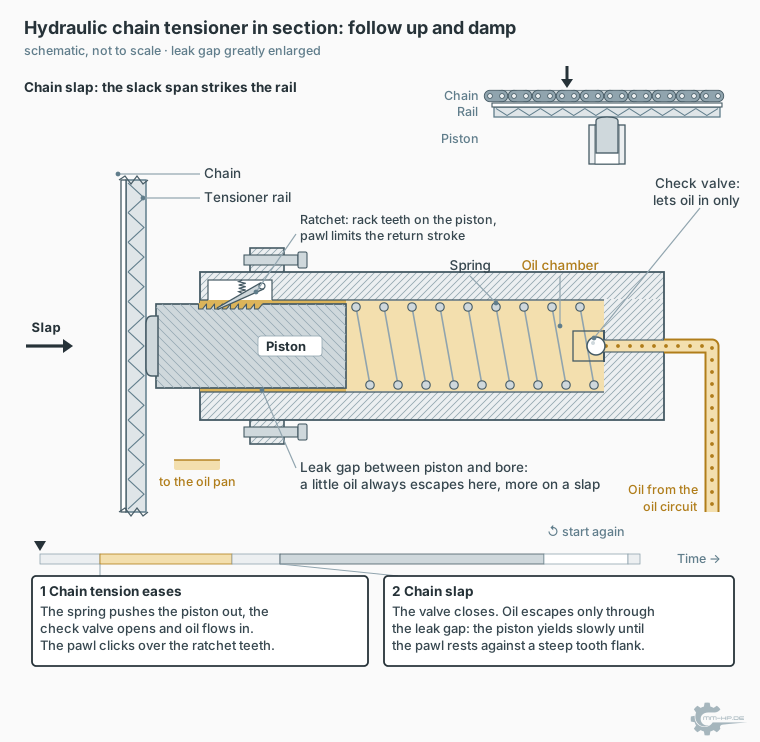
Schematic, not to scale. When the chain eases, the spring pushes the piston out and oil flows in through the check valve. A little oil constantly escapes through the leak gap, more on a slap: the tensioner stays almost rigid and yields only slowly. The ratchet limits how far the piston can move back.
| Spring-loaded | Hydraulic | |
|---|---|---|
| Tension source | Spring | Spring + oil pressure |
| Damping | Spring characteristics, friction | Leak-gap throttling (speed-dependent) |
| Function without oil pressure | Unrestricted | Limited (spring and, where fitted, ratchet as fallback) |
| Typical weakness | Limited fine damping | Leaking check valve, drained chamber |
| Typical use | Simple, short drives, ancillaries | Timing drives under high dynamic load |
Neither design is universally the better one. Which is right depends on the engine, the load and the intended use — and on a point that's easy to overlook: a hydraulic tensioner is only ever as strong as the oil pressure supplying it. On an engine that already has oil-pressure problems — exactly where it matters most — it can give way at the worst possible moment, while a spring-loaded tensioner keeps tensioning regardless of oil pressure. Why this trade-off comes out differently on the oil pump drive than on the timing drive is explained in the next chapter.
The best-known everyday proof that this technology genuinely works is, incidentally, a sound many readers will recognise: the brief chain rattle some engines make in the first two or three seconds after a cold start. The table above explains it: in many hydraulic tensioners some oil drains from the pressure chamber overnight, for example through the check valve or an emptying feed passage, and at start-up the chain hangs slack until the oil pump has refilled the tensioner. The sound is nothing other than the audible difference between a tensioned and a slack chain, demonstrated afresh every morning. Anyone who has heard it once needs no further argument for why chain tension isn't an optional feature. A brief rattle on its own is not damage. If it gets longer or also appears when the engine is warm, though, it is a wear signal that shouldn't be ignored.
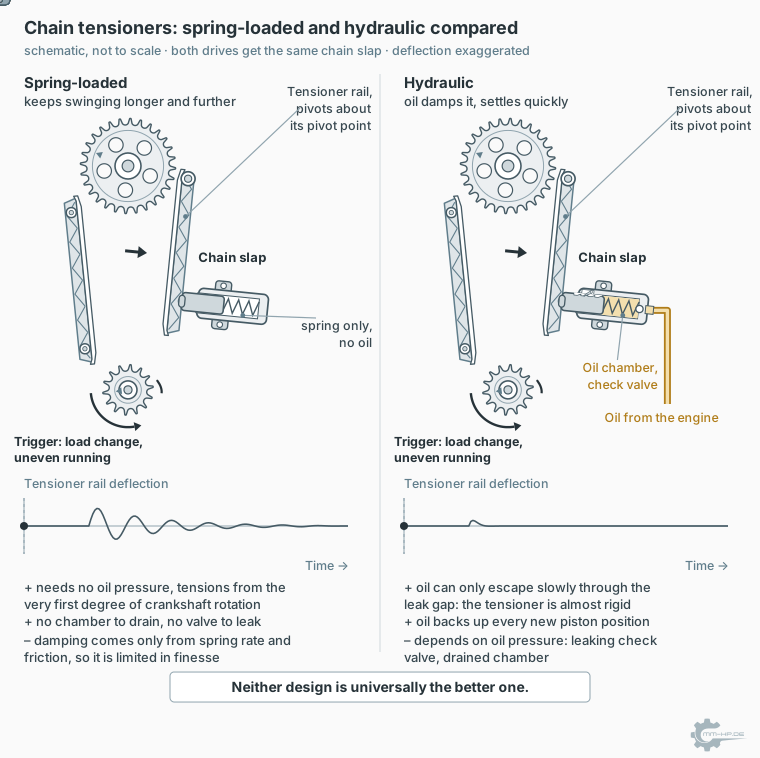
Schematic, not to scale. Same trigger, same chain slap, two responses: the spring-loaded tensioner needs no oil pressure but keeps swinging longer, the hydraulic one damps through the oil but depends on oil pressure.
¶ Oil pump drive and timing drive: two different jobs
The table above assigns the spring-loaded tensioner to short, simple drives and the hydraulic one to timing drives. That is not a matter of taste. It follows from what pulls on the chain.
The timing drive carries the camshaft. Each cam pushes a valve open against its spring and lets it close again. While opening, the valve spring brakes the camshaft; while closing, it pushes it on, so the torque on the shaft reverses direction several times per revolution. The chain is pulled and relieved in turn, in time with the valves. Add camshaft phasers that twist the shaft relative to the crankshaft while driving, and every load change that hits the chain through the crankshaft. Timing chains are also long, because they reach from the crankshaft up into the cylinder head, and a long strand vibrates more easily. The tensioner there has to absorb impacts that come in quick succession from both directions. That is exactly what hydraulic damping is made for: it barely yields to a fast impact, yet willingly follows slow elongation.
The oil pump drive is calmer. The pump offers the chain a steady resistance that rises and falls slowly with engine speed and oil temperature, but doesn't jump back and forth in time with individual valves. Whether the driver accelerates or lifts off makes little difference to its demand at that moment. The chain is short, because crankshaft and oil pump usually sit close together. What unrest remains comes mainly from elongation and from the polygon effect, in other words from slow or evenly recurring processes. A spring can compensate for those without needing oil pressure. Bauer's reference book describes oil pump drives the same way: “Auf ein hydraulisches Spannelement wird in der Regel verzichtet; zum Einsatz kommen üblicherweise mechanische Spanner mit Federvorspannung.” (A hydraulic tensioning element is generally dispensed with; mechanical, spring-preloaded tensioners are typically used.) The tensioner itself is not dispensed with.
| Timing drive | Oil pump drive | |
|---|---|---|
| What pulls on the chain | Camshaft, torque reverses with every valve lift | Oil pump, steady resistance |
| Load changes | Hit through via the crankshaft, plus camshaft phasers | Barely felt |
| Chain length | Long, up into the cylinder head | Short |
| What the tensioner must do | Damp fast impacts from both directions | Take up elongation, keep the strand calm |
| Suitable design | Hydraulic | Spring-loaded |
Then there is the point from the previous chapter: a hydraulic tensioner depends on oil pressure. On the very drive that creates the oil pressure in the first place, that would be circular. Precisely at a cold start, while the pump is still building pressure, its own tensioner would still be empty. For our oil pump chain conversions we therefore use a spring-loaded tensioner. How it is designed we keep to ourselves, as we do with our pump performance curves.
The reverse conclusion doesn't hold: a spring that is enough on the oil pump drive would not be enough on a timing drive. It would be too soft for the camshaft's impacts. A spring stiff enough for those impacts would over-tension the chain permanently and wear chain, rails and bearings faster. Only hydraulic damping, which is stiff against fast movements alone, resolves that contradiction.
¶ When a guide rail is needed
A tensioner presses on the slack strand at one point. If the strand is long, enough free chain remains between tensioner and sprocket to vibrate anyway, and then a guide rail belongs in the drive to lead the strand along its full length. There is no fixed length at which this becomes necessary. It depends on several things at once:
- Free length and chain size. What still runs calmly with one chain already flutters with another. It comes down to the relationship between free length, chain pitch and tensioning force.
- Installation position. A vertically hanging strand is pulled lengthwise by gravity and hangs straight. A horizontal strand is pulled down across its direction of travel, sags and starts slapping more easily. The same chain can manage without a rail in one position and need one in the other.
- Speed range. Every free strand has engine speeds at which the polygon effect excites it in rhythm and it builds up. If they lie within the engine's operating range, it needs guidance.
- The geometry as a whole. Chain, tensioner and rail work as one system: where the tensioner acts, how long and how curved the rail is, at what angle the strand runs onto the sprockets. A rail in the wrong place helps as little as none at all.
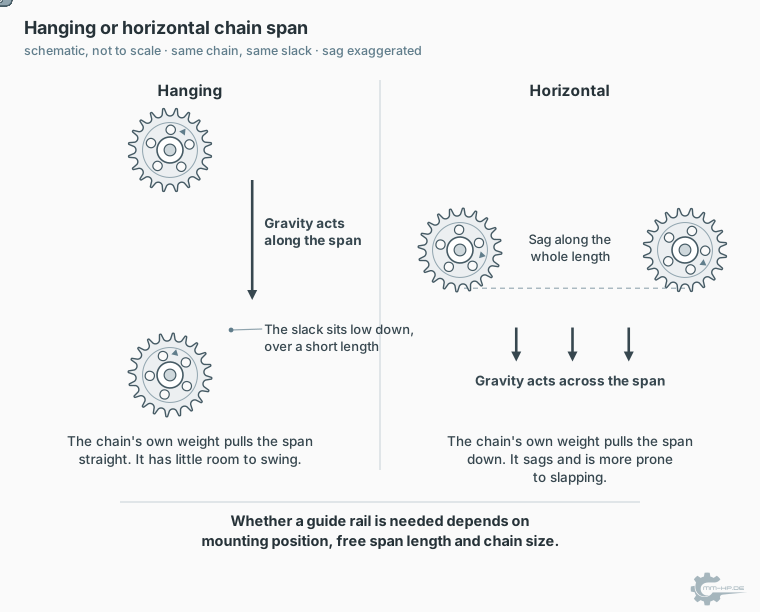
That is why we decide for each installation location and each design individually whether a guide rail is needed and what it looks like. What a guide rail has to withstand and what it is made of is covered in the article on timing chain guide and tensioner rails.
¶ Lessons from other manufacturers' failures
That the tensioner of all things is the critical component of a chain drive doesn't need a theoretical argument. Failure statistics from the last fifteen years have demonstrated it twice at mass-production scale, and both cases are instructive precisely because they don't involve our own engines.
VW EA111 (1.2/1.4 TSI): the timing chain drives of this petrol engine generation started failing in some cases after as little as 30,000 to 40,000 kilometres. Workshop trade portals name the tensioner as the core problem: a weak locking mechanism lacking an effective check valve, so the tensioner couldn't hold its position without oil pressure, combined with wearing guide rails. VW itself gave a different cause in 2012. According to the German business daily Handelsblatt of 13 April 2012, VW admitted a production defect on the 1.4-litre TSI: the chain supplier had used its punching tools „über deren Verschleißgrenze hinaus“ (beyond their wear limit), as the head of VW quality assurance told the magazine Auto Bild. Chips and burrs formed on the chain plates, and the chain wore out quickly in service. That is a manufacturing defect in the chain, not in the tensioner. The two explanations do not exclude each other, and both lead to the same failure pattern. The result was the full programme from this article: slack, rattle, accelerated elongation, a chain jumping teeth, engine damage. According to the workshop portals, VW also revised the tensioner in 2012. For the successor generation, the EA211, VW switched to a timing belt entirely.
BMW N47 (2.0 diesel): here, guide rails and tensioner fell into disrepute together. Workshops observe that the plastic rails harden over the years and break, and that the hydraulic tensioner eventually can no longer keep up with growing chain elongation. We have not found a published laboratory analysis of broken N47 rails, and even the rail material is given inconsistently in the sources. That heat in the oil made the rails brittle is therefore a plausible assumption, not a finding. What is known about plastics, temperature and ageing is covered in our article on timing chain guide and tensioner rails. Here too the wear spiral ended in catastrophic engine failure. Workshop trade portals name a reinforced tensioner, tougher rails and revised chain geometry as the successor generation's fix. We have not found a manufacturer document on this.
A third case comes from our own engine family, and it's the most instructive of all: the drive chain of the early EA189 balancer shaft modules. This chain was tensioned by a hydraulic tensioner — in other words, by a component that itself depends on oil pressure. When the hexagon drive dog wore down and the module's oil pump was no longer driven cleanly, oil pressure fell, the tensioner lost its tensioning force, the chain began to slap, and it tore the entire drive unit apart. The full story is in the module article. For this chapter, it delivers the third lesson: a hydraulic tensioner is only ever as good as the oil supply behind it. A chain drive hanging off an ailing oil system loses its tensioning system too, at the worst possible moment — and that's exactly why, in our conversions, chain design and pump design have to be thought through together: the chain in our conversion hangs off a pump with reserves, not a dying one.
The punchline of all three cases is the same, and it's often read backwards: not "chains are problem parts," but "chain drives stand or fall with their tensioning system and its supply." In all three cases the system meant to hold the chain's tension was involved, and with the EA111, according to VW, a manufacturing defect in the chain itself as well. Anyone who concludes from this that you can simply leave out the tensioning system has read the statistics completely against their own content.
¶ How to recognise a tired tensioning system
There's a practical benefit to draw from these failure cases, because an ageing tensioning system often announces itself audibly. The sounds are hints, not a diagnosis, but they tell you when a look in the workshop is worthwhile:
| Sound | Likely meaning | Urgency |
|---|---|---|
| brief rattle only on cold start, gone after a few seconds | tensioner lost some oil overnight and refills until oil pressure builds. Normal on many engines | no action needed, keep an eye on how long it lasts |
| cold-start rattle gets clearly longer over months | tensioner or chain may be wearing | schedule a workshop visit |
| rattle also on a warm restart or at idle | tensioning system can no longer hold the chain even with oil pressure | have it checked promptly |
| persistent chain slap, plus fault codes for camshaft position | elongation beyond tolerance, tooth-jump imminent | stop driving, have it checked |
The table is not a timeline. Many engines rattle for a second or two after a cold start for years without it ever turning into more. Manufacturers say so explicitly in their workshop documents. Mercedes writes about the start-up rattle of its M276, M278 and M157 engines: "No consequential damage is to be expected." Audi writes about the rattle of the V6 3.0 TFSI in the first one to three seconds after the first start of the day: "The noises do not lead to damage." Ford wrote in 2021 about cam phaser rattle on the 3.5-litre V6 in the F-150: "A cam phaser that has developed an undesirable noise does not affect the vehicle safety, performance, or emissions." It becomes serious when the picture changes: when the rattle lasts longer, also appears when warm, or comes with fault codes. If you note how long the sound lasts in the morning, you will notice such a change early. How to read the rattle by duration and timing, and when it isn't coming from the tensioner at all, is covered in our article Timing chain rattle on cold start.
For the oil pump drive, the caveat from the chapter above applies: it has this vocabulary only to a limited extent, since it sits deep inside the engine and its noises are more easily masked by the running crank drive. That makes what the design itself brings to the table all the more important — which brings us back to the original question.
¶ Why a chain drive without a tensioner is not an option
Which leaves the original question: why are there conversions on the market without a chain tensioner at all? The reasons are economic, not technical. A tensioner costs money, it needs installation space, and it has to be designed, tested and manufactured. Leave it out and the conversion gets cheaper. The argument that usually follows is: short chain, little elongation, no tensioner needed. We consider it wrong, and we advise against fitting a chain without a tensioner in every case.
Why, you have read in this article. Every chain elongates, and it does so first during running-in, after just the first few thousand kilometres. A chain fitted without a tensioner is then longer than at assembly, and nothing takes up the difference. Even this smallest elongation is enough for the chain to start flapping in the slack strand, because, as the table above shows, half a millimetre of extra length turns into several times as much movement. Every one of these flapping movements disturbs smooth running, the links strike the teeth hard, the joints wear beyond the normal rate, the chain gets longer and flaps even more. It winds itself up until the chain jumps a tooth or breaks. Add operation on top: the centre distance isn't a fixed drawing dimension in a warm, working engine. Thermal expansion, bearing clearances and load changes make the tension in the strand fluctuate, and whatever the design doesn't take up turns into slack and vibration.
A short centre distance doesn't change this. It becomes especially clear when the drive is installed horizontally, when it runs in a speed range in which the free strand starts to vibrate, or when running-in costs the chain the decisive millimetre right at the start. A drive without a tensioner may run unremarkably on day one. It gets worse with every kilometre, with nothing re-adjusting and nobody noticing. That some suppliers leave the tensioner out to save cost is therefore, in our view, the wrong place to save, because the service life of the whole drive depends on it. A drive with a tensioner also ages, but is continuously re-adjusted and damped as it does.
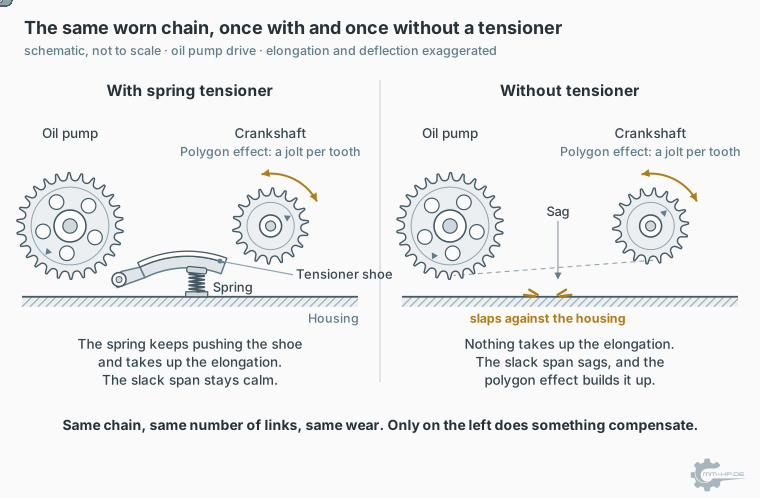
The picture shows both drives with the same chain, elongated by the same amount. On the left the spring pushes the tensioner forward by exactly the length the chain has grown, and the slack strand stays calm. On the right nothing takes up that length. The strand sags, the polygon effect kicks it with every tooth, and it starts to slap against the housing, against the sprockets and against itself.
You could also put it in the language of our design article: anyone who leaves out the tensioner is betting that running-in, thermal expansion and wear on that specific engine will turn out favourably over its entire remaining service life. From everything we know about chains, that bet doesn't pay off. We fit the tensioner because we design conversions for the full second half of an engine's life, not just for the first unremarkable years afterwards. For a component whose failure destroys the entire engine, we consider any other decision the wrong place to cut costs.
¶ From running-in to breakage
How this ends is shown in the animation of a vertical oil pump drive, with the crankshaft at the bottom and the oil pump at the top. On the left the chain runs without a tensioner, as short as possible and fitted without slack. On the right the same drive runs with a tensioner rail that a spring presses against the slack span. It has its own geometry, because no tensioner added from the side fits the shortest possible chain. Both run at the same engine speed and the same mileage. In the worked example with an 8 millimetre pitch and 50 links, running-in makes the chain 0.4 millimetres longer, and that alone moves the slack span about 4 millimetres sideways. Above a certain engine speed a wave forms, the chain slaps against the housing, and every slap stretches it further. In the end it climbs onto the teeth of the pump sprocket and breaks. The crankshaft keeps turning, the oil pump stops, the oil pressure drops to zero, and shortly afterwards the engine is finished. On the right the spring pushes the rail on by exactly the amount the chain grows. Chain and oil pressure stay calm.

Schematic, dimensions as a worked example. Same engine speed, same mileage: without a tensioner the drive ends in breakage, with a tensioner it keeps running calmly. The grey zone of the gauges below 1 bar is where such a gauge no longer guarantees an accurate reading (why).
¶ Why a chain at all?
That leaves one last question, the question behind the question: why do we rely on a chain for the oil pump drive at all, when the engine world knows other concepts too? The answer comes from comparing the three types of drive that could do this job, and it turns out clearer than you might expect.
Positive-locking drive via a drive dog, the factory solution used in the EA189 with balancer shaft module, is compact and cheap, but concentrates the entire power transmission onto a tiny, wearing contact surface, with the well-known consequences. The wet timing belt (belt-in-oil) runs quietly and with low friction, but is made of an elastomer that chemically lives and dies in ageing oil — we've covered that trade-off in detail elsewhere. The chain, finally, is the only one of the three concepts made entirely of metal: oil quality is chemically irrelevant to it, it knows no degradation, and its only ageing mechanism, joint elongation, is exactly the one a tensioner is built to master.
That's the real point of this article, and it answers the customer's original question more completely than the tensioner alone could: a chain with a tensioner is the combination in which every known weakness of the system has a component responsible for countering it. The tensioner catches the elongation, helps damp the vibration, and the material doesn't age with the oil. A chain without a tensioner would have left its main weakness unanswered — which is exactly why the tensioner was never an optional extra for us, but part of the concept from the start.
The same logic, incidentally, is why we don't use the chain only in the EA189 module replacement: in the engine variants whose oil pump runs from the factory off a wet timing belt, our conversions replace that belt with exactly this reinforced, high-performance chain and a newly designed pump drive. The elastomer part with its unsolvable wear problem disappears, replaced by the drive element whose one ageing mechanism is controllable. The same decision, made twice, for the same reasons.
¶ See also
- The timing chain drive: design, wear, oil supply
- Timing chain rattle on cold start: tensioner, phaser or chain?
- Timing chain guide and tensioner rails: what plastic is inside, and what heat does to it
- The balancer shaft module in the 2.0 TDI (EA189)
- Understanding the oil pump: what it delivers, what limits it and what it fears
- Why more delivery rate is always the better choice
- Wet timing belt: the time bomb you can't inspect
- The oil-pressure warning light: what it tells you, and what it doesn't
Transparency note: we develop and sell the chain conversion mentioned here ourselves. The elongation and phase-offset figures come from workshop trade portals and are marked as typical reference values; the EA111 and N47 failure patterns come from workshop trade portals and the press (Handelsblatt, 13 April 2012), the statements by Audi, Mercedes and Ford on start-up rattle from their workshop documents. We do not publish the design details of our own tensioning system.