¶ Glossary: technical terms on oil supply and TDI engines
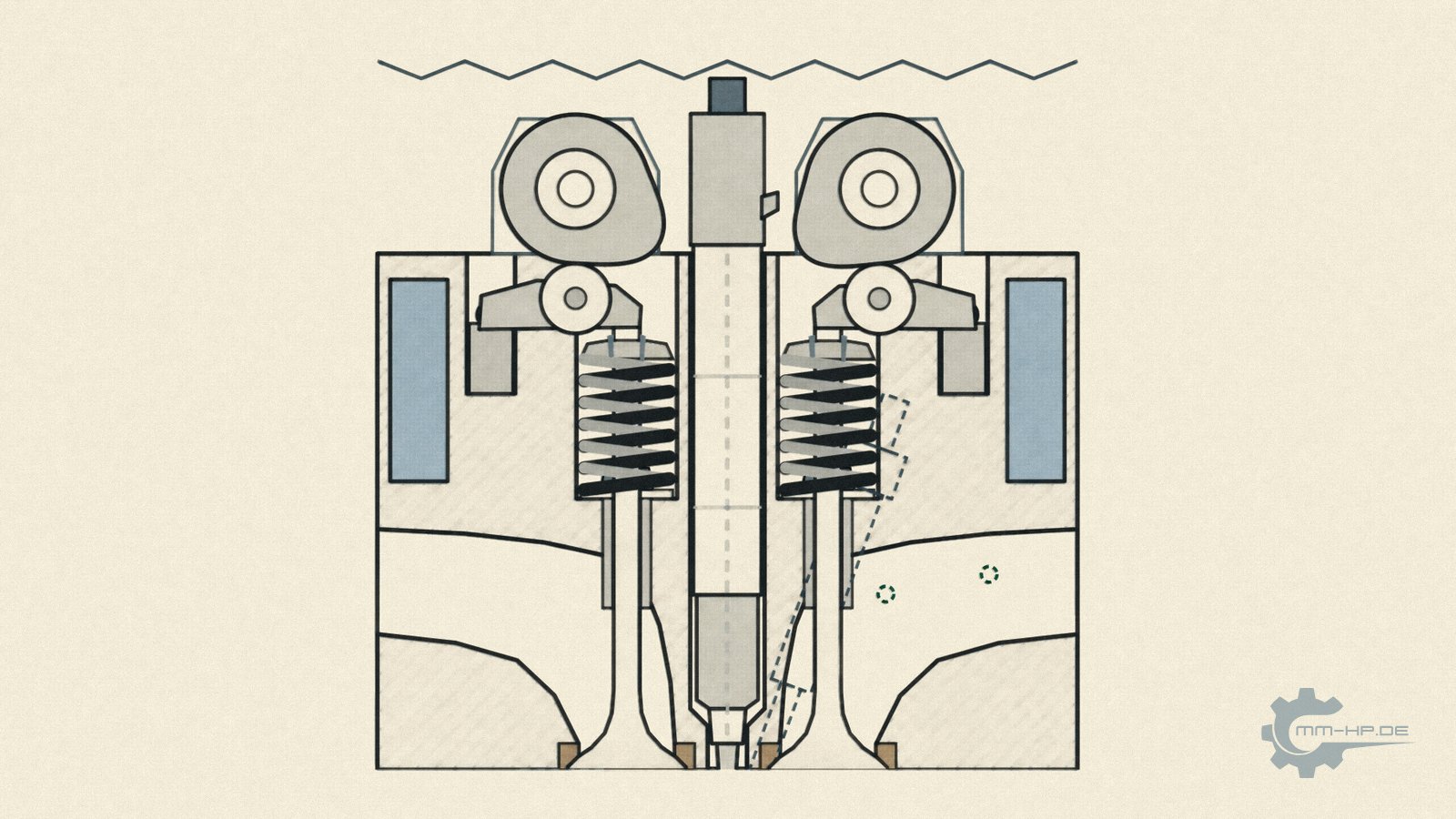
Cylinder head in section: almost every part has its own technical term.
Short explanations of the terms that keep coming up throughout our knowledge section. Where a detailed article exists, it's linked.
¶ Oil supply, measurement and engines
¶ Balancer shaft module (BSM)
Assembly in the oil pan of certain 2.0 TDI engines. Contains two counter-rotating balancer shafts for vibration damping and, integrated there for space reasons, the oil pump. Detailed article
¶ Blueprinting
A practice from motorsport: every dimension of a series-production engine is individually measured and reworked to a tight target to eliminate production variation. Its very existence is the best proof that identical engines are not identical.
¶ CFCA
Engine code of the 2.0 BiTDI with 132 kW (180 hp) in the VW T5, model years 2009 to 2015. Due to its distinctive failure pattern, a special case with its own page on our site.
¶ EA189
VW engine series (2.0 TDI common rail and, within the family, the preceding pump-injector design), built in the millions. Within the series there are different oil-pump designs: with balancer shaft module, without the module using a timing-belt-driven oil pump, and special cases such as the CFCA.
¶ EA288
Successor series to the EA189 (1.6 and 2.0 TDI). Drives the oil pump via a timing belt running in oil — an issue of its own with a solution of its own.
¶ Delivery rate (delivery volume / flow)
The amount of oil a pump moves per unit of time. Not to be confused with oil pressure: the pump generates a volumetric flow, and pressure only arises from the resistance of the gallery system. More on this
¶ Positive/form-fit connection
Force transmission through the shape of two components — in the hexagon drive dog, via the six flanks in the bushing. As the form-fit connection wears down, the drive dog eventually stops transmitting torque at all.
¶ Accuracy class
Classification of pressure gauges by permissible deviation (DIN EN 837-1), referenced to full-scale value and to static pressure. Says nothing about behaviour under rapid pressure changes. Why this matters
¶ Main oil gallery
Central distribution line of the oil circuit in the engine block, from which bearings, cylinder head, and spray jets are supplied. A common reference measurement point, but not the end of the supply chain.
¶ Hydrodynamic lubrication
Operating state of a plain bearing in which the rotating shaft itself builds up a load-bearing oil wedge. Only works as long as enough oil is continuously supplied into the gap — which is exactly what supply pressure is for.
¶ Bearing bore line (main bearing alignment)
The alignment of the crankshaft main bearings in the engine block. Their bores are line-bored and finish-machined in production, and their supply of pressurised oil is the single most important task of the entire oil system.
¶ Drive dog (hexagon drive dog)
Hexagonal pin roughly 6 mm across flats that drives the oil pump on the EA189 with balancer shaft module. The best-known wear part of this design. Detailed article
¶ Pressure relief valve (PRV)
Spring-loaded piston at the outlet of the oil pump. If oil pressure exceeds the set threshold, the valve opens and routes the excess directly back into the oil pan. Caps system pressure at the top end and rules out over-supply by design. How it works in detail
¶ Filter bypass valve
Valve at the oil filter that reacts to the differential pressure across the filter element. Opens when the filter is clogged or the oil is very thick, and routes the oil around the filter unfiltered so lubrication doesn't fail. Side effect: in bypass operation, particles reach the entire circuit unfiltered. Why this becomes critical with debris in the oil
¶ Oil-pressure switch
Switch with a fixed pressure threshold at a single point in the oil circuit. Controls the warning light but is not a measuring instrument. What the warning light really tells you
¶ Oil spray jets (piston-crown cooling)
Jets in the crankcase that spray pressurised oil upward against the piston crowns from below, carrying away a large share of the piston heat. Only open above a minimum oil pressure. Relationship with oil temperature and coking
¶ Ra / Rz (surface roughness)
Parameters for the roughness of a machined surface. In series production, they change with the wear condition of the tool and affect the flow resistance of oil galleries. More on this
¶ Tool life
The service duration of a cutting tool from new to a defined wear limit. Within its tool life, the tool's machining result changes — one of the roots of production variation.
¶ Stage 1 / Stage 2
The two versions of our conversion oil pumps: Stage 1 at 35%, Stage 2 at 116% more delivery rate than the standard pump. Stage 2 is the variant with large reserves: it also compensates for already worn engines and covers unfavourable conditions. Because the condition of a used engine cannot be precisely determined from the outside, it's our general recommendation. On the CFCA, we supply Stage 2 exclusively.
¶ VHFI (Volumetric Hydrodynamic Feed-Pressure Index)
Our proprietary metric, which condenses delivery rate, pressure distribution, and dynamic behaviour of an oil system across the operating range into a single index figure. Dedicated article
¶ Viscosity
The thickness of the oil, strongly temperature-dependent. Determines flow resistance and therefore directly affects the measured oil pressure. The main reason why oil-pressure measurements without the same temperature baseline aren't comparable.
¶ Repeatability / reproducibility
Basic measurement-technology terms: repeatability applies under identical conditions; reproducibility, when exactly one condition changes. If several change at once, a numerical comparison is no longer methodologically sound. More on this
¶ Timing drive: rails and plastics
¶ Guide rail
Used in two ways: as the collective term for the plastic rails the timing chain runs along, and often as the name of the fixed guide rail specifically. Guide rails steer the chain and damp its slapping. They are almost always made of polyamide, often as an unreinforced lining on a glass-fibre-reinforced carrier. Detailed article
¶ Fixed guide rail
A rail bolted to the engine on the tight span of the timing chain. It keeps the chain on its path and does not move itself. Often simply called the guide rail. Where it sits and what it withstands
¶ Tensioner rail
The rail on the slack span. It pivots at one end, and the chain tensioner pushes against the other end. Because it follows every movement of the chain, it is generally loaded more heavily than the fixed guide rail (Peter Bauer, "Kettensteuertriebe", 2013). The typical failure is a broken lining at the entry end, where the chain first meets the rail. More on the tensioner rail
¶ Tight span
The taut section of a chain that is currently transmitting force from the crankshaft to the camshaft. In German workshop literature, for example Schaeffler's INA brochure on timing drives, it is called the „Lasttrum". The fixed guide rail usually sits here. Its counterpart is the slack span.
¶ Slack span
The loose section of a chain, on which it runs back (German „Leertrum"). The tensioner rail sits here, and this is where the chain tensioner acts.
¶ PA46
Polyamide 46, a plastic from the polyamide family. It has a higher melting point than PA66 and tolerates more heat, but costs more. The best-known grade for engine components is Stanyl TW341 from Envalior (formerly DSM). According to a 2012 utility patent from chain maker iwis (DE 20 2012 011 592 U1), the continuous service temperature of PA66 is around 30 °C lower than that of PA46. PA66 and PA46 compared
¶ PA66
Polyamide 66, the more common and cheaper polyamide for guide and tensioner rails. According to the same iwis utility patent, it is the material mainly used for guide and tensioner rails because it is cheaper than PA46. Examples are the standard grade Ultramid A3K and the heat-ageing-stabilised Ultramid A3W, both from BASF. PA66 and PA46 compared
¶ Cast PA6
Cast polyamide 6. It is sold as semi-finished stock in sheets and bars for machining, including the blue grades Nylatron MC 901 and Nylatron GSM Blue from Mitsubishi Chemical. According to the manufacturer's datasheets, their continuous temperature is 90 °C and roughly 93 °C respectively, while the same manufacturer's PA46 stock reaches 130 °C by the same definition. Why we don't consider it suitable for the timing drive
¶ Temperature index
A measure of a plastic's heat ageing according to IEC 60216. Samples are stored for long periods at different temperatures until a property such as tensile strength has dropped to a defined residual value. The index is the temperature at which this happens after a stated time, for example 20,000 hours. A higher index means more reserve against heat. Datasheet values are measured in air, not in engine oil. Values for PA46 and PA66
¶ Heat deflection temperature
The temperature at which a test bar deflects by a set amount under a defined load, measured to ISO 75 (HDT). The value depends heavily on the load. The same grade, Ultramid A3K, reaches either 75 °C or 220 °C. The standard itself warns against reading its values as an operating limit. For the question of how long a plastic lasts in hot oil, the temperature index is the right figure. Why the 75 °C is often misused
¶ Leak gap
The narrow gap between the piston and the bore of a hydraulic chain tensioner. When the chain pushes against the piston in a sudden impact, the oil can only escape slowly through this gap, and that is what damps the impact. The leak gap is intended and precisely designed. A leaking check valve, by contrast, is a defect. How a hydraulic tensioner works
¶ Roller chain
Chain design made of inner and outer links. The inner link carries two bushings with rollers turning on them, and in the outer link the plates hold the pins. According to a 2022 review by Paulovics and colleagues, it is a compromise between bushing chain and silent chain and is used comparatively rarely as a timing chain.
¶ Bushing chain
Chain design without rollers. The bushings are larger and engage the sprocket themselves. It has the largest joint bearing area and therefore, according to Peter Bauer's textbook "Kettensteuertriebe" (2013), wears the least. It is found mainly in highly loaded camshaft drives and in diesel engines.
¶ Silent chain
Chain design in which the plates themselves are toothed and engage the sprocket (also called inverted-tooth chain). There is no bushing, the pin runs directly in the punched hole of the plate. Silent chains run quietly but wear and elongate more than bushing and roller chains. A well-known example is the 1.4-litre TSI of VW's EA111 series.
¶ Chain elongation
The permanent increase in a chain's length caused by wear in its joints, not by stretching of the steel. Each joint develops a little play, and across the many joints this adds up. A common design target is a permissible elongation of 0.5 percent at around 250,000 kilometres (Bauer 2013). The tensioner takes up the slack, but it cannot restore the shifted valve timing. Why chains elongate
¶ Boundary friction
A friction regime in which two surfaces touch under load and are separated only by very thin layers formed from the oil and its additives, without a load-bearing oil film. Chain joints run in boundary friction because the pin only swivels through small angles and cannot build up an oil cushion. That is why the joints are sensitive to the condition of the oil.
¶ Phase offset
The rotation of the camshaft away from its target position relative to the crankshaft, measured in degrees of crank angle. An elongated chain makes the camshaft lag behind, and the engine control unit detects this through the sensors on both shafts. According to Bauer (2013), timing shifts of 1.0 to 1.5 degrees are still considered permissible today. A cam phaser or a sensor can also cause a phase offset.
¶ Cam phaser
The component at the end of the camshaft that carries the sprocket. It rotates the camshaft relative to the sprocket during operation to adapt valve timing to engine speed and load, usually using engine oil as the actuating medium. A cam phaser can also rattle briefly after a cold start.
Missing a term? Write to us — we keep expanding the glossary.