¶ Oil Pressure Light On? What It Means and What It Doesn't
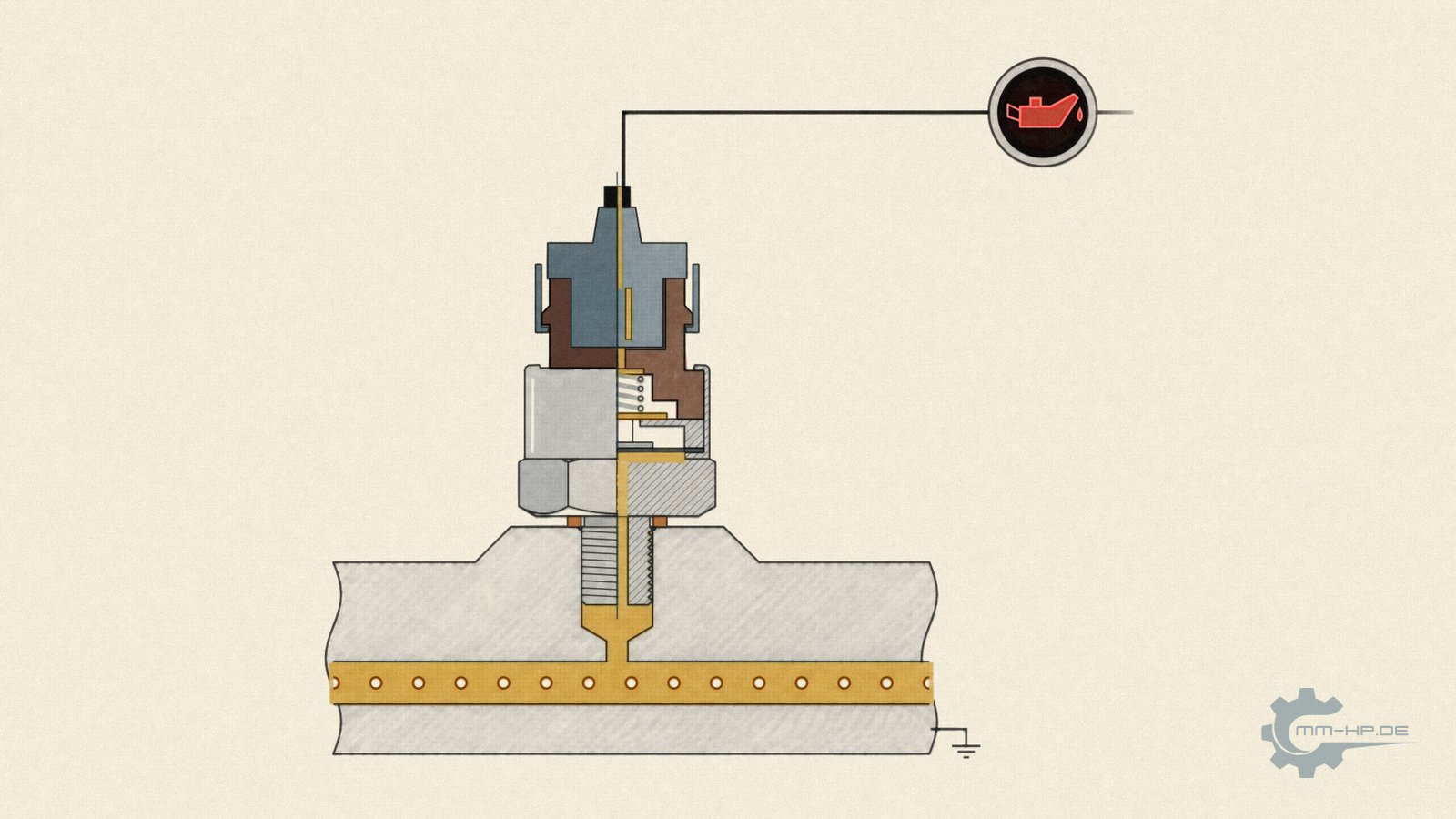
Schematic. The animation is further down in this article.
¶ The key points at a glance
The red oil can in the instrument cluster is probably the most overestimated indicator in the car. Many drivers read it like this: light off, oil pressure fine. That equation doesn't hold up, because behind the light there is no measuring instrument, only a simple switch with a single, deliberately low threshold, mounted at a single point far down the supply chain. It knows neither engine speed nor oil temperature, it doesn't monitor trends, and on the engines covered in this knowledge area the warning concept is kept so simple that not even a disconnected switch connector reliably shows up as a fault. An engine can therefore run for a long time with a sick oil system without the light ever flickering. When it does come on, the problem isn't approaching, it's already here.
Two rules follow from this. First: if the red oil light comes on or flickers, stop as soon as it is safe to do so, switch off the engine and do not restart it until the cause has been found. Not at the next exit, not once you're home. Bearings run dry within seconds once pressure is lost. Second: what belongs on the table afterwards is a genuine pressure measurement on a warm engine, not a switch swap. The reflexively replaced oil-pressure switch is the classic start of a misdiagnosis career, as a case from our own practice shows, where two oil changes and a new switch went by before anyone took real measurements and found the actual culprit.
The long version explains how this switch works technically and why its warning concept kicks in so late, tells the misdiagnosis case in full, translates the various light states into concrete actions, and shows where to actually look once the initial scare is over.
¶ What's really behind the red oil can
Anyone who wants to take the symbol seriously should see what feeds it. The oil-pressure switch is a component the size of a thumb and the complexity of a light switch: a diaphragm pushed against a spring by oil pressure, and a contact that opens or closes. If the pressure at the installation point is above the spring threshold, the light stays dark. If it falls below, the light comes on. That's all. No electronics, no resolution, no trend, two states.

Schematic, not to scale. Two states, nothing more: with pressure below the threshold, the spring presses the contact disc onto the housing, the circuit is closed and the light is on. Above it, the diaphragm lifts the disc. When the pressure hovers around the threshold, the contact keeps opening and closing and the light flickers.
Three design details turn this simple principle into a deceptive sense of safety. First, the threshold: it is deliberately set LOW, typical passenger-car switching thresholds sit around 0.3 to 0.8 bar, so the light doesn't come on for no reason at every hot idle. An engine can therefore be operating well below its healthy pressure level and still stay above the alarm limit. Second, the position: the switch sits at ONE point, often on the cylinder head or oil filter housing, so far down the supply chain, exactly where the pressure is lowest anyway and where many fault patterns show up late or not at all. What happens at the main bearings or in a single supply passage, it simply doesn't see. Third, the inertia of the concept: brief pressure dips in the millisecond range, the early signs of some kinds of damage, never reach the light as a perceptible signal.
¶ How simple is a warning system allowed to be?
The 2.0 TDI generations this knowledge area covers add a quirk that makes engineers shake their heads: the warning concept is also electrically minimalist. Technician discussions document that even a disconnected plug at the oil-pressure switch doesn't necessarily generate a fault-memory entry, plausibility-checking of the signal effectively doesn't happen, the light is simply suppressed during cranking and otherwise hangs directly off the switch. So there's no instance asking, "can this value even be right?" A corroded contact, a damaged cable, a stuck switch, and the "warning system" reliably stays silent, quite literally.
This isn't meant as manufacturer-bashing, but as an expectation correction: this light was designed as the last line of alarm, a shutdown demand for the moment just before the damage happens. Everything before that, the gradual deterioration over months, the shrinking reserves, the differences between measuring points, lies outside its horizon by design. Reading it as a health indicator asks a light switch to perform a diagnosis.
Rule of thumb: the red oil light isn't an early-warning system, it's the last line of the farewell letter.
¶ When VW already knew better: dynamic oil-pressure monitoring
The bitter punchline of this minimalist warning concept: the same manufacturer group had a considerably smarter system in series production decades earlier. It was called dynamic oil-pressure monitoring, it entered the lineup from model year 1985 with the turbodiesels of the Bus and Golf era, and its underlying idea is so obvious that you can explain it to any driver today in one sentence: how much oil pressure counts as "enough" depends on engine speed, so the warning has to depend on engine speed too.
Technically the system consisted of two switches with different thresholds and a small evaluation circuit. The first switch, a normally-closed contact with a low threshold around 0.25 to 0.3 bar, was evaluated independently of engine speed, it corresponds to today's alarm line. The second, a normally-open contact with a threshold of 0.9 to 1.8 bar depending on engine variant, was only armed by the electronics above roughly 2,000 rpm. If pressure at higher engine speed fell below this second threshold for longer than a second, the light flashed and a buzzer sounded, even though the lower alarm limit was nowhere near reached. The system therefore knew: 0.5 bar at idle is everyday business, 0.5 bar at motorway speed is an emergency, and it treated the two situations differently.

Schematic, thresholds without values. The same pressure that is perfectly normal at idle lies in the alarm zone of the second threshold at high engine speed. The 1985 system recognised that; a single switch at the lowest threshold does not.
Read that paragraph twice and hold it against the previous chapter: a warning concept with two thresholds, speed-dependent logic and acoustic escalation, in series production in 1985. Four decades later, the same oil film is once again watched over by a single switch at the lowest alarm limit. Why the multi-stage approach disappeared from the mass market isn't documented, and we won't speculate about motives here. What matters to you as a driver is the consequence: the intelligence that the old system had built into electronics, you now have to bring yourself, namely the knowledge that low pressure at high engine speed is dangerous, long before any light admits it.
¶ The case that shows it all
How expensive this misunderstanding can get is shown by a case from our own practice, told here anonymised because variations of it keep repeating.
A Passat driver notices a brief flicker of the oil-pressure light on the way to work, then nothing more. The workshop he visits reaches for the reflex programme: new oil-pressure switch, oil change, safe travels. A few days later the light is back. Second attempt, this time with fresh oil of a different brand, quiet again, but only briefly. Only the third stop, a different workshop, does what should have happened at the start: a mechanical oil-pressure measurement on a fully warmed-up engine. Result: the pump no longer builds reliable pressure, the readings swing dangerously. On the 2.0 TDI with balancer shaft module, this trail leads with high probability to a known suspect, the wearing hexagon drive dog of the oil pump drive, and that's exactly what it was here. That no bearing damage had occurred between the first flicker and the correct diagnosis was simply luck, the flicker was already the final stage of a long, silent wear process.
The anatomy of this misdiagnosis is worth a second look, because it follows a pattern: the cheapest part in the chain got replaced first, not the most likely one. The switch costs a few euros, the measurement costs an hour of labour, so the switch wins. Except "cheap first" isn't a diagnosis, it's hope with an invoice attached. A new switch doesn't turn too little pressure into good pressure, at best it reports it more reliably.
¶ Reading the light: four states, four responses
To turn theory into action, here is the practical translation table:
| What you see | What it means | What to do |
|---|---|---|
| Light stays ON permanently while driving | Pressure at the switch position below the threshold, acute emergency | Stop as soon as it is safe to do so, switch off the engine and do not restart it until the cause has been found; have it towed, get a mechanical pressure measurement |
| Light FLICKERS (e.g. at idle, in corners, when the engine is hot) | Pressure is oscillating around the threshold, the system has no reserves left | Same as above: stop, switch off the engine, do not restart. Flickering isn't an early warning, it is the warning |
| Light flashes BRIEFLY and disappears | Borderline situation, often the first visible sign of an advanced problem | Don't wait to see if it comes back: get it measured promptly, go easy on the driving profile until then |
| Light stays dark, but consumption/noise/regenerations are noticeable | The light doesn't (yet) see the problem, its threshold and position allow for that | Follow up on the symptoms, don't wait for the light (warning-sign catalogue for the CFCA, oil consumption chain) |
And for the moment of the actual emergency, the physics behind it, spelled out once: without oil pressure the film of oil in the crankshaft and connecting-rod bearings breaks down within seconds, metal runs on metal, and the resulting friction heat welds, chews and destroys faster than anyone can react. Between "light on" and "bearing gone" there are no minutes with the engine still running. A stopped engine, on the other hand, is a saved engine, every towed mile is cheaper than a driven one.
¶ The three seconds after starting
One special case deserves its own short chapter, because it regularly causes uncertainty: the light immediately after a cold start. That it lights up when the ignition is switched on is intentional, that's the bulb check. That it needs a blink of an eye after the engine catches is also normal: the pump first has to push oil through empty passages to the switch position. As a rule of thumb from workshop practice, the light should go out within one to three seconds of starting, a window of three to five seconds is treated as the outer tolerance, though these are experience-based figures, not standard specifications.

Workshop rules of thumb, not standard values: one to three seconds count as normal, three to five as the outer tolerance. Schematic.
What's interesting is what happens inside the engine during these seconds: it genuinely runs briefly without a load-bearing oil film. That it survives this unharmed is down to the emergency-running properties of its bearing materials, which are designed for exactly this recurring brief phase, not for sustained pressure loss while driving. Two practical conclusions follow: a starting phase that noticeably lengthens over the years before the light goes out is a wear indicator worth taking seriously (tired pump, an oil filter running empty, growing clearances) and should be measured. And a cold start followed immediately by full throttle demands the maximum from the bearings at exactly their most vulnerable moment, the first few kilometres belong to the oil, not the rev counter. Incidentally, the brief chain rattle some engines make after a cold start falls into these same seconds: the hydraulic chain tensioner is likewise waiting for oil pressure to build. More on this in the article Timing chain rattle on cold start.
¶ After the initial scare: measure, don't guess
Once the engine has been safely switched off, the real work begins, and its first step is ALWAYS a mechanical pressure measurement on a fully warmed-up engine with documented oil temperature and a defined measuring point, not a multimeter on the switch, not just a look in the fault memory, and certainly not a pre-emptive switch swap. Only a properly taken measurement separates the three possible worlds: an electrical problem (switch, wiring), a systemic pressure problem (pump, drive, bearings, dilution), or a one-off event. Honest framing here also means knowing what a single workshop measurement can and can't deliver, it's sufficient for the yes/no question "is there a serious pressure problem", not for fine diagnosis (and certainly not for comparisons with forum readings).
If the measurement comes back abnormal, it's worth looking at the design-specific suspects before parts start flying: on variants with a balancer shaft module, the drive dog of the oil pump drive tops the list. On the BiTDI in the T5, the whole damage picture of oil consumption, EGR history and oil dilution belongs on the table. And on engines with documented oil consumption, the trail often leads into the blow-by chain, whose oil-dilution stage pulls pressure down system-wide. In all these cases the same truth applies: the cause is practically never the switch.
¶ How modern engines monitor: from switch to sensor
That things can be done better is shown by the present state of engine design, because there the switch has long since evolved into a sensor, for a simple reason: the control unit needs the value itself. Modern engines with map-controlled oil pumps store a target-pressure map in the ECU over engine speed, load and temperature, a genuine oil-pressure sensor continuously supplies the actual value, and an electrically actuated control valve continuously adjusts delivery. A binary switch simply couldn't feed such a control loop. As a side effect, such systems can warn in stages, with a yellow pre-stage ("check") before the red escalation ("stop"), exactly the gradation the single-stage concept lacks.
Alongside this comes a second family of sensors that widens the view from pressure to the oil itself. Thermal oil-level sensors measure fill level via the cooling behaviour of a briefly heated element. Capacitive oil-condition sensors go further: they evaluate the oil as the dielectric of a capacitor and use this to detect water ingress, ageing and fuel dilution, exactly the dilution problem we've dedicated a separate article to. BMW has been condensing such data since 2002 into individual service-due dates via Condition Based Service, and Mercedes has, on quite a few model ranges, replaced the dipstick entirely with an onboard-computer measurement, which incidentally isn't taken at start-up but with the oil warmed up and settled. The trend is clear, and it has a downside that guides rightly point out: where the mechanical dipstick spot-check disappears, the entire truth about the oil hangs on sensors and their plausibility-checking. For the TDI generations covered here, that remains a matter for the future in any case, their series-production standard is and remains the switch. The EA288 does carry several oil pressure switches, but they have different jobs, such as switching the oil pump; none of them delivers a continuously measured oil pressure either.
¶ Could it be monitored better? The retrofit question
The obvious final question: if the standard solution is this crude, why not retrofit something better? There genuinely are oil-pressure SENDERS with an additional gauge that measure continuously instead of merely switching, standard equipment in motorsport. As an early warning for an attentive driver, such gauges are clearly superior to the standard light, with two honest caveats: they too measure at ONE position and thereby inherit all the blind spots of single-point measurement, and their informative value stands or falls with the quality of the sender and its installation.
On installation practice, the key points from workshop experience. The usual route runs via an adapter plate between the oil filter and filter flange, or a T-piece on a free plug, both the standard sender and the retrofit sender find room there side by side. When choosing between gauge types, the safety argument favours the electrical variant: mechanical gauges route the pressure via an oil-filled capillary line all the way behind the dashboard, and a break in this line means hot oil in the cabin. Electrical senders only send a signal through the bulkhead. Two classic pitfalls to close with: an oil temperature sender never belongs in a T-piece, it belongs directly in the oil flow, otherwise it measures the temperature of the adapter instead of the oil. And anyone working on a vehicle with the old two-stage VW warning system must keep the two standard switches apart, swapping the wrong one scrambles the warning logic without anyone noticing.
Our own answer to the monitoring problem sits one level deeper: an oil system that operates with generous reserves makes the alarm question less relevant in the first place, the best warning light is the one that never gets a reason to come on. This reserves philosophy is exactly what's built into the design of our conversion systems, but that's the story told in the other articles of this knowledge area. For this one, the conclusion in a single sentence is enough: trust the red oil can for exactly what it was built for, the very last call, and organise everything before that yourself, with attention to consumption, noise and intervals, and when in doubt, with a genuine measurement.
¶ See also
- The balancer shaft module in the 2.0 TDI (EA189): design, weak point, consequences
- VW T5 2.0 BiTDI (CFCA): the special case
- Oil consumption in the 2.0 TDI: the blow-by chain reaction
- Why off-the-shelf oil-pressure gauges don't deliver reliable readings
- Oil pressure too low after a conversion? The most common causes
Transparency note: MMHP has been developing, testing and manufacturing its own products for the automotive industry for over 25 years, including solutions for the oil supply of VW TDI engines. The customer case described is reproduced anonymised; the details on the warning concept are drawn from documented technician discussions (source dossier).