¶ VW CFCA Engine Problems: Why the T5 2.0 BiTDI Dies of Oil
¶ The key points at a glance
The 2.0 BiTDI with the engine code CFCA, fitted in the VW T5 from October 2009 onwards, is the engine that van forums simply call the "oil-death engine." According to consistent reports, roughly one in ten CFCA units built suffered a major failure — out of around 140,000 units produced, an order of magnitude barely matched by any other engine in the EA189 family.
Behind the "oil death" label, however, are two distinct failure paths that get constantly mixed up in public discussion. Path one starts on the exhaust side: the EGR cooler of early production series decomposes internally, and its aluminium particles migrate into the combustion chambers, where they act as an abrasive on piston rings and cylinder bores. The result is rising oil consumption, which then accelerates itself through carbon build-up. Path two concerns the oil itself: frequent particulate filter regenerations dilute it with diesel, it loses viscosity, and an oil system that already runs without reserves from the factory loses pressure exactly where it's needed. Both paths ultimately converge on the same components: bearings, turbocharger, pistons.
In practice, this means: document oil consumption, diagnose properly instead of guessing at parts when something looks off, and never mistake the warning light for an all-clear system. And for our conversion solution, a firm rule applies to the CFCA: we supply CFCA customers exclusively with Stage 2, at 116 percent additional delivery rate. The smaller Stage 1 assumes a largely healthy engine, and that is precisely what cannot be guaranteed from the outside on this engine.
That was the short answer. From here on follows the long version: the complete engine profile, both failure paths in detail, the EGR cooler's part-number history, the diagnostic sequence from our support practice, and the reasoning behind the Stage 2 rule — everything we can say publicly.
¶ Engine profile: the machine behind the reputation
Before we get into the failure patterns, it's worth taking a sober look at what VW actually built here, because on paper the CFCA was an impressive piece of engineering:
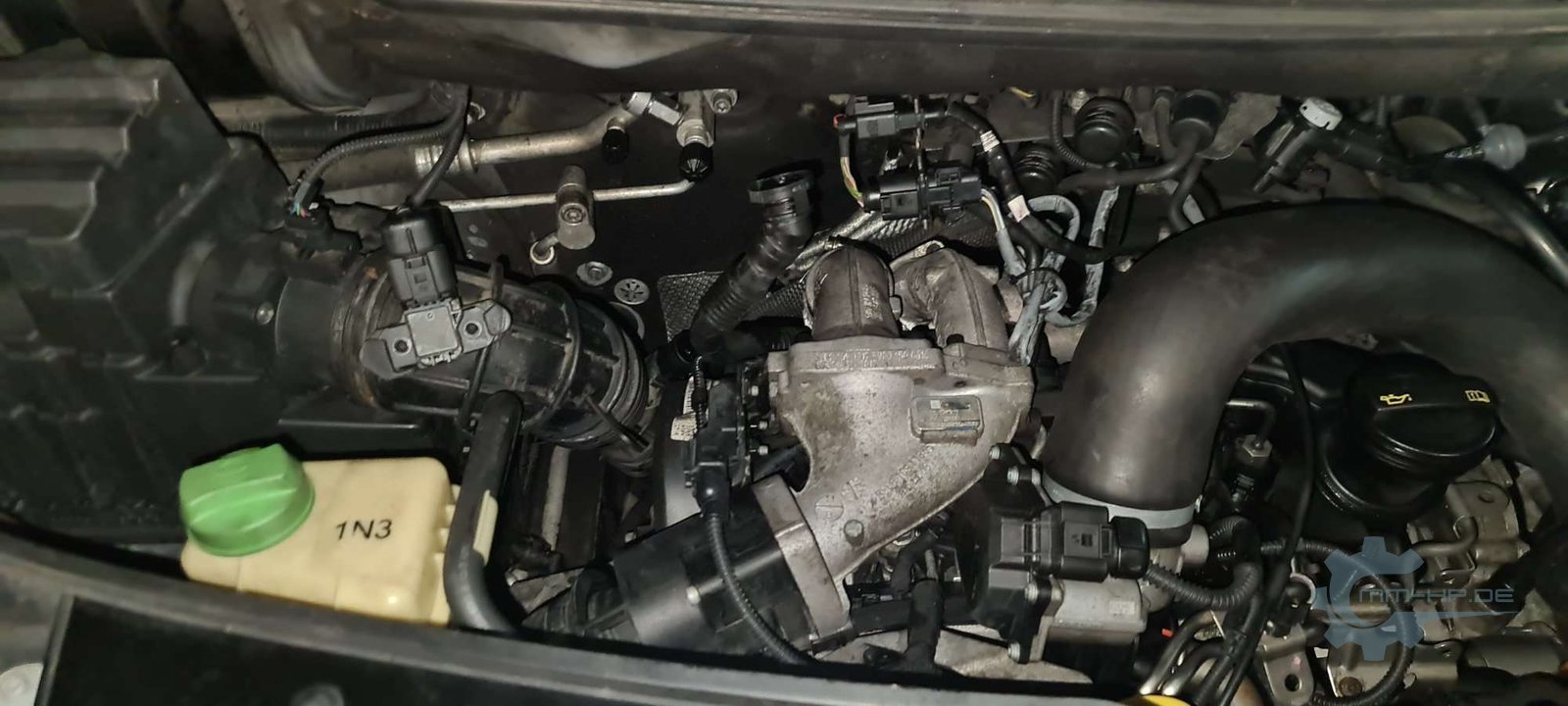
Own photo. Tight quarters in the engine bay of a VW T5.
| Feature | Value |
|---|---|
| Engine code | CFCA |
| Engine family | VW EA189 (2.0 TDI common rail) |
| Displacement | 1,968 cc |
| Bore × stroke | 81.0 × 95.5 mm |
| Power | 132 kW (180 hp) at 3,500 rpm |
| Torque | 400 to 420 Nm (depending on source and version) from around 1,500 rpm |
| Compression ratio | 16.5 : 1 |
| Forced induction | two-stage sequential turbocharging (bi-turbo) |
| Emissions standard | Euro 5, with DPF and water-cooled EGR cooler |
| Oil specification | VW 507 00 (Longlife), capacity approx. 7 litres |
| Production period | 10/2009 to approx. 2015/2016 |
| Vehicles | VW T5 (Transporter, Multivan, Caravelle, California), occasionally early T6, and Amarok |
The CFCA was the range-topping engine of the revised T5, and many see it as the successor to the legendary five-cylinder tradition from the van's history — big shoes to fill. On paper, it filled them effortlessly: more power, more torque, lower consumption, all from two litres of displacement. What made that possible was the most elaborate technology ever fitted to a T5 diesel.
Three lines in the table already tell half the story. Sequential turbocharging first: two differently sized turbochargers share the work — a small high-pressure turbo responds instantly at low revs, a larger one takes over towards full load, with a valve control smoothly blending between them (reports describe the combination as a BorgWarner pair consisting of a small KP35 and a large K04). The result was 400 Newton-metres available practically from idle — a dream in everyday van use.
But it also means: two turbo bearing sets that both need a constant, cooled supply of pressurised oil, doubled heat sources in the engine bay, and a unit that, in the heavy, often fully loaded T5, runs under high load more often than average. The second notable line is the Longlife oil with a capacity of around seven litres and long change intervals — we'll come back to this, because long intervals and this engine's weaknesses don't mix well. And the third is the production period: the CFCA belongs to the EA189 family and therefore also carries its oil-system design with the balancer shaft module, including the compact-built oil pump.
One more clarification that's constantly needed in support: the CFCA is mainly fitted in the T5 and the Amarok, but it was still used occasionally in the first model years of the T6. That is less surprising once you know that the T6 is technically a very far-reaching facelift of the T5. Only later did the EA288 take over in the T6. And because the T5, T6 and Amarok all came with various engines, the same rule as always applies: anyone who wants to know for certain what's fitted should check the engine code, not the horsepower figure or model name.
¶ One van, two turbos, no reserves
Picture a California, fully loaded, four people, bikes on the rear rack, on the Brenner motorway in summer. Both turbochargers are glowing, the pistons are being oil-cooled from below by spray jets, the cooling system is working flat out, and hot exhaust gas is flowing through the EGR cooler, which has to bring it back down to temperature on its way back into the intake tract. This is exactly the load profile the CFCA was bought for — and exactly the load profile that exposes its design weaknesses.
Because this engine's oil budget is stretched tight. The oil here has to do more work than in almost any other engine in the family: lubricating and cooling two turbochargers, protecting the piston crowns from combustion heat via spray jets, and handling normal bearing and valvetrain supply on top of that. This flow is delivered by the familiar EA189 pump — made deliberately small due to space constraints — sitting in the balancer shaft module at the end of a long drive chain. Every additional consumer, every extra degree of oil temperature, and every percentage point of viscosity loss eats into a buffer that was never generous to begin with (why pressure is different at every single point in the engine anyway, read here).
On top of that comes a monitoring system that barely deserves the name: a single oil-pressure switch with a fixed threshold, positioned far down the supply chain, with no trend measurement and no plausibility check. In technical circles, this engine's warning concept is openly described as primitive. A CFCA can already be critically underserved at the crucial points while the cockpit is still showing complete calm (what the warning light can actually tell you — and what it can't).
Onto this already stretched system now converge two failure paths that reinforce each other. The first begins in a place nobody would suspect.
¶ Failure path one: the cooler that tears itself apart
The water-cooled EGR cooler sits in the exhaust gas recirculation system and has a thankless job: cooling down exhaust gas that's several hundred degrees hot and chemically aggressive, thousands of times per journey, for years on end. In early CFCA production series, the aluminium cooling fins couldn't withstand this constant load. They oxidise and decompose from the inside, and their fragments — described in technical discussion as corundum-like, i.e. related to abrasive material — are carried by the recirculated exhaust gas directly into the intake air and from there into the combustion chambers.
That's where a self-feeding wear process begins. The particles act like fine sandpaper between piston, piston rings, and cylinder bore. The rings lose their sealing effect, oil enters the combustion chamber and burns off, and oil consumption rises. Burning oil leaves carbon deposits, which further seize the rings in their grooves, raising oil consumption even more. More blow-by gas pushes oil mist through the crankcase ventilation towards the turbocharger. At the end of this path stand worn cylinder bores, seizing rings, dying turbochargers, and, in the worst case, a replacement engine. Reports mention early oil-consumption symptoms from around 70,000 kilometres and repair bills running into five figures.

Failure path one over the mileage: fin fragments reach the combustion chamber on the intake stroke, score marks let oil past, carbon seizes the rings, and blow-by pushes oil mist towards the turbo.
VW revised the cooler several times over the years, and this part-number history is worth real money to any CFCA owner, because the fitted revision level lets you gauge the risk:
| EGR/combination cooler (part-number series 03L 115 512) | Assessment |
|---|---|
| 03L 115 512 A | early original equipment, the problematic version |
| 03L 115 512 C | interim revision |
| 03L 115 512 D | revised version with more durable cooling fins, reportedly fitted from late 2015 onwards and established in the spare-parts trade as the "correct" version |
Important when replacing parts: there's a second, similarly named part-number series (03L 131 512) that refers to the EGR valve or module. Anyone who only replaces that number may not have touched the critical cooler body at all.
That this isn't a case of individual bad luck is shown by the scale reported in press and legal coverage: around 140,000 engines built, a failure rate of about ten percent, thousands of documented cases. There was never a mandatory recall; cost coverage ran on a case-by-case goodwill basis. That's the material the forum name "oil death" was born from.
⚠️ WARNING: Rising oil consumption on the CFCA. Source of danger: progressive ring and bore wear that accelerates itself. Possible consequence: major engine failure up to and including a replacement engine. Action: document oil consumption in writing from the first time it's noticed (mileage and amount topped up) and work through the diagnostic sequence further below instead of waiting. A CFCA that visibly consumes oil will not get better on its own.
¶ Failure path two: when the oil itself becomes the problem
The second path is quieter and therefore routinely overlooked. It concerns not the hardware, but the fluid on which the engine's survival depends.
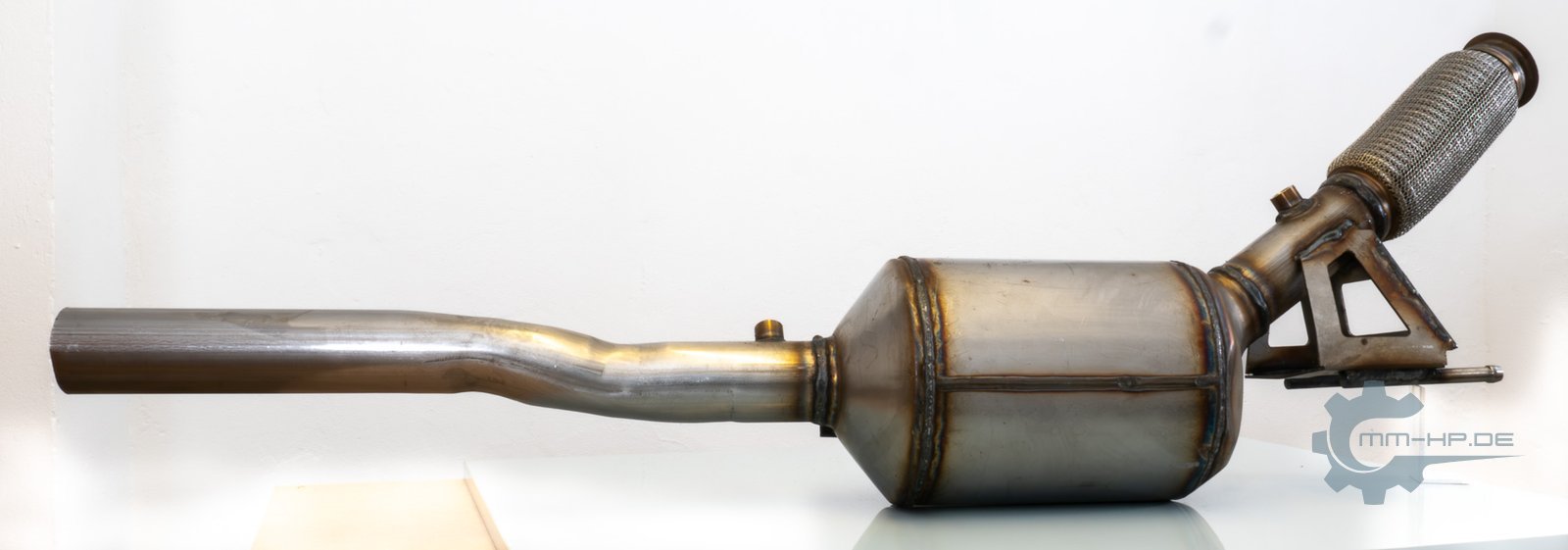
New part, own photo. A diesel particulate filter from the T5: ash from burnt engine oil stays in it for good.
The CFCA carries a diesel particulate filter, and it has to be burned free regularly. There are two ways this happens:
| Regeneration type | When | Filter temperature | Mechanism |
|---|---|---|---|
| passive | continuously during brisk driving | approx. 250 to 500 °C | soot reacts continuously with the nitrogen dioxide in the exhaust gas |
| active | initiated by the ECU once soot loading reaches the limit | approx. 600 to 700 °C | an additional late post-injection deliberately heats up the exhaust gas |
The passive variant is uncritical; it just needs enough load and distance. The active one is problematic: the late post-injection doesn't burn completely in the cylinder, part of the diesel forms a film on the cylinder wall and gets scraped into the engine oil by the piston rings. So every active regeneration dilutes the oil a little. Anyone who drives a lot of short trips, and thereby frequently interrupts regenerations, accumulates diesel in the oil the way other people collect loyalty points. Engine management systems calculate this dilution level internally; the technical literature cites around eight percent fuel content as the critical mark.
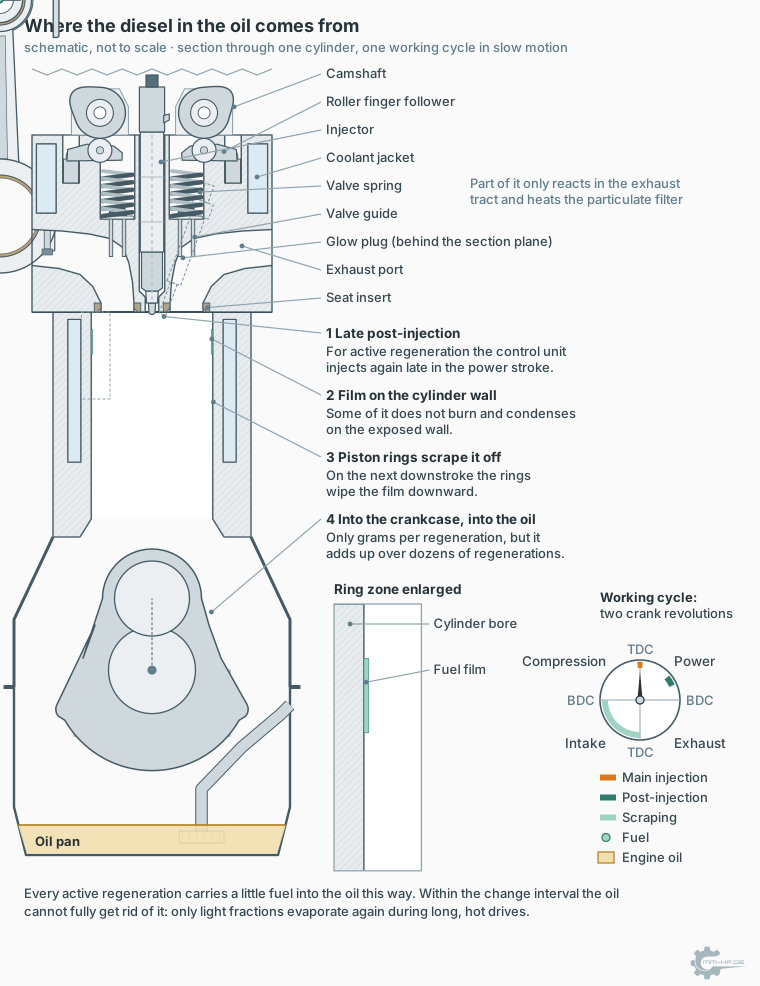
Preview from the article on oil dilution: the fuel's path from the post-injection via the cylinder wall down into the oil pan.
➜ Where the diesel in the oil comes from, step by step
Diluted oil is thinner oil. And with the same pump and the same engine, thinner oil means: less pressure at every single point in the supply chain, weaker lubricating films in the bearings, less cooling effect at the pistons. On the CFCA, this loss of viscosity meets the already reserve-less oil system described above, and long Longlife intervals in which dilution and oil ageing are free to add up undisturbed. You don't need to be a prophet to see where this combination leads under unfavourable driving profiles. Then there's the temperature side: hot, aged oil cokes faster on the rings and in the turbo tract — we've described the relationship between oil temperature, coking, and service life in detail here.
The two paths, incidentally, aren't alternatives — they cooperate. The EGR path raises the oil's thermal load via blow-by and oil consumption; the dilution path lowers its protective effect against exactly that wear. That's why CFCA engines die at such different speeds: it depends on which path wins the race under which driving profile.

Two paths, the same places: path one grinds rings and bore and heats the oil, path two thins it. Both meet at the piston, turbocharger and bearing.
¶ Why everything gets mixed up in the forums
Anyone who reads through the relevant threads finds everything under "oil death": EGR splitters, seized crankshaft bearings, dead turbos, oil-pressure warnings on a hot engine, sudden total failures. What almost never happens is a clean separation of which case belongs to which path. Oil-pressure drop appears in many reports only as a final stage, without it being clear whether it was cause or consequence. Workshops then like to replace the cheapest link in the chain — the oil-pressure switch — and the engine keeps dying with a fresh switch fitted.
This mix-up has a simple reason: from the outside, both paths look the same for a long time, and the onboard electronics don't help distinguish them. The causes can really only be separated with a systematic approach — documented oil consumption, DPF and EGR data from the ECU, genuine pressure measurement under defined conditions, and, when in doubt, endoscopy. In our own investigations of this engine type, measured with our multi-position measurement technology and condensed into our internal comparison metric VHFI, the CFCA in standard condition ranks among the most conspicuous engines we've measured. That matches its reputation: among all variants of the EA189 family, the CFCA is considered the most problematic worldwide.
And one more forum classic belongs in this chapter: mix-ups. Anyone searching for "T5 oil pressure" often lands on posts about the hexagon drive dog problem of the transversely mounted EA189 (our foundational article on that), whose failure pattern is completely different. Conversely, the CFCA's EGR issue is often projected onto engines it doesn't affect at all. The engine code decides, not the similarity of symptoms.
To put this distinction in black and white once and for all: as an EA189 engine, the CFCA also carries the balancer shaft module with its drive-dog design in the oil pan, but its FAMOUS problem is not the drive dog — it's the EGR/oil combination described in this article. Both are separate issues within the same engine, and both ultimately affect the oil supply. That's precisely why our conversion solution for the T5 treats the engine as a complete system: the module, including the drive dog and small pump, is removed entirely and replaced by direct drive with the large pump, in the installation position the T5 requires. Anyone who only tackles a single symptom always leaves half the failure chain in the vehicle on a CFCA.
¶ Buying used: what to watch for on a T5 BiTDI
The 180 hp T5 is both coveted and feared on the used market, and both feelings are justified. Anyone considering a purchase can significantly reduce the risk with an hour of diligence. From the documented failure histories and our support practice, this checklist emerges:
- Ask about oil consumption in writing. Not "does it need oil?" but specifically: how many litres over how many kilometres, since when. Evasive answers are an answer in themselves.
- Clarify the EGR cooler history. Was the cooler replaced, when, and to which part number (the 03L-115-512 series from the table above)? A vehicle with a documented D-revision replacement is a different risk than one with original equipment.
- Read the service book for intervals. Consistent Longlife intervals combined with a lot of short-distance driving are the worst possible history for this engine. Shortened fixed intervals are a good sign of a knowledgeable previous owner.
- Experience a cold start. Start the engine cold (touch the bonnet beforehand — a pre-warmed "cold start" at the viewing appointment is a classic trick), and watch for rattling, blue smoke, and the oil-pressure light.
- Have the DPF and fault-memory data read out. Regeneration frequency and ash value tell the true usage history, regardless of what the seller says.
- Test drive under load. A motorway stretch with a share of full throttle, then at standstill: fan behaviour, smell, oil-level check. Many issues only show up once the engine is warm.
None of these checks make the purchase risk-free — the failure paths work in the background. But they filter out the obvious candidates, and they shift the negotiating position considerably.
¶ Warning signs you should take seriously
From the documented failure histories, a list of symptoms emerges where a CFCA should be examined, not just "watched":
- noticeably rising oil consumption, the lead symptom of path one (regular topping up between intervals)
- rising oil level without topping up, the lead symptom of path two (diesel in the oil)
- oil-pressure warning, even if it only lights up briefly (stop as soon as it is safe to do so, switch off the engine and do not restart it until the cause has been found)
- noticeably frequent or interrupted DPF regenerations, recognisable by fan run-on, elevated idle speed, briefly increased consumption
- coolant loss with no visible cause, a possible sign pointing to the EGR cooler
- turbocharger noises or oil in the charge-air system as late-stage signs of either path
Any one of these signs on its own can be harmless. Two of them together are, on a CFCA, grounds for investigation.
¶ Diagnose properly instead of guessing at parts
When a CFCA starts acting up, this sequence has proven itself in practice, before any part is replaced on suspicion:
-
Secure baseline data. Document oil consumption in writing (mileage and amount topped up), smell the oil (a diesel odour points to dilution), log coolant level over several weeks.
-
Read out the fault memory and DPF data. Soot loading, regeneration frequency, ash value and EGR readings often tell the engine's history more honestly than any test drive.
-
Measure oil pressure mechanically. On a fully warmed-up engine, with oil temperature noted and a defined measurement point (why this is critical). A rule of thumb circulates in reports according to which a warm idle pressure below one bar is a very bad sign. We consider the hard threshold misleading and prefer to put it as a gradient: the further the warm idle value slips below roughly one bar, the thinner the reserve gets and the less further "watching" is worth. No factory specification draws a line there beyond which something different suddenly applies.
There is a reason for that caution, and it has nothing to do with the engine, it has to do with measuring. In exactly this range the reading is at its least certain: on the usual 10-bar scale of a test kit, a value below one bar sits under ten percent of the indicating range, and there DIN EN 837-1 no longer guarantees the accuracy class at all for gauges with a pointer stop. The permissible deviation can therefore be larger than the difference being argued about. A figure just below the rule-of-thumb threshold is thus a reason to measure more carefully, and not yet a diagnosis. Also keep in mind what a single gauge reading can and can't tell you, and why the instrument itself becomes the problem here.
-
If cylinder-bore wear is suspected: endoscopy and a leak-down test, check the turbocharger for oil carry-over.
-
Identify the EGR cooler. Check the part number or revision level of the fitted cooler (part-number series 03L 115 512, see table above).
Prevention is possible independent of any retrofit: shorter oil-change intervals instead of Longlife starve the dilution and ageing path of fuel, and driving profiles that allow the particulate filter to complete full regenerations (regular country-road or motorway stretches) noticeably reduce the post-injection burden. Both cost almost nothing and, on the CFCA, aren't pedantry — they're risk management.
¶ After a rebuild: the second critical moment
A chapter we've added to this article after the fact, because our support data demands it: many CFCA engines we deal with are no longer original units. This engine's failure history means that a significant share of the units still on the road have had at least one engine rebuild behind them, and it's precisely in this group that we're noticing a cluster of low oil-pressure readings, which we're currently collecting systematically.
The technical explanation fits disturbingly well with everything in this article. The CFCA tolerates rebuild variance worse than more forgiving engines: its oil system runs with no meaningful reserves, the thermal load is high, and oil dilution additionally gnaws at the viscosity. A tolerance error that would go unnoticed for years on a relaxed naturally aspirated diesel — a hundredth of a millimetre too much bearing clearance, an oil pump reused because it "still looked fine," an oil cooler that was only flushed rather than replaced despite old debris — tips this already brimming system noticeably over the edge. The CFCA is the amplifier among rebuild patients: it exposes errors that other engines hide.
For owners, this means two things. First: anyone having a CFCA rebuilt should know the due-diligence points we've compiled in our own article on oil pressure after a rebuild, including a list of questions to ask the workshop — on the CFCA, these aren't optional extras. Second: the moment the engine is already open is the cheapest moment in its life to give the oil supply the reserves it never had from the factory. Rebuild and conversion belong together in thinking about this engine, not paid for one after the other.
¶ On the CFCA, we supply Stage 2 exclusively
Our conversion kit "without balancer shaft module" comes in two versions: Stage 1 at 35% and Stage 2 at 116% more delivery rate than the standard pump. On the CFCA, this isn't a choice. We do not supply Stage 1 to customers with this engine. That's a condition born of experience, not a sales tactic.
The background: Stage 1 assumes a largely healthy engine. But how healthy a used CFCA actually is cannot be reliably determined from the outside — not from the mileage, not from its condition, and not with a simple pressure measurement. Both failure paths in this article work in the background for years, and no engine is like another anyway. Anyone who chooses the smaller stage takes on this residual risk themselves. Stage 2, by contrast, is the reserve variant: sized to compensate for an already affected engine and to cover all unfavourable variables at once — hot oil, diluted oil, high continuous load, worn bearing clearances.
On the CFCA, everything simply comes together: the highest oil demand in its family due to two turbochargers and piston cooling, the documented tendency to degrade its own oil quality in operation, and a failure pattern whose true extent is often only visible on the workbench. Under these conditions, Stage 1 would be a risk we're not willing to share. Hence the clear rule — and hence we actively flag and hold orders combining "T5 plus Stage 1," asking for the engine code before anything is shipped.
In a milder form, the same logic applies to all engines: we generally recommend Stage 2. The price difference is small, the installation effort identical, and you'll never get this level of reserve as cheaply again as during a conversion that's happening anyway. A noticeable side effect of the stronger circulation is temperature: the significantly higher delivery volume makes the factory-fitted oil cooler work considerably more efficiently, because more oil mass passes through it, cooled, in the same amount of time. How much the oil temperature drops as a result depends on the individual case — driving style, load, and ambient temperature — a blanket figure would be irresponsible. We wanted to know anyway and researched the question broadly: customer vehicles fitted with measurement systems, whose feedback we evaluated as comparably as possible. The result across typical usage patterns: on average 10 to 15 degrees lower oil temperature. That sounds unspectacular, but it isn't. On an engine whose failure pattern is half rooted in thermal overload, 10 degrees less continuous temperature is a massive contribution to service life — the question of an additional oil cooler generally resolves itself as a result (the complete chain of effects behind this).
How exactly we engineer Stage 2, which measurement series from our own CFCA development vehicle went into it, and how our pump geometry interacts with the sequential turbocharging — we keep to ourselves. There's considerably more on this engine in our records than what's written here. What we publish is the part that helps you understand and decide; the formula behind it took years to develop and remains ours. We ask for your understanding that we protect this know-how — it's an asset of our company.
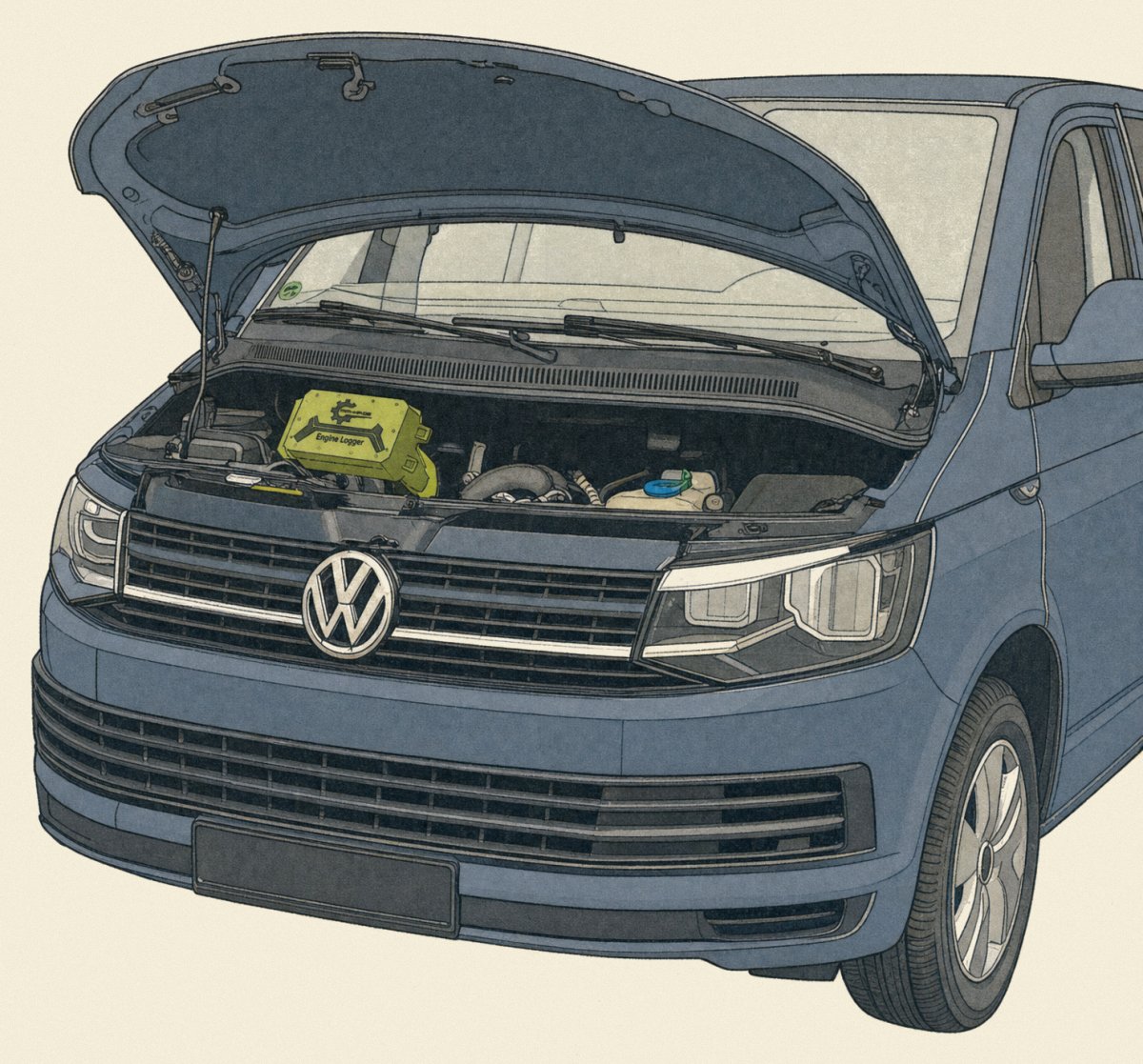
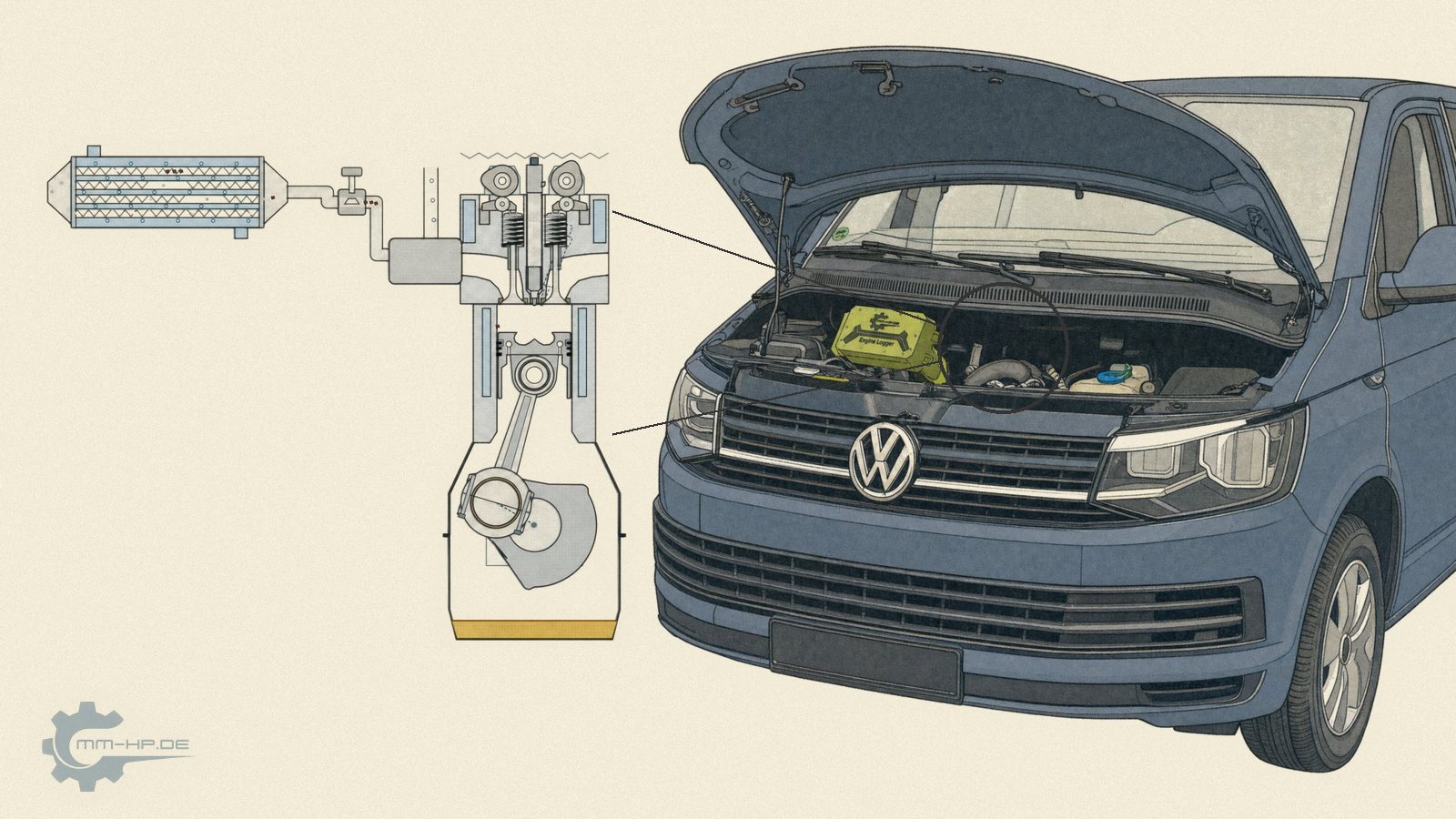
Measurement hardware in the engine bay: the MMHP Engine Logger fitted in a VW T5/T6.
¶ Honesty at the end
A conversion of the oil supply does not turn a CFCA with advanced particle or bore damage back into a healthy engine. Anyone already experiencing massive oil consumption from worn piston rings needs a mechanical rebuild first, and anyone having a rebuild done should then know this article on oil pressure after conversions. Our solution starts before that point: it gives the oil system the reserves this engine never had from the factory, removing one of the factors from the failure chain that made this engine type so notorious.
¶ See also
- The balancer shaft module in the 2.0 TDI (EA189): design, weak point, consequences
- The oil-pressure warning light: what it really tells you and what it doesn't
- More delivery volume, cooler oil: the temperature chain of effects
- Oil pressure too low after a conversion? The most common causes
- Why we don't promise bar values
Transparency note: MMHP has been developing, testing and manufacturing its own products for the automotive industry for over 25 years, including solutions for the oil supply of VW TDI engines, among them a version for the CFCA described here. The description of the failure patterns is based on publicly documented sources and our own investigations of this engine type; information from secondary sources (revision levels, case numbers) is marked in the text as reported. The assessments of the oil supply are our professional evaluation.