¶ Timing Chain Stretch? Why Oil Matters More Than the Chain
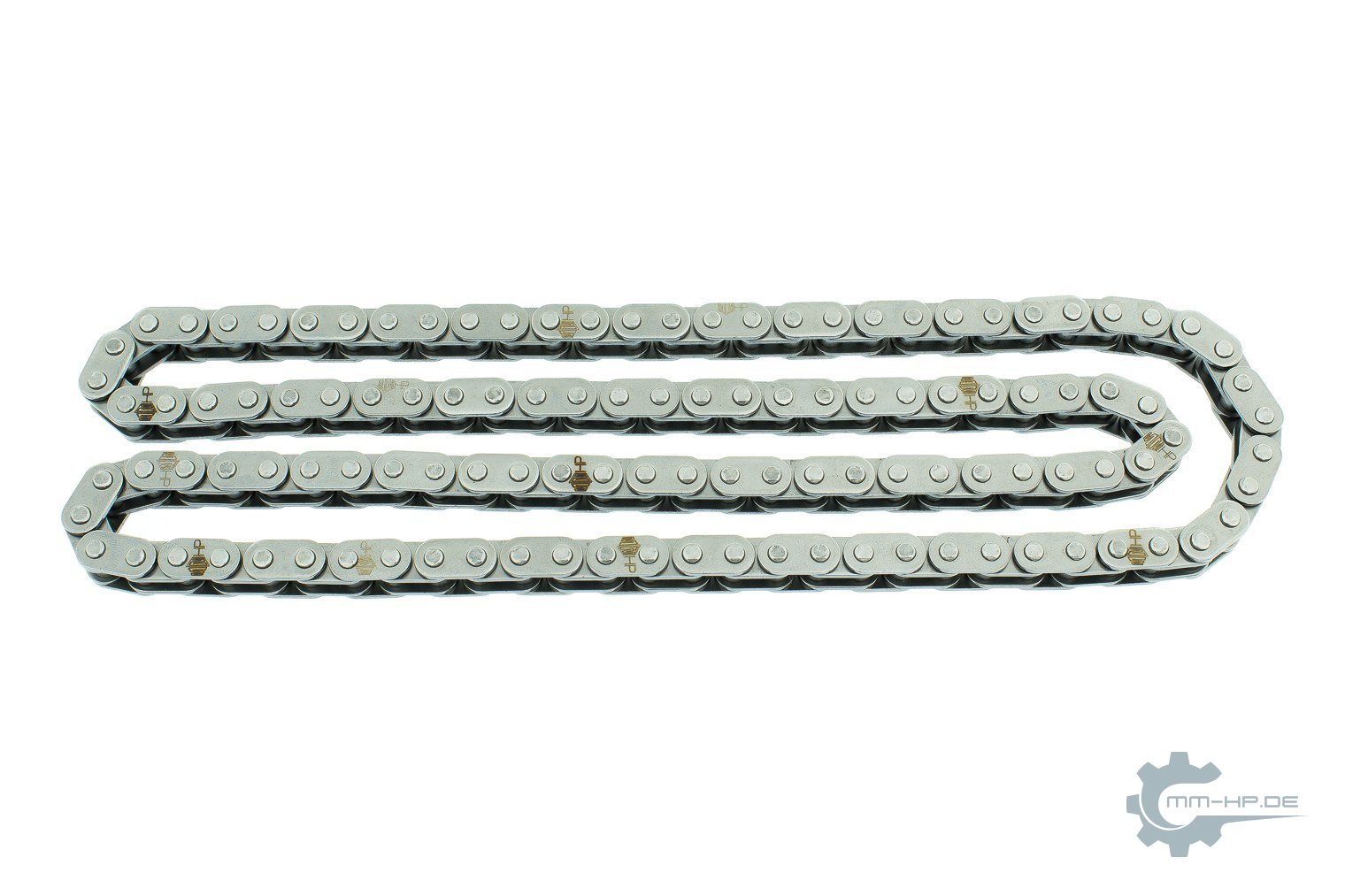
New part, own photo. A roller chain for the timing drive. Every joint is a pin in a bushing, and that's where elongation happens.
¶ The key points at a glance
An elongated timing chain hasn't stretched. The steel in its plates stays exactly as long as it always was. The chain gets longer because, in each of its roughly 150 to 180 joints, the pin works its way a tiny amount into its bearing seat. These minuscule clearances add up. The result is that the camshaft lags behind the crankshaft, and it's exactly this phase offset that the engine control unit measures.
There are three designs. In the roller chain and the bushing chain, the pin turns inside a pressed-in bushing. In the silent chain, it runs directly in the holes of toothed plates. The silent chain is quieter but, according to the technical literature and research, wears more. Many petrol engines run one, for example the 1.4-litre TSI of the EA111 series.
Wear runs in three phases. At the start, a new chain elongates quickly as the joint surfaces bed in. After that, in a tensioned drive, elongation grows evenly for a long time, and only near the end of its service life does it speed up again. The manufacturer specification for modern engines calls for around 0.5 percent elongation after roughly 250,000 kilometres.
The single biggest lever, though, isn't the chain — it's the oil. No load-bearing oil cushion forms in the chain joint; there, metal rubs on metal, protected only by wafer-thin layers formed from the oil. A review from the University of Győr sums up engine tests by saying that aged, diluted, acidified or heavily soot-contaminated oil can raise chain wear more than tenfold. Cold short-trip driving works in the same direction, through water, acids and fuel that end up in the oil from the blow-by gases. Anyone who wants to do their chain a favour changes the oil on time and picks the right one.
That was the short answer. Anyone who wants to understand what actually happens inside a chain joint, where the figures come from, and where research itself still has gaps, will find the long version from here: with measurements from engine test benches, figures from the chain makers' technical literature, and the points where caution is warranted.
¶ Roller chain, bushing chain, silent chain: three designs, three different joints
From the outside, every timing chain looks the same: plates, pins, an endless steel band. The difference lies in the joint, meaning the point where two chain links pivot against each other. And because that's exactly where wear occurs, the joint's design also decides how much a chain elongates over its life.
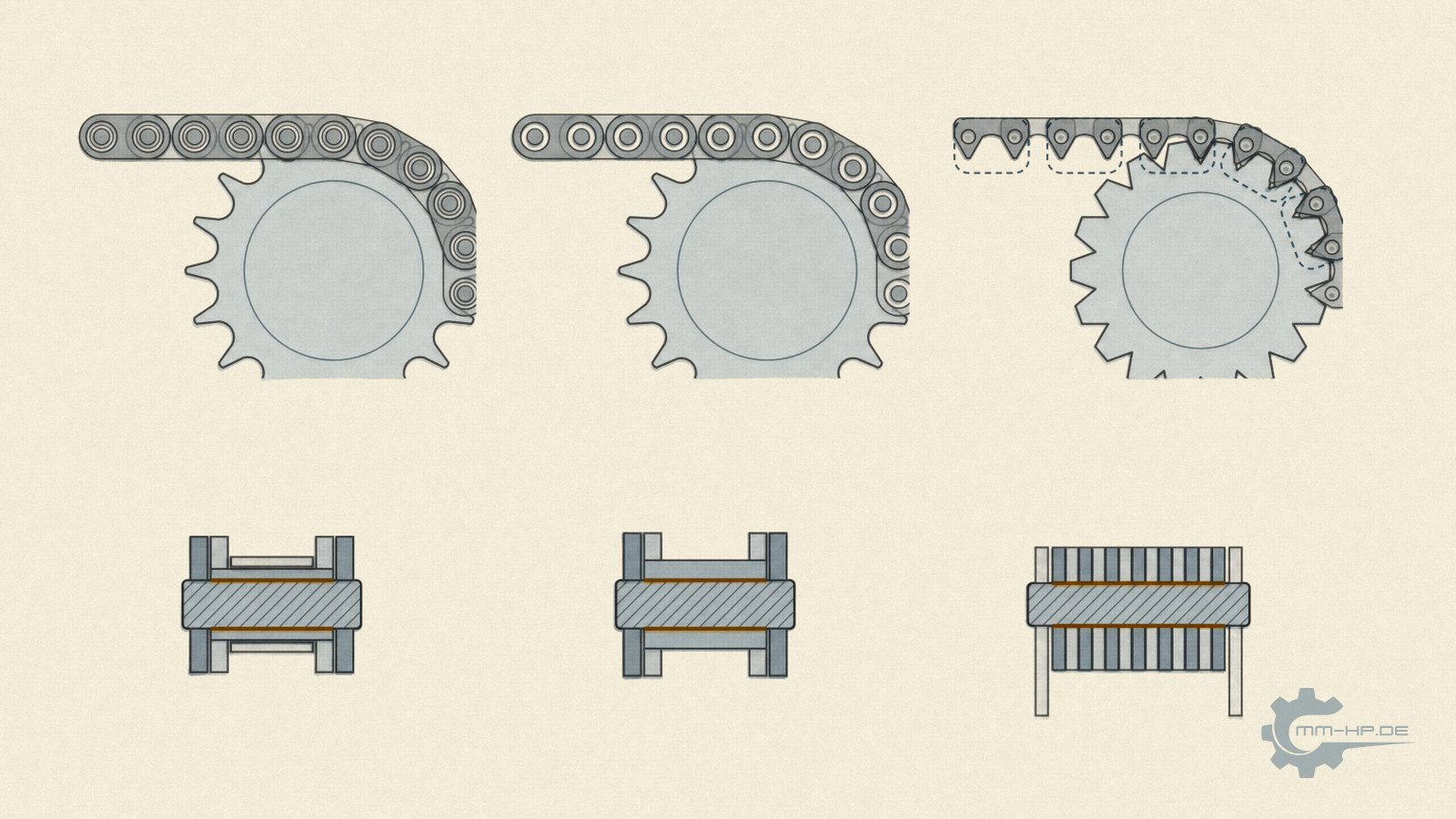
The technical book "Kettensteuertriebe" (Chain Timing Drives) by Peter Bauer, published in 2013 with technical input from chain maker iwis, describes the three designs like this. A roller chain consists of inner and outer links. In the inner link, two bushings are pressed into the inner plates, with rollers turning on top of the bushings. In the outer link, two outer plates hold the pins, and each pin sits inside a bushing. The bushing chain does without the rollers. Its bushings are larger in diameter and engage the sprocket themselves. The silent chain is a special variant. In it, the plates themselves are toothed and take over engagement with the sprocket, and there's no bushing at all.
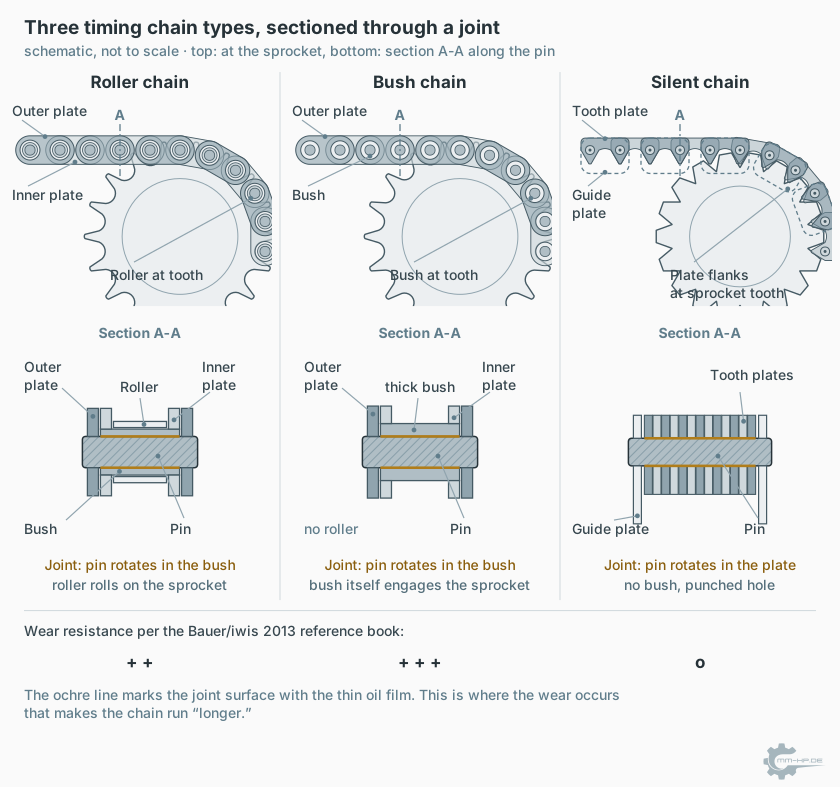
Schematic, not to scale. The ochre line is the bearing surface. That's where the wear occurs that makes the chain longer.
The drawing shows what matters. In roller and bushing chains, the pin turns inside a purpose-made bushing. Bauer describes that such bushings are wound or cold-extruded, surface-ground, case-hardened, and pre-formed so that, after pressing in, an even line contact with the pin results. The silent chain lacks this component. Bauer states literally that internal friction is “bei Rollen- oder Hülsenketten maßgeblich durch den Kontakt Bolzen – Hülse, bei Zahnketten durch den Kontakt Bolzen – Lasche bestimmt” ("for roller or bushing chains mainly determined by pin-to-bushing contact, for silent chains by pin-to-plate contact"). So the pin runs directly in the punched hole of a plate. The punched edge is the bearing surface.
¶ Which design wears the least?
Bauer sets the designs side by side in a comparative rating. The table below reproduces an excerpt; the symbols come from the book.
| Property | Bushing chain | Roller chain | Silent chain |
|---|---|---|---|
| Wear resistance | +++ | ++ | o |
| Noise and vibration (NVH) | o | + | ++ |
| Friction | +++ | ++ | o |
Source: Bauer, Kettensteuertriebe, fig. 2. Legend in the book: + positive, o neutral. The book itself notes that a timing-belt manufacturer might rate this differently.
The bushing chain has the largest joint bearing area. At the same pitch and breaking strength, the larger area gives, according to Bauer, lower surface pressure in the joint and therefore less wear. That's why it's found “insbesondere bei hoch beanspruchten Nockenwellenantrieben und bei schnelllaufenden Dieselmotoren” ("particularly in highly loaded camshaft drives and in high-speed diesel engines"). That matches a 2022 review by László Paulovics and colleagues from the Audi Hungaria Faculty of Automotive Engineering at Széchenyi István University in Győr. According to it, bushing chains typically sit in diesel engines, while silent and roller chains are mostly found in petrol engines.
The silent chain loses on wear and gains on noise. The same review writes of it that it is “silent ... but has higher friction loss and higher wear” — quiet, but with more friction loss and more wear. Bauer goes further still. Silent chains, he says, proved themselves for a long time only in dynamically lightly loaded drives; in more heavily loaded engines they had “aufgrund der im Vergleich zu Hülsen- und Rollenketten größere Kettenlängung bislang nicht eingesetzt” ("so far not been used, owing to their greater chain elongation compared with bushing and roller chains"). The industry has responded to this. Bauer describes a toothed-bushing chain combination, in which a bushing is reinserted into the toothed plates, with “deutlich niedrigeren Verschleißwerten” ("significantly lower wear values") than the conventional silent chain. The joint thereby moves back into the bushing.
The roller chain sits in the middle. Paulovics and colleagues call it a compromise between the other two, one that's comparatively rarely fitted.
¶ A well-known example of a silent chain: the EA111
Which chain sits in a particular engine is stated in no owner's manual. For the 1.4-litre TSI of VW's EA111 series, built from 2005 to 2015, it's documented. The technical workshop bulletin FTEC138 from parts manufacturer Ferdinand Bilstein describes the timing drive as a “metal-toothed silent chain, tensioned by a hydraulic tensioner”. The same document calls the chain “in theory, maintenance-free if the engine is regularly serviced with quality lubricants.” That closing clause shouldn't be skimmed over. It's the subject of the second half of this article.
The EA111 also had a manufacturing defect that VW itself admitted in April 2012. We come back to it in the chapter on chain quality, because it shows just how directly manufacturing and elongation are connected.
¶ Chain elongation: why nothing stretches, and the chain still gets longer
When VW admitted the problems with the 1.4-litre TSI's timing chains in 2012, the German business daily Handelsblatt wrote that the culprit was “Motor-Steuerketten, die sich ausdehnen” ("timing chains that expand"). That's how almost everyone talks about the subject, and it's misleading. Steel does stretch elastically under the forces in the timing drive, and springs back. A chain becomes permanently longer by a different route. The fundamentals of that are covered in our article on the chain tensioner; here we go deeper into the joint itself.
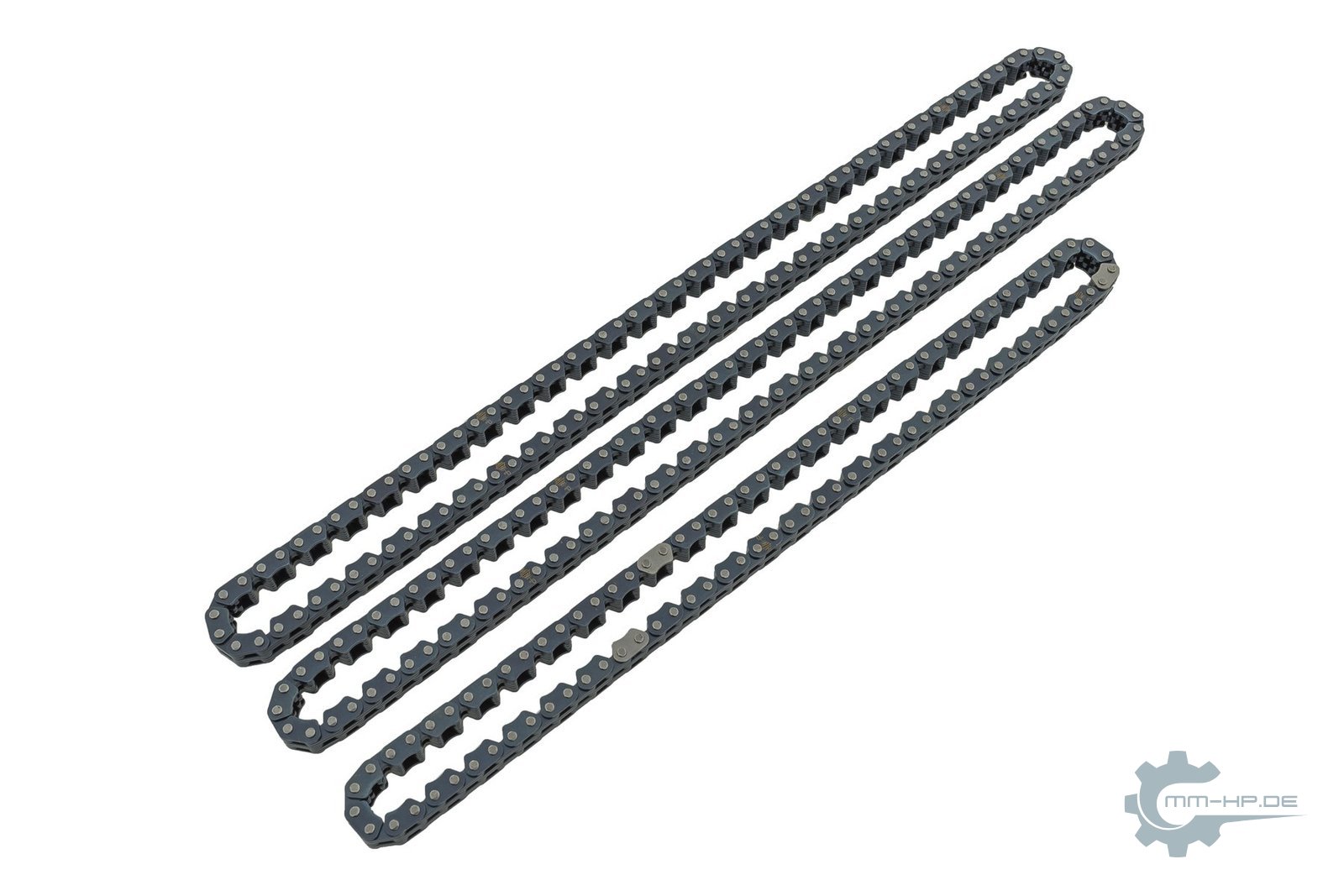
New part, own photo. Timing chains from a V6 engine. It's not any plate that gets longer, but the clearance in every single joint.
Paulovics and colleagues describe the process in one sentence. Wear causes elongation “due to the increasing play between the chain links.” The wear sits in the joints — for roller and bushing chains between pin and bushing, for silent chains between pin and the moving plates. Every joint gives a little. Because a chain has a great many of them, the small amount adds up to a lot.
¶ How small the individual values are
The review works through an example that makes the order of magnitude tangible. A typical timing chain has a pitch of 6 to 10 millimetres and 150 to 180 joints. A chain with a 9-millimetre pitch and 170 joints is therefore 1,530 millimetres long. The usual specification allows 0.5 percent elongation over the service life, which is 7.65 millimetres.
Spread these 7.65 millimetres across 170 joints, and 0.045 millimetres are left for each joint. That's our own calculation from the paper's figures. Forty-five thousandths of a millimetre of wear per joint, over an engine's entire service life, is what decides whether a chain is still within limits. You can't see that on any single link.
The specification itself is confirmed independently by two sources. Bauer names as the customary value in modern engines' specification sheets “eine gemessene Kettenlängung von 0,5 % bei einer Laufleistung von ca. 250 000 km” ("a measured chain elongation of 0.5% at a mileage of roughly 250,000 km"). Paulovics and colleagues write that manufacturers allow 0.3 to 0.5 percent over the chain's service life, for passenger cars around 250,000 to 300,000 kilometres. If the value is exceeded, the chain must be replaced.
¶ What the tensioner can do, and what it can't
A chain tensioner presses against the slack strand via the tensioner rail and takes up the slack that arises from elongation. Bauer describes this as its job: to keep the chain “in allen Betriebsbedingungen im Leertrum zu spannen, auch wenn durch den Motorbetrieb eine gewisse Verschleißlängung der Kette eingesetzt hat” ("tensioned on the slack span under all operating conditions, even once a certain amount of wear elongation has set in through engine operation").
What the tensioner can't do is claw back the valve timing. Paulovics and colleagues state explicitly that the tensioner cannot compensate for elongation from wear, that it can only reduce vibration. That sentence sounds at first like a contradiction, but it isn't. The tensioner keeps the chain taut. The extra length doesn't disappear because of that; it only shifts the camshaft's position relative to the crankshaft. The chain runs taut and still runs late. Keeping vibration small is no side issue. It is what drives wear when nothing damps it.
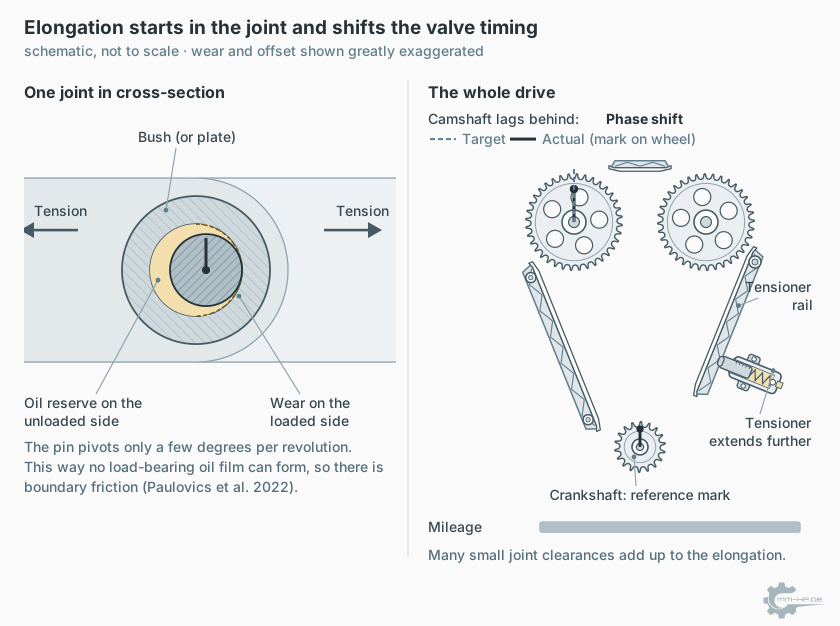
Schematic, wear and offset heavily exaggerated. On the left, one joint; on the right, the whole drive.
¶ A detail from manufacturing: the pitch allowance
A detail from Bauer's book shows just how precisely chain manufacturers factor in this wear. For a chain to wear well over the engine's entire service life, “muss ein Teilungsvorhalt zwischen Innen- und Außenglied der Kette vorgesehen werden” ("a pitch allowance must be built in between the chain's inner and outer link"). Inner and outer links, in other words, are deliberately not built to exactly the same length, and it's only after a certain running time that their pitches converge. Wear, then, isn't merely a problem you design against. It's already factored into the design from the start.
¶ Wear progression: fast running-in, a long straight, a late end
How does elongation progress over time? There are measurements for chains whose tensioner continuously takes up the elongation. There are none for drives without a tensioner, which lack exactly the component that breaks the cycle of play, slap and wear.
Paulovics and colleagues write: “Between the end of the running-in phase and the end of life wear-out, wear processes are generally linear, assuming a permanent contact area. In this phase, the amount of wear depends on the load and the sliding distance.” So between the end of running-in and end-of-life wear-out, wear generally progresses evenly, and its amount depends on load and sliding distance. A. Becker, D. Meffert and B. Sauer of the University of Kaiserslautern compared tests on individual chain joints and on whole chains at the 2019 annual meeting of the American tribologists' society STLE, and there speak of “stationary wear rates” after running-in — that is, of steady wear rates. Both test series ran on chains held by a tensioner.
This gives three phases:
- Running-in. A new chain elongates quickly at first, because the fresh surfaces bed into one another.
- The long, even phase. As long as the tensioner keeps up, elongation grows linearly with running time, load and sliding distance. This is where a chain spends almost its entire life.
- End of life. Only right at the end, once the surfaces are worn away, does wear speed up again.
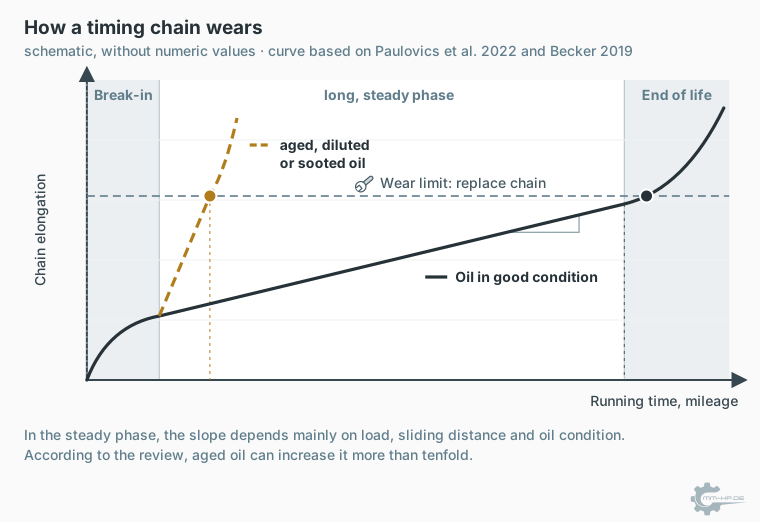
Schematic, without figures. The dashed line shows the same chain with permanently poor oil; it reaches the wear limit in a fraction of the time.
How important running-in is shows up in a detail from oil testing. The Sequence X engine test (ASTM D8279), used to test engine oils for the American ILSAC GF-6 and API SP standards for protection against chain wear, first lets the test chain run in for eight hours. Only afterward is the zero length measured, from which elongation is then counted. Otherwise, running-in would distort the result.
Chain manufacturers pre-empt part of this initial elongation right at the factory. Bauer describes that every chain, after assembly, is first measured in a measuring and loading unit and then stretched with a force below its breaking strength: “Infolge der Belastung der Kette kommt es zu Setzvorgängen in den Fügestellen, die zu einer Längenzunahme der Kette führen.” ("As a result of loading the chain, seating processes occur at the press fits, which lead to an increase in the chain's length.") The press fits of bushings and pins in the plates thus settle before the chain ever goes into the engine. That this pre-empts elongation that would otherwise occur during the first hours of operation in the engine is our own conclusion from this description. Bedding in the joint surfaces themselves cannot replace this pre-stretching, which only happens once the chain is running.
For practical purposes, the even progression means something reassuring and something inconvenient. The reassuring part is that a tensioned chain with some elongation doesn't suddenly spiral downward. That is the tensioner's work, taking up every millimetre as it appears. Without it, that brake is missing, as our chain tensioner article shows. The inconvenient part is that you also can't tell from it when it will reach the limit. The slope of the straight line determines how long the chain lasts. And that slope, as the next chapter shows, depends less on the chain than on what flows through its joints.
¶ Boundary friction in the chain joint: why no oil cushion carries the load there
In a crankshaft bearing, the shaft floats on a film of oil. It turns fast and always in the same direction, and in doing so it draws oil into the gap and builds up a load-bearing pressure. Metal there barely touches metal in normal operation. How much oil the oil pump needs to deliver for that is covered in our article on the oil pump.
A chain joint can't manage that. As the chain link runs onto the sprocket, the pin swivels through a small angle inside its bushing; as it runs off, it swivels back; in between, it stands still. Paulovics and colleagues write on this: “The small angular swivel motion of the joints leads to a boundary friction regime, making the chain joints more sensitive to oil quality and contamination.” The small swivel motion leads to boundary friction and makes the joints more sensitive to the oil's quality and contamination.
Boundary friction means the surfaces touch under load. They're separated only by very thin layers that form on the metal from the oil and its additives. There's no load-bearing oil film, as in a plain bearing. How well the joint is protected therefore depends directly on the condition of the oil that happens to arrive there.
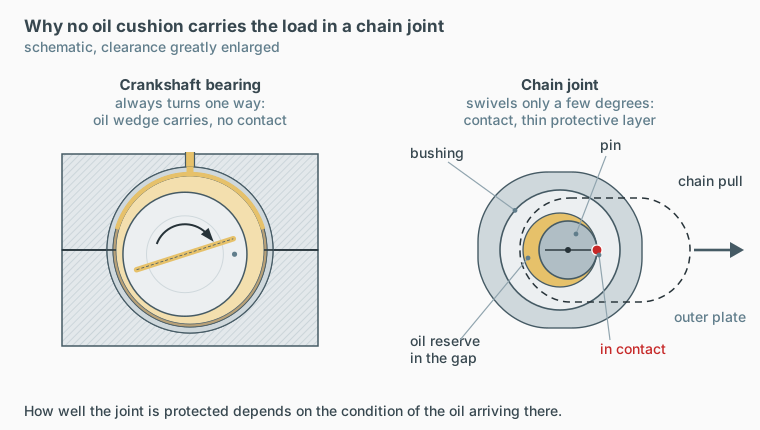
Schematic, clearance greatly enlarged. In the bearing the oil wedge carries the load, in the chain joint the surfaces touch under load.
The clearance in the joint nonetheless serves a purpose. Under tension, the pin rests against one side of the bushing. An expired 1987 US patent describes this condition by saying that pin and bushing there are “separated by a relatively thin film of lubricant.” On the opposite, unloaded side, a gap remains. Oil collects there, and from that reservoir the loaded side is replenished with every swivel motion. In the animation further up, that's the ochre-coloured area to the left of the pin.
A secondary finding from the same review shows how sensitive this small lubrication system is. In tests with E85 fuel, wear on the chain pins rose, compared with 95-octane premium petrol, by 20 percent in cold operation and by around 30 percent in warm operation. For the rise in warm operation, the authors cite cavitation of fuel that had entered the oil, specifically at the chain joints, as the cause. So in hot oil, the fuel that's found its way in forms vapour bubbles there under the fluctuating pressures, and those attack the surfaces. For cold operation, the paper names no cause of its own.
¶ Oil is the biggest lever: what the measurements show
Chain manufacturers have many levers to pull: steel grade, hardening, pin coating, plate quality. All of them matter, and all of them matter within a framework set by the oil. There are measurements on this, and they're clearer than you'd expect.
The review by Paulovics and colleagues evaluates several engine-test-bench studies on petrol and diesel engines, with both bushing and silent chains. Their conclusion reads, verbatim: “aged, degraded, acidified, heavily soot-contaminated, and with water and fuel diluted oils can increase wear by more than 10 times.” So oils that are aged, degraded, acidified, heavily soot-contaminated, and diluted with water and fuel can increase wear more than tenfold.
The individual studies behind this look as follows. Each row measures something different, so the values can only be compared within a row, not between rows.
| Study | Engine and chain | Comparison | Result | Measured quantity |
|---|---|---|---|---|
| Paulovics et al., Győr | Diesel, bushing chain, high load, 1,250 to 4,000 rpm | fresh 0W-20 and 0W-30 versus the same 0W-30 after 200 test-bench hours | 0.5 to 0.8 nm/h versus 7.2 to 11.2 nm/h, more than tenfold | wear rate, radioactively tagged pins and bushings |
| Gergye et al., Győr | Petrol engine, silent chain | fresh oil versus oil after 15,000 km | vanadium-coated pins wore on average twice as much, uncoated plates on average ten times as much | wear, radioactively tagged pins and plates |
| Schwarze et al. | Petrol engine, 500-hour city and motorway programme | oil kept cold (20 to 50°C) versus warm (110 to 140°C) | total wear ten times higher when cold, around thirty times when normalised to the same distance | total wear of the chain pins, measured via radioactive tagging |
| Schwarze et al., same series | as above | mean wear depth of the pins after 500 hours | 3 µm warm, 15 µm cold, 7 µm cold with blow-by gases extracted | mean wear depth from surface analysis, a different quantity from the total wear in the row above |
Source: Paulovics, Rohde-Brandenburger, Tóth-Nagy, Timing Chain Wear Investigation Methods, FME Transactions 50 (2022), section 5.3. The paper summarises the studies; the original works are cited there.
Three values from this table deserve a second look.
The 200 test-bench hours correspond to the oil-change interval. The authors equate them with around 15,000 kilometres, “which is the prescribed oil change interval for this engine.” So the oil wasn't neglected; it was at the end of its regular service life. As a caveat, the test bench ran at high load, higher than in everyday driving. Whether normal driving ages an oil similarly hard by the time it's due for a change, this test doesn't say. But it does show that chain wear doesn't stay at fresh-oil levels until the oil is visibly bad.
With the silent chain, it's mainly the plate that wears with old oil. The pins were coated and wore twice as much; the uncoated plates wore ten times as much. The weak point, then, migrates to the softer mating surface. Anyone who judges a chain only by the coating on its pins is looking at the wrong half of the joint.
Oil temperature itself played almost no role. In the silent-chain study, oil at 120°C brought “slightly higher wear than at 90°C” — but according to the authors, without significance for the chain's service life. We say this explicitly, even though it puts our own measurements into perspective. In our measurement campaign, oil temperature after converting to a pump with more delivery volume was, on average, 10 to 15°C lower. For the chain itself, this study suggests that brings little benefit. For the plastic rails running alongside the chain it might look different, since their heat ageing depends strongly on temperature, as our article on guide and tensioner rails shows. Whether cooler oil measurably extends a rail's service life, nobody has measured, including us. We consider it plausible, and we're stating it for what it is: a thesis.
¶ Cold operation: why short trips take a toll on the chain
The table's most striking figure is cold operation. With cold oil, the chain wore, overall, ten times as much as with warm oil, even though it completed only a third as many revolutions in the cold programme. Normalised to the same distance, wear was around thirty times higher. The factor of ten describes total wear, measured via radioactive tagging. The 3 against 15 µm from the table is a different quantity, the mean wear depth on the pins from surface analysis, and so comes out at only a factor of five.
The reason is chemical, not mechanical. The authors write that at low temperatures, water, sulphuric and nitric acid, and fuel condense out of the blow-by gases — the gases that flow past the piston rings into the crankcase. The acids, together with the water, attack metal and oil; the fuel dilutes the oil and robs it of lubricity. When the researchers extracted the blow-by gases from the crankcase as far as possible, cold wear roughly halved, from 15 to 7 µm, while the warm value stayed the same.
Two caveats belong here without fail. First, the test ran on a petrol engine. That the same mechanisms apply to a diesel we consider plausible, but it isn't demonstrated by these measurements. Second, the authors themselves write that extraction reduces water, acids and oil ageing, “but fuel dilution persists” — fuel dilution remains. How fuel gets into the oil and how to recognise it is explained in our article on oil dilution. What else the blow-by gases do inside the engine is covered in our article on blow-by and oil mist.
¶ Soot: why there's a dedicated chain test for engine oils
That soot attacks the chain is so well documented that the oil industry has introduced a dedicated test for it. The Sequence X engine test (ASTM D8279) is meant, according to the testing body Southwest Research Institute, to show whether an oil protects against “soot-induced timing chain wear” in modern direct-injection petrol engines. It's tested on a Ford 2.0-litre EcoBoost with a silent chain. To get enough soot into the oil, the piston-ring gaps are enlarged until around 70 litres of blow-by gas per minute flow through the crankcase. After 216 hours, the chain is allowed to have elongated by no more than 0.085 percent.
This test belongs to the American ILSAC GF-6 and API SP standards. For European diesels with a manufacturer approval, it's no yardstick — there, the vehicle manufacturer's approval is what counts. How to find the right one is covered in our article Which oil?. But the test shows how seriously the industry takes the link between oil condition and chain wear.
How much soot is too much depends on the system. In a laboratory test at the University of Győr using real chain parts, adding 1 percent industrial soot didn't yet raise wear, but 2 percent did. With standardised steel balls instead of chain parts, wear rose already at 0.5 percent. The authors conclude from this that soot must be tested on the real component, not on simplified specimens.
¶ How big the difference between two chains can be
How does the influence of the oil compare with the influence of the chain itself? We found no clean comparison in which someone ran the same engine family once with different chains and once with different oils. There is one point of reference, though. In Győr, timing chains from two manufacturers ran for 1,000 hours each in an externally driven petrol engine without combustion. After 1,000 hours, one had elongated by 0.81 millimetres, the other by 1.01 millimetres. The authors call the difference small.
So the difference between these two chains was around a quarter. The difference between fresh and aged oil in the engine tests was tenfold and above. The tests aren't directly comparable — they ran on different engines under different conditions, and the chain tests ran with used oils. Even so, the orders of magnitude speak a clear language. In our view, the condition of the oil is the single biggest lever for a timing chain's service life, bigger than any difference between two properly manufactured chains. That's our own weighting, not the sources'.
What follows from this is unspectacular. Don't push oil changes past the prescribed interval, change earlier rather than later if you do a lot of short trips, use an oil with the right manufacturer approval, and take fuel-in-oil seriously. There is nothing more an owner can do for the chain, and it tolerates less rather poorly.
¶ Measuring elongation: the camshaft's phase offset
Measuring a removed chain is barely worthwhile in a workshop. Chain manufacturers measure length under a precisely defined tensile force, via two discs with a centre-distance measurement, or via the pitch pattern, optically for silent chains. The tensile force is prescribed depending on chain type, and without the new part's reference length, a measured value says little. And once removed, the chain needs replacing anyway.
While installed, what remains is an indirect but elegant measurement that the engine itself supplies. As the chain gets longer, the camshaft lags behind the crankshaft. The engine control unit knows the position of both shafts from their sensors and can detect the offset.
The sources show clearly how small the permissible values are. Bauer writes that, within the framework of CO2-reduction strategies, “heute Steuerzeitverschiebungen von 1,0 bis 1,5° bezogen auf die Kurbelwelle noch zulässig” ("timing shifts of 1.0 to 1.5° relative to the crankshaft are still permissible today"). Paulovics and colleagues name the same range of 1 to 1.5 degrees of crank angle, and add that severe wear — meaning an elongation of just a few millimetres — can shift the timing by 5 to 8 degrees. For diesel engines, they say, that's especially dangerous. Because of the high compression, the pistons come very close to the valves, and a late-closing exhaust valve can be struck.
For individual engines, workshop trade portals circulate threshold values above which a chain is considered elongated. We've named some of these as reference values in our article on the chain tensioner. They aren't official manufacturer limits. What's binding is whatever the manufacturer's repair manual prescribes for the specific engine and its diagnostics. And anyone who finds a phase offset in the fault memory should know that the chain isn't the only thing that can cause it. A cam phaser or a sensor can also be behind it.
A second measurement principle comes from research. In the tests at Győr, elongation could be tracked reliably via the tensioner's position, measured with a laser vibrometer, and the values matched the measurements on the removed chain. The tensioner extends further the longer the chain gets. Nobody needs this measurement in everyday practice, but it shows that tensioner travel and elongation go together.
How you notice an elongated chain in everyday driving, which noises are harmless and which aren't, and when a replacement is due, is covered in our overview of the timing chain drive. The rattle in the first few seconds after a cold start often has a different cause than elongation, namely a tensioner that first needs to refill with oil after standing. That's explained in the article cold-start rattle.
¶ Manufacturing: what makes a chain robust against elongation
A buyer can barely tell a chain's quality by looking at it. What they can know is what good manufacturing pays attention to. Bauer's book describes production in detail, and three points from it are directly connected to elongation.
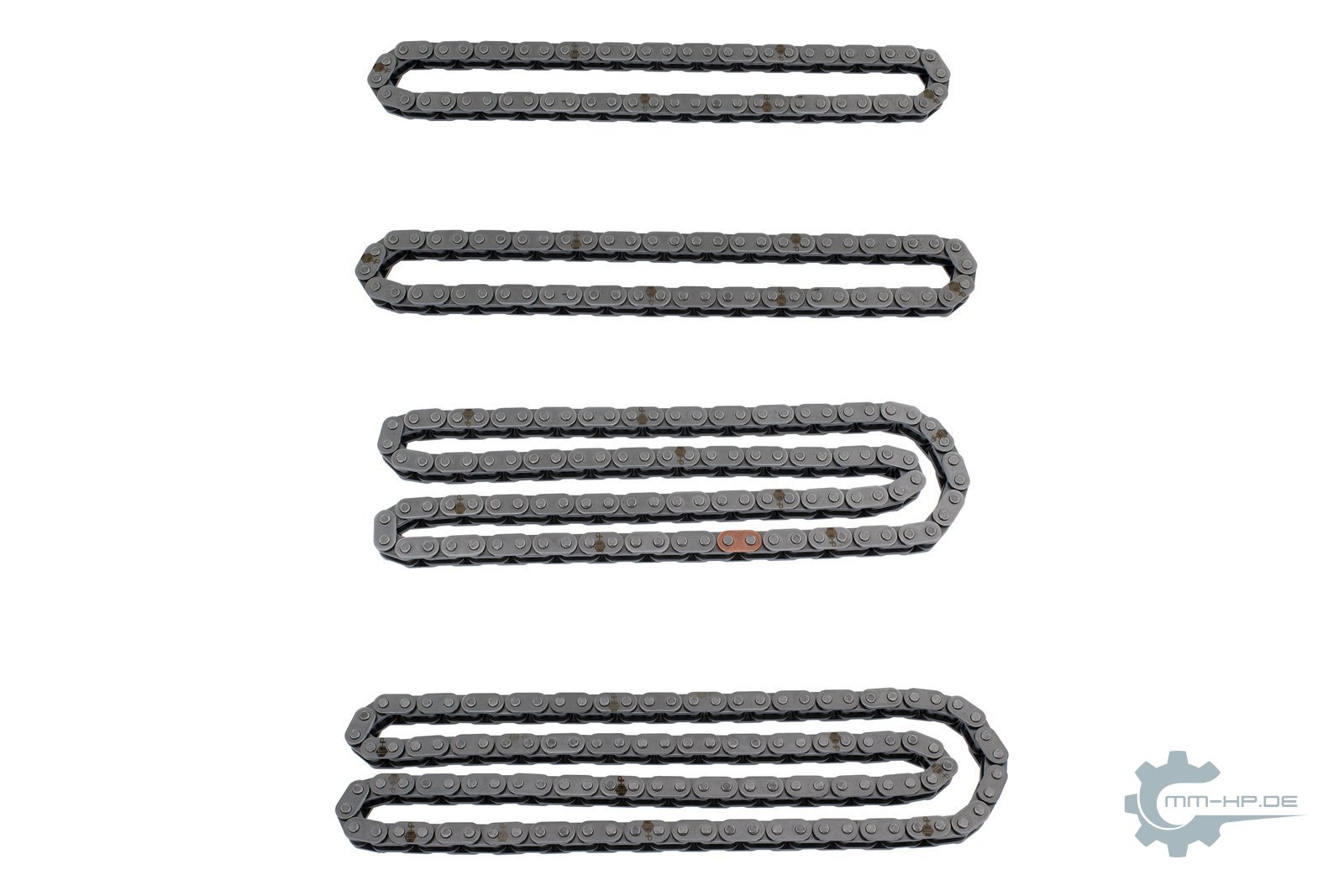
New part, own photo. Chains from a single kit. How carefully they were made can't be seen from the outside.
Clean plates without burrs. Plates are punched, and there are big differences in how. With simple standard punching, Bauer says, the contours are only cleanly cut to about 20 percent and torn the remaining 80 percent, with edges left at a surface roughness of roughly 20 to 40 µm. With re-cutting over several operations, it's about 6 to 10 µm; with fine blanking, the clean-cut fraction reaches up to 95 percent. According to Bauer, timing chains with simply punched plates are no longer used in new designs. After heat treatment, the plates are surface-ground “um anhaftende Stanzgrate zu beseitigen” ("to remove adhering punching burrs").
How important this is shows up in the EA111 case. In April 2012, according to Handelsblatt, VW admitted a production defect for the first time. The chain's supplier had “seine Stanzwerkzeuge über deren Verschleißgrenze hinaus verwendet” ("used its punching tools beyond their wear limit"). That resulted in imprecisely punched chain plates with chips and burrs, and the chains wore quickly in service. VW spoke of case numbers in the low hundreds and said production had since been optimised. Narrowing it down to particular batches or time periods, they said, wasn't possible. In a silent chain, the punched hole is the joint's bearing surface. A burr there isn't a cosmetic flaw; it's abrasive grit inside the joint. As a caveat, this is a press report quoting VW, and it says nothing about the current state of the parts today.
Treated pins. The pin is the joint's partner component, and it gets special treatment. Bauer describes three routes: a chromium carbide layer of 10 to 20 µm, applied by CVD, with a surface hardness above 1,500 HV; a chromium nitride layer of 1 to 2 µm by PVD with 1,800 to 2,200 HV; or nitriding, with a hard compound layer of 3 to 8 µm and a diffusion zone of roughly 0.1 to 0.2 mm below it. In comparative wear tests on bushing chains, Bauer says the combination of a PVD-coated pin and a carbonitrided bushing gave the best protection. That, with old oil, it's then the uncoated mating surface that wears, we've seen in the oil chapter. A good chain needs both sides of the joint.
Pre-stretched at the factory. As described above, every chain is measured after assembly and stretched under a load below its breaking strength, so the press fits settle. Bauer then describes a runout check and further inspections, ultrasonic cleaning and oiling. And he mentions a detail that casts the EA111 case in a different light. Pins are manufactured in diameter classes, “da die eingesetzten Stanz- und Hülsenwerkzeuge im Betrieb verschleißen” ("because the punching and bushing tools used wear during operation"). Tool wear, in other words, is a known part of every chain manufacturing process. What matters is whether a manufacturer keeps it under control.
None of these features is printed on a chain kit's packaging. What you can actually check when buying, and what to pay attention to during installation, is covered in our article Buying a timing chain kit.
¶ What research hasn't answered yet
We list the open points separately, so nobody mistakes them for settled.
- Diesel in cold operation. The measurements on tenfold cold wear come from a petrol engine. For diesel engines, we found no comparable series of measurements.
- Everyday driving versus the test bench. The aged-oil tests ran at high load. How much an oil ages in normal everyday operation before it's changed, and what that means for the chain, hasn't been measured.
- Chain versus oil in the same test. We found no test that pits the influence of a better chain against the influence of better oil condition on the same engine under the same conditions. Our weighting rests on orders of magnitude drawn from different tests.
- Thresholds per engine. At what phase offset a manufacturer prescribes chain replacement for a specific engine is barely documented in freely accessible sources.
- Which chain in which engine. The design is documented for individual engines, but not for many others. Manufacturers, as a rule, don't tell the buyer.
If you have measurements or your own findings on any of these questions, write to us via Support. We'll update this article as soon as new evidence is available.
¶ See also
- The timing chain drive: design, wear, oil supply
- Cold-start rattle: tensioner, cam phaser, or chain?
- Timing chain guide and tensioner rails: what plastic is inside, and what heat does to it
- Buying a timing chain kit: how to recognise quality
- Oil dilution: the invisible swap for the worse
- Which oil? Why we don't give a blanket recommendation
- Glossary