¶ Timing Chain Rattle on Cold Start: Tensioner or Cam Phaser?
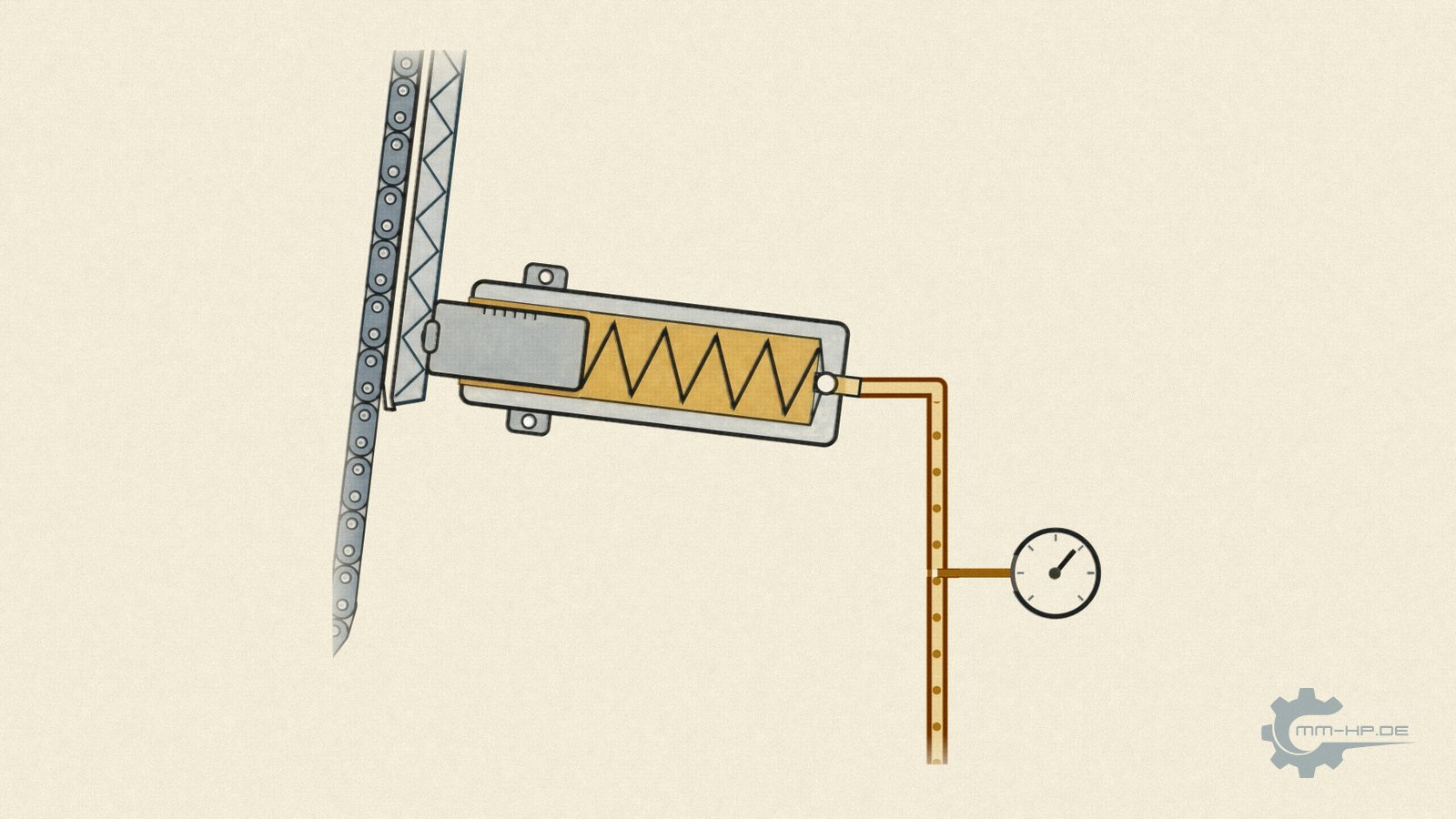
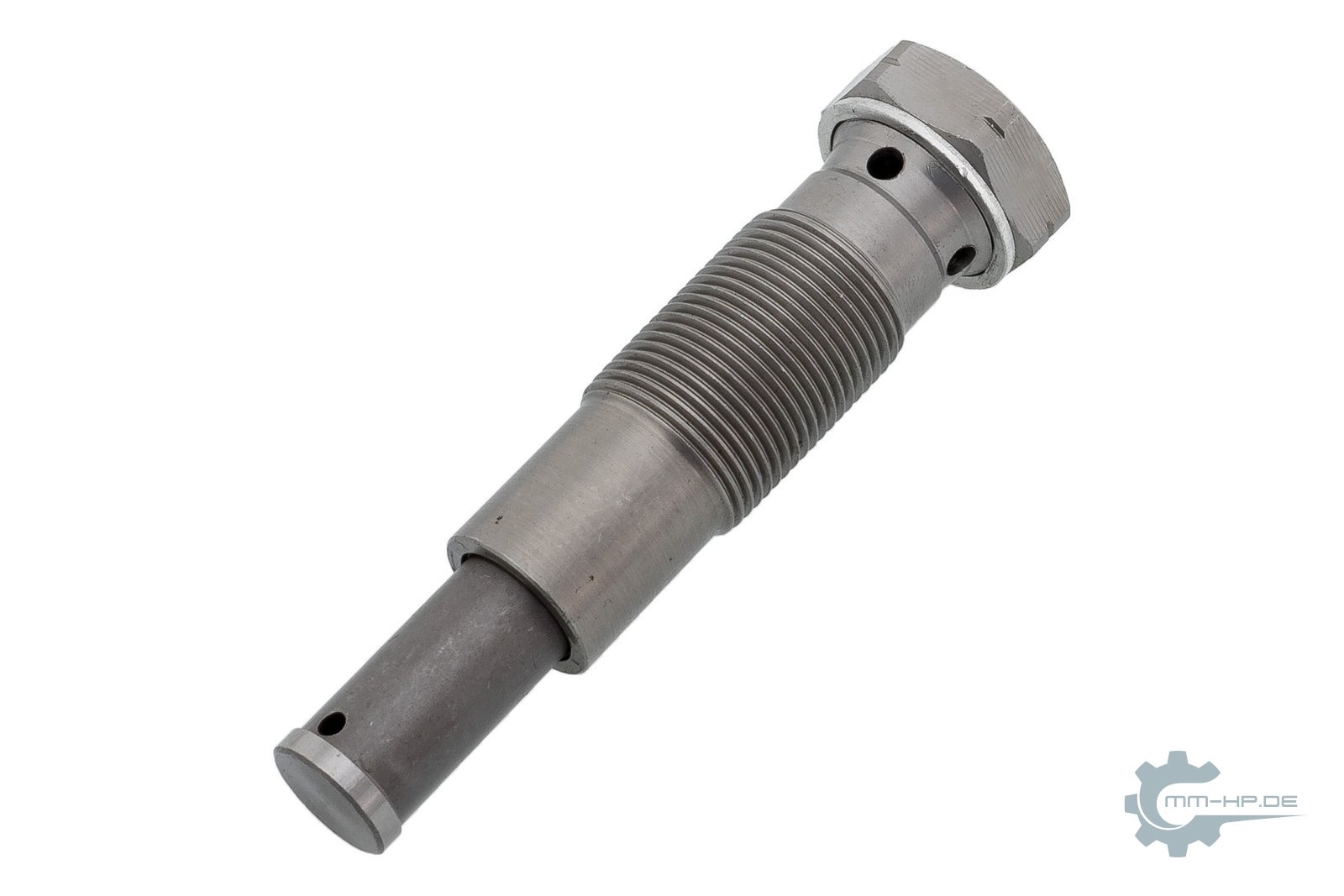
New part, own photo. Hydraulic screw-in chain tensioner. This article is mainly about this part.
¶ The key points at a glance
When the timing chain rattles on a cold start, the cause is usually the chain tensioner, sometimes the cam phaser, and only rarely the chain itself or a broken rail. The hydraulic tensioner keeps the chain tensioned using engine oil. Overnight, with no oil pressure, it gives a little. On start-up the chain then has a moment of slack and slaps until the oil pump has refilled the tensioner. According to manufacturer documents, that takes one to five seconds.
This isn't a workshop rumour. Five carmakers have described this noise in their own workshop documents. Two of them state explicitly that it causes no damage, a third that it doesn't affect safety, performance, or emissions. One manufacturer writes literally: “The noises do not lead to damage.”
On some engines it isn't the tensioner rattling at all, but the cam phaser. Two manufacturers solved the problem with a new cam phaser, not a new chain. On a third, part of the fix sat in the oil feed inside the cylinder head. Anyone fitting a complete chain kit against the rattle may therefore be working on the wrong part.
Thicker oil is not a solution. None of the five manufacturers fixed the rattle with a different oil; all of them replaced components.
Pay attention if the rattle lasts longer than it used to, if it persists until the engine warms up, if it also occurs with a warm engine or at idle, or if the check engine light comes on. Then the engine belongs in a workshop, immediately if the warning light is on.
Cold does genuinely harm the chain, incidentally, and what has been measured is mainly the route through the oil. In one test series, a chain wore ten times as fast in continuous cold operation as when warm, because water, acid, and fuel from the combustion gases collect in the oil. A good oil, changed on time, helps against that. A quieter start doesn't.
That was the short answer. Anyone who wants to understand why a tensioner gives overnight, how to tell it apart from a cam phaser, and what the manufacturers write about this in their workshop documents, will find the long version from here: with the original quotes, a table for placing the noise, and the points where the sources end.
¶ Cold-start rattle: a noise the manufacturers describe themselves
A winter morning, the car has stood outside all night. The engine starts, and for two or three seconds there's a rattle at the front of the engine, as if a loose bicycle chain were running over sheet metal. Then it's quiet, and the engine runs as always. The next morning, the same thing.
Anyone hearing this noise for the first time thinks of engine damage. Anyone searching online finds both reassurance and doomsday scenarios, often in the same forum thread. But there's no need to guess here. The manufacturers themselves have investigated the noise and told their workshops where it comes from and what to do. These workshop documents are called Technical Service Bulletins, or TSBs for short. In the US, manufacturers must submit them to the road safety authority NHTSA, and from there they're publicly available. We read the following five in the original.
| Manufacturer | Engine | Document | When and how long | Cause per manufacturer | Fix per manufacturer |
|---|---|---|---|---|---|
| Mercedes-Benz | M276, M278, M157 | LI05.10-P-056435, 16 July 2013 | after starting, “for several seconds” | secondary chain tensioner, until oil pressure builds | improved tensioners and check valves in the cylinder head |
| Audi | V6 3.0 TFSI | TSB 2039995/1, 3 March 2015 | roughly 1 to 3 seconds after the first start of the day | “one of the upper chain tensioners” | “Improved chain tensioner” |
| Kia | Lambda II 3.3 (Cadenza, Sorento) | ENG 148, revision 3, 31 August 2016 | shortly after starting, “after a cold soak” | chain tensioner | tensioner with finer ratchet pitch (1.5 mm), in some cases together with the intake cam phaser |
| Ford | 3.5 EcoBoost (F-150, 2011 to 2015) | TSB 18-2305, 24 October 2018 | 2 to 5 seconds after at least 6 hours parked | not named individually | replace all four cam phasers and the primary chain, a tensioner kit is included in the parts list |
| Toyota | 1AR-FE, 2AR-FE | T-SB-0041-13, 15 March 2013 | roughly one second after the cold start | not stated | replace the intake cam phaser |
The term “cold soak”, which appears in several documents, means a vehicle that has stood long enough to cool down fully. The workshop document for the EcoBoost names six hours or more for this.
Three things stand out in this table. First, the duration. In none of the documents does the rattle last longer than five seconds. That's the order of magnitude this article is about. Second, the cause. In the first three documents it was the tensioner, in the last two the cam phaser. The same noise, two different components. Third, the fix. Not a single manufacturer solved the problem with a different oil, and only on the EcoBoost was the chain replaced alongside it. Everywhere else it was tensioners, cam phasers, or the oil feed.
We'll go through the candidates in order, starting with the most common one.
¶ The hydraulic chain tensioner: why it gives a little overnight
A chain tensioner pushes against the slack side of the timing chain through a tensioner rail, keeping it taut. In many engines this is a hydraulic tensioner: a piston in a cylinder, behind it a spring and a chamber filled with engine oil. How it's built in detail and what design variants exist is described in our article on the chain tensioner. Here, what matters is only why it gives overnight.
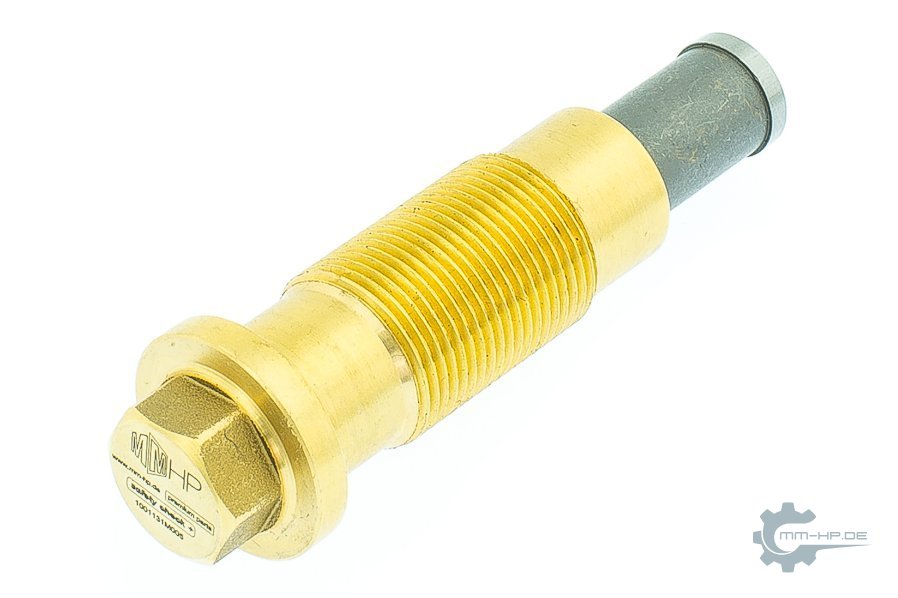
New part, own photo. A screw-in tensioner. Piston, spring, and check valve sit inside the housing; from outside, only the piston is visible.
¶ The leak gap is the damper, and it works at standstill too
Between piston and cylinder there's a tiny gap, a few hundredths of a millimetre wide. You might mistake it for an imprecision. In fact it's the tensioner's most important functional feature. The technical book "Kettensteuertriebe" (Chain Timing Drives) by Peter Bauer, published in 2013 with technical input from chain maker iwis, describes it this way: “Die notwendige Dämpfungsarbeit erfolgt durch eine laminare Leckspaltströmung, die sich aus dem zwischen Bohrungs- und Kolbenaußendurchmesser vorhandenen Spiel ergibt.” ("The necessary damping work is achieved through laminar leak-gap flow, which results from the clearance between the bore and the piston's outer diameter.")
When the chain strikes the rail, the oil in the chamber has to escape through this narrow gap. That can only happen slowly, and that's exactly what absorbs the impact. How strongly the gap acts was calculated by a research group led by Feng in 2023 in a simulation and confirmed on a test rig, with a deviation of under 8.3 percent between calculation and measurement. The conditions were excitation at 100 Hz and 0.2 mm stroke, 0.4 MPa oil pressure, 100°C oil temperature, and 0.1 percent air in the oil.
| Leak gap | Maximum damping force |
|---|---|
| 0.045 mm | 621 N |
| 0.035 mm | 1,086 N |
| 0.025 mm | 1,942 N |
Source: Feng et al., Chinese Journal of Mechanical Engineering 36:122, 2023. Conditions as described in the text.
Two hundredths of a millimetre less gap, and the damping force becomes roughly three times as large. This shows how finely a tensioner is tuned. The authors write that the gap must be chosen to match the highest tension on the chain's slack side, for a stable chain drive and low noise. That a tighter gap isn't therefore simply better is our own assessment, not the authors'.
The catch is obvious. A gap through which oil is pressed during operation also lets oil out at standstill. As long as the engine runs, the oil pump replenishes it. When it's stopped, there's no replenishment, and the spring alone holds the piston. If the chain pushes back against it with its weight and residual tension, the piston slowly retreats.
¶ Why the oil drains at standstill: a known problem
This isn't a theory of ours; it's been described in the industry for decades. American supplier Eaton writes in a patent filing applied for in 1993 on hydraulic tensioners (US 5,304,099): “When the engine is shut down and no oil pressure is present in the tensioner, the output member can retract, allowing the chain to slacken, resulting in noise and vibration on start-up until sufficient hydraulic pressure is built up to again maintain the predetermined chain tension.”
iwis itself, one of the major chain suppliers to the European auto industry, is even more explicit. A 2007 utility patent (DE 20 2007 002 456 U1) states about tensioners with unregulated venting, meaning throttle channels without an upstream check valve, that they have “das Problem, dass das Hydraulikmittel im statischen Zustand, d. h. bei Stillstand des Verbrennungsmotors, über die Drosselkanäle ausläuft und bei einer erneuten dynamischen Inbetriebnahme die hydraulische Dämpfungsfunktion nicht sofort gegeben ist.” ("the problem that the hydraulic fluid drains through the throttle channels in the static state, i.e. when the combustion engine is stopped, and on renewed dynamic operation the hydraulic damping function is not immediately available.")
So the drainage isn't intentional on the designers' part, but a side effect they accept because the gap is needed for damping. There are further ways the chamber loses oil or draws in air at standstill. The tensioner has a check valve in its feed, meant to let oil in but not back out. If it isn't fully tight, the chamber drains faster. And if the feed channel in the engine runs dry, air reaches the tensioner first on start-up. Air compresses; it barely damps at all. Bauer therefore describes a venting bore at the piston face, through which “Luft, die sich möglicherweise im Hochdruckraum ansammelt” ("air that may collect in the high-pressure chamber") can escape.
This is exactly where the workshop document for the M276, M278, and M157 engines picks up: “Correctly installed check valves and optimized secondary chain tensioners will minimize oil drainage from tensioners.” The additional check valves don't go into the tensioner itself, but into the oil feed port in the cylinder head. In our reading, they're meant to keep the channel ahead of it full.
A fourth adjustment point is revealed by the workshop document for the Lambda V6, the only one with a technical figure. Many tensioners carry a ratchet, a row of teeth on the piston with a pawl that mechanically prevents the piston from retracting too far. Bauer calls it a “Rastersperre zur Begrenzung des Rückhubs” ("ratchet to limit the return stroke"). About the improved tensioner it says: “New tensioner design with finer pitch on teeth (1.5mm).” The manufacturer doesn't explain why the finer pitch helps. Our reading is that with a finer pitch, the next tooth engages sooner, so the piston can fall back less far at standstill. Notably, the new tensioner is prescribed for only one of the two cylinder banks. Same engine, same oil, same parked duration, and yet apparently only one side rattled. Installation position and oil path matter too, then.
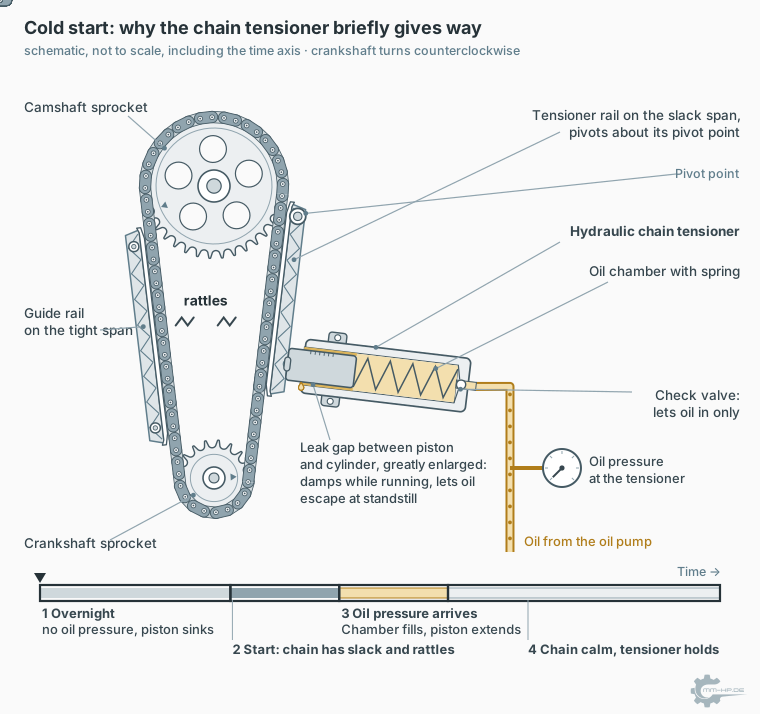
Schematic, not to scale, including the time axis. In an engine, phases 2 and 3 together typically last from one to a few seconds.
¶ Oil pressure after starting: how fast the tensioner refills
How long the rattle lasts depends on how quickly pressurised oil reaches the tensioner. The workshop document for the M276, M278, and M157 describes this sequence in one sentence: “Secondary timing chains might produce a rattling sound during engine start up until the engine oil pressure builds up. Once there is sufficient oil pressure created in secondary chain tensioners, they provide operating tensions to timing chains and the rattling stops.”
So the cold-start rattle reaches into the oil supply, a part of the engine that's easily forgotten. After starting, the oil pump first has to draw oil from the sump and push it through the filter and channels before it's pressurised everywhere. How long that takes as measured at the oil-pressure warning light, and what those first seconds mean for the bearings, is covered in our article on the oil-pressure warning light. The tensioner is just one of many consumers along the way, and it often sits at the end of a long bore high up in the engine. It gets its oil once pressure has built all the way there.
A second figure from Feng's work fits this. At the same 0.035 mm gap, the maximum damping force was 1,634 N at 80°C oil temperature, 1,086 N at 100°C, and 793 N at 120°C. Between 80 and 120°C the damping roughly halves. So oil temperature acts on the same order of magnitude as the gap itself. That applies to the running engine. How cold, viscous oil affects the tensioner's fill time after starting, we found measured in no source.
An obvious thought suggests itself, and we mark it explicitly as a thesis. We researched it thoroughly and found no evidence. It's a thesis, and here's our assessment of it: an engine whose oil supply builds pressure faster after starting also fills its tensioner faster, and the rattle window becomes shorter. Mechanically we consider that plausible, because the tensioner depends on oil pressure. To our knowledge, nobody has measured it, us included. And even if it's true, all that follows is a shorter noise. Whether that measurably extends chain life, nobody has examined. According to the measurements in the section after next, the oil has the larger influence. What generally determines an oil pump's delivery rate is covered in our article Why more delivery volume is the better choice.
¶ Cam phasers: when it isn't the tensioner rattling at all
Two of the five manufacturers described the same noise and found a different culprit: the cam phaser. That's the component at the end of the camshaft carrying the sprocket. It rotates the camshaft relative to the sprocket during operation to adapt valve timing to engine speed and load. Most cam phasers, like the tensioner, work with engine oil as the actuating medium. Many are locked into a base position when the engine is switched off. In the workshop document for the 1AR-FE and 2AR-FE, such a locking pin is even part of the repair instructions.
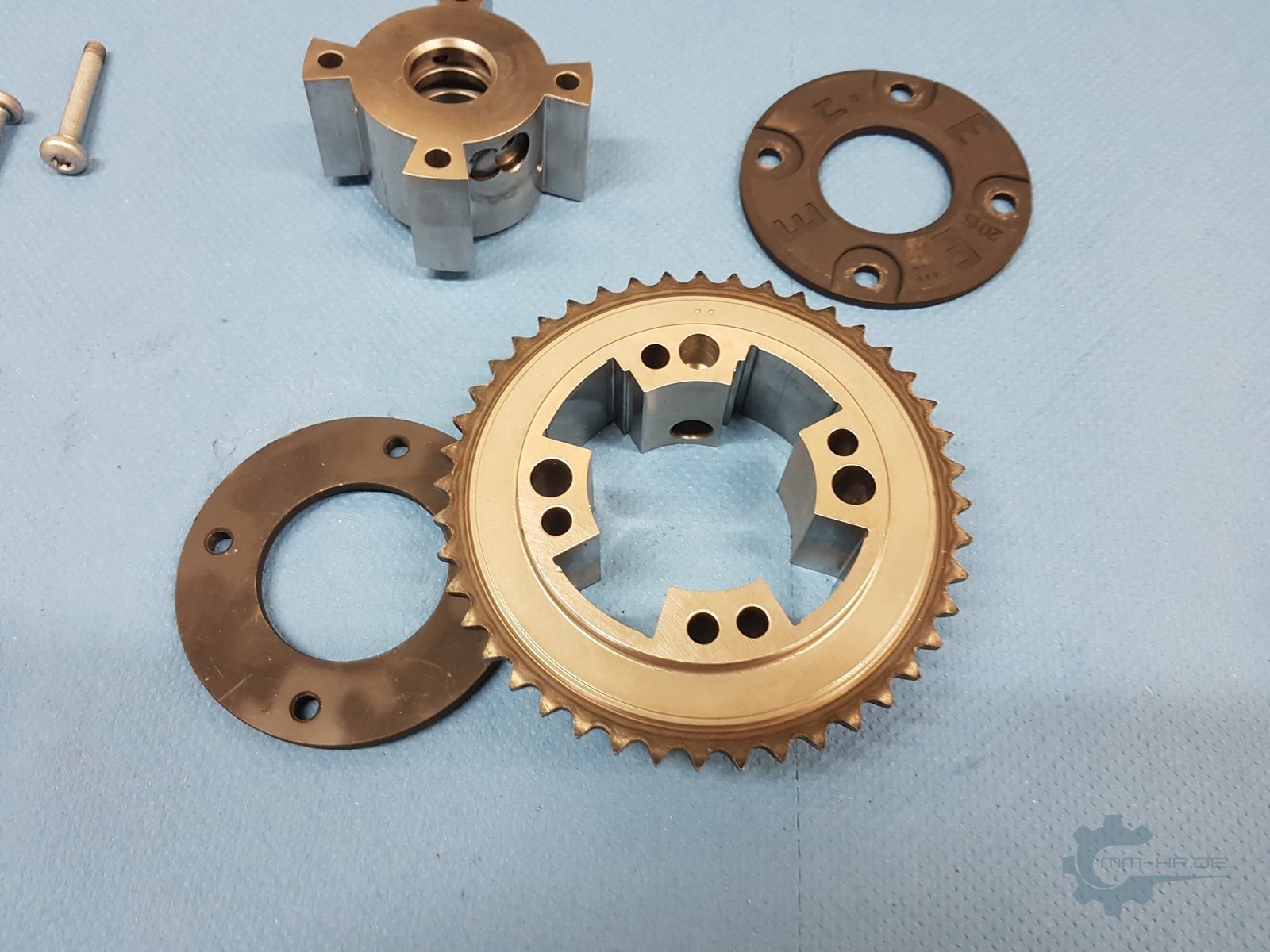
Own photo. A cam phaser disassembled: inside the housing with the chain sprocket sit the chambers, into which the rotor with its vanes engages. Oil in the chambers rotates the rotor and, with it, the camshaft.
For these four-cylinder engines, the manufacturer describes a “brief knock/rattle noise from the engine compartment for approximately one second” after a cold start. The fix is replacing the intake cam phaser with a revised part. The document doesn't name a cause. Forums cite an oil bore in the old cam phaser that was too narrow. That's not in the workshop document itself, so we haven't adopted it.
The workshop document for the 3.5-litre EcoBoost in the F-150 describes a tick or rattle of two to five seconds after at least six hours parked. The workshop is told to replace all four cam phasers and the primary chain. For the later engine generation, the manufacturer even launched a customer programme (21N03) in 2021 that extends the warranty on the cam phasers. It states the noise may appear “as a rattle when starting the engine after the vehicle was turned off for an extended period of time.”
The workshop document for the M276, M278, and M157 also allows for this possibility. The 2013 version required reporting a case with an audio recording to the technical department if the noise persisted after new valves and new tensioners had been fitted. The 2019 version says it directly: “Other causes not related to secondary chain tensioners are also possible and not described in this LI.”
Neither document explains why a cam phaser rattles on starting. Our own reading is that the same mechanism is at work here as with the tensioner: a component working with oil pressure hasn't yet filled in the first few seconds and has play. For the owner, the distinction matters because it decides the repair. It's hardly separable by ear. Both sit at the front of the engine, both rattle briefly after a cold start. Only a workshop that knows the engine and its known weak points can clarify that.
¶ Does the rattle cause damage? What manufacturers say, and what cold really costs
The most important question for most readers isn't where the noise comes from, but whether it causes damage. Here the manufacturers are surprisingly clear.
¶ Three manufacturers, one direction
About the V6 3.0 TFSI it states: “The noises do not lead to damage.” About the M276, M278, and M157: “No consequential damage is to be expected.” And in programme 21N03 about the cam phasers of the 3.5 EcoBoost: “A cam phaser that has developed an undesirable noise does not affect the vehicle safety, performance, or emissions.” The last statement is narrower in scope. It doesn't speak of damage, but states that safety, performance, and emissions aren't affected.
Three manufacturers, three engines, one direction. None of the three describes the brief cold-start rattle as a danger. They fixed it anyway, with new parts and at their own expense, because customers are rightly bothered by an engine that sounds, every morning, as if something were loose.
Two caveats belong here. These statements apply to the named engines and to the described picture, meaning a few seconds after a long parked period on an otherwise sound engine. A rattle that gets longer or also occurs when warm is a different picture. And a manufacturer naturally has an interest in classifying a defect as harmless. That three independent manufacturers point in the same direction speaks, in our view, in favour of them being right anyway. It stays harmless only because it ends after a few seconds. After that the tensioner is under pressure again and keeps the chain calm for the rest of the drive. These statements do not carry over to a chain that has play all the time because it has no tensioner. And the measurements in the next section fit that.
¶ Cold operation wears the chain, measured through the oil
Still, it would be wrong to say cold doesn't matter to the chain at all. The opposite is measured, just by a different route than you'd think.
A review paper from Széchenyi István University in Győr, Hungary (Paulovics and colleagues, FME Transactions 50, 2022) summarises measurements by Schwarze and colleagues. They ran a petrol engine on a test bench for 500 hours, once cold with 20 to 50°C oil temperature, once warm with 110 to 140°C, and measured chain pin wear using a radioactive tracer method. In cold operation, the chain wore ten times as much overall as in warm operation, and roughly thirty times as much when converted per distance travelled. That's the total wear, measured via the radioactive tracer. Subsequent surface analysis reveals a second figure, the mean wear depth of the pins after 500 hours: 3 µm warm, 15 µm cold.
What "cold" means here matters. The engine ran the whole time with cool oil, as if on constant short trips. It wasn't about the moment of starting. And the cause was chemical. The authors write that at low temperatures “water, acids (sulfuric and nitric acids), and fuel condense from the blow-by gases”. Acid and water attack the surfaces, fuel dilutes the oil. When the researchers extracted these gases from the crankcase as far as possible, cold wear halved from 15 to 7 µm. The warm value didn't change.
A second measurement from the same paper shows how strongly oil condition acts. With two fresh oils, the chain bushing wear rate was 0.5 to 0.8 nanometres per hour. With a 0W-30 that had already run 200 hours, it was 7.2 to 11.2 nanometres per hour, more than tenfold.
For the cold-start rattle, this means two things. These measurements did not examine the impact in the first few seconds. That it lasts only seconds is down to the tensioner, which fills and then keeps the chain calm again. A chain that runs without tension all the time is a different case. What cold really costs the chain is the time during which the engine doesn't warm up, and the oil that ages during it. Both are a reason to change the oil sooner rather than later with a lot of short-distance driving. Why short trips take such a toll on the oil is covered in our article on oil dilution. It should be noted that the tests ran on a petrol engine. For a diesel we consider the transfer plausible, but it isn't proven.
There's one point where the start-up impact could still play a role after all, and besides the chain, it is above all the rail. Plastic becomes more brittle with age in hot oil over the years, and it's less tough in the cold to begin with. In our article on guide and tensioner rails we derived the thesis from this that sustained heat ages the rail and the cold start exposes it. That, too, is a thesis, not a measured finding.
¶ Reading cold-start rattle: short, long, warm, or constant
The noise itself reveals more than you might think. Three questions matter: when does it occur, how long does it last, and does anything else accompany it? The table below places the typical pictures. It doesn't replace a diagnosis; it helps with placing it and with the conversation with a workshop.
| What you hear | Likely cause | What to do |
|---|---|---|
| Brief rattle only on the first start after a long parked period, gone after a few seconds | tensioner or cam phaser filling with oil, as described in the manufacturer documents | observe, occasionally note the duration in seconds |
| As above, but it lasts longer than it used to, gets longer over weeks, or persists until the engine is somewhat warm | tensioner holds less well, cam phaser is wearing, the chain has elongated, or a tensioner rail has broken | schedule a workshop appointment, have tensioner, cam phaser, and chain elongation checked |
| Rattle also with a warm engine, at idle, or on throttle | the tensioning system can no longer keep the chain quiet even with oil pressure | have it checked promptly |
| Constant rattling or slapping, plus a check engine light or a camshaft position fault | chain significantly elongated or tensioner at its limit, valve timing may be shifting | stop driving, have it checked |
The table isn't a timeline. The first picture can accompany an engine for its whole life without it ever becoming more. It only gets serious once the picture changes, and that's exactly where it's worth listening closely. Anyone who occasionally counts the duration will notice a change early. The bottom two rows have nothing more to do with normal cold-start rattle.
Why an elongated chain can lengthen the rattle, we explain mechanically. The chain gets longer over the years because its joints wear. The tensioner absorbs the extra slack by extending its piston further. At some point it's extended so far that it has no travel or ratchet reserve left, and then a long chain slaps more on starting than a short one. The shift in valve timing that comes with elongation can't be compensated by the tensioner in any case. Paulovics's review says so explicitly: “The tensioner can only reduce vibrations.” None of the five manufacturer documents deals with elongated chains.
There is, however, one documented case in which cold-start rattle is genuine damage, and it involves the rail. Nissan describes, in its workshop magazine TechNews (summer 2016), a broken tensioner rail for the V6 engines of the VQ series. The plastic breaks at the top and slides down the metal frame. The tensioner piston then extends all the way out until it hits the frame, and the manufacturer writes: “The tensioner was not designed to extend this far.” The damage is recognisable, it states, by “a hard rattle on startup, typically after cold soak.” And further: “Usually, the noise will go away once the engine warms up a bit, but not always.” The magazine warns that such damage can destroy the engine if not repaired in time.
The difference from the harmless picture, then, lies not in the timing, but in the duration. A few seconds until oil pressure builds is what the manufacturers describe. A rattle that persists until the engine is warm no longer fits that picture. What else a broken rail can cause, up to chunks in the oil pump's intake strainer, is covered in our article on guide and tensioner rails. How a chain elongates and what to measure it by is covered in our article on the timing chain and its elongation. Our article on the chain tensioner has a similar table on tensioner noises; both are aligned with each other.
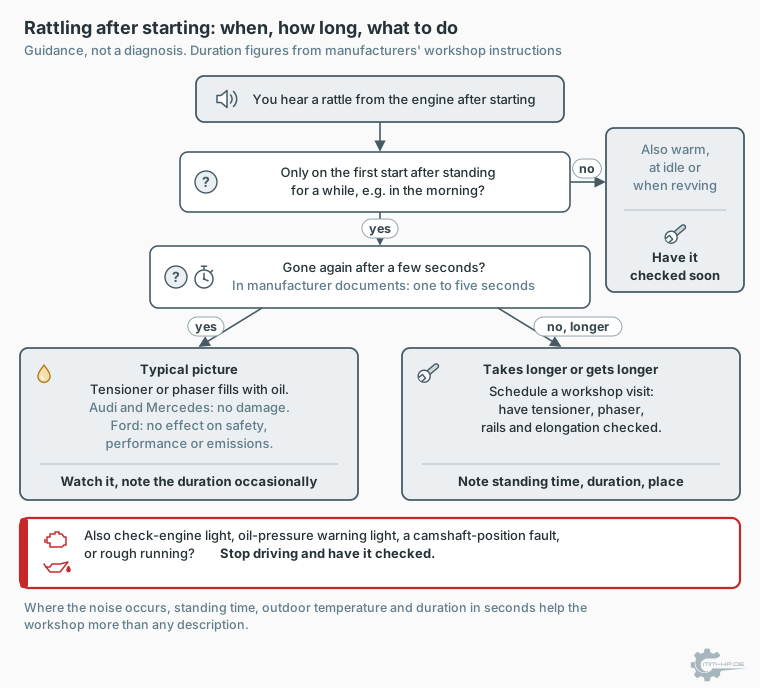
Orientation, not a diagnosis. The duration figures come from the workshop documents in the table above.
¶ What helps the workshop
Describing a noise is hard, and by the appointment the engine is often warm and quiet. Manufacturers know this. The document for the V6 3.0 TFSI requires hearing the noise first on the cold start itself. The one for the EcoBoost checks whether the customer describes exactly this picture, two to five seconds after at least six hours parked. The one for the M276, M278, and M157 required an audio recording for stubborn cases in 2013.
From this follows what you can prepare. Record the noise on the first start of the day with your phone, with the bonnet open if that's safe to do. Note how long the car had been parked, how cold it was outside, and how many seconds the rattle lasted. Note whether it sits at the front of the engine, where the timing drive usually is, or more towards the rear. On the V6 3.0 TFSI, for example, it sits at the rear of the engine, where the chains run there. And write down since when you've been hearing it and whether it's changed. With this information, a workshop can schedule the appointment so it hears the noise itself, rather than guessing from your description.
¶ Oil and rattle: what the oil affects, and what it doesn't
The tensioner works with engine oil. It's tempting, then, to look for a solution in the oil, and forums often recommend a thicker one. We think nothing of that, for three reasons.
The first is in the table at the start. None of the five manufacturers fixed the rattle with a different oil. All of them replaced components. If a different oil had been enough, that would have been by far the cheapest solution for the manufacturers.
The second is the approval. Which oil belongs in an engine is set by the manufacturer through a standard and a viscosity grade, and these figures are matched to its oil passages, its bearings, and its tensioners. An oil outside the approval changes things nobody has tested for this engine. How to read an approval, and why a 0W-30 isn't thinner than a 5W-30 in a warm engine, is explained in our article Which oil?.
The third is more fundamental. A thicker oil can mask a noise whose cause remains. If the rattle gets quieter because a more viscous oil seeps out of the tensioner more slowly, the symptom is gone, and so is the finding that might have changed. We consider that the worse situation.
What the oil actually affects is wear, and there condition is what counts. The measurement with fresh and aged oil in the previous section shows a factor of over ten. An oil with the correct approval, changed within the prescribed interval and sooner rather than later with a lot of short-distance driving, is therefore the best thing an owner can do for their chain. Against the cold-start rattle itself it's no cure, and we don't promise that either.
¶ Tensioner, cam phaser, or chain: what a repair can actually fix
If the rattle becomes bothersome or gets longer, the question of repair arises. The manufacturer documents show there's no general answer to this, only one per engine.
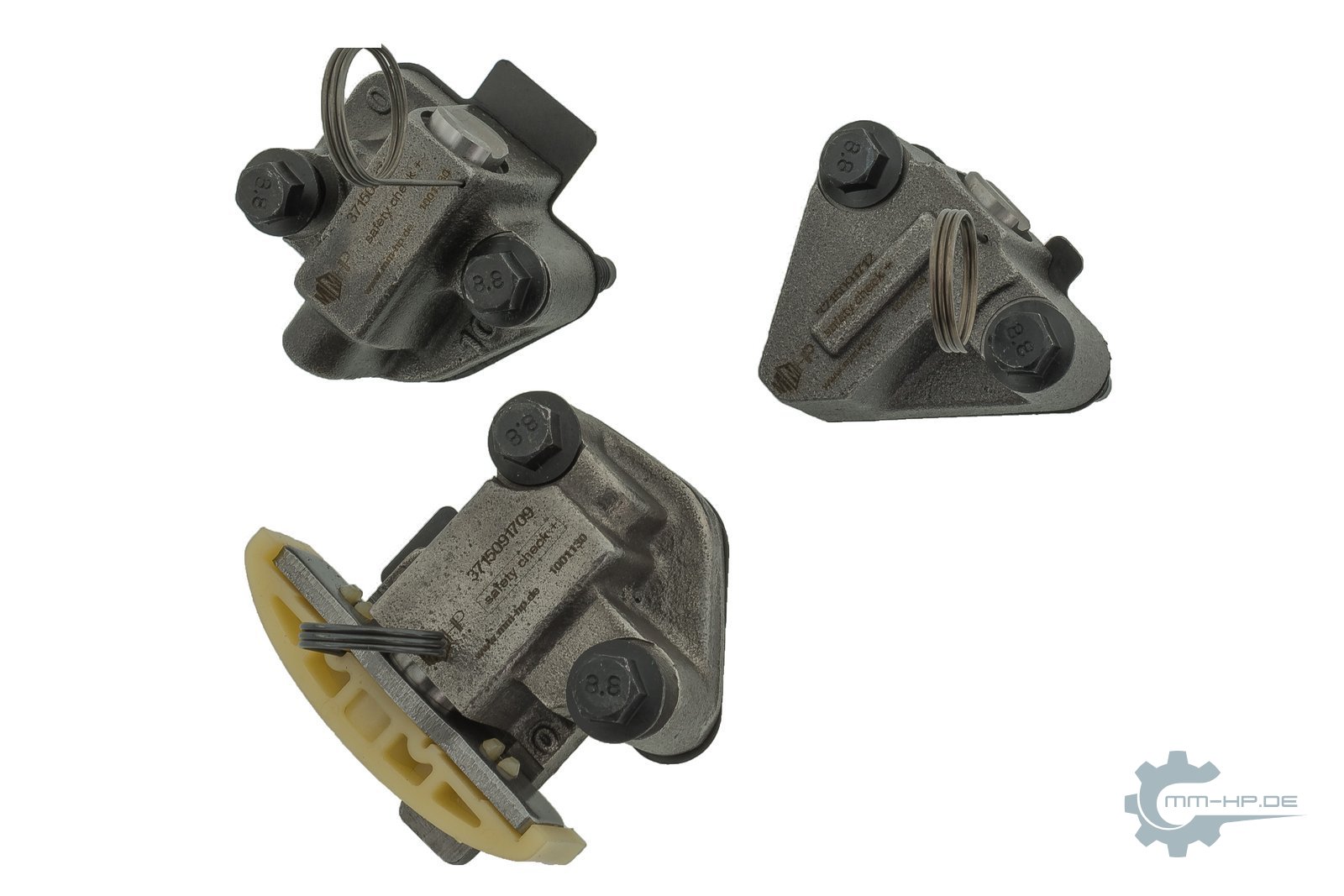
New part, own photo. Chain tensioners of a V6 engine. An improved tensioner was the fix against cold-start rattle for several manufacturers.
An improved tensioner was the fix for the V6 3.0 TFSI, for the Lambda V6, and partly for the M276, M278, and M157. For the V6 3.0 TFSI it's listed as a “Production Solution”, meaning a change in series production: “Improved chain tensioner.” In the workshop, both upper tensioners are replaced with the revised version. Manufacturers do improve tensioners retroactively, then.
A check valve in the oil path was the second part of the fix for the M276, M278, and M157. It sits in the cylinder head, not in the tensioner, and must be selected to match the bore after measurement and fitted using a special tool. On these engines, a new tensioner alone wasn't enough. Depending on the engine number, the manufacturer requires both, only the valves, or only the tensioners. The December 2019 revision of the same workshop document is already version 14 and carries the note “Cause revised. Remedy revised.” Even the manufacturer needed several attempts, then.
New cam phasers were the fix for the EcoBoost and for the 1AR-FE and 2AR-FE. There, a new tensioner or a new chain does nothing against the cold-start rattle, because the noise originates elsewhere.
A new rail is due when one has broken, as in the VQ engine example. In our view, the complete set belongs there, because a broken rail has already let the chain slap for a while.
A new chain alone was never the answer to the brief cold-start rattle for any of the five manufacturers. On the EcoBoost the primary chain was replaced together with the cam phasers, but the main work sits with the cam phasers there. A new chain becomes necessary when the old one has elongated, and that's a different picture from the brief rattle in the morning. It usually shows up as the noise getting longer, also occurring when warm, or the engine management reporting a camshaft position fault.
A simple rule follows for a chain kit. A kit only helps against cold-start rattle if the cause lies in its parts, meaning the tensioner or the elongated chain, and if it includes the revised version of the tensioner, in case the manufacturer issued one. If the noise comes from the cam phaser or from the oil path in the cylinder head, it's the wrong part. What to watch for when buying a kit is described in our article Buying a timing chain kit. How chain, tensioner, rails, and sprockets work together in the timing drive is shown in the overview of the timing chain drive.
¶ What nobody has measured
Finally, we gather where the sources end, so nobody mistakes this for settled.
- By what route a tensioner loses how much oil overnight, through the gap, the check valve, the feed channel, or gravity, depends on the individual engine. We found no measurement that separates this out.
- We also found no standardised test for how quickly a chain tensioner gives at standstill. Anyone wanting to advertise with this would have to define and disclose their own test procedure.
- How strongly oil viscosity in the cold extends the tensioner's fill time is, to our knowledge, unpublished.
- Whether faster pressure build-up after starting measurably shortens the rattle is our thesis, not a measurement.
- For many well-known chain engines, such as the BMW diesel N47, we found no public workshop document on cold-start rattle. What's online about it comes from forums and workshop experience.
- The wear measurements in continuous cold operation ran on a petrol engine. Whether they apply equally to diesel is open.
If you have measurements or your own findings on any of these questions, write to us via Support. We'll update this article as soon as new evidence is available.
¶ See also
- The timing chain drive: design, wear, oil supply
- Guide and tensioner rails: what plastic is inside, and what heat does to it
- The timing chain: designs, elongation, and why oil is the biggest lever
- Why our chain conversion has a chain tensioner
- The oil-pressure warning light: what it tells you, and what it doesn't
- Which oil? Why we don't give a blanket recommendation