¶ Timing Chain Kit Quality: What the Box Won't Tell You
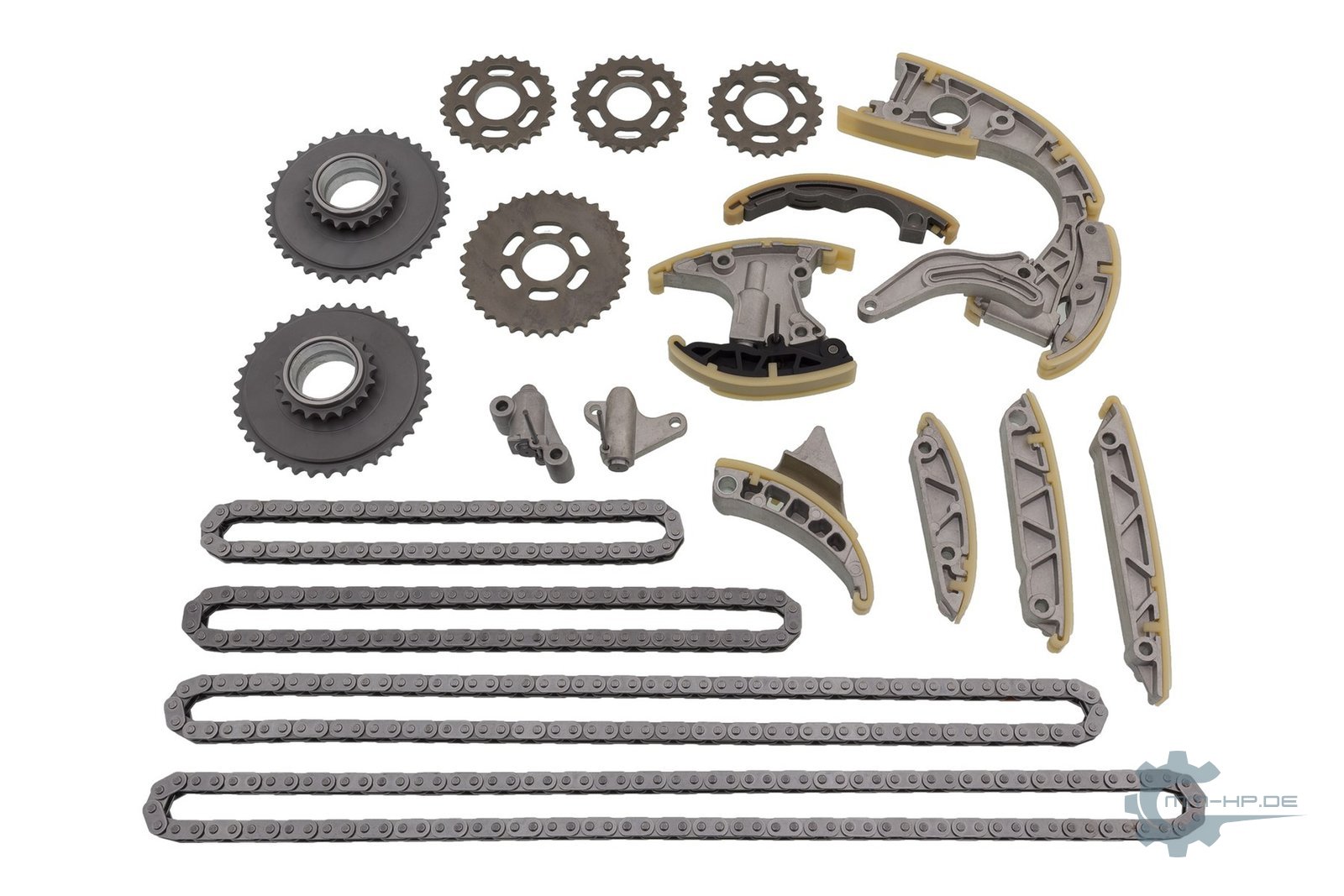
New part, own photo. Chain kit for a V6 engine: chains, sprockets, rails and tensioners.
¶ The key points at a glance
Anyone buying a timing chain kit is buying a black box. No supplier we found tells the buyer what plastic the rails are made of, not even an original equipment manufacturer in its workshop brochure. Nothing on the box says anything about the tensioner's spring or the hardness of the sprockets either. Quality can therefore hardly be checked at the point of purchase. Country of origin doesn't help much either. In one case documented on video, the original replacement kit from a major carmaker came, according to its packaging, from four countries across Europe and Asia, and it held up, while an aftermarket kit with parts from, among others, Germany and France failed after five miles.
In the workshop reports we evaluated, it's rarely about a broken chain. It's about rails with the wrong dimensions, tensioners with too weak a spring, cam phasers with too much play, and burrs on components. These are workshop reports about individual cases, not a statistic. We consider kits with no identifiable manufacturer very risky, because you don't know what you're getting, and because nobody stands behind them.
What everyone has in their own hands is the installation. Replace the whole kit, sprockets included. Check the cam phaser too. Wet the chain and sprockets with clean engine oil before the first start, as one manufacturer of timing drive parts recommends in its workshop guide. Turn the engine over by hand twice afterward. And at the next oil change, check the used oil for plastic fragments.
The old rail doesn't belong in the bin unseen. Its wear pattern reveals whether the tensioner was doing its job, whether the chain ran crooked, or whether the lining had already broken. Anyone who reads it knows whether the new kit alone has fixed the cause.
That was the short answer. Anyone who wants to know in more detail what workshops find in bad kits, how to read an old rail, and where the sources fall silent, will find the long version from here: with manufacturer statements, workshop reports, and a checklist to save.
Materials referenced in this article
| Short name | Polymer | Type | Manufacturer | |
|---|---|---|---|---|
| ◆ | PA46 | Polyamide 46 | Stanyl TW341 | Envalior (formerly DSM) |
| ● | PA66 | Polyamide 66 | depends on the rail | mostly unknown |
For a detailed look at the different grades and how they behave under heat, see our article on guide and tensioner rails.
¶ The timing chain kit as a black box: what the box reveals
A timing chain kit is more than a chain. Depending on the engine, the box contains one or more chains, two to four guide and tensioner rails, one or more chain tensioners, sprockets, often gaskets and bolts, and sometimes a cam phaser. How these parts work together is explained in our overview of the timing chain drive. Here, the question is a different one: how can you tell whether the parts in the box are any good?
The honest answer is uncomfortable. From almost nothing the buyer can see before installation. The box carries a brand name, a part number, vehicle and engine codes, sometimes the phrase "OE quality". What's missing is exactly the information you could actually check something against: the plastic the rails are made of, the tensioner's spring force, the hardness of the sprockets, the phaser's tolerances.
How far this reticence goes is shown by the most thorough workshop brochure on the subject we found. Schaeffler, for the INA brand, explains the timing drive and damage diagnosis across 56 pages. On the rail material, it says only this: “Die Steuerkette gleitet über einen Belag aus unverstärktem Kunststoff (Polyamide/PA)” ("The timing chain slides over a lining made of unreinforced plastic (polyamides/PA)"), and the carrier is “Aluminium, Stahl oder verstärkter Kunststoff” ("aluminium, steel or reinforced plastic"). No grade, no manufacturer. And this is from an original equipment manufacturer writing for workshops. Of 23 videos on the topic of timing chains whose subtitles we evaluated, not a single one names a plastic grade.
That real differences can lie hidden here nonetheless is something manufacturers only say elsewhere. Chain maker iwis wrote in a 2012 utility patent that ● PA66 is mainly used for rails because it's cheaper than ◆ PA46, and that PA66 has a continuous service temperature around 30°C lower as a result. Two rails that look identical can therefore be made of plastics that behave quite differently under heat. You can't see that from the outside. The details are in our article on rail materials.
And even a figure on paper would be no proof. How hard it is to control plastic in a supply chain is shown by a case that has nothing to do with timing chains. Aston Martin had to recall around 5,000 vehicles in the US in 2014 because accelerator pedal arms could break. In its letter to the US traffic safety authority NHTSA, the manufacturer describes that a third-tier supplier had processed material that arrived in sacks labelled as the specified plastic manufacturer's PA6. Testing found a different material, “consistent with PA6.6 material”, meaning PA66 instead of the specified PA6. The label on the sack was correct, the contents weren't. If this happens to a carmaker with its own material specification, a chain-kit buyer certainly can't spot it at the counter.
As far as we can tell, the buyer of a chain kit can look up the materials at no supplier and read them off no part. That's the starting point for everything that follows.
¶ Origin is no proof of quality
If you don't know the material, it's tempting to go by origin. "Made in Germany" versus "Made in China". The idea is understandable, but it doesn't hold up.
An American workshop channel demonstrated this with a case of its own. An aftermarket kit for a V6 engine, by far the cheapest on the market, failed after around five miles. Its packaging listed Taiwan, France and Germany. According to the supplier, when asked, the rails came from Taiwan, the tensioners from France and the chains from Germany. The carmaker's original replacement kit, with which the engine then ran without issue, listed Slovakia, Taiwan, Vietnam and China on the box. In this case, the kit with the supposedly better country mix was the worse one.
In a Russian-language video, a mechanic compares chains for a BMW diesel. The chains from two aftermarket packages from different brands, according to the presenter, come from the original chain's manufacturer and differ from the original only in the stamping on one chain. A chain from a third kit, by contrast, had stretched considerably after 20,000 kilometres. So the brand on the box doesn't reliably tell you who actually made the part.
Both cases show the same thing. A chain kit doesn't have to come from a single factory. In the US case, the chain, rails and tensioner came from three countries and were only assembled into a kit by the supplier. Whether the next shipment comes from the same factories, no box says.
In our view, two other questions therefore matter more than the country of origin. What exactly is inside? And who stands behind it if it fails? The first can hardly be answered at the point of purchase. The second can.
¶ What workshops find in bad kits
Which faults actually occur in chain kits can't be answered from the technical literature. We found no statistics on this. What exists are workshops that take kits apart and show what they find. We evaluated the subtitles of 23 such videos. The most informative findings are in the table. All are individual cases, mostly with estimated rather than measured values, and that's how we read them too.
| Component | What the workshop found | Engine | Assessment |
|---|---|---|---|
| Chain tensioner | Tensioner gave way almost completely under load, the main chain jumped a tooth. The supplier confirmed on request that the spring tension had been wrong | GM V6, 3.6 l | one case, cause confirmed by the supplier |
| Chain tensioner | Contact face square instead of round like the original, worse sealing rings | Mercedes V6 | one case, visual comparison |
| Rails | Bearing point spacing and guide length deviate from the original | Mercedes V6 | one case, visual comparison |
| Cam phaser | Noticeably more play, estimated by the presenter at 0.3 to 0.5 mm versus 0.1 to 0.15 mm on a used original, sheet-metal sealing strips too thin, burrs, crooked locking mechanism | Mercedes V6 | one case, estimated, not measured |
| Rail coating | Rubbery coating on the lower rails crumbled off after around three years, especially under heat, fragments in the oil pump's intake strainer | BMW N47 | one workshop, six years of experience with this engine |
Three things stand out in this table.
The tensioner is at the top of the list, and that's no coincidence. It's the component that holds the chain under tension, and it works with a spring and with engine oil. A too-weak spring isn't visible from the outside. In the US case, the kit looked completely unremarkable after removal, the chains taut, the rails new. Only a camera during hand-turning showed that the tensioner nearly collapsed with every piston stroke. How a hydraulic tensioner is built is explained in our article on the chain tensioner.
The cam phaser shows up even though it isn't included in many kits at all. Where it is included, hardly anyone checks it. In the Mercedes video's case, the entire aftermarket kit cost less than a single genuine phaser. That alone proves nothing. But the list of findings on this one part is long.
And the finding on the rail coating comes with a caveat that makes it more cautious than it first sounds. According to the same workshop, new genuine rails for this engine now also carry the rubbery coating, whereas a genuine kit from 2012 did not yet. Whether the coating lasts longer on the genuine part, the workshop doesn't say. So this isn't simply a problem confined to cheap parts.
From the workshops we work with in our development work, who trial new parts and solutions for us in everyday use, we keep hearing the same thing: kits with no identifiable manufacturer are a recurring problem in the workshop. That, too, is experience rather than measurement. But it matches what the videos show.
¶ Kits with no identifiable manufacturer: why we consider them very risky
There are two common views on chain kits with no identifiable manufacturer. One says it's all the same junk. The other says it all comes from the same factories anyway. We can't substantiate either claim, and so we don't make them.
What we can say: with a kit from no identifiable manufacturer, you don't know what you're getting. The material is unknown, as with every kit. On top of that, you don't even know who assembled the parts, whether the next shipment comes from the same factory, or who to turn to if the engine suffers damage after 5,000 kilometres. Such a kit can be flawless. You just have no way of finding that out beforehand, and nobody to stand behind it afterward.
For a component whose failure can destroy the engine, we consider that very risky. A chain jumping a tooth in an engine where pistons and valves can touch is catastrophic damage. Labour time for the installation is the same for either kit. Measured against that, we consider the price difference to a kit with a known manufacturer the smaller risk.
In fairness, it should be said that kits from known brands fail too. Forums have individual reports, some hearsay, about branded kits their owners were very unhappy with, and on the BMW N47, the crumbling coating, according to the workshop mentioned above, now affects genuine parts as well. A brand is no guarantee. But it is someone you can ask.
¶ What you can look out for when buying
If the quality of the parts can't be checked, the question remains what a buyer can actually do. More than you'd think, and most of it doesn't concern the brand, but completeness and installation.
Buy the complete kit, sprockets included. Manufacturer Gates writes in its 2025 workshop guide on chain replacement that replacing only the failed part is “a risky and unprofessional practice”. The recommendation is the complete kit, “always including the sprockets”. The reason is in the same text: worn teeth, recognisable by a pointed, hook-shaped or thin profile, sharply accelerate wear on the new chain. A new chain on old sprockets wears itself into their existing wear pattern.
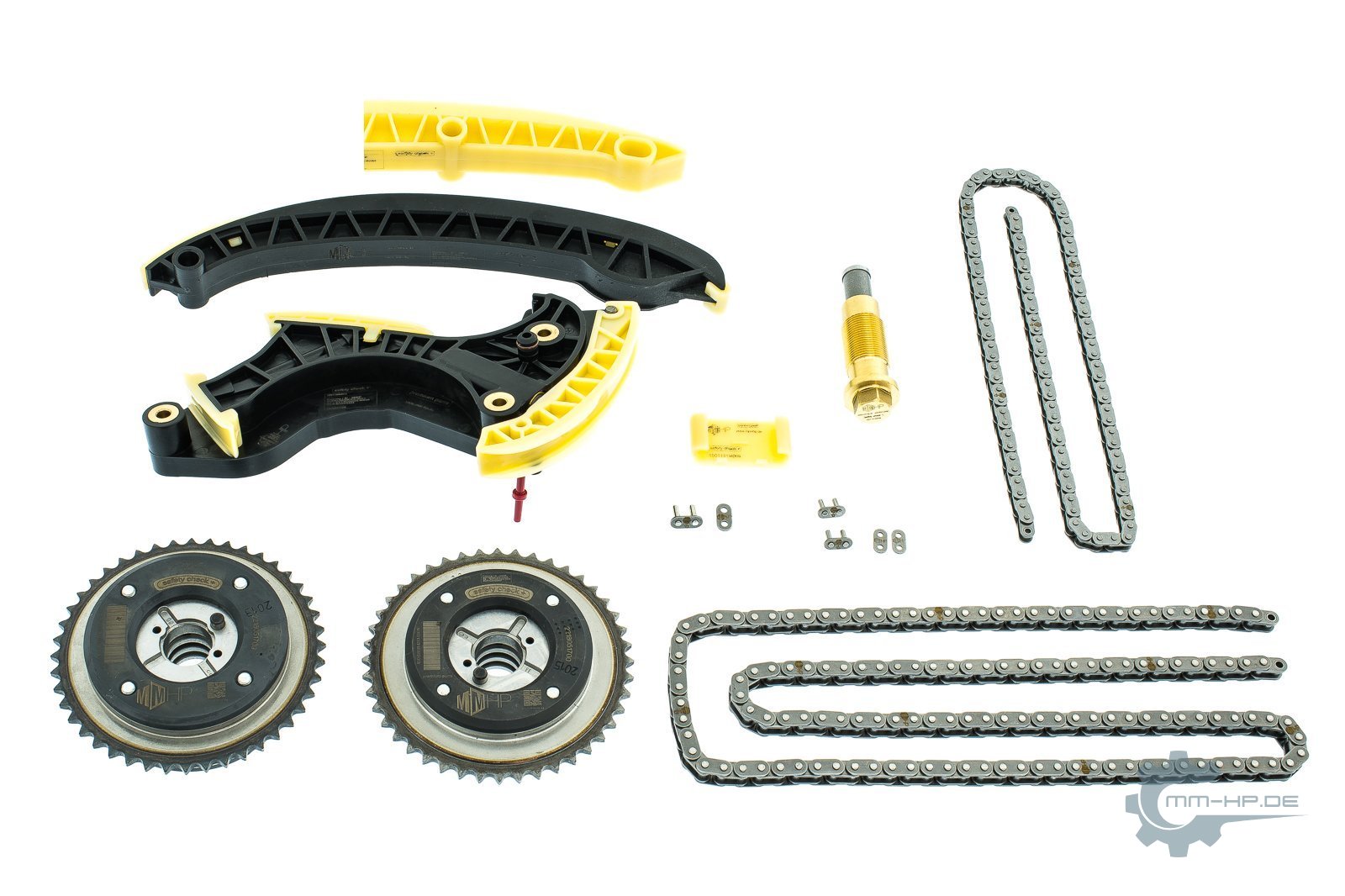
New part, own photo. A complete kit, sprockets and phasers included.
Think about the cam phaser too. Many kits don't include it, and it's easily overlooked during a chain replacement. Yet it hangs off the same oil supply as the tensioners. Audi describes in a training document for the 3.2-litre V6 that a dedicated riser line “die Kettenspanner für die Steuerketten und die Nockenwellenversteller” ("supplies the chain tensioners for the timing chains and the cam phasers"). In a workshop video about phasers on the VW 1.4 TSI and 1.6 FSI engines, the presenter describes the case of a viewer: the rattle persisted after the chain replacement and only disappeared with a new phaser costing just under 500 euros in parts. A single case, but an expensive one if it means opening the engine twice. How to tell tensioner, phaser and chain apart when it comes to cold-start rattle is covered in our article on cold-start rattle.
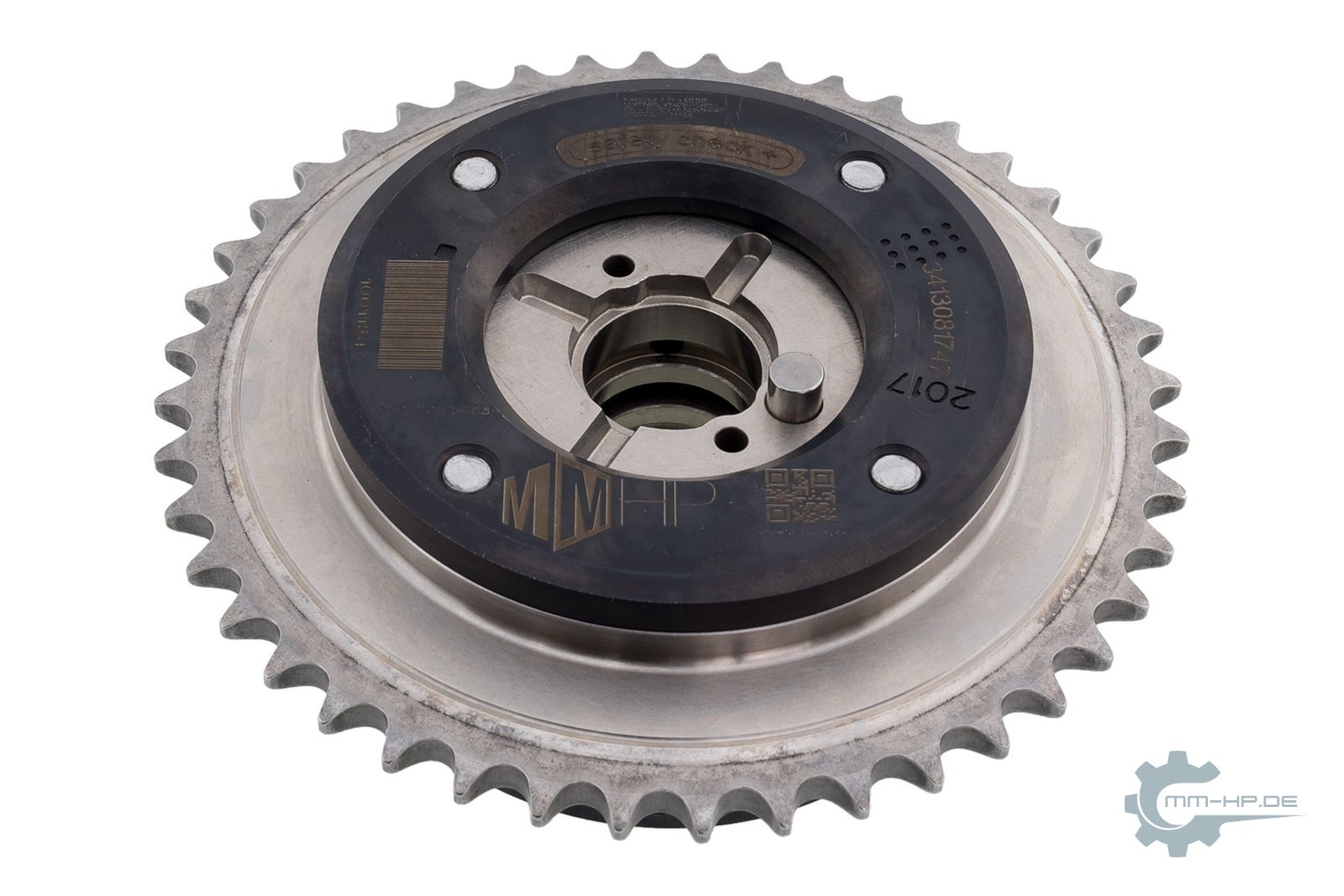
New part, own photo. A cam phaser. It hangs off the same oil supply as the tensioners.
Check for completeness and undamaged packaging. One workshop advises in a video against installing a kit that's already been opened. That sounds obvious. But with a kit made up of several individual parts, an opened box is simply one where you don't know whether everything the manufacturer put in is still there. Checking against the parts list before installation is worthwhile.
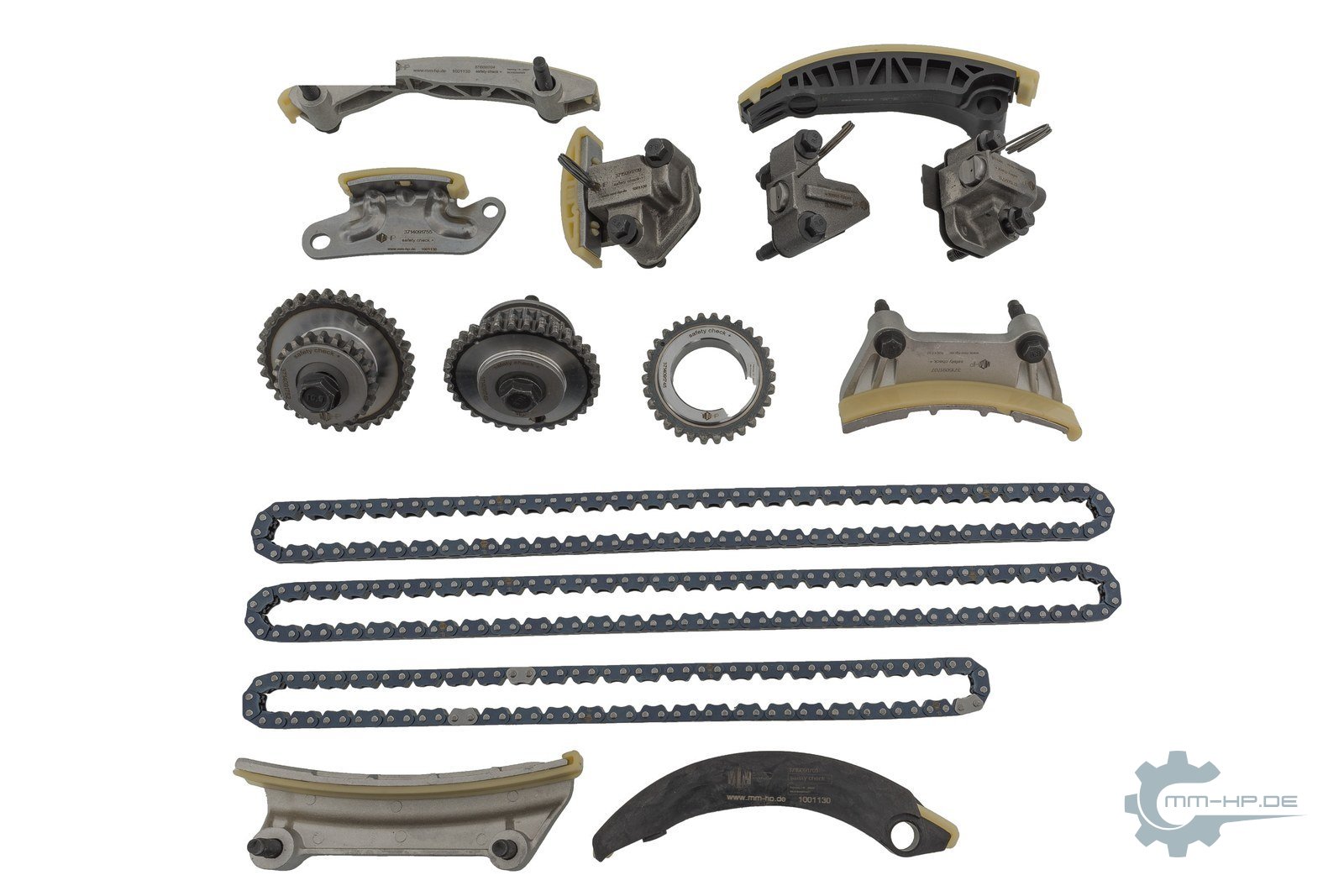
New part, own photo. A kit, fully laid out. Checking against the parts list before installation is worthwhile.
Bolts as specified by the vehicle manufacturer. Whether bolts on the timing drive need to be replaced is stated in the repair manual for the given engine. Some kits supply new bolts, others don't. Our recommendation: wherever the manual specifies stretch bolts, new ones belong in, even if the kit doesn't include them.
Use an oil filter as specified by the manufacturer. That sounds like a different topic, but it isn't. Nissan writes in its workshop magazine on chain tensioners that pressure in the tensioner can drop after the engine is switched off, naming as one possible cause “a poor quality, non-OEM oil filter”. Nissan's own filters, it says, have a check valve that prevents this. That's a statement about Nissan engines. But the principle applies wherever a hydraulic tensioner has to refill with oil after a start. Why the oil supply to the timing drive is no side issue is explained in our overview of the timing chain drive.
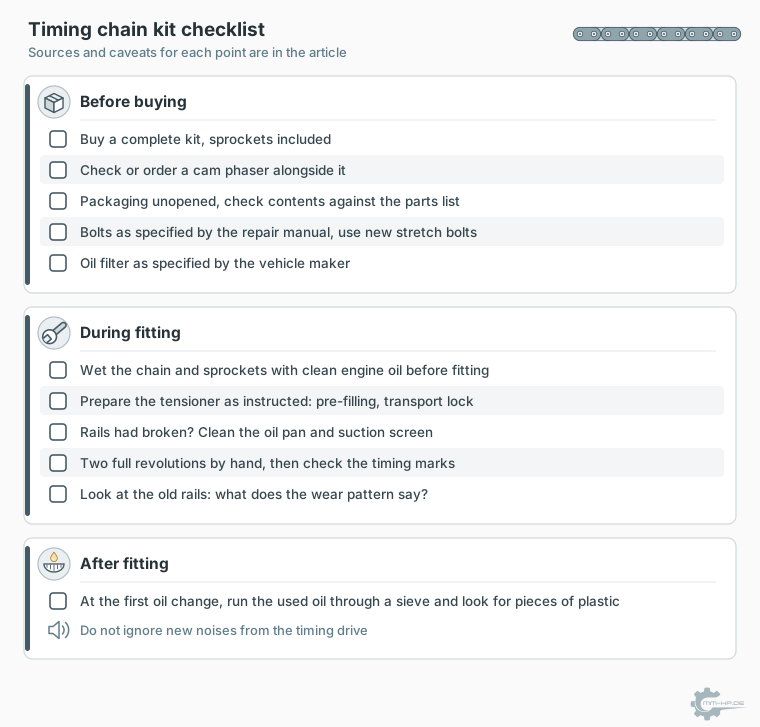
Checklist to save. The sources for each point are in the text.
¶ During installation: oil first
The best kit doesn't help much if the first revolutions go wrong. The manufacturer describes four installation steps in the guide mentioned above that, in our view, everyone installing or having a chain kit installed should know.
Pre-lubricating. Literally: “Before installing the new chain and sprockets, apply a coat of clean engine oil to the chain and sprocket teeth to ensure adequate initial lubrication.” So before installation, coat the chain and sprocket teeth with clean engine oil. The reason is simple. At the first start, the oil circuit isn't yet established, the pump first has to deliver the oil through the filter and galleries to the timing drive. Until then, the parts run only on what they were given beforehand. We additionally recommend also wetting the rails' running surfaces. That's not in the guide.
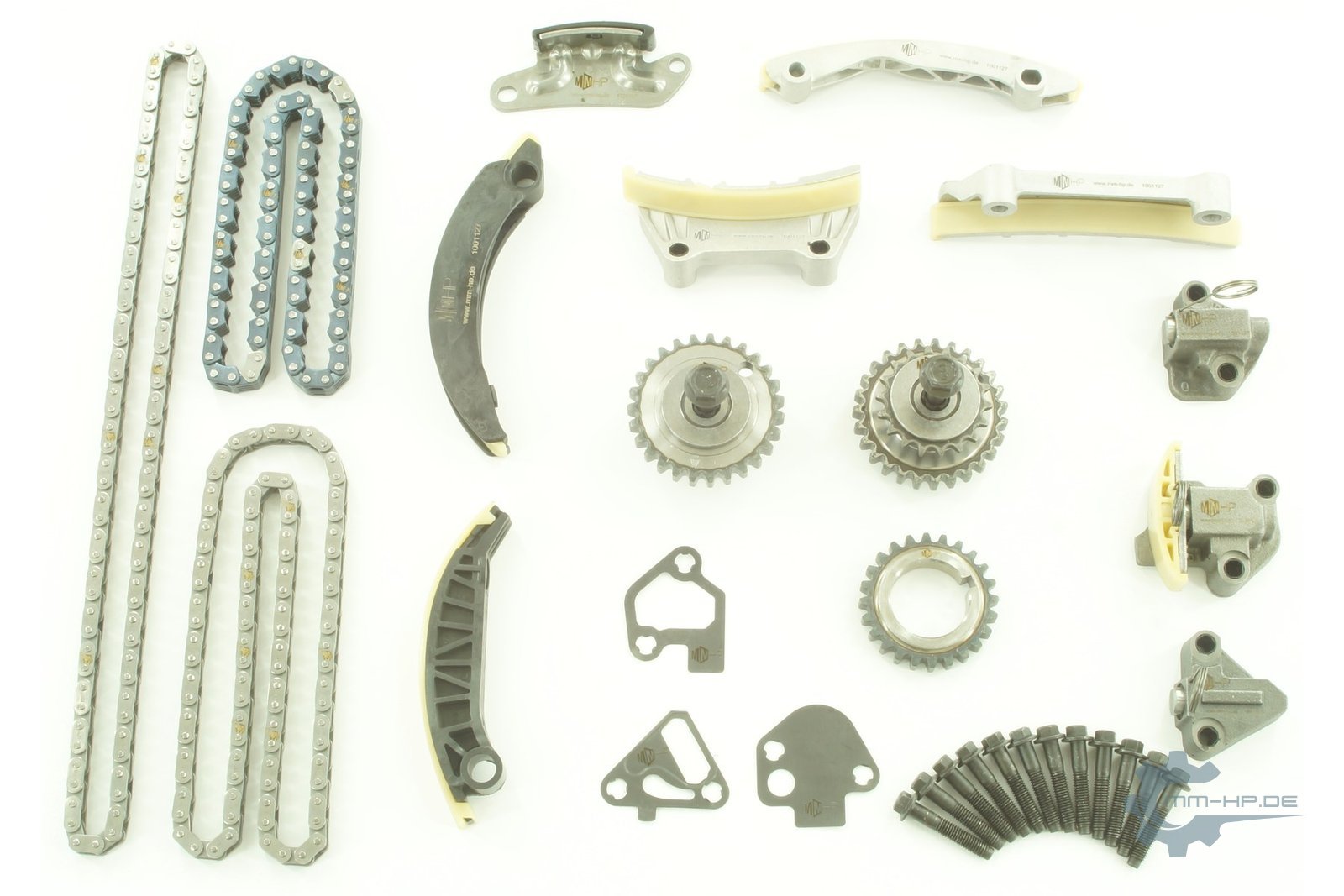
New part, own photo. The individual parts of a kit. Before installation, the chain and its teeth get a coat of clean engine oil.
Preparing the tensioner. The guide recommends checking whether the new hydraulic tensioner needs to be pre-filled or has a shipping lock that's removed after installation, following the manufacturer's instructions in either case. A hydraulic tensioner works with engine oil. If it's empty at the first start, only its spring holds the chain until oil pressure is established. A 1993 patent filing from manufacturer Eaton (US 5,304,099) describes this state: without oil pressure, the chain goes slack, with “noise and vibration on start-up until sufficient hydraulic pressure is built up”. This window is short because the tensioner fills within seconds, and only for that reason do Audi, Mercedes and Ford state in workshop documents that such rattling causes no consequential damage. But there's no reason to make it any longer than necessary at the first start of a new kit.
Cleaning the oil pan if rails had broken. Anyone finding broken rails must, according to the guide, remove the oil pan and thoroughly clean the pan and the oil pump's intake strainer, otherwise “a fatal lubrication obstruction” threatens shortly after the repair. Fragments of an old rail are then still sitting at the bottom of the engine, and the strainer is the first place they get caught. How sensitive the oil pump's intake side is to foreign matter is described in our article on the oil pump.
Turning the engine over by hand twice. Before the engine starts for the first time, it's turned at the crankshaft by hand for at least two full revolutions. The guide calls this “VITAL”. This reveals whether valves and pistons collide anywhere, and whether all timing marks line up exactly again after two revolutions. In the case of the American channel, exactly this step, with a camera on the tensioner, would have shown the fault before the first mile.
After installation comes one last step, due weeks later. The workshop with long experience on the BMW N47 recommends running the used oil through a strainer at the oil change and checking for plastic fragments. The guide mentioned above calls plastic parts in the oil pan “An unmistakable sign of breakage”. Anyone who finds fragments at the first oil change after the repair has received a warning before the strainer clogs. How oil and chain wear relate to each other in the first place is covered in our article on the timing chain and its elongation.
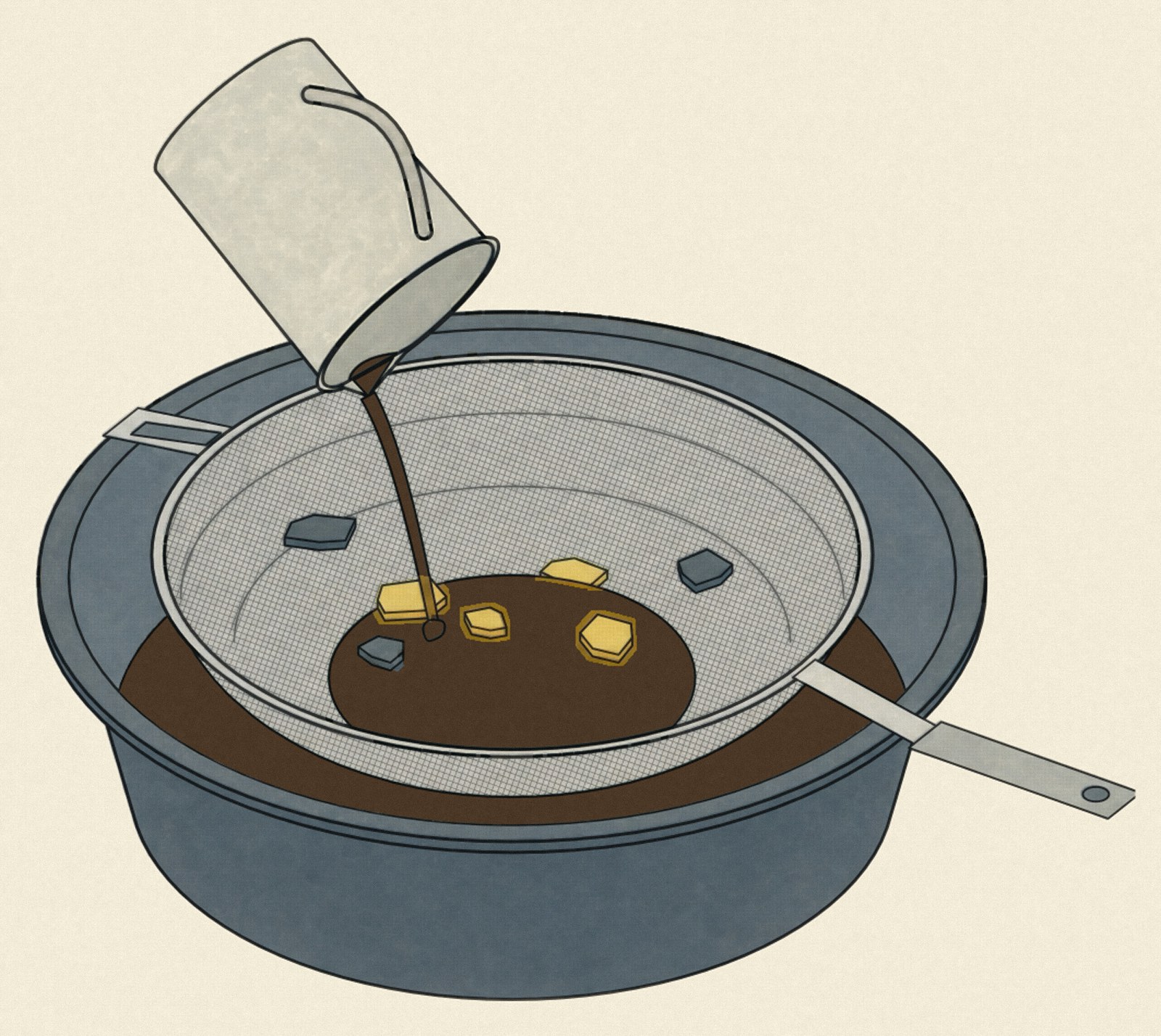
Pouring the used oil through a strainer at the oil change: plastic fragments in it are a warning sign of a broken rail.
¶ Reading the wear pattern on the old rail
At a chain replacement, there's a piece of evidence on the table that hardly anyone looks at: the old rails. Yet they tell you what was going on inside the engine. The American trade magazine Counterman puts it in a short video like this: the wear pattern on the rails is a good indicator of the condition of the chain, sprockets and engine. Unusual patterns point to axial play on the crankshaft or camshaft, to a tensioner not working properly, or to incorrect oil pressure. Rails are designed to wear, but should last an engine's lifetime. If they wear prematurely, something is wrong with lubrication or the tensioner.
The same source names one more sign that has nothing to do with wear and still reveals a lot. If, on a warranty claim, the new rails are lying unused in the box, only half the job was done.
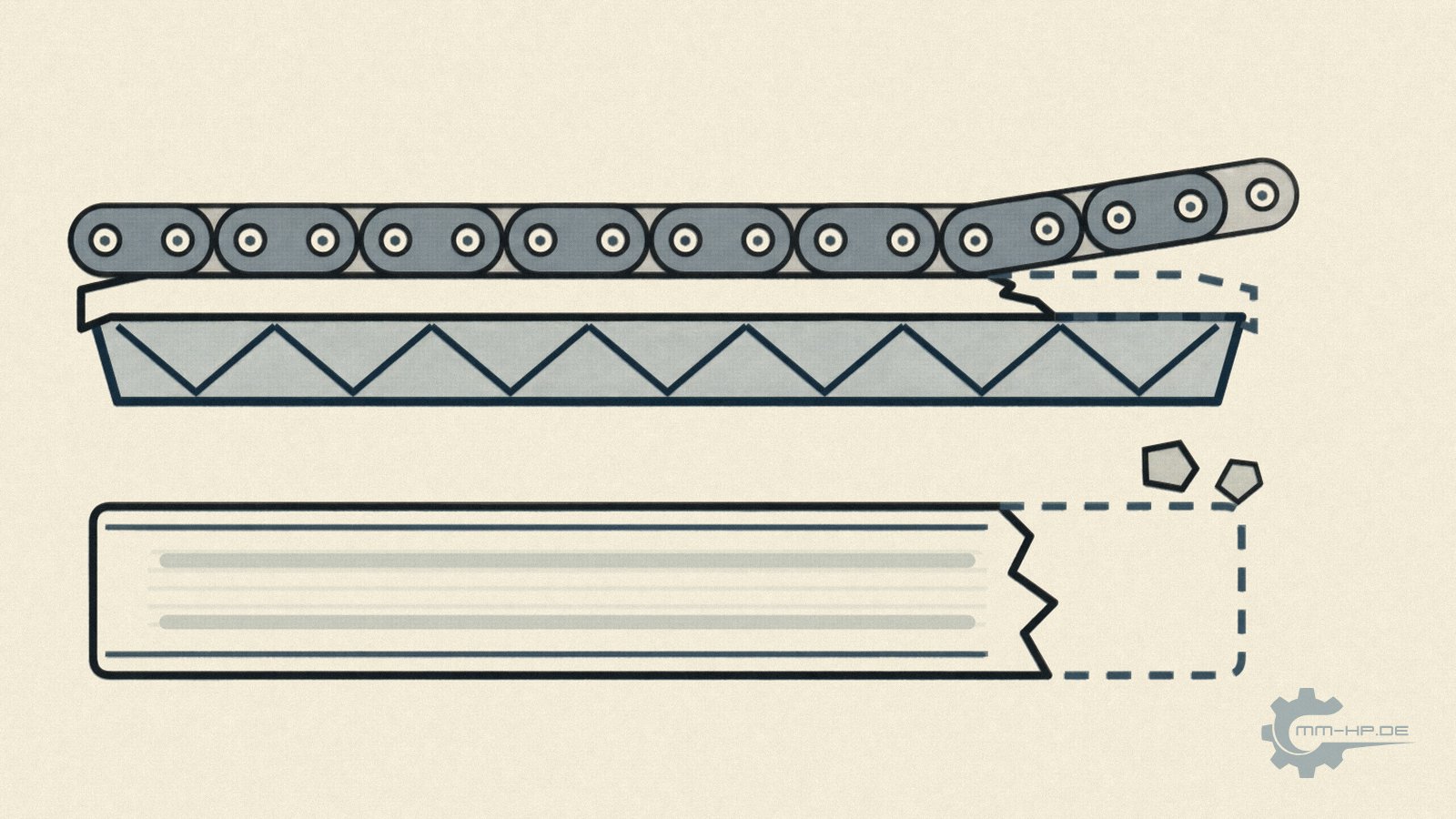
We've pieced together how the patterns look in detail from several sources: the damage catalogue in the technical book "Kettensteuertriebe" (Chain Timing Drives) by Peter Bauer (2013, with technical input from iwis), a Nissan workshop magazine on rails and tensioners, the workshop guide on chain replacement mentioned above, and the workshop reports from the videos. The graphic shows six patterns schematically. It doesn't replace a diagnosis on the engine, it helps you know what to look for.
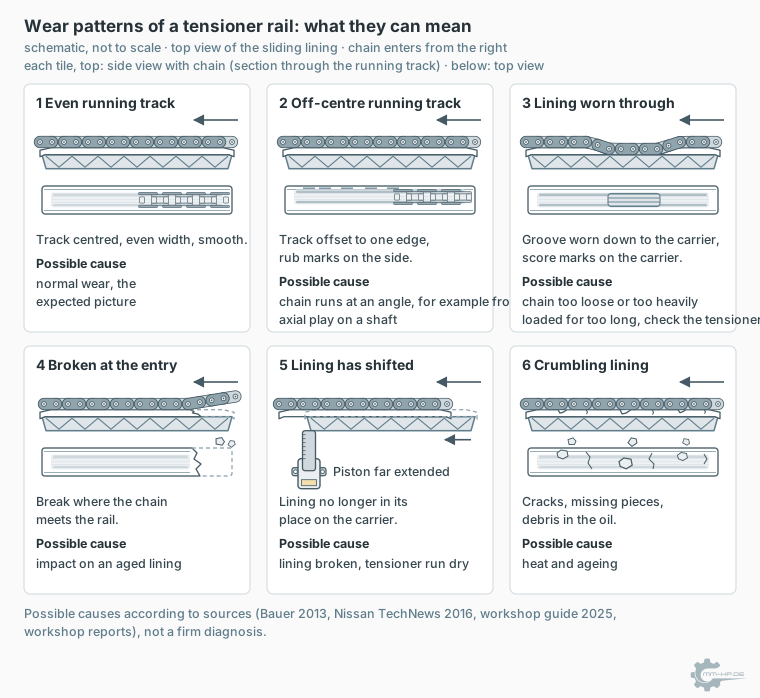
Schematic, not to scale. Each pattern comes with a possible cause, not a certain diagnosis.
| Pattern | What you see | Possible cause | Source |
|---|---|---|---|
| 1 Even running track | flat, smooth track in the middle of the lining, equally wide along its length | normal wear, the expected picture | Counterman (designed to wear) |
| 2 One-sided running track | track shifted to one edge, contact marks on one side flange | chain running crooked, e.g. from axial play on the crankshaft, camshaft or a sprocket | Counterman, Bauer ("skewed running of the timing chain") |
| 3 Worn-through lining | groove down to the carrier, bare or scored patch on the metal or carrier plastic | chain too loose for too long or overloaded, check the tensioner | Nissan, workshop guide 2025 |
| 4 Lining broken at the inlet | chipped-out section at the end where the chain first meets the rail | impact from the incoming chain, aged or brittle lining | Bauer ("sliding lining broken at the rail's inlet") |
| 5 Lining shifted or detached | lining no longer sits in place on the carrier, tensioner piston fully extended | lining broken and slid along the carrier, tensioner pushing into empty space | Nissan, Bauer ("sliding lining detached from the carrier") |
| 6 Crumbling coating | chips and cracks in the surface, missing fragments | heat, ageing of the lining, fragments in the oil circuit | BMW N47 workshop, workshop guide 2025 |
A few of these patterns deserve a second look.
Pattern 2, the one-sided track, is one a new kit won't fix. If the chain runs crooked because a shaft has too much axial play, the new chain runs crooked too, and the new rail wears at the same spot. Bauer explicitly lists “Schräglauf der Steuerkette” ("skewed running of the timing chain") in his damage catalogue. The interpretation that a one-sided track points to this is our own reading of the sources. It's only certain once the axial play has been measured on the engine.
Pattern 5, the shifted lining, is precisely described in Nissan's workshop magazine for the V6 engines of the VQ series. There, the plastic on the large tensioner rail typically breaks at the top and slides down the metal frame. The tensioner piston then no longer presses on the moulded plastic part but extends fully until it hits the frame. Nissan writes: “The tensioner was not designed to extend this far”. The tensioner can no longer hold the chain that way, and the noise is the chain slapping back and forth between rail and piston. According to Nissan, this is audible as a hard rattle on starting, typically after the engine has sat cold. On this engine, it can be checked through a cover on the tensioner without removing the timing cover.
Pattern 3, the worn-through lining, shows how long a problem has already existed. Nissan describes, on the same engines, tensioner shoes the chain had worked its way through, recognisable by a high, singing or whistling tone that rises with engine speed. The guide names a scraping sound, from the chain rubbing on metal, as a sign of a completely worn rail lining. Anyone finding such a lining should not only replace the chain, but also ask why it was loose for so long.
A word on the limits of this table. It describes what sources have observed on rails, and assigns causes the way the sources name them. A systematic investigation into which cause produces which pattern, with measurements across many engines, we didn't find. The wear pattern is a clue that raises the right question. The answer only comes from measuring on the engine.
¶ What we don't know
This article draws on manufacturer documents, one technical book, and workshop reports. In several places these sources aren't enough, and we say so explicitly:
- How often chain kits fail prematurely, broken down by original, branded aftermarket, and kits with no identifiable manufacturer, has, as far as we know, never been published. The findings in this article are individual cases.
- Which plastic is in a specific rail is named by no manufacturer. Only a lab analysis can determine it.
- How hot the oil at the timing chain actually gets in normal operation, measured with the location stated, we haven't found. Plastic manufacturer DSM names 130 to 150°C with peaks of 165°C, without stating the measuring point. Audi's 150°C is a design value for the 4.0-litre V8 TDI at full load and high ambient temperature, not an operating value.
- How great the forces at each individual rail are is stated as a figure in no freely accessible source.
- Whether a one-sided running track reliably indicates axial play is our own reading of the sources and hasn't been investigated.
- Whether pre-lubricating measurably extends a kit's service life has not been measured by anyone. We recommend it because it costs nothing and the first revolutions demonstrably run without an established oil circuit.
If you have measurements, photos of wear patterns, or your own findings on any of these questions, write to us via Support. We'll update this article as soon as new evidence is available.
¶ See also
- The timing chain drive: structure, wear, oil supply
- Guide and tensioner rails: what plastic is inside, and what heat does to it
- Cold-start rattle: tensioner, phaser, or chain?
- The timing chain: designs, elongation, and why oil is the biggest lever
- Why our chain conversion has a chain tensioner
- Understanding the oil pump: what it does, where its limits lie, and what it fears
- Oil dilution: when fuel gets into the engine oil
- Glossary