¶ Timing Chain: How It Works, Symptoms and When to Replace
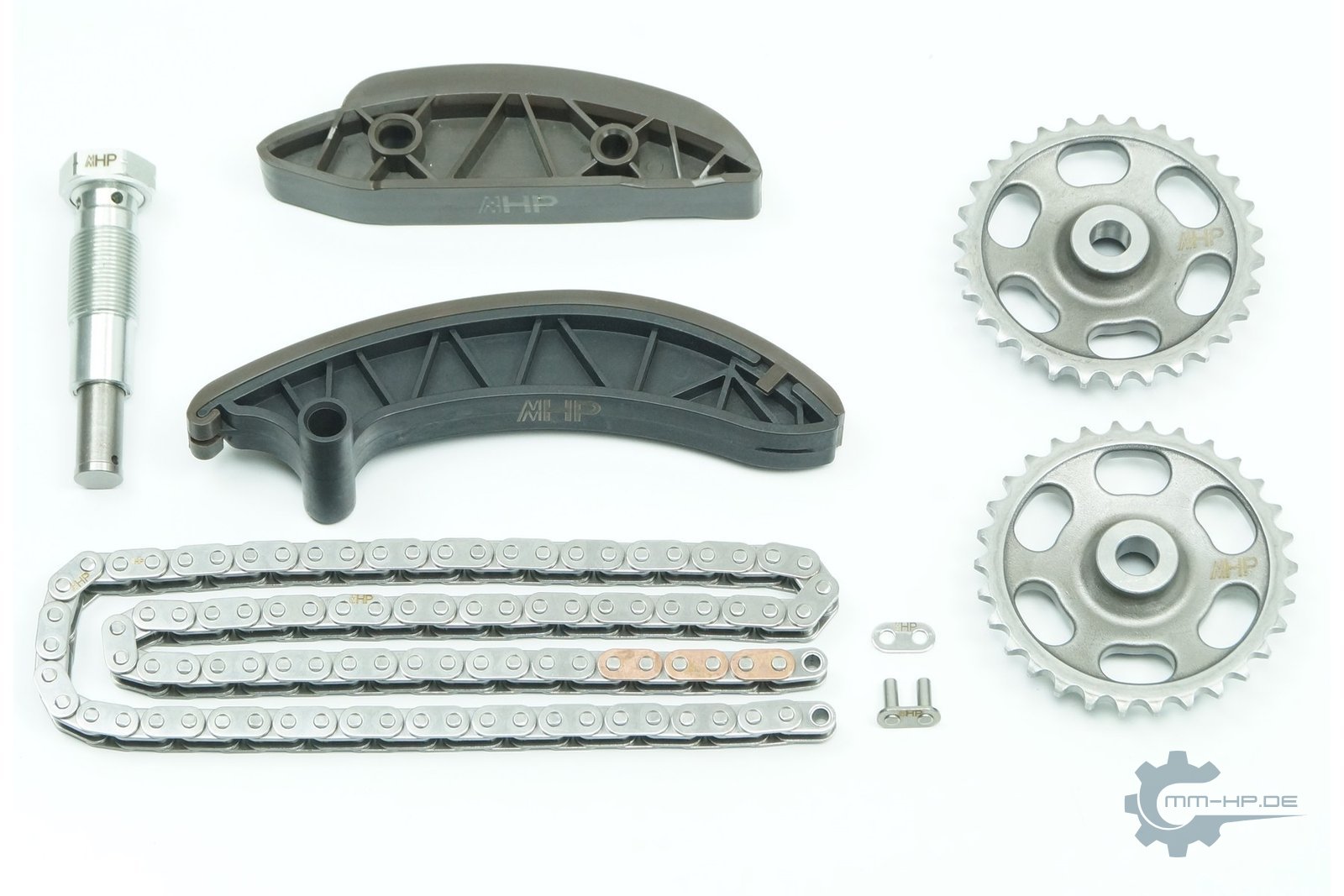
New part, own photo. A timing chain kit consists of chain, sprockets, a guide and a tensioner rail, and the tensioner.
¶ The key points at a glance
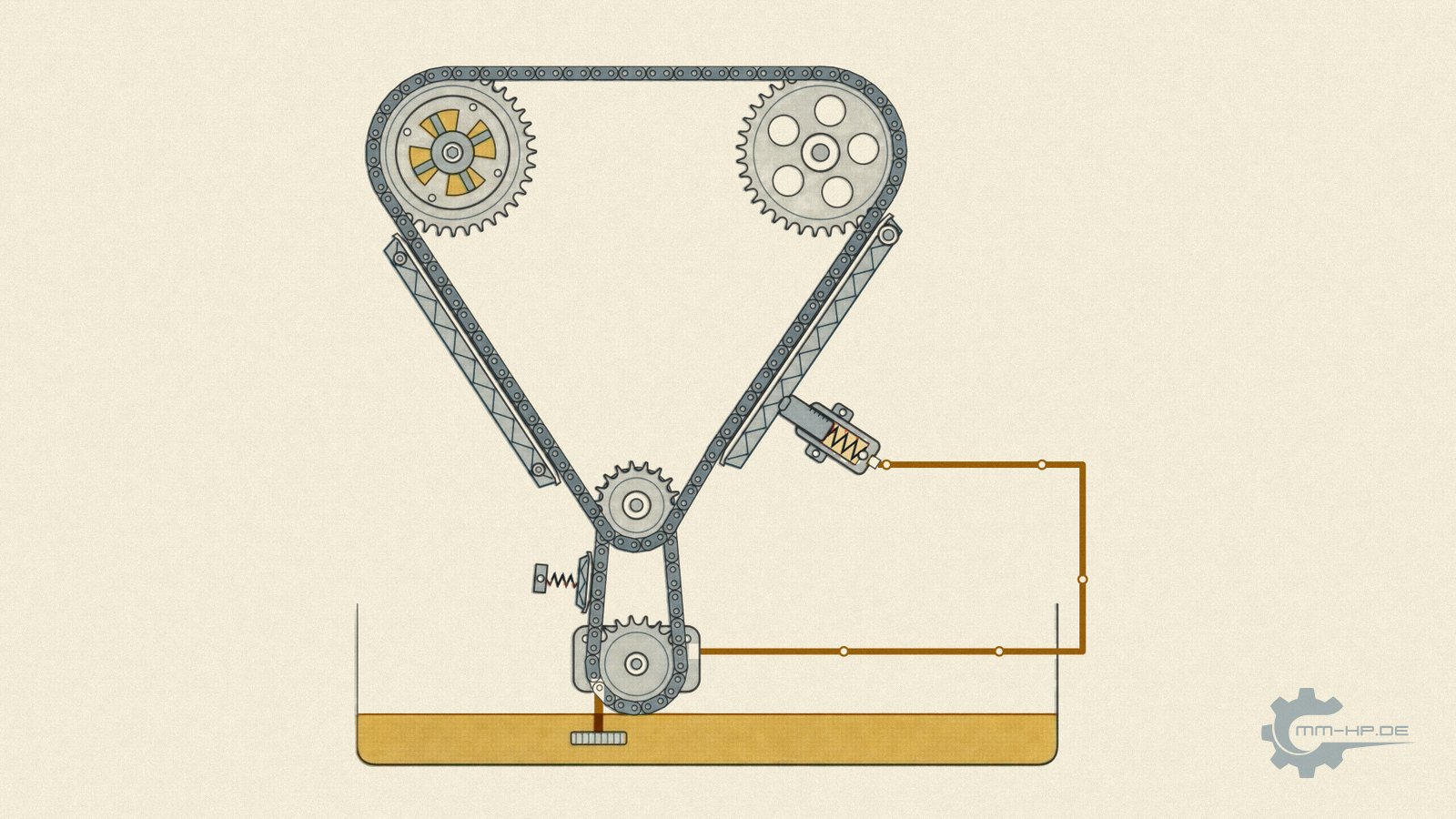
The timing chain drive connects the crankshaft to the camshafts so the valves open and close at exactly the right moment. A timing chain always comes with several components: sprockets on the crankshaft and camshafts, the chain itself, a fixed guide rail, a movable tensioner rail, and a chain tensioner that keeps the chain taut. A cam phaser and ancillary drives such as the oil pump often sit in the same drive. The crankshaft pulls the chain taut on one side, the tight span. The other side, the slack span, runs back loose. There the tensioner pushes against it via the tensioner rail and absorbs the chain's impacts.
A timing chain doesn't automatically last an engine's whole life. Its joints wear, which makes it measurably longer, and the camshaft ends up lagging a little behind the crankshaft. A timing drive rarely fails on the chain alone, though. More often it's the tensioner, the plastic rails, or the cam phaser that give way first.
The main symptoms are rattling after starting, fault codes on crankshaft and camshaft position, and plastic debris in the used oil. According to Audi's and Mercedes's own workshop information, brief rattling on cold start causes no damage. Ford writes about noises from its cam phasers that they have no effect on safety, performance, or emissions. Plastic debris in the oil, by contrast, is a warning sign that should be checked immediately.
There's no fixed replacement interval. Engine manufacturers design timing drives to be maintenance-free. Replacement happens based on findings, and then as a complete set: chain, rails, tensioner and sprockets together.
The timing drive also depends on the oil supply. The hydraulic tensioner is an oil consumer at the end of its own line, and it only becomes taut once enough oil pressure arrives after starting. What pressure is actually present there is something a gauge at the measuring point can't show. Where the oil pump itself hangs off a chain, manufacturers typically secure that drive with a mechanical spring tensioner rather than a hydraulic one, which tensions even without oil pressure.
That was the short answer. Anyone who wants to understand how a timing drive's parts work together, what it dies of, and why oil plays a bigger role in that than you'd think, will find the long version from here. Each component links out to its own, detailed article.
Materials referenced in this article
| Short name | Polymer | Type | Manufacturer | |
|---|---|---|---|---|
| ◆ | PA46 | Polyamide 46 | Stanyl TW341 | Envalior (formerly DSM) |
| ● | PA66 | Polyamide 66 | depends on the rail | mostly unknown |
| ■ | GF carrier | Polyamide with glass fibre | depends on the rail | mostly unknown |
No manufacturer names which plastic is actually inside a given production-run rail. The details are in our article on guide and tensioner rails.
¶ The timing drive: what it does, and why a chain usually does the job
A four-stroke engine needs two crankshaft revolutions for one complete working cycle. Each valve opens exactly once in that time. The camshaft that pushes the valve open therefore has to turn at half the crankshaft's speed, and stay exactly in phase while doing so. That's precisely the timing drive's job. The technical book "Kettensteuertriebe" (Chain Timing Drives) by Peter Bauer, published in 2013 with technical input from chain maker iwis, puts it this way: the timing drive ensures “dass die Ventile synchron zur Kurbelwelle betätigt werden” ("that the valves are actuated in sync with the crankshaft").
There are three ways to make this connection. Spur gears mesh directly with each other. According to Bauer, they've become the standard in commercial-vehicle engines, because those demand service lives of 1.5 million kilometres. Passenger cars almost always run a traction drive instead: a timing belt or a chain. Both transmit rotation positively, through teeth, rather than through friction like a V-belt.
Which traction drive an engine gets is a fundamental design decision. Bauer writes that it's “maßgeblich von der Auslegungsphilosophie des jeweiligen Automobilherstellers bestimmt” ("largely determined by the design philosophy of the respective car maker"). The history has run in waves. During the era of mass motorisation in Europe, chains mostly ran; the timing belt arrived in the 1970s and 80s. By now, Bauer sees a trend back toward the chain, because of durability problems with timing-belt engines.
The most important structural difference is oil. A chain drive can't run without lubrication. That's why it sits inside the engine, or behind a sealed timing cover. A classic timing belt runs dry behind a sheet-metal cover, but needs more installation space, because it's wider than a chain. Bauer names two clear advantages of the chain: a longer service life and less installation space. He himself concedes that a timing-belt manufacturer would probably see it differently.
In between sits a design that bridges both worlds: the timing belt that runs in oil. It's quiet and low-friction, but made of an elastomer that ages in the oil, and its wear debris ends up right where the oil pump draws from too. What that means is covered in our article on the timing belt running in oil.
¶ Timing chain drive components at a glance
A chain drive looks simple at first glance: two or three sprockets, a chain wrapped around them. In fact, six to eight different components work together inside it, and each has its own way of wearing out. The graphic shows a typical layout with two overhead camshafts and an ancillary drive for the oil pump.
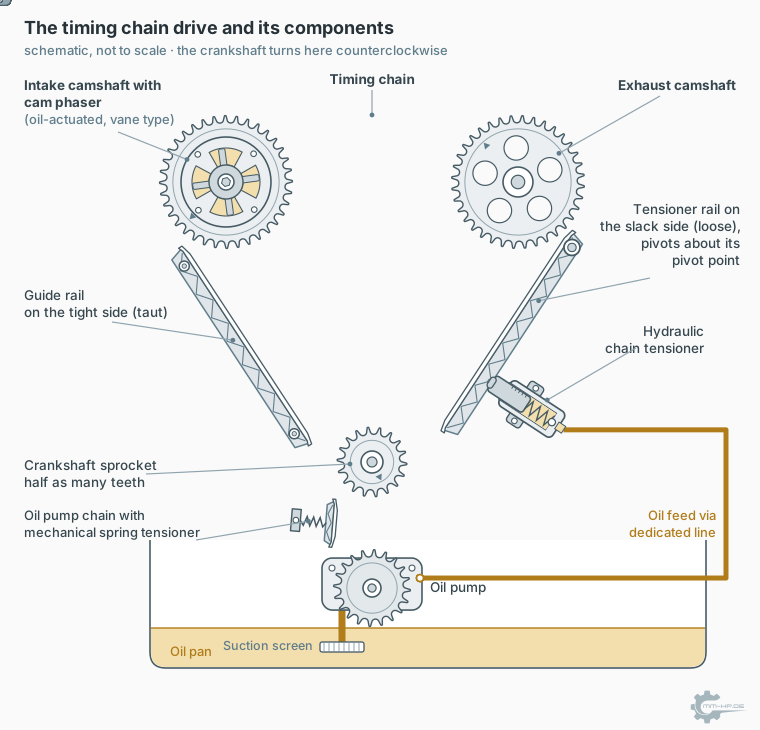
Schematic, not to scale. Real engines often have several chains, intermediate shafts, or additional guides.
Crankshaft sprocket and camshaft sprockets. The small sprocket on the crankshaft drives; the large sprockets on the camshafts are driven. Because the camshaft turns at half the speed, its sprocket has twice as many teeth. According to Bauer, sprockets are made from steel by machining, sintering, or fine blanking. Steel sprockets are then case-hardened or nitrided. Sprockets wear too. Replacement-parts maker Gates, in its 2025 workshop guide on chain replacement, describes worn teeth as pointed, “hooked”, or thinned, and writes that they significantly accelerate chain wear.
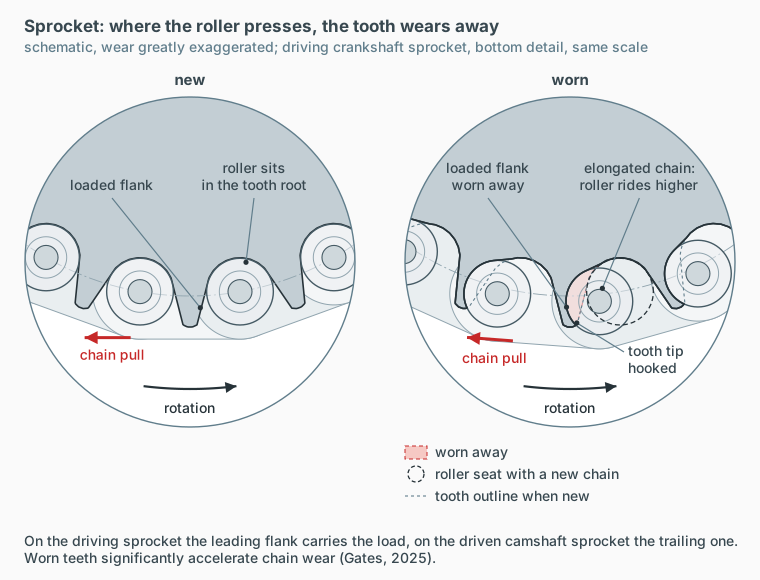
Schematic, wear greatly enlarged. On the driving sprocket the leading flank carries the load, and that is where the tooth wears away until it becomes hooked.
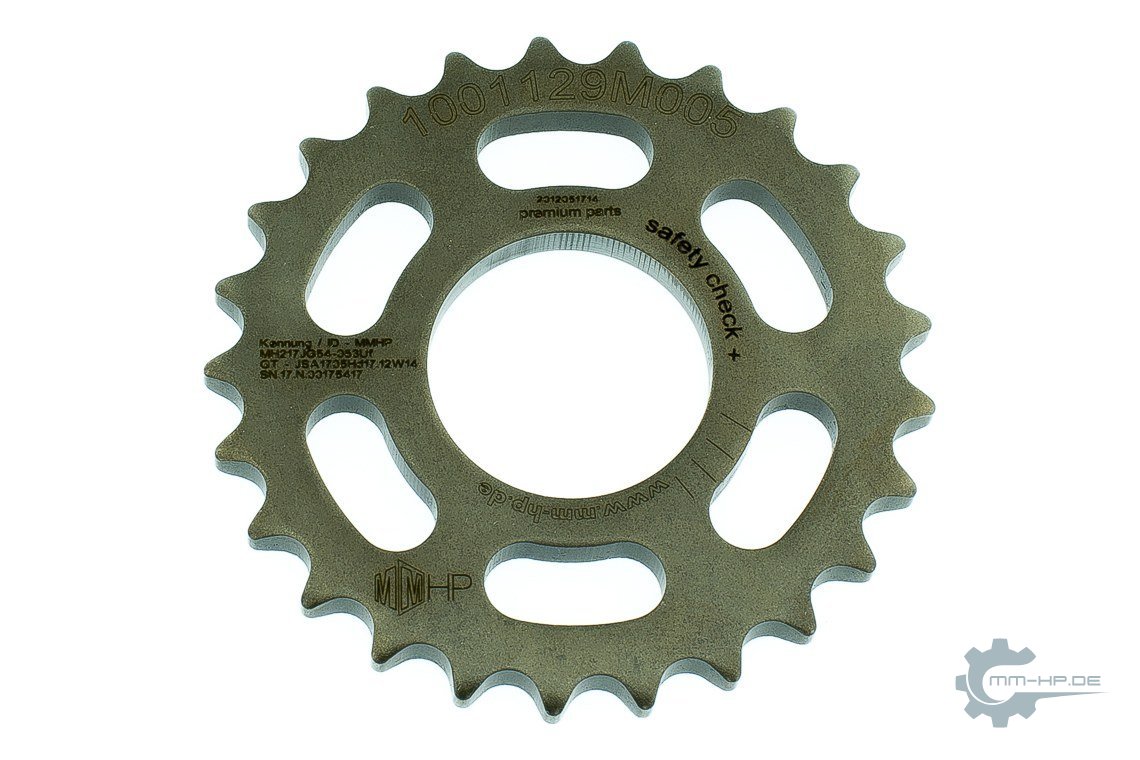
New part, own photo. Steel sprocket. Where the chain runs, tooth shape decides how it wears.
The timing chain. Passenger cars run three designs: bushing chain, roller chain, and silent chain. Bushing and roller chains are considered robust, the silent chain quiet. Quiet comes at a price. A 2022 study by the University of Győr with Audi Hungaria writes about the silent chain that it has “higher friction loss and higher wear”. How chains elongate and which design sits where is explained in our article on chain designs.
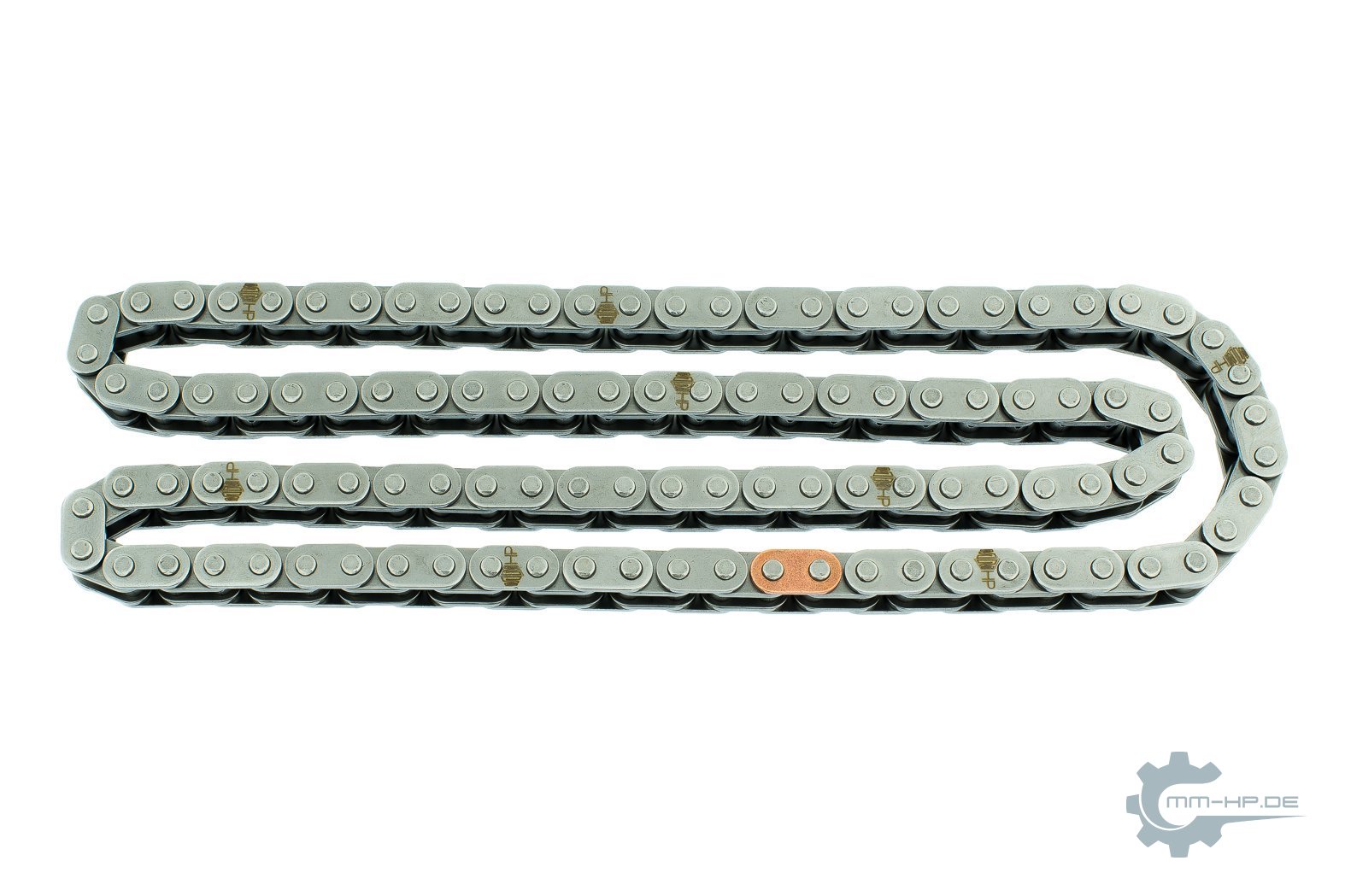
New part, own photo. A timing chain. Some links are colour-marked as a fitting aid for the timing marks.
Guide rail and tensioner rail. The guide rail, also called a sliding rail, is bolted in place and keeps the chain on its path. The tensioner rail is pivoted at one end, and the tensioner pushes at the other. Both are usually made of polyamide, often as a lining on a glass-fibre-reinforced ■ carrier. Which plastic is actually inside, whether ◆ PA46 or ● PA66, and why we consider temperature the most important property, is covered in our article on guide and tensioner rails.
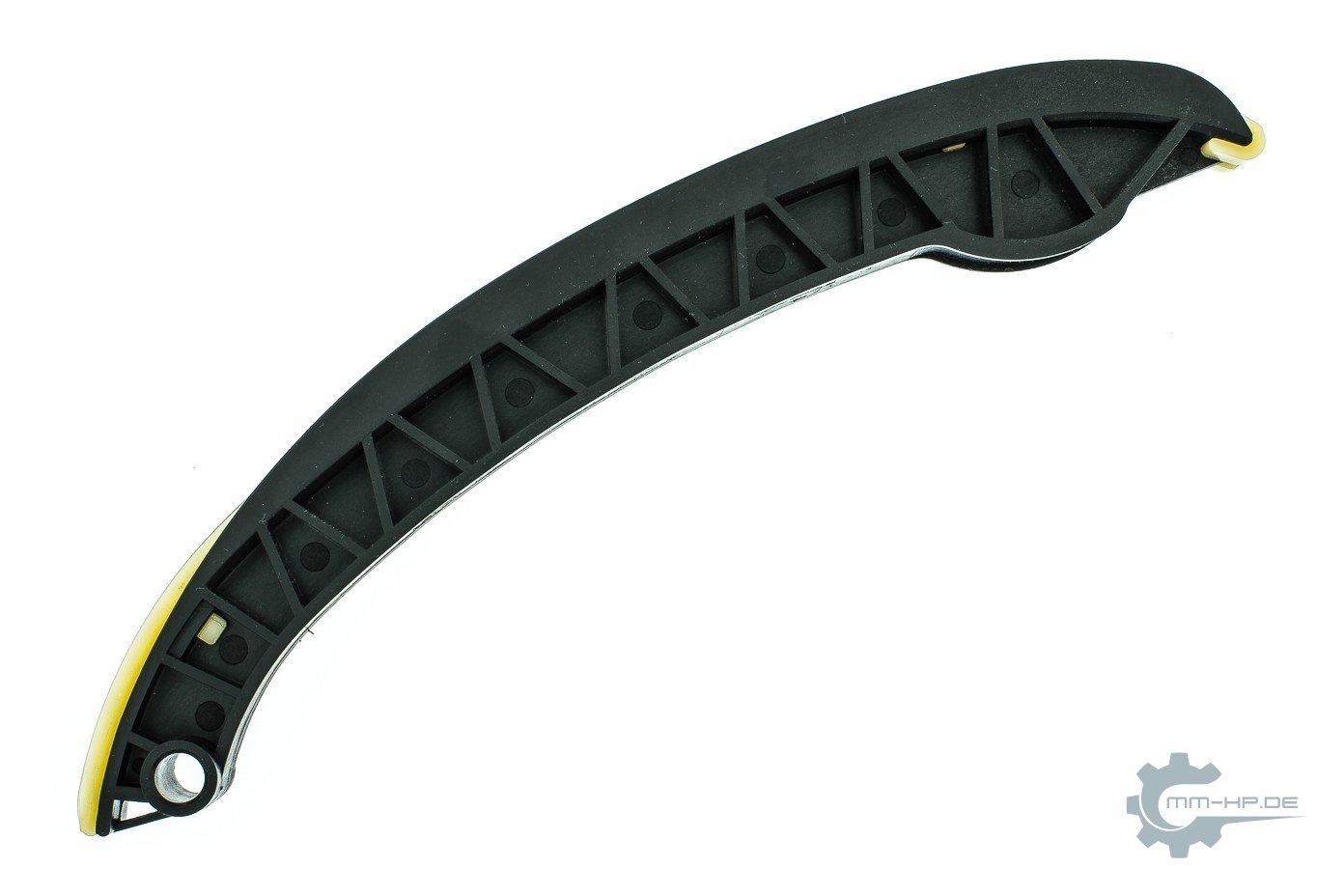
New part, own photo. A guide rail is bolted in place and keeps the chain on its path.
The chain tensioner. It presses the tensioner rail against the chain and takes up whatever length the chain gains. In the timing drive it works almost always hydraulically. According to Bauer, a hardened piston 8 to 15 millimetres in diameter sits in a housing, a compression spring delivering 40 to 200 newtons provides the base force, and a check valve lets oil in but not back out. Damping comes from the oil that escapes through the narrow gap between piston and bore. Some tensioners additionally have a ratchet lock that stops the piston from retreating. Our article on the chain tensioner compares the two basic designs, spring-loaded and hydraulic.
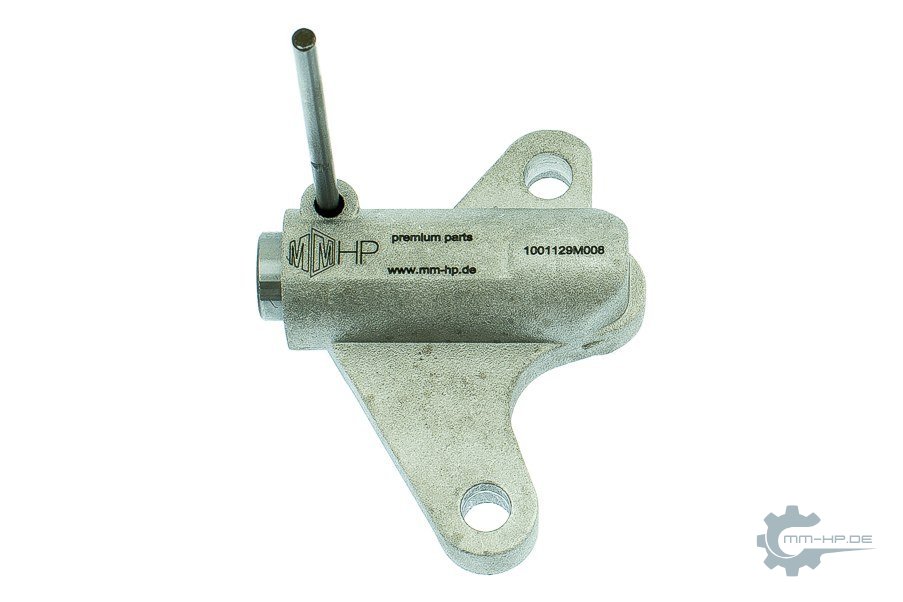
New part, own photo. Hydraulic chain tensioner with holder. The piston pushes the tensioner rail against the chain.
The cam phaser. Many engines rotate the camshaft relative to its sprocket during operation, to adapt valve timing to engine speed and load. Audi describes such a phaser on the 1.6-litre FSI in a workshop training document, the Self-Study Programme 327 on its own timing chain drives. It works as a vane-type phaser, is actuated by the engine's oil pressure, and continuously adjusts the intake camshaft by up to 20 degrees of camshaft angle toward advance. The phaser therefore sits right in the middle of the timing drive, and it too depends on oil.
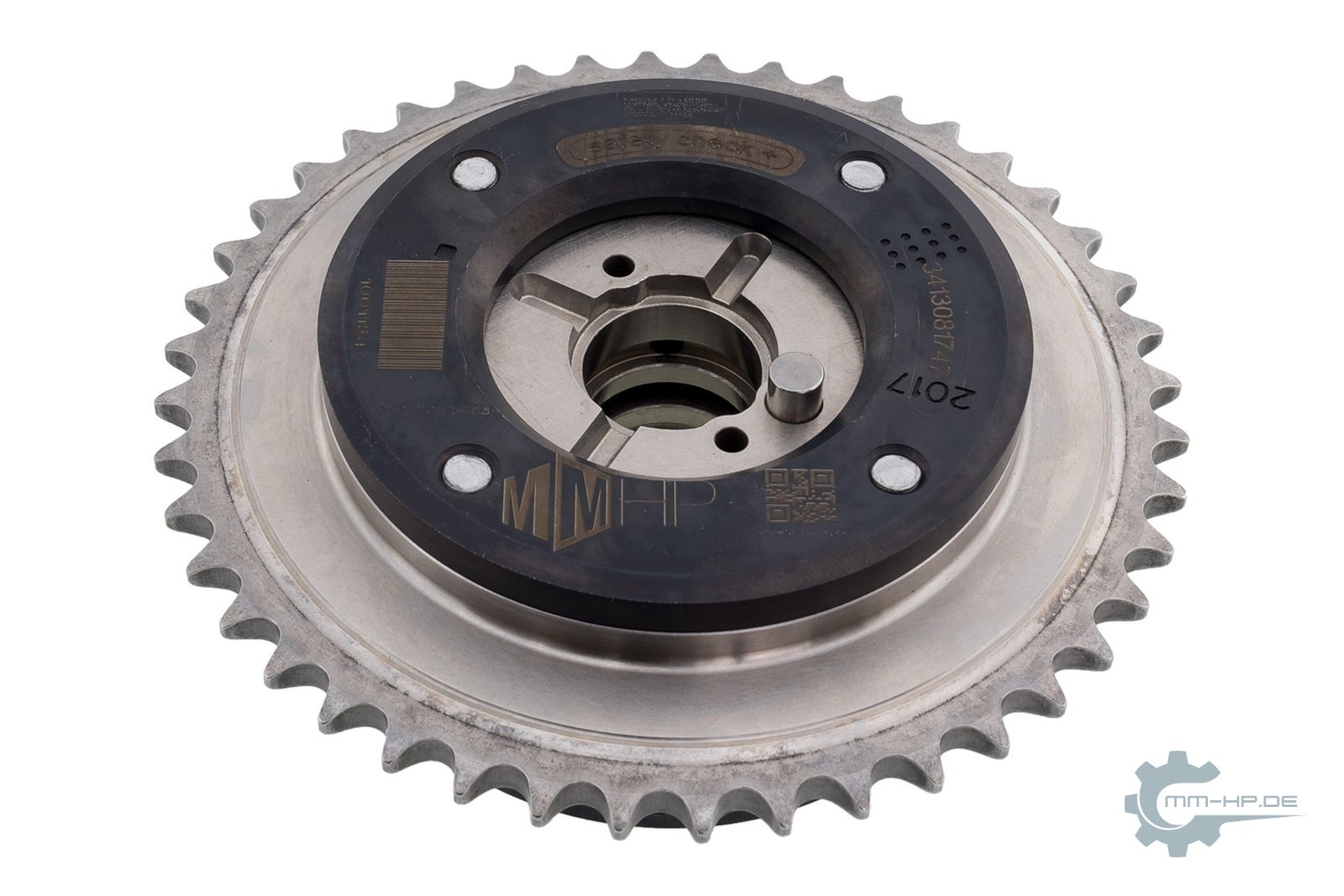
New part, own photo. Cam phaser. From the outside a sprocket, inside a vane-type phaser that works with engine oil.
Ancillary drives. The timing drive often turns more than just the camshafts. Bauer names the oil pump, the injection pump, and balancer shafts. On Audi's 3.2-litre V6 FSI, a separate chain drive with a roller chain drives the oil pump and the balancer shaft, at a ratio of 0.86, so the pump runs at the right speed. On the 1.6-litre FSI, the oil pump has its own separate timing chain from the crankshaft. Such ancillary drives are often built more simply than the main drive; more on that further below.
¶ Tight span and slack span: why a chain has two different sides
A chain pulls, it never pushes. The crankshaft pulls on one side of the chain, and that side carries the entire force up to the camshafts. The workshop brochure "Timing Drive, Technology, Damage Diagnosis" by Schaeffler for the INA brand calls this taut side the “Lasttrum” (tight span). The opposite side, on which the chain runs back to the crankshaft, is loose. INA calls it the “Leertrum” (slack span); Bauer describes it as “lastfreier Kettenabschnitt” (load-free chain section).
This difference determines the whole layout. On the tight span, a fixed guide rail is enough, because the pulled chain lies taut against it anyway. On the slack span, the chain would sag and slap without help. That's why the movable tensioner rail sits there, with the tensioner behind it. Bauer puts it this way: its job is “die Steuerkette in allen Betriebsbedingungen im Leertrum zu spannen, auch wenn durch den Motorbetrieb eine gewisse Verschleißlängung der Kette eingesetzt hat” ("to keep the timing chain tensioned on the slack span under all operating conditions, even once a certain amount of wear elongation of the chain has set in through engine operation").
Which side is the tight span depends on the direction of rotation. If the crankshaft, viewed onto the timing drive, turns anti-clockwise, it pulls the left side taut and the right side becomes the slack span. That's how it's drawn in our graphics. On an engine that turns clockwise in this view, everything is mirrored.
The two sides also work under different degrees of stress. Bauer writes: “Im Vergleich zu den Gleitschienen werden Spannschienen in der Regel stärker beansprucht.” ("Compared with guide rails, tensioner rails are generally subjected to greater loads.") The tensioner rail moves with every fluctuation of the chain and absorbs the impact when the chain slaps. The guide rail stays fixed and is loaded more evenly.
Where does the slapping come from? Bauer names the impact loading of the chain as it runs into the sprocket with the fewest teeth as the main source of noise. A chain is made of rigid links and wraps around a sprocket like a polygon, not like a circle. As it rolls, its speed therefore fluctuates periodically — the trade calls this the polygon effect. It excites the chain into vibration, and this has the strongest effect on the free, long slack span. More on this is in the polygon effect chapter of our chain tensioner article.
In practice that means: a timing drive is a vibrating system, and the tensioner is its damper. That damping depends on oil, and that brings us to the most important point of this article.
¶ Oil supply in the timing drive: the tensioner at the end of its own line
A timing drive needs oil at two points, and both are easily overlooked. Bauer writes on this: “Neben der Schmierung des Kettentriebs muss auch für das Kettenspannsystem eine ausreichende Ölmenge eingeplant werden.” ("Besides lubricating the timing drive, a sufficient oil quantity must also be planned in for the chain tensioning system.") Ideally, Bauer continues, an oil spray nozzle sits at the chain tensioner, fed from the tensioner's own oil supply, and lubricates the chain. The tensioner is therefore both a consumer and a distributor at once.
How seriously manufacturers take this is shown by Audi in the Self-Study Programme 327. On the 3.2-litre V6 FSI, each cylinder head is supplied via two separate riser lines. The first supplies the hydraulic valve-lash compensation and the camshaft bearings. About the second, it says, verbatim:
“Die zweite Steigleitung versorgt die Kettenspanner für die Steuerketten und die Nockenwellenversteller. Durch die getrennten Steigleitungen werden Pulsation, die durch die Dynamik (Volumenänderungen) der Nockenwellenversteller und Kettenspanner entstehen, von der Zylinderversorgung getrennt.”
("The second riser line supplies the chain tensioners for the timing chains and the cam phasers. The separate riser lines keep pulsations, which arise from the dynamics (volume changes) of the cam phasers and chain tensioners, separate from the cylinder supply.")
So the tensioners and phasers are such turbulent oil consumers that Audi puts them on their own line, so their pumping doesn't disturb the rest of the supply. On the 6.0-litre W12, Audi goes a step further. The tensioner running rails there have oil spray openings, according to Audi “zur Schmierung und Kühlung” ("for lubrication and cooling"). The oil at the chain doesn't just lubricate — it also carries away heat.
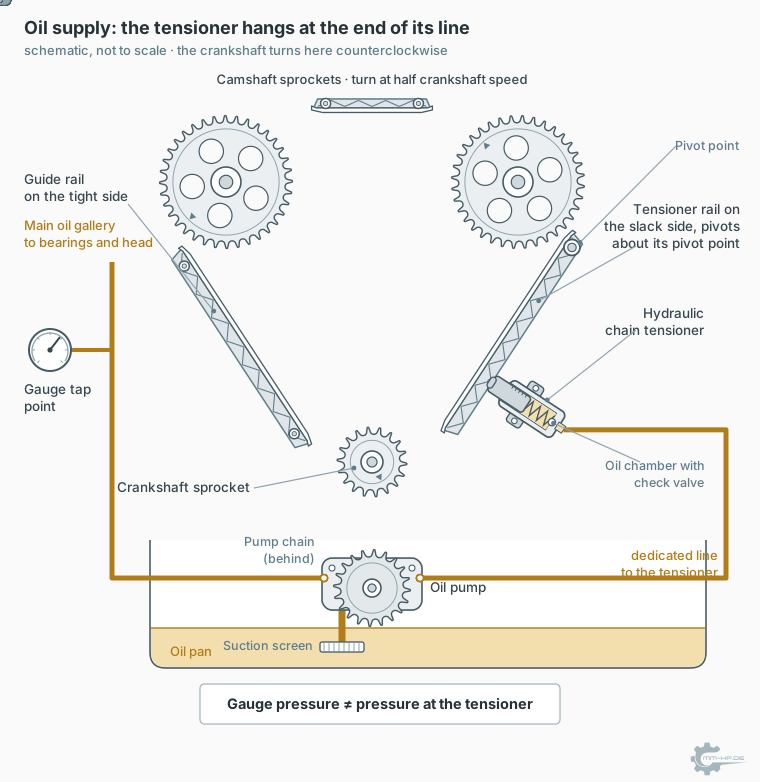
Schematic, not to scale. The tensioner hangs at the end of its own line; the gauge measures somewhere else.
¶ Without oil pressure, the tensioner gives way
What happens when the oil is missing is described unusually clearly in a 1993 patent filing by US supplier Eaton (US 5,304,099). At standstill, no oil pressure is present at the tensioner, and its piston can retreat. The consequence, verbatim: “allowing the chain to slacken, resulting in noise and vibration on start-up until sufficient hydraulic pressure is built up”. The chain goes slack, and there's noise and vibration on start-up until enough oil pressure has built up. The same filing names the usual countermeasure: a mechanical ratchet lock that holds the piston in place even without oil.
Mercedes-Benz describes the same sequence in a technical service bulletin for workshops (XENTRY LI05.10-P-056435, 2013) for the M276, M278 and M157 engines. The secondary chains can rattle on start-up until oil pressure has built up. Once enough pressure is present in the tensioners, the rattling stops. Audi, too, is aware of the problem at start-up and writes in its Self-Study Programme on the V6 that oil-pressure holding valves ensure “nach dem Motorstart möglichst schnell eine ausreichende Schmierung stattfindet” ("that adequate lubrication takes place as quickly as possible after engine start").
Whether this brief rattling harms the chain is something the manufacturers answer themselves. Mercedes writes in the same bulletin: “No consequential damage is to be expected.” Audi writes about start-up noises on the V6 3.0 TFSI: “The noises do not lead to damage.” Ford writes about noises from its cam phasers that they have no effect on safety, performance, or emissions. The rattling is unpleasant and a hint about the tensioner's condition. None of these manufacturers describe damage from the rattling itself. That applies to a few seconds until the tensioner has filled. After that it keeps the chain taut. A chain without a tensioner never leaves that window behind. Why one engine rattles and another doesn't, and how to identify the cause, is explained in our article on cold-start rattle.
Anyone who watches the red oil-pressure light at start-up, incidentally, sees the same window of time from the other side. What happens in the oil circuit in the first seconds after starting is covered in our article on the oil-pressure warning light.
¶ The pressure at the gauge is not the pressure at the tensioner
Here's a misconception we encounter often in everyday practice. Anyone checking oil pressure screws a gauge onto a measuring point, usually the same spot where the oil-pressure switch otherwise sits. The tensioner, though, hangs somewhere else entirely, up in the cylinder head, at the end of its own riser line, behind bores, restrictions, and sometimes a check valve. Pressure drops along this path, and to a varying degree depending on oil temperature, engine speed, and bearing condition. We've explained step by step, in our article on oil-pressure measurement position, why a single reading therefore says little about a different point in the engine.
For our own development work, we therefore measure at several points in the engine simultaneously, and condense delivery volume, pressure distribution, and dynamic behaviour into our own metric, the VHFI. We keep the exact way it's composed to ourselves. For this article, the underlying idea is what counts: what actually arrives at the tensioner can't be read off from a single value at the measuring point.
One caveat explicitly belongs here. None of this implies that more oil pressure or a stronger oil pump makes the chain last longer. What's documented is the mechanism: the tensioner only becomes taut once oil arrives at it with sufficient pressure. We found no source making a statement about chain service life, and the manufacturers explicitly contradict any such link where start-up rattle is concerned. This concerns whether more pressure than needed helps. That the chain has to be tensioned at all is not in question.
¶ Where the oil pump itself hangs off a chain
In many engines, the dependency runs both ways. The tensioner needs the pump's oil, and the pump is in turn driven via a chain. Bauer writes that, because of the tight installation space in engine construction, driving the oil pump via a chain drive with the smallest possible pitch has become the standard. A different rule applies to these drives than to the timing drive:
“Auf ein hydraulisches Spannelement wird in der Regel verzichtet; zum Einsatz kommen üblicherweise mechanische Spanner mit Federvorspannung.”
("A hydraulic tensioning element is generally dispensed with; mechanical, spring-preloaded tensioners are typically used instead.")
Bauer also mentions designs meant to do without a tensioner altogether when the chain line is favourable. We consider that wrong: every chain elongates during running-in, and without a tensioner nothing takes that length back. Why is explained in the chain tensioner article. Audi uses a mechanical chain tensioner for the oil pump chain on the 1.6-litre FSI. There's a reason for that, following from the previous chapter: a hydraulic tensioner on the oil pump drive would depend on the oil pressure of the very pump it's meant to drive.
How dangerous exactly this coupling can become is shown by the drive chain of the early balancer shaft modules in the 2.0 TDI (EA189). Its story is told in our article on the balancer shaft module. Why we never work without a tensioner on the oil pump drive in our own conversions is explained in the chain tensioner article.
¶ What a timing drive dies of: elongation, tensioner, rails, phaser
A timing drive rarely fails at a single point. Usually several parts wear at once, and one of them gives way first. We introduce the four most common failure paths here briefly; each has its own article.
Chain elongation. A chain barely stretches. What grows is the play in its joints, each one by thousandths of a millimetre, adding up across all the joints into a measurable increase in length. This makes the camshaft lag a little behind the crankshaft. Bauer names, as a typical value from car makers' design specifications, a measured chain elongation of 0.5 percent at a service life of around 250,000 kilometres. That's a design target, not a workshop threshold. How much a chain wears depends above all on the oil. A 2022 review of several engine test-bench studies concludes that aged, acidified, soot-laden, or water- and fuel-diluted oil can increase wear by more than tenfold.
Elongation can also originate in manufacturing. On the VW EA111 engine, the 1.2 and 1.4 TSI, which has a silent chain, timing chains drew attention early on. Handelsblatt reported on 13 April 2012, quoting VW that the supplier had used the punching tools that stamp the holes into the chain links “über die Verschleißgrenze hinaus” ("beyond their wear limit"). Burrs on the holes had accelerated wear, they said. That's an incident from that time, reported by the press, without a stated period or engine numbers. It says nothing about today's parts. How elongation arises, how to measure it, and why oil is the biggest lever, is covered in our article on the timing chain.
The tensioner. It's the component manufacturers themselves have revised most often. According to its own workshop information, Audi fixed start-up noises on the V6 3.0 TFSI in production with an improved chain tensioner. Mercedes, for the V6 and V8 engines mentioned above, mandated check valves in the cylinder head's oil feed alongside optimised tensioners. A tensioner can develop an internal leak, it can gum up with sludge, and its spring or ratchet lock can fatigue. Design, types and weak points are covered in the chain tensioner article.
The rails. Guide and tensioner rails made of polyamide age through heat. They become hard and brittle and can break, preferentially at the inlet, where the chain first meets the rail. Bauer names “Gleitbelag gebrochen am Einlauf der Schiene” ("lining broken at the rail's inlet") as a typical failure pattern. Which plastics are used, what heat does to them, and where the fragments travel, is covered in our article on guide and tensioner rails.
The cam phaser. It's easily overlooked because it doesn't look like a chain part. Ford, in its workshop information, traced start-up noises on the F-150 pickup (model years 2011 to 2020) to the cam phasers. For the second engine generation, Ford even explicitly specifies replacing only the phasers, no other timing drive parts. A new chain kit wouldn't have fixed the noise on these engines. Cam phasers will get their own article later in this series.
Add to that the sprockets, whose teeth wear along with the chain, and, on some engines, idler sprockets and intermediate shafts. They rarely fail alone, but they're along for the ride with every other failure.
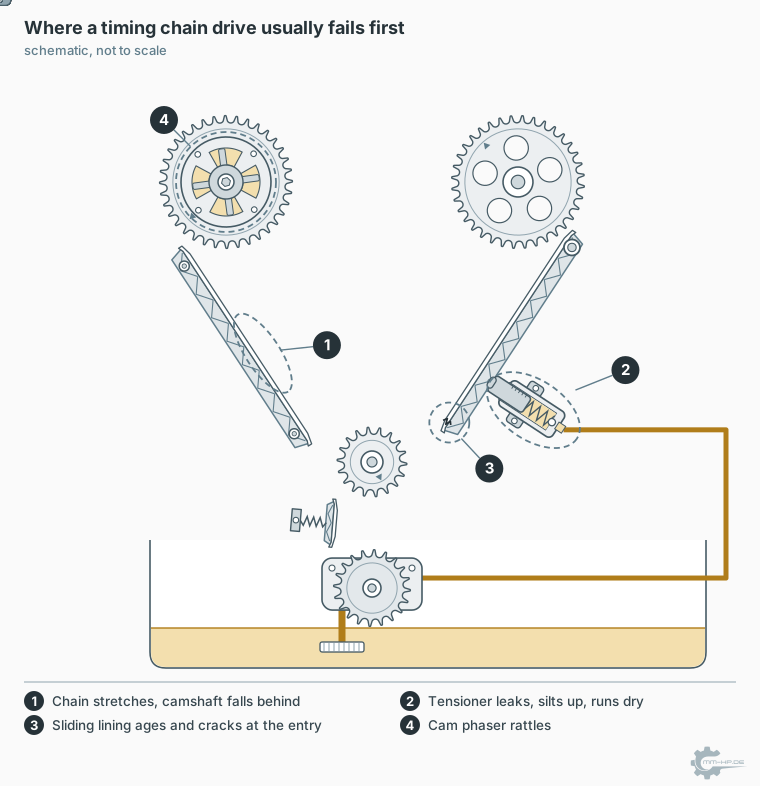
Schematic, not to scale. The four places where a timing drive usually gives way first.
¶ Timing chain: symptoms and when to replace it
A timing drive usually signals its condition long before it fails. The signs aren't unambiguous, though, and each one can have several causes. The table below matches the most common symptoms to the places worth checking first. It's based on the workshop information from the manufacturers named above and the workshop guide on chain replacement mentioned earlier.
| Symptom | Where to look first | How urgent |
|---|---|---|
| brief rattle only on cold start, gone after a few seconds | tensioner (overnight oil loss), on some engines the cam phaser | monitor, manufacturers say no consequential damage |
| rattle gets longer over weeks, or persists at warm idle | tensioner no longer holding the chain, chain elongated | schedule a workshop visit |
| fault code on crankshaft/camshaft position (e.g. P0016, P0017) | chain elongated, phaser, jumped tooth | have it checked |
| grinding or scraping noise | rail lining worn through, chain rubbing on metal | have it checked |
| plastic fragments in the oil pan or used oil | rail broken | check immediately |
| metal shavings in the oil | severe wear in the drive | check immediately |
| loss of power, rough running, poor starting | valve timing shifted, in the worst case a jumped chain | stop driving, have it checked |
Three rows of this table deserve a second look.
The fault codes show how finely a timing drive operates. Modern engine control units compare the signals from the crank and cam sensors and detect when the camshaft is lagging. A figure from Bauer shows how small the margins are. With emissions and CO2 in mind, timing shifts of 1.0 to 1.5 degrees of crank angle were still considered permissible in 2013. That's a design figure from the engine developers, not the threshold at which a fault gets stored. Every manufacturer sets its own diagnostic thresholds. Workshop portals name reference values of a few degrees for this; we've collected some of them in our chain tensioner article, explicitly as workshop values, not manufacturer specifications.
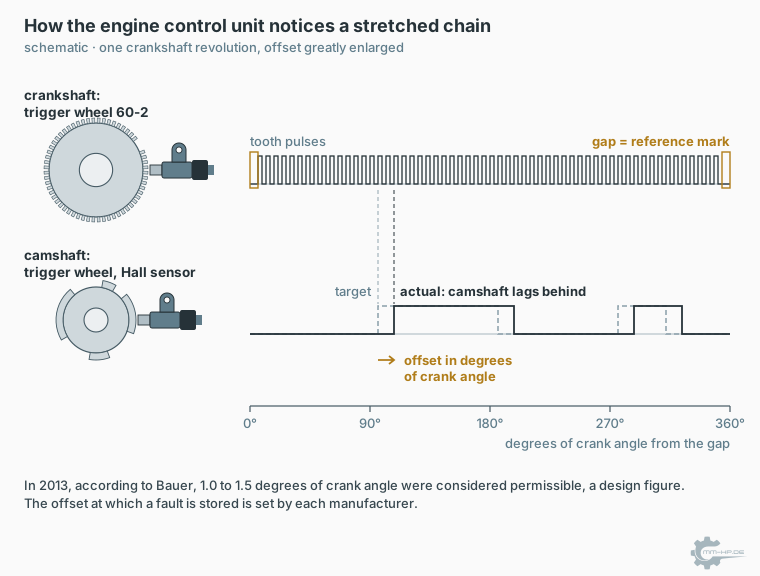
The engine control unit counts from the gap at which crank angle the camshaft edge arrives. Offset greatly enlarged, schematic.
The plastic fragments in the oil are the clearest warning sign a timing drive can give. The replacement-parts maker calls them, in its guide, “An unmistakable sign of breakage”. One workshop that has been comparing chain kits for the BMW diesel N47 for years therefore recommends running the used oil through a strainer at the oil change. That's the experience of a single workshop, but it's a check that costs almost nothing and warns of oil starvation before the oil pump's intake strainer clogs.
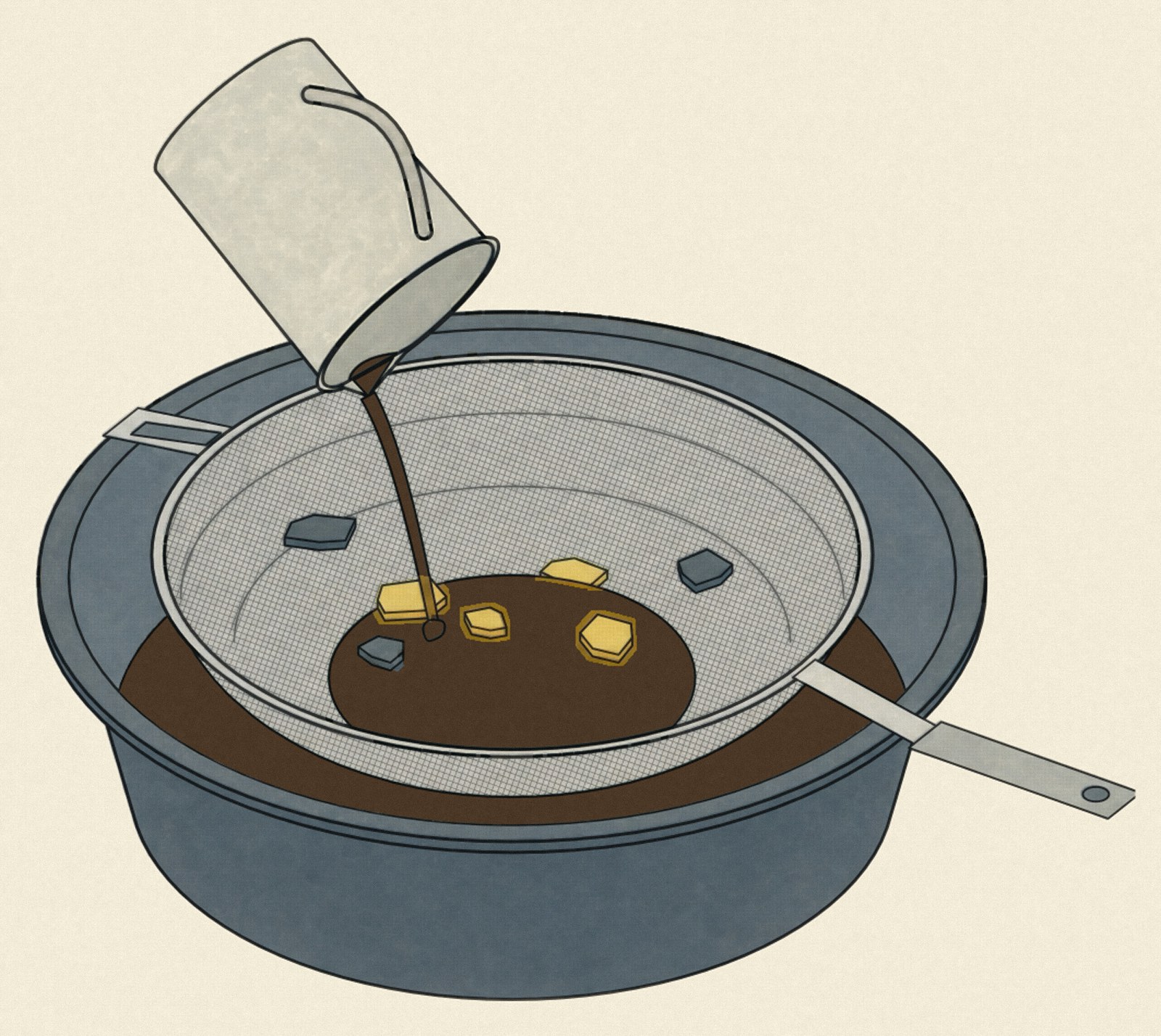
Pouring the used oil through a strainer at the oil change: plastic fragments in it are a warning sign of a broken rail.
Cold-start rattle is the best-known symptom, and at the same time the one most often misread. It tells you the tensioner is losing oil overnight or the phaser is clattering. It doesn't tell you the chain is elongated. Anyone who wants to know which component is rattling in their engine will find the distinction in our article on cold-start rattle.
¶ When to replace: based on findings, not mileage
There's no fixed replacement interval for the timing chain. Audi writes in the Self-Study Programme 327 that the timing drive is “wartungsfrei und auf Long Life ausgelegt” ("maintenance-free and designed for long life"). The design specification Bauer cites projects an elongation of 0.5 percent after about 250,000 kilometres, in other words a chain that's still working at that point. The replacement-parts maker mentioned above names, in its guide, 100,000 miles, roughly 160,000 kilometres, as a typical point, or earlier given symptoms or poor oil maintenance. That's a replacement-parts maker's assessment, not an engine manufacturer's specification.
In our view, the honest answer is therefore: replacement follows findings. Findings mean the symptoms from the table, a measured elongation, or a noticeable phase offset in the fault memory. Anyone running an engine with a known timing-drive weakness, or who hasn't changed the oil in a long time, should look earlier and more closely. Opening up an engine on mere suspicion, with no noticeable findings, isn't something we consider necessary.
¶ Replace the whole kit, not piece by piece
Once the findings are clear, the question of scope remains. It's tempting to replace only the part that's obviously broken, say the cracked rail or the rattling tensioner. The replacement-parts maker thinks nothing of that and writes, in its workshop guide, that replacing only the failed part is “a risky and unprofessional practice”. The complete kit is recommended, sprockets explicitly included.
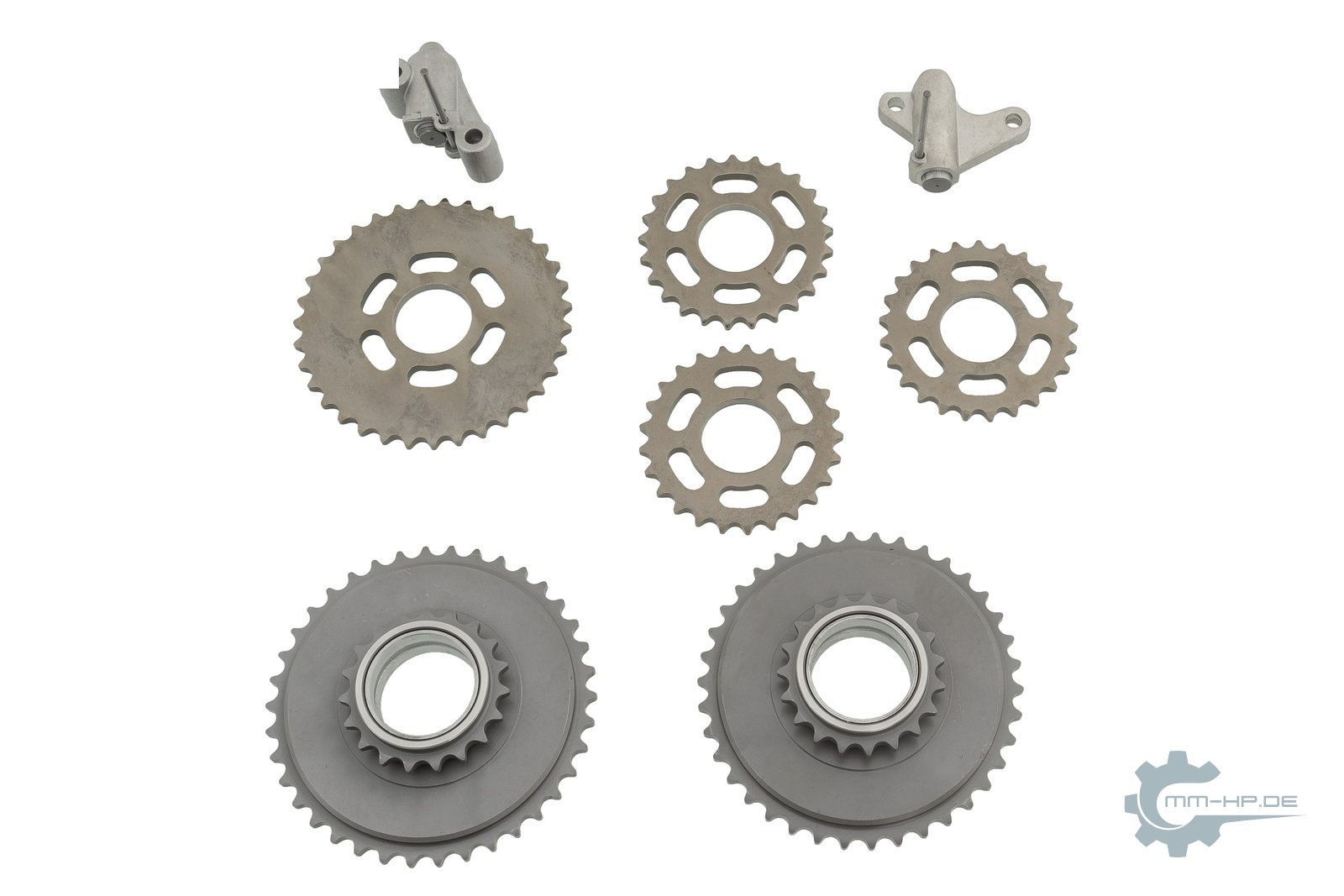
New part, own photo. The sprockets of a V6 kit. Replacing the complete kit means the sprockets too.
The reason lies in how the parts interact. A new chain on old sprockets runs on teeth that have adapted to the elongated chain. A new rail under an elongated chain is loaded unevenly right from the start. A new tensioner behind an old chain is already near the end of its own travel. The parts wear together, and they get replaced together.
A few steps during the installation itself count, and they're often shortchanged. If rails had broken, the oil pan and intake strainer need cleaning, otherwise, according to the guide, a “fatal lubrication obstruction” threatens shortly after the repair. Chain and sprockets are wetted with oil beforehand, because at the first start the oil circuit isn't yet established, and until then the parts only run on the oil they've been given. All the steps, in the right order, are in our article on buying a timing chain kit.
¶ When the chain kit alone isn't enough
“Complete”, though, has a limit, and it's worth knowing before you buy. On some engines, the cause of a problem sits in a component that no chain kit includes.
On the Mercedes M276, M278 and M157 engines, according to the workshop information, fixing the start-up rattle requires a check valve in the cylinder head's oil-feed bore. It stops the tensioner's feed from draining overnight. A new chain kit without this valve doesn't fully cure the rattle there. On the Ford engines with phaser noise, it's the other way round: the phasers need replacing, and the chain kit stays put.
Before replacing anything, it's therefore worth checking the manufacturer's workshop information for that specific engine. What parts a good chain kit should include, and how to tell its quality, is covered in our article on buying a timing chain kit.
¶ What remains open about the timing drive
To close, we're collecting what we couldn't substantiate despite a thorough search. These questions also appear in the deep-dive articles; we're noting them again here so nobody mistakes them for settled:
- how hot the oil at the timing drive actually gets in normal operation, measured with the location stated,
- which plastic is actually inside a given production-run rail, since no manufacturer names the grade,
- how great the load is at each individual rail position, as a figure,
- which of the possible ways a tensioner loses oil overnight carries the largest share on a given engine,
- whether measurements of cold-operation chain wear, made on petrol engines, transfer to diesel engines.
If you have measurements or findings of your own on any of these questions, write to us via Support. We'll update this article as soon as new evidence is available.
¶ See also
- Timing chain guide and tensioner rails: what plastic is inside, and what heat does to it
- Cold-start rattle: tensioner, phaser, or chain?
- The timing chain: designs, elongation, and why oil is the biggest lever
- Buying a timing chain kit: how to tell quality, and how you can't
- Why our chain conversion has a chain tensioner
- Oil Pressure Is Not Just Oil Pressure: Why Measurement Position Determines What the Number Means
- The balancer shaft module in the 2.0 TDI (EA189)
- Timing belt in oil: the time bomb you can't inspect
- Glossary