¶ Low Oil Pressure After an Engine Rebuild? The Causes
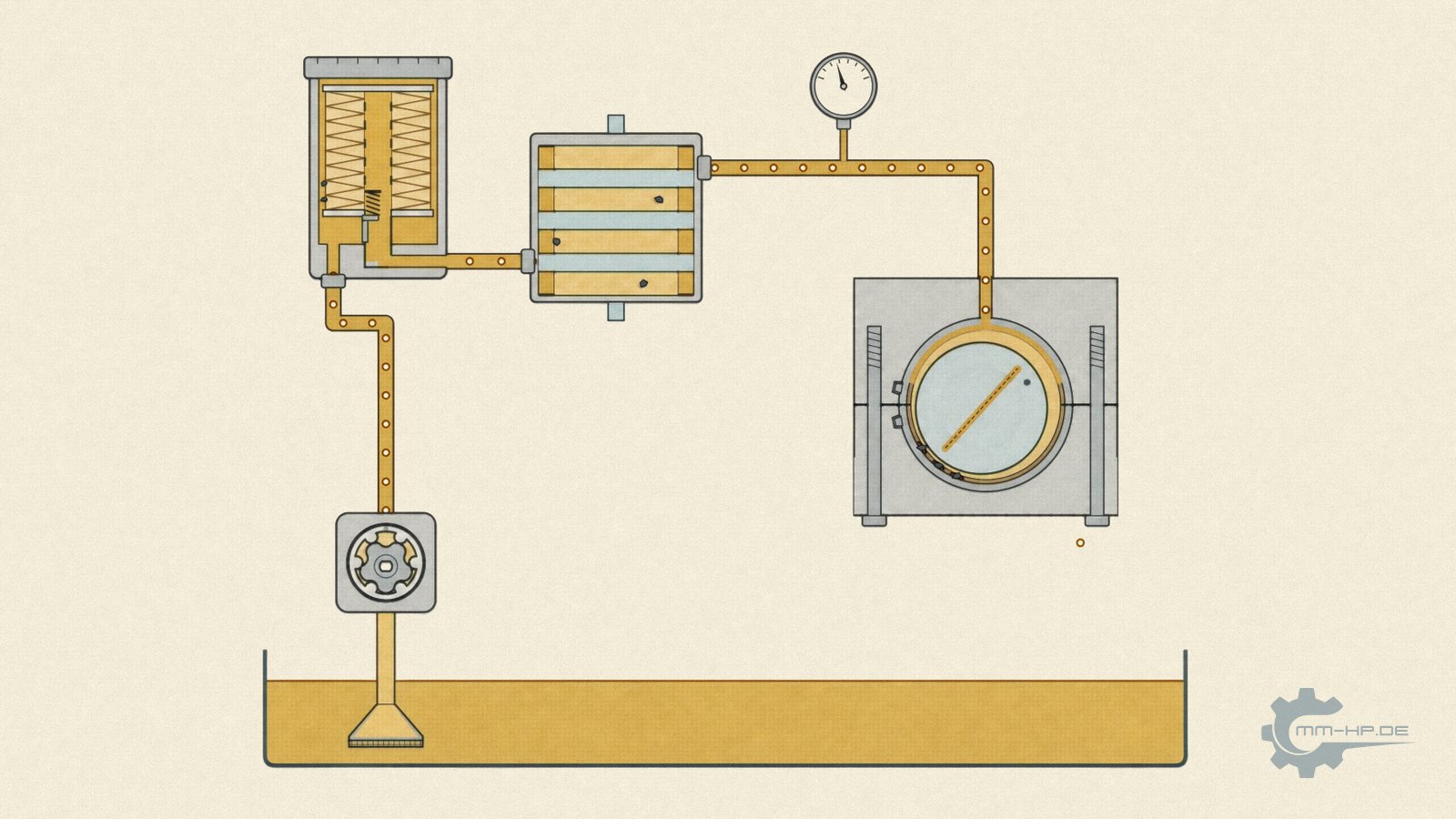
Schematic. The animation is further down in this article.
¶ The key points at a glance
It sounds like a contradiction: a freshly rebuilt engine, new bearing shells, honed cylinder bores, all done by a specialist workshop, and yet it reports too little oil pressure after reassembly. Logically the opposite should happen, because new bearings mean tighter clearances, and tighter clearances mean more pressure. That's exactly why low oil pressure after a rebuild isn't a running-in phenomenon you should wait out, but a warning sign with a cause.
The list of causes is manageable and almost always the same: bearing clearances that don't match the fitted shell dimension after the crankshaft was ground, residue from the original damage that survived in the oil cooler and the channels, a reused oil pump that carries the original damage inside it as wear, excessively applied sealant that comes loose and ends up in the intake strainer, or simply a channel that wasn't sealed correctly during reassembly. All these causes have one thing in common: they're mechanical, they're findable, and they don't get better if you wait.
We're looking into this topic for a concrete reason: in the feedback from our customers, a cluster of low oil pressure readings stands out specifically in freshly rebuilt engines, and we're currently gathering these cases systematically. This article summarises what can already be learned from that, how to properly diagnose such a case, and why a rebuilt engine isn't a restored factory-spec engine but a new one-off with its own tolerance profile.
The long version goes through the causes one by one, explains the diagnostic approach with a measurement log, and describes what a rebuild actually is from the oil circuit's point of view: a second manufacturing process.
¶ The paradox of the freshly rebuilt engine
Let's start with the physics, because that's what makes the topic interesting in the first place. An engine's oil pressure arises from the oil pump's delivery working against the engine's resistances, chiefly the tight clearances of the plain bearings. Wear enlarges these clearances over the years, the oil escapes more easily, the pressure drops. That's the normal ageing path, which we describe in detail in our articles on the oil pump and pump sizing.
A rebuild reverses this path: new bearing shells, measured shafts, restored surfaces. A correctly rebuilt engine therefore tends to have tighter clearances than the one that was removed, and its oil pressure should if anything be above its prior condition rather than below it. If a freshly rebuilt engine instead shows too little pressure, that's not a cosmetic flaw or a running-in effect. It means that somewhere in the rebuilt system, something doesn't match the design, and experience shows: that something belongs to a short, recurring list.
Before we go through it, a point that matters to us. Nothing in this article is an accusation against rebuild shops. An engine rebuild is one of the most demanding jobs a workshop can perform, hundreds of individual decisions, tight tolerances, time pressure. Precisely because that's true, it has its own typical failure patterns, like any manufacturing process. Knowing them helps you find them faster, and that's what this is about.
¶ Cause one: bearing clearances that don't match
The most common cause family sits exactly where the pressure is generated: at the bearings themselves. During a rebuild, the crankshaft is often ground to remove scoring and out-of-roundness. That reduces its journal diameter, and the design provides undersize bearing shells in graduated repair stages: thicker shells that bring the clearance to the smaller journal back to spec. The reverse case exists too. If it is not the shaft that is damaged but the bearing bore in the block, the bore is line-bored or honed, and then oversize shells with a larger outside diameter are needed. Which grade is right therefore depends on what exactly was damaged and what was machined. Several opportunities for error lurk in this chain: a shaft that was ground but received standard shells, a mixed set of different grades, or a tolerance stack-up where the shaft dimension and shell dimension are each fine on their own but add up to too much clearance overall.
The result is the same in every variant: one or more bearings have more clearance than intended, and the oil circuit reacts to it just like it would to a worn engine, only starting from zero kilometres. The oil escapes through the oversized clearances, and pressure is missing throughout the system, most noticeably at hot idle. Anyone familiar with our article on manufacturing tolerances will recognise the principle: even in factory production, individual tolerances stack up into noticeable differences between engines. A rebuild is a second run through exactly this game, with workshop tools instead of a transfer line. A rebuilt engine is therefore not a "restored factory condition" but a new one-off with its own, unknown tolerance profile.

Which shell is right depends on what was machined: reground shaft, then undersize; line-bored tunnel, then oversize. Reground shaft with a standard shell: same pump, same delivery, but the oil escapes through the oversized clearance. Pressure is missing at every point downstream, most clearly at hot idle.
Incidentally, this cause family can only be measured with the engine open, using Plastigage or a micrometer. That's exactly why it comes later in the diagnostic order, with the simpler checks first.
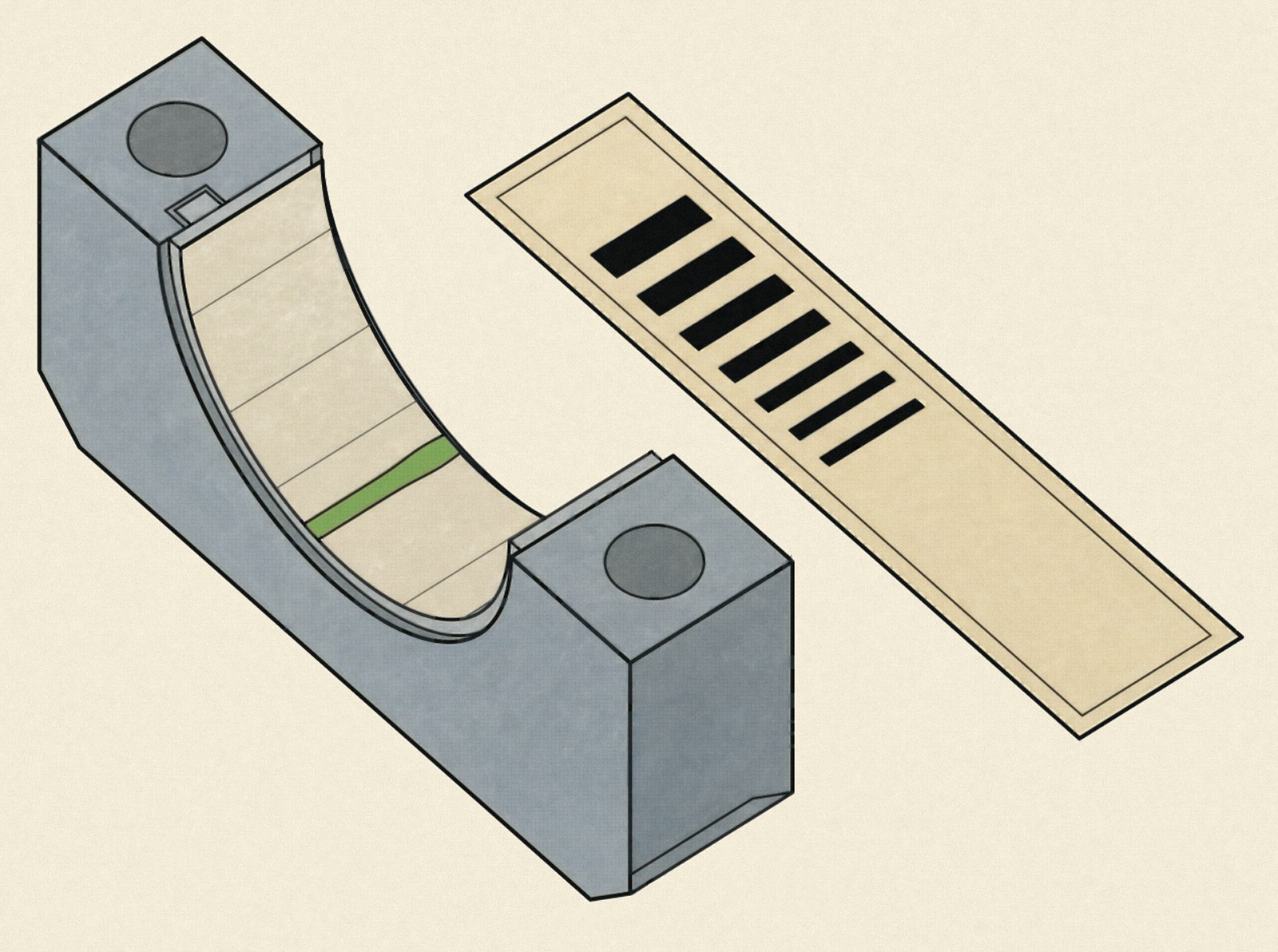
After tightening and removing the cap: the width of the flattened strip is compared with the scale on the envelope at its widest point.
¶ Cause two: the old damage lives on in the circuit
Most rebuilds have a trigger, and it's often a bearing failure. A dying plain bearing produces astonishing amounts of metal debris in its final minutes of operation, and this debris spreads through the entire circuit with the oil: into every bore, every corner, and above all into the oil cooler, whose fine channels act like a swarf trap.
During the rebuild, the block gets cleaned, the pan gets cleaned, that much is visible. What isn't visible: an oil cooler can be flushed, but can hardly be reliably cleaned out completely, and lodged swarf likes to come loose later, when hot oil pulses through the cooler under pressure. Then the old damage migrates piece by piece into the freshly rebuilt engine, through the new pump, into the new bearings. In rebuild practice, the rule is therefore to replace the oil cooler rather than clean it after a major bearing failure, along with all ancillary parts with cavities that are hard to inspect. Where this is skipped for cost reasons, exactly the failure pattern of this article results: an engine that starts well and whose oil pressure drops, gradually or suddenly, over the first hundred or thousand kilometres.

The old damage lives on in the oil cooler: while the oil is cold, the chips stay put. Hot oil under pressure breaks them loose, and they travel portion by portion into the new bearings and through the new pump.
Rule of thumb: an engine failure doesn't end when the engine is removed. It lives on as debris in the oil cooler, in lines and side cavities, until someone removes it completely or it reaches the new build.
¶ Cause three: reused wear parts in the oil system
The third family is the most uncomfortable one, because it's a cost decision. In a rebuild, the budget naturally concentrates on the crank assembly and cylinders. The oil system runs along in the background, and that's where parts that "still look fine" tend to get reused: the oil pump, the intake strainer, the pressure relief valve.
We explained why that's risky in our oil pump article: the pump works with clearances of hundredths of a millimetre, sits ahead of the oil filter, and lived through the original failure under full debris bombardment. Scoring in the pumping element isn't visible from outside, it shows up as internal leakage, in other words as a loss of delivery that's missing precisely at hot idle. An intake strainer carrying residue of sealant or debris, in turn, throttles the supply from the very first second. And a pressure relief valve with a chip jammed in its seat can get stuck partially open and then permanently divert delivery back into the pan, a classic, hard-to-find pressure drain.
Our position on this is clear and matches sound rebuild practice: after damage relevant to the oil circuit, the pump and strainer belong on the replacement list, not the inspection list. Measured against the total cost of a rebuild, that's the smallest line item with the biggest leverage.
¶ Cause four: small assembly details with big effects
That leaves the fourth family, the one-off cases you could see coming. From our support history we know the textbook example in its conversion variant: a customer measured only 0.18 bar at idle after a conversion, and the cause turned out to be a mixed-up bore, a mounting thread had been sealed instead of the oil channel. The rebuild world knows the same category in many forms: a forgotten or incorrectly fitted plug in a cross-drilling, a piston cooling jet not refitted, a gasket partially covering a channel, and the perennial favourite, over-applied sealant whose overflowing beads tear off in the oil stream and end up in the intake strainer.
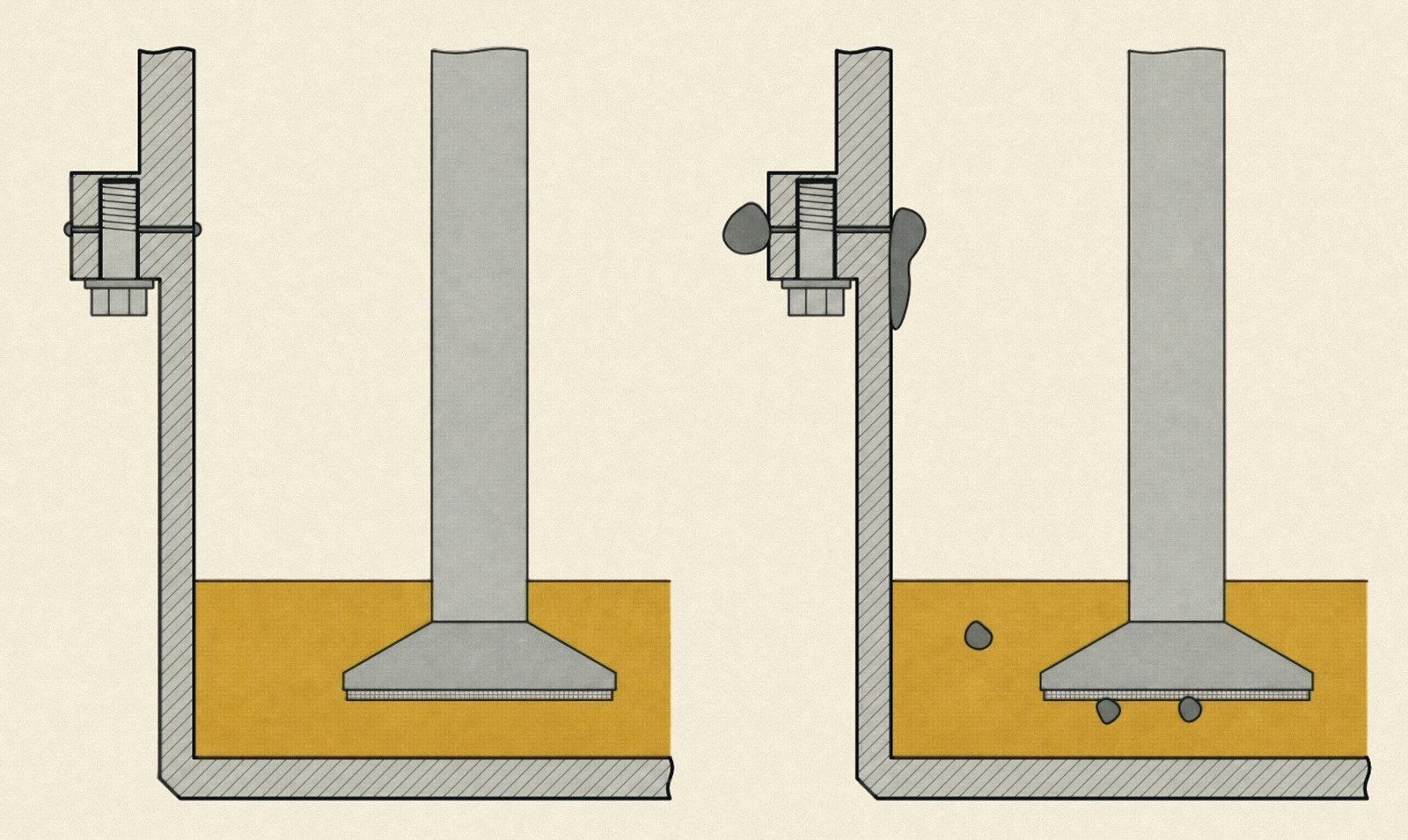
Left correctly applied, right too much: the inner bead tears off in the oil flow and the pieces end up on the pump's pickup strainer.
All these cases share two things. First, they're invisible once assembled, revealing themselves only through oil pressure and occasionally through oil distribution in the engine. Second, they're entirely binary: the engine isn't "somewhat weaker", it has a defined leak or blockage at a specific point. That's exactly why low readings after a rebuild are not worth waiting out patiently. A mechanical problem of this kind doesn't run itself in, it works itself loose.
¶ The diagnosis: measure first, then open up
How do you approach such a case? In the same order we described for oil pressure problems after a conversion, with one added twist: in a rebuilt engine, the history is part of the finding.
Step one: measure properly. Before anyone opens the engine, the reading itself needs to be checked. A single value from a workshop gauge with no temperature noted isn't a basis for diagnosis, as we explained at length in our article on comparability of measurements. How much of a conspicuous figure can be down to the instrument itself, and why a reading below one bar on the 10-bar scale of a test kit is no longer within the guaranteed range at all, is covered in the article on off-the-shelf oil-pressure gauges. The minimum is the complete measurement log, which we also request in support cases, eight pieces of information that together turn a number into a finding:
- Measurement point (exactly where on the engine it was measured)
- Measuring instrument (type and, if known, accuracy class)
- Oil temperature at the time of measurement
- Engine speed, ideally values at several speed steps
- Oil type and age of the fill
- Oil level on the dipstick
- Mileage since the rebuild
- Behaviour of the oil-pressure warning light (when, how long, at which operating state)
Anyone who supplies these eight points saves themselves and any diagnostician half the legwork, because the combination of oil temperature and engine speed alone sorts a large share of apparent problem cases into the category "normal for this operating point".
Step two: interrogate the history. What was the original damage? Was the crankshaft ground, and which shell dimension is documented? Were the oil pump, strainer, and oil cooler replaced or reused? A rebuild shop that documents its work can answer these questions in five minutes, and the answers already narrow down the list of causes.
Step three: check from outside in. Oil level and oil condition first, then open the filter and filter housing and inspect for debris and sealant residue, then the intake strainer, which, once the oil pan is off, also tells you about migrating residue. Only once these layers are clean does it move on to the pump, the valve, and finally the bearing clearances. This order isn't pedantry, it's sorted by effort and likelihood of a hit.
| Check step | Effort | Typical finding |
|---|---|---|
| Complete the measurement log | one test drive | measurement error, wrong measuring point, cold instead of hot oil |
| Clarify the history | one phone call | reused pump, cleaned instead of replaced oil cooler |
| Inspect filter and housing | minutes | metal debris, sealant residue |
| Check intake strainer | oil pan off | clogged strainer, sealant beads |
| Pump and pressure relief valve | partial disassembly | scoring in the pumping element, stuck valve |
| Measure bearing clearances | engine open | clearance out of tolerance, mixed shell grades |
¶ Why the CFCA is so often affected
That our case collection contains a conspicuously high number of CFCA engines is probably no coincidence, and the explanation lies in the combination of two things we've described separately elsewhere.
First, the CFCA is simply rebuilt more often than average. Its damage history means a large share of the examples still on the road have already had at least one engine overhaul, so the population of rebuilt CFCA engines is large. Second, and this is the technically interesting part, the CFCA tolerates rebuild variance worse than more forgiving engines. Its oil system is designed by nature with no meaningful reserves, thermal load is high, and oil dilution from frequent regenerations further erodes viscosity. A tolerance error that would go unnoticed for years in a relaxed naturally aspirated diesel, a hundredth of a millimetre too much bearing clearance here, a slightly tired reused pump there, pushes this already fully loaded system noticeably over the edge. The CFCA is thus something like the amplifier among rebuild patients: it makes visible the faults other engines hide.
For owners, that doesn't mean a CFCA rebuild is hopeless, quite the opposite, done correctly it works. It means that with this engine, the care points in this article aren't optional extras, and that combining a rebuild with an upgraded oil supply makes particular sense here: if the system is already open anyway, that's the cheapest moment to give it the reserves it never had from the factory.
¶ What's normal after a rebuild, and what isn't
So the warnings in this article don't cause unnecessary alarm, the opposite direction also deserves a clean description: not every anomaly after a rebuild is a red flag.
Normal is a certain running-in period for the whole engine: new piston rings bed into the honed cylinder bores over the first hundred to thousand kilometres, oil consumption may be slightly elevated during this time and should then drop. What happens on the bore surface during this phase is shown in Stuck Piston Rings: Why Rings Seize and Burn Oil. It's also normal for a freshly built engine with tight, new bearing clearances to show somewhat higher oil pressure readings than the old engine that was removed, and for these readings to settle slightly once run in. Finally, small settling effects are normal too, such as a bolt torque that needs retightening after the first warm-up cycles, where the procedure calls for it.
Not normal is the opposite: oil pressure readings that are lower than the old, worn engine's from the very start. Not normal is an oil-pressure warning at hot idle in an engine with zero kilometres since the rebuild. And not normal is oil pressure that drops over the first hundred operating hours instead of staying stable, that's the pattern of migrating old debris from cause two. The running-in period explains a lot about a freshly built engine, but it never explains missing oil pressure. Pressure is either there from the first start or it isn't, and if it isn't, one of the causes in this article is behind it.
Rule of thumb: "it'll settle in" is a legitimate sentence for oil consumption and a dangerous one for oil pressure. Bearing clearances don't get tighter through running in, and blockages don't clear themselves.
¶ The right questions to ask the rebuild shop
Anyone planning a rebuild, or who has just had one done, can do more for their oil pressure with a handful of questions than with any accessory part. A good shop answers them without hesitation, and the manner of the answer is itself a quality indicator.
- "Was the crankshaft ground, and which bearing shell dimension is fitted?" The answer belongs in the documentation, with measurements. "Standard, it's fine" is the wrong answer for a ground shaft.
- "Were the bearing clearances measured and logged?" Plastigage or micrometer, either way, but measured and recorded. A clearance log is worth its weight in gold for a later oil-pressure problem, in either direction.
- "What happened to the oil pump, intake strainer, and pressure relief valve?" The answer you want is replaced, or disassembled and inspected. "Looked fine" is, as described above, not an inspection for these components.
- "Was the oil cooler replaced or cleaned, and what was the original damage?" After a bearing failure, replacement is the safe answer. Anyone who cleans it should be able to explain how the cleanliness was verified.
- "Which oil was used, and when is the first change due?" An early first oil change after running in, filter included, flushes assembly residue and running-in debris out of the fresh build, money well spent on a rebuilt engine.
This list isn't a vote of no confidence, quite the opposite: it gives the shop a chance to demonstrate its care, and gives the customer the documentation that protects everyone involved if a problem arises. The best rebuild shops our customers deal with provide these answers unprompted in the final report.
¶ What we're learning right now: the case collection
Which brings us to the reason this article exists now. In our customers' feedback, a cluster has stood out for some time: low oil pressure readings disproportionately often in engines that were rebuilt shortly before, and conspicuously often in the already sensitive CFCA. We're currently gathering this feedback systematically, with measurement logs, rebuild histories, and, where possible, findings from the follow-up work.
We deliberately aren't drawing a public conclusion yet about which of the described causes dominates the cluster, because that's exactly what distinguishes a case collection from an anecdote: it's only worth something once the data holds up. What we can already say is in this article, the list of causes, the diagnostic order, and the basic rule that a freshly rebuilt engine with low oil pressure always has a concrete reason. Once our collection shows solid patterns, this article will be expanded, just as our entire knowledge section grows from ongoing research.
Until then, a request of our own: if you have such a case, a rebuilt 2.0 TDI with documented low oil pressure, we'd welcome a message to our support team, ideally with a complete measurement log and the rebuild history right away. Every well-documented case sharpens the picture, and everyone whose engine ends up on the lift ultimately benefits from a sharper picture.
¶ See also
- Oil pressure too low after a conversion? The most common causes
- Every engine is a one-off: manufacturing tolerances
- Understanding the oil pump: what it does, what limits it, and what it fears
- Why measurements before/after a conversion can't be compared
- Why more delivery rate is always the better choice
Transparency note: we don't perform engine rebuilds ourselves and are not in competition with rebuild shops. The list of causes reflects standard rebuild practice, the cases described come from our support, anonymised. The case collection mentioned is ongoing, its results will be incorporated into this article once reviewed.