¶ Stuck Piston Rings: Why Rings Seize and Burn Oil
¶ The key points at a glance
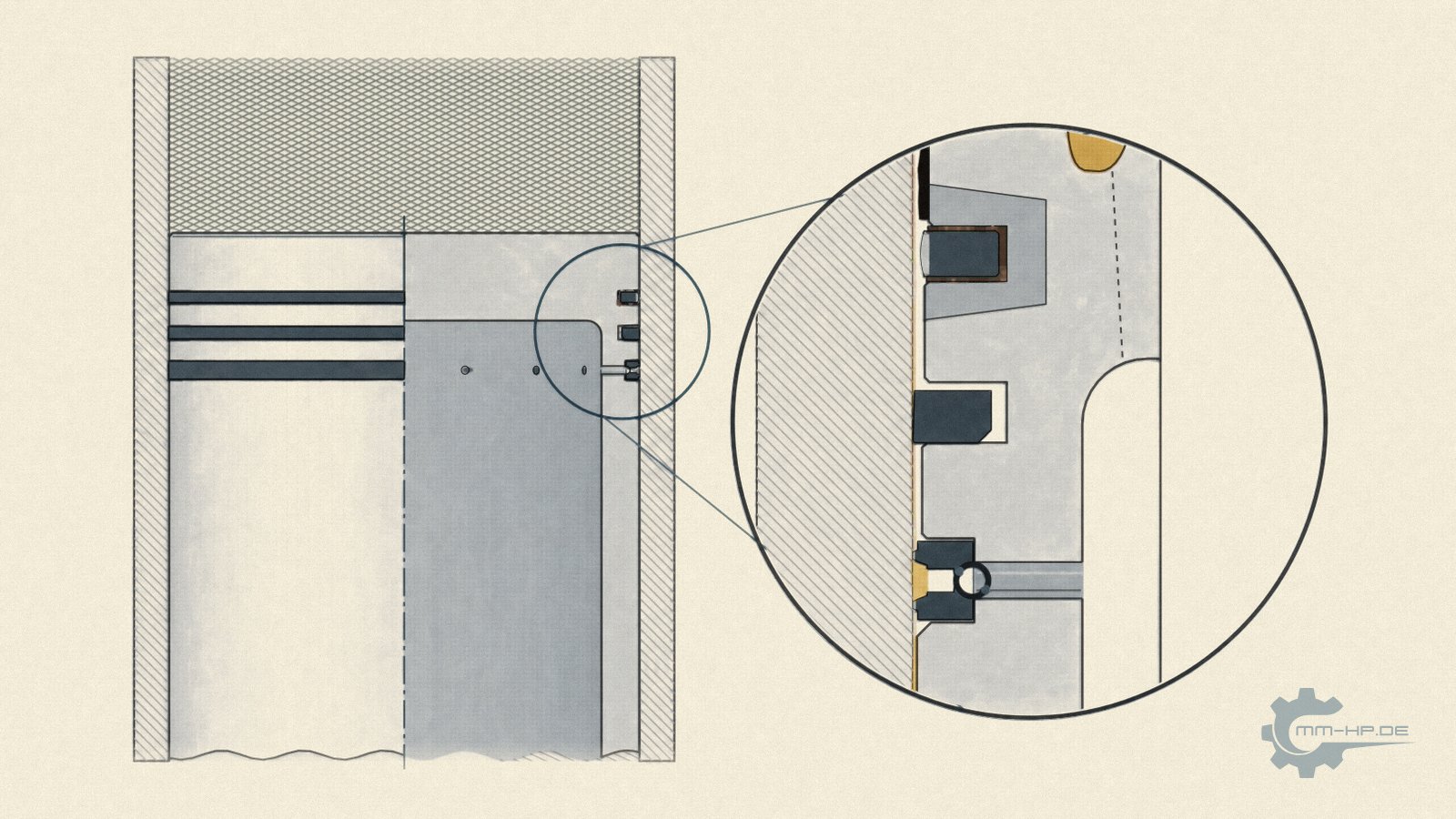
Piston rings coke up when the oil in the ring grooves is heated at high temperature, first to varnish and then to carbon. In a diesel, soot in the oil speeds this up. In a direct-injection petrol engine, the fuel that hits the cylinder wall does. Once the groove grows shut, the ring loses its freedom to move and stops in place.
What happens next depends on which ring sticks. The top two rings seal with combustion pressure, which flows behind them and presses them against the wall. If they stick, gas blows past, compression drops and blow-by rises. The oil control ring below them does not seal gas. It wipes the oil film off the wall and sends the oil back into the piston through drillings. If it clogs, the oil stays on the wall and the engine uses oil even though the compression test comes out fine. This is exactly what confuses many owners.
Both faults reinforce each other. More blow-by carries more oil mist through the breather into the intake air, and the residues clog the grooves further. In a diesel, the ash from the burnt oil ends up in the particulate filter. MMHP measured on a VW T5 that around 50 litres of oil were enough to fill it.
The manufacturers' limit of 0.5 litres per 1,000 kilometres is roughly ten times what a healthy engine uses. Chemical cleaning treatments, as some manufacturers prescribe them, sometimes loosen early deposits. Nobody states a success rate, and wear on rings and bore remains.
The strongest lever comes before the damage: a cool ring zone, meaning piston cooling jets that also spray when the oil is hot and engine speed is low, and an oil with the right approval. When an engine is rebuilt, honing decides the next years. What you want is a plateau surface with low peaks and deep oil reservoirs, a crosshatch angle with a known reference axis and a running-in under varying load rather than at idle.
That was the short answer. If you want to understand what really happens in the ring grooves, why the compression test so often reassures although the engine burns oil, and what honing decides over years of mileage, the long version starts here, with animations for every ring, the manufacturers' figures and the relationships that forums mostly mix up.
¶ Piston rings: three rings, three jobs
A piston in a modern car engine carries three rings. At the top sits the compression ring, below it a ring that seals and wipes oil at the same time, and at the bottom the oil control ring. According to the ring brochure from MS Motorservice, the aftermarket arm of Kolbenschmidt, more than three rings are rare today. The three share six jobs. They have to keep the gas above the piston, keep the oil away from the combustion chamber, leave a precisely metered oil film on the bore, distribute the oil, support the piston as it rocks and carry heat away.
The last job is almost always forgotten. Around 70 per cent of the heat the piston absorbs flows through the rings into the cylinder. According to MS Motorservice, without this path a piston would seize within a few minutes. A ring stuck in its groove is therefore not only leaking. It is also a blocked heat bridge.
¶ Gas pressure presses the top ring into place
The spring force of a compression ring is small. Most of the contact force comes from the gas it is meant to seal against. The gas flows over the ring into the groove, fills the space behind the ring and presses it from the inside against the cylinder wall and from above onto the lower groove flank. MS Motorservice puts a figure on it: on the power stroke, up to 90 per cent of the total contact force of the compression ring comes from combustion pressure. The force on the lower groove flank comes from the gas alone.

Two things follow that matter for everything else. First, a ring only seals if it is free in its groove and the gas can get behind it. Second, it seals worse at idle, because there is little pressure in the cylinder. MS Motorservice points out explicitly that this is especially noticeable in diesels. Long idling periods lead to higher oil consumption and to blue smoke on the first touch of the throttle, because oil collects in the cylinder and the exhaust tract.
¶ The second ring does two jobs
The second ring only sees the pressure that gets past the first. It helps with sealing, but its real strength is wiping. It is usually a taper-faced ring (minute ring). Its running face is tapered by 45 to 60 minutes of arc, which is just under one degree. When new, it therefore touches only with its lower edge, with high surface pressure, and runs in quickly. On the upstroke it glides on the oil film like a sledge, on the downstroke the edge digs in and pushes oil downwards. After several hundred thousand kilometres the taper has worn away, and it carries on working like a rectangular ring.
¶ The oil control ring cannot rely on any gas
The bottom ring gets no help. No combustion pressure acts on it, and its contact force comes from its own tension alone, in modern rings from a spring behind the ring body. MS Motorservice puts it briefly: with a pure oil control ring, gas pressure cannot act as an amplifier. It sets the thickness of the oil film that the rings above it work with. This means 1 to 3 thousandths of a millimetre. Thinner leads to mixed friction, thicker raises oil consumption.
Rule of thumb: the compression rings seal with the gas, the oil control ring only with its spring. That is why they fail differently when carbon deposits lock them in place.
¶ What is fitted in the VW 2.0 TDI
For the EA189, the ring catalogue from Nippon Piston Ring lists a set with 1.75 millimetres height at the top, 2.0 millimetres in the middle and 3.0 millimetres at the bottom. At the top is a rectangular ring, below it a taper-faced ring with an internal chamfer at the bottom, and at the bottom a two-piece oil control ring with a coil spring. The EA288 has 1.75, 2.0 and 2.0 millimetres. This contradicts the widespread belief that a diesel always runs a keystone ring at the top. For many older diesels it is true, but for the VW 2.0 TDI it is not, according to the catalogue.
¶ Oil control rings: how the oil finds its way back into the piston
The oil control ring has the hardest job. On every downstroke it has to take the oil film off the wall and send the oil somewhere. For this it has two rails that bear on the wall, with passages between them. The oil the upper rail wipes off runs through slots or holes in the ring body to the back, into the groove root. From there it passes through drillings in the piston wall into the hollow piston and drips back into the sump. Some pistons instead lead it away through shallow cut-outs at the pin boss, called cover slots, and some use both.
How many drillings a piston has, how large they are and where they sit is decided by each piston manufacturer and tuned in testing. MS Motorservice writes that a general statement in favour of one design or the other can only be made inadequately in theory. The only numerical example we could find freely comes from a test piston in a patent by Nippon Piston Ring and Toyota: eight holes of 2.0 millimetres diameter at a bore of 86 millimetres. The graphics therefore show an example arrangement.
¶ Two designs worth knowing
In a passenger car diesel, there is usually a two-piece ring with a coil spring. The ring body is narrow and flexible, an I-beam in cross-section with two rails on the outside and a spring seat on the inside. Behind it lies a coil spring whose axis runs along the circumference. It presses the ring evenly against the wall all the way round. The most common form has rails whose edges are bevelled on both sides, the double-bevelled coil-spring oil ring (DSF). MS Motorservice calls it the most widely used oil control ring of all, and with chrome-plated rails especially suitable for diesels.

In a passenger car petrol engine, there is usually a three-piece ring. Two thin steel rails lie at the top and bottom of the groove, with an expander of corrugated steel strip laid in a circle between them. Seen from the side, it looks like a strip of corrugated sheet, with the upper rail resting on its upper waves and the lower rail on its lower waves. At the inner edge of each wave sits a small angled tab. According to a patent by Nippon Piston Ring, it is inclined by 15 to 25 degrees to the piston axis, by about 20 degrees in the example. This means it presses the rail not only outwards against the wall but at the same time against its groove flank. The rail therefore seals in three places.

The trend is towards narrower oil control rings with less tension, because the oil ring causes a large part of the friction in the ring pack. Kolbenschmidt showed this with figures in the trade journal MTZ in 2011. The oil ring of a production set in a passenger car petrol engine had 2.0 millimetres height and 30 newtons tangential force, the low-friction version 1.5 millimetres and 12 newtons, with a stepped running face and a hard coating only 8 newtons. Less tension saves fuel. But it is less forgiving when deposits form or the bore is not round.
¶ When the return paths clog up
If slots, spring seat and drillings fill up with carbon deposits or sludge, the wiped-off oil can no longer drain inwards. The ring then no longer bears cleanly or sticks completely, and the oil film stays standing on the wall. That this happens in practice is shown by the fitting instructions of the ring manufacturers themselves. Kolbenschmidt prescribes removing the carbon deposits from the return drillings with a twist drill and tap wrench before new rings are fitted.
¶ Compression ring or oil control ring: why the compression test says nothing about oil consumption
In the big forum thread on the T5 with the CFCA engine at Motor-Talk, almost 900 replies long, the same question comes up again and again: how can an engine burn a litre of oil per thousand kilometres when the compression is fine? One participant sums it up in 2018: "The compression measurement says nothing about the condition of the oil control rings." (our translation of a German forum post). Another writes that he does not understand why it is not done with a compression measurement like in the old days. The answer is in the previous chapter.
A compression test measures how well the compression rings and the valves hold the gas. The oil control ring does not seal gas. It can be completely coked and the compression still stays good. Conversely, compression only falls when the first or second ring no longer bears.
This gives two damage patterns that look the same from the outside, because both cost oil:
| Oil control ring clogged or stuck | Compression ring stuck | |
|---|---|---|
| Main symptom | oil consumption without a visible leak, blue smoke after overrun or idling | blow-by, loss of power, in a diesel poor cold starting |
| Compression test | often unremarkable | individual cylinders low |
| Leak-down test | unremarkable | air escapes audibly into the crankcase, at the oil filler cap or at the breather |
| Glow plug or spark plug | oily on the affected cylinder | often oily as well, as a consequence |
| Blow-by measurement | unremarkable for a long time | raised |
A compression test and a leak-down test cannot check the oil ring at all. There is no manufacturer source that says this in so many words. But it follows necessarily from the function, and it is still constantly mixed up in forums. In addition, both tests are done on a stationary engine. A ring that only sticks at operating temperature and gas pressure can look unremarkable when cold.

¶ The two pictures are linked
In practice it rarely stays with one of the two cases. A clogged oil ring leaves more oil standing on the bore. More of it gets into the grooves of the upper rings, and there it cokes at the highest temperatures in the piston. Then the compression rings stick too, blow-by rises and the engine is in the spiral that the chapter after next describes. This chain of consequences has not been measured in a single study, it is put together from the manufacturers' cases. In a workshop bulletin, General Motors names cracked or sooted spark plugs on individual cylinders as the end state, and Kia names an engine replacement as the last stage.
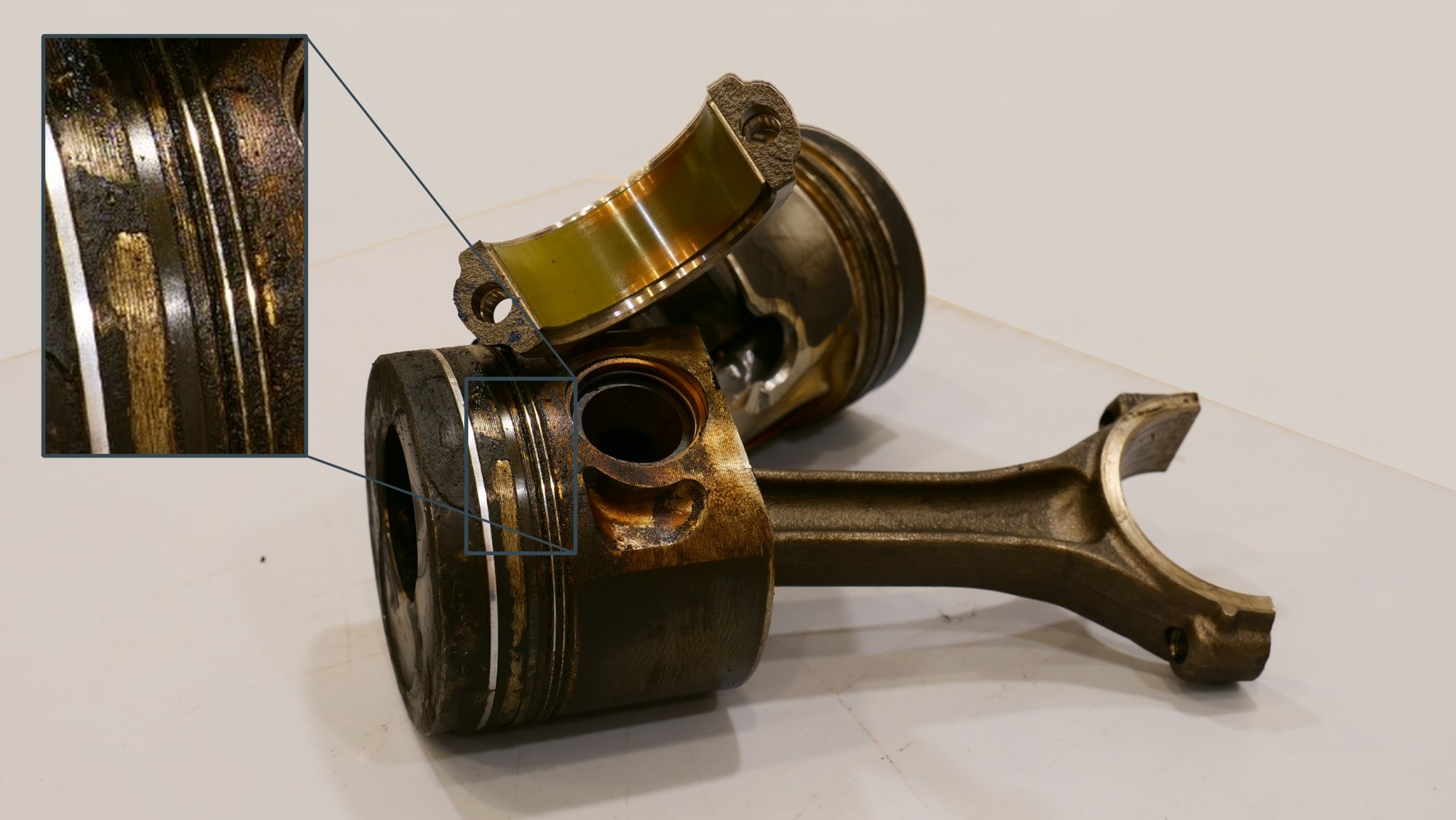
The photo below comes from a dismantled engine from the workshop. The rings are stuck in carbon deposits, the grooves have grown shut.
¶ Scoring or a nick: when a ring is open at one spot only
A ring can seal all the way round and be open at a single spot. A longitudinal score in the bore, for example from dirt or from coating that has come loose from the exhaust gas recirculation cooler, as occurs in the CFCA engine, forms a channel through which the gas shoots past the ring. A chip on the ring's running face has the same effect. A ring then looks almost good when removed, and the cylinder still leaks.

¶ How the cause is narrowed down
The order in which a workshop checks decides whether the right parts are replaced in the end:
- Measure oil consumption properly. In its workshop instructions for the US market, Volkswagen prescribes a fixed procedure, electronic or by scale. The second part of the measurement starts only after at least 1,014 kilometres. VW itself points out that an error of just 50 grams when weighing distorts the result considerably. A look at the dipstick is not enough, particularly since fuel in the oil raises the level and hides the consumption (more on this in the article on oil dilution).
- Rule out other routes. Turbochargers, valve stem seals and the crankcase ventilation also use oil. On the EA888 petrol engine, Audi first replaced the pressure regulating valve of the crankcase ventilation, not the rings.
- Measure blow-by. It reacts earlier than compression. How this is done and which values are suspicious is described in the article Oil Consumption 2.0 TDI: A Chain Reaction Ending in the DPF.
- Check compression and leak-down. If both are good and consumption is still high, the oil ring moves to the front.
- Endoscope. It shows oily piston crowns, polished bores and scoring. It does not look into the ring groove itself.
¶ Coking in the ring groove: how a ring grows fast
Oil that gets into the ring groove does not stay liquid for long. The top groove is the hottest place in the piston that oil still reaches. How hot it gets, at which temperature deposits begin and how the chemistry behind it works is explained in detail in the article Oil Temperature: Why Hot Oil Ages Your Engine Faster. Here we look at what becomes of it in the groove.
¶ What the carbon in the groove is made of
In a petrol engine, oxidised oil is the most important building block. It first becomes varnish, then carbon. In a diesel, soot is added, and that changes the picture. A Hyundai study, published as SAE paper 980526, found that soot in the oil speeds up deposits in the first ring groove even below 260 degrees. Above that, temperature and soot content work together.
How the soot gets into the oil was investigated in a dissertation at the University of Nottingham on a common-rail diesel. The main route is the wall. Soot particles migrate from the hot combustion gas into the cooler oil film on the bore, and the rings scrape them into the crankcase on the next downstroke. After around 15,000 kilometres, there is about one per cent soot by weight in the oil. At exhaust gas recirculation rates above 20 per cent, the recirculated soot becomes the main source.
If fuel gets into the oil as well, the reserve of dispersants that hold the soot in suspension shrinks. Once it is used up, the soot clumps together. That this speeds up the groove deposits further is pieced together from two findings, not measured in a single study. But the direction is clear.
¶ Why direct-injection petrol engines are affected too
In a direct injector, liquid fuel hits the piston and the bore. These wall films evaporate with a delay and are a main source of soot particles. The petrol engine thus gets a soot problem in the oil similar to that of the diesel, plus fuel dilution at cold start and friction-optimised rings with low tension. Sticking is not purely a direct-injection problem, though. Toyota's best-known case, the 2AZ-FE with almost two million vehicles affected, is a port-injection engine.

¶ The keystone ring cleans itself
Ring manufacturers have developed a shape of their own against ring growth. The keystone ring has angled flanks, inclined by 6, 15 or 20 degrees depending on the manufacturer. Each time the piston changes its thrust side at top and bottom dead centre, the ring moves radially in the groove, and the angled flanks rub off the carbon. MS Motorservice names exactly this purpose: keystone rings are used to fight carbon deposits in the grooves that would otherwise lock the rings. They preferably sit in the first groove of diesel engines.
¶ The top land polishes the bore
Carbon also collects above the first ring, on the top land. Hard deposits there polish the bore in its upper area to a shine on every stroke. The crosshatch disappears, the oil film has nothing to hold on to, and ring wear and oil consumption rise. For a large truck diesel, Cummins introduced liners with a scraper ring at the top of the liner, which keeps the carbon layer on the top land thin. As consequences of the polishing, the 2015 workshop bulletin names oil consumption above the limit, frequent regenerations of the particulate filter and aged oil.
¶ How the oil standards test for sticking
How seriously the industry takes the subject is shown by the test runs that every engine oil has to pass for an ACEA class. The piston cleanliness test for passenger car oils runs on a VW TDI, today as CEC L-117-20. The limit for ring sticking is zero. Not a single ring may be stuck at the end. In the predecessor CEC L-78 on the 1.9 TDI, the engine ran for 54 hours, alternating 30 minutes of idling and 180 minutes at full load at 4,150 rpm. A ring counts as sticking if it can no longer be moved freely in the groove by hand.
The industry therefore uses the TDI as a test engine precisely because its rings are sensitive. That is also the strongest argument for an oil with the right approval, which the article Which Oil for the 2.0 TDI? Approval Beats Brand explains. The test runs, however, work with fresh oil over a short time. How an oil behaves after a 30,000-kilometre long-life interval is only tested indirectly.
¶ The blow-by spiral: how a sticking ring makes itself worse
A sticking ring rarely stays a stable condition. It sets off a cycle that gets stronger with every round. The article Oil Consumption 2.0 TDI: A Chain Reaction Ending in the DPF describes the stations in the crankcase and the ventilation in detail. Here we show how the rings are tied into this cycle.

The cycle has five stations. If a ring sticks, more gas flows past the ring pack. This gas carries oil off the bore and takes it as mist into the crankcase. The crankcase ventilation leads the mist into the intake air. In the combustion chamber, the burnt oil produces soot and residues, and more soot in the combustion chamber means more soot in the oil by way of the bore. The grooves then grow shut faster, and the ring sticks harder.
In a healthy engine, the ventilation is a side route here. Test bench measurements assign it roughly a tenth of the oil consumption. Researchers at MIT found at low load that around 90 per cent of the oil used gets directly into the combustion chamber. With sticking rings, the ratio shifts. In a workshop bulletin, General Motors explicitly names oil drawn in through the ventilation as a cause of ring groove deposits. How large the share of mist is in a damaged TDI has not been published by anyone except MMHP. In our measurements on such engines, by far the largest part went through the mist, as the article on blow-by and oil mist shows in detail.
¶ The diesel branch: ash, differential pressure, fuel in the oil
Oil that burns leaves ash from its additives. In a diesel, it ends up in the particulate filter and does not burn off there. Ash does not trigger a regeneration itself. But it takes up the space of the soot and drives the differential pressure up, and that is exactly how the control unit measures the loading. Studies at MIT show that ash can more than double the pressure sensitivity of a filter to soot up to a typical cleaning interval. Modern control units calculate the ash out, but with a modelled oil consumption. An engine that really burns considerably more oil fills its filter faster than the model assumes. More regenerations mean more post-injection, more fuel in the oil, thinner oil and, as laboratory tests on misting show, more mist.
How much burnt oil a filter tolerates can only be given as a range. MMHP measured this on a T5 with a CFCA engine and sticking rings: over around 50,000 kilometres, it put through about 50 litres of oil, then the particulate filter was full. The mileage is less certain than the oil quantity. Depending on filter size and driving profile, our figures from experience lie between 30 and 60 litres. If you instead calculate with the limits at which VW control units indicate a filter replacement, around 70 to 80 grams of ash for the 1.6 and 2.0 common-rail TDI and 110 grams for the T6, you arrive at 10 to 50 litres. The control unit limit is a cautious replacement value, not a physical limit, and not all the ash stays in the filter. That explains part of the difference. Both agree in order of magnitude. We are talking about a two-digit number of litres, and part of it is already accounted for after 150,000 kilometres by perfectly normal consumption.
¶ The petrol branch runs differently
In a petrol engine with a particulate filter, this chain does not apply in the same way. The filter usually regenerates by itself on the overrun, when oxygen flows through the hot filter. A post-injection as in the diesel does not normally exist there. Fuel in the oil comes in a direct injector mainly from cold starts, heating up the catalytic converter and short trips. Since when particulate filters have existed also explains why the subject is more pressing today than twenty years ago. Peugeot launched the first production particulate filter in May 2000. Since the Euro 5 emissions standard, for all new vehicles from January 2011, practically no diesel car manages without a filter. In petrol engines, the VW Group began in June 2017. Earlier, intake oil mist simply went out through the exhaust. Today its ash stays in the filter.
¶ Manufacturer limits: what 0.5 litres per 1,000 kilometres really means
How much oil an engine may use is stated in the owner's manual. The figures have shifted considerably over the decades:
| Manufacturer and model | Statement in the owner's manual | Source |
|---|---|---|
| VW Transporter T1 and T2 | 0.5 to 1.4 l per 1,000 km | Technical data |
| VW LT (older edition) | up to 2.0 l per 1,000 km | Operating notes |
| BMW 3 Series E30 | max. 0.15 l per 100 km, i.e. 1.5 l per 1,000 km | Engine compartment |
| VW Touran 1T (edition around 2008) | up to 1.0 l per 1,000 km, in the first 5,000 km also above | Checking and topping up |
| Mercedes-Benz C-Class W204 | up to 0.8 l per 1,000 km | Engine oil |
| VW Passat B8, Caddy | up to 1 l per 2,000 km | Engine oil |
| Škoda Octavia III, Audi Q3 | up to 0.5 l per 1,000 km | Engine oil |
| Audi Q7 3.0 TDI (English edition, our own reading) | up to 0.5 l per 1,000 km, higher in the first 5,000 km | Engine oil |
The most important sentence is not in this table. According to MS Motorservice, a healthy modern car engine uses less than 0.05 per cent of its fuel consumption in oil. At eight litres per hundred kilometres, that is around 0.04 litres per 1,000 kilometres. The permitted limit is therefore roughly ten times what a healthy engine needs. It is a warranty threshold that covers running-in, full load and scatter between engines. It does not say that an engine with this consumption is healthy. From the point of view of engine rebuilders, it is generous.
For the particulate filter, the limit has a simple consequence. At 0.5 litres per 1,000 kilometres, 30 litres have burnt after 60,000 kilometres, at one litre already after 30,000. With the capacity described above, it is clear why an engine that uses oil at the edge of the manufacturer's limit can fill its filter long before its planned life. How the myth of the "normal litre" came about is described in the article on oil myths.
¶ What helps against sticking rings, and what does not
For freeing stuck rings there are two worlds: the workshop procedures of the vehicle manufacturers and the can from the accessory shelf. Only the first is documented.
Three manufacturers have published their own cleaning procedures, all for petrol engines, and all work from above, through the spark plug hole directly into the combustion chamber:
| Hyundai, 2023 | Kia, 2020/21 | General Motors, 2014 | |
|---|---|---|---|
| Quantity per cylinder | 50 cm³, repeated | 50 to 66.5 cm³, twice | 118 to 147 ml |
| Special feature | vacuum in the crankcase draws the agent into the ring zone, engine hot | cylinder pressurised with 2 to 3 bar compressed air | no piston at top dead centre |
| Soak time | twice at least 2 hours | overnight, at least 8 hours | 2.5 to 3 hours, explicitly not longer |
| Afterwards | oil and filter change mandatory | oil and filter change | reassess oil consumption |
| If it is not enough | next stage of the bulletin | engine replacement | new pistons and rings |
All three use cleaning as the first stage, and all three provide a next stage if it is not enough. Nobody states a success rate. In their well-known cases, Toyota and Audi fitted different pistons straight away. Toyota's repair kit for the 2AZ-FE contained four new piston cooling jets in addition to new pistons and rings. Toyota names no cause in the bulletin, but the jets in the kit suggest that piston cooling was part of the solution. That is our reading, not Toyota's.
Flushes that you add to the old oil advertise free rings and better compression. No independent measurements were found, neither from the ADAC nor from the trade press. Technically, there is little to suggest that an agent in the oil circuit effectively reaches the first ring groove. Its upper side lies in the combustion chamber, and oil only gets there from below as splash oil and past the oil ring. The manufacturers therefore deliberately approach the rings from above. Loosened particles then have to leave the engine with an oil change, otherwise they end up in the strainer and the bearings, as the article on oil myths describes under engine flushes.
⚠️ WARNING, liquid in the cylinder: Cleaning agents in the spark plug or glow plug hole can cause hydrolock if the engine starts before everything has been extracted. In a diesel with its high compression, this is especially dangerous. The manufacturers' procedures therefore switch injection and ignition off and turn the engine over with the holes open before it runs again.
Chemistry does not help with mechanical damage. Worn rings, scoring, a broken ring or a worn groove remain what they are. MS Motorservice sums up the experience of the ring manufacturers in one sentence: new rings alone let a worn engine run a while longer, they do not improve oil consumption. The rings are almost always involved in excessive oil consumption, but rarely the cause.
¶ Piston cooling: the lever at the root
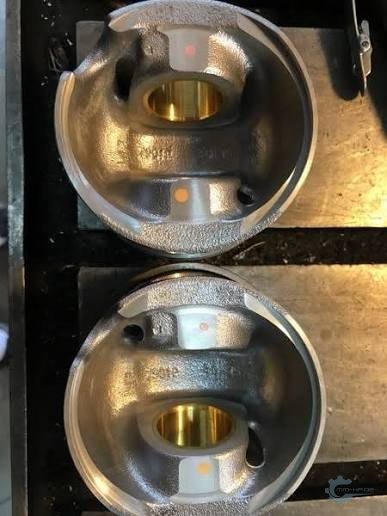
If the temperature in the first ring groove sets the pace of coking, then the most effective lever is not in the groove but below it. The pistons of modern diesel engines are cooled from below. A jet in the crankcase sprays oil against the underside of the piston or into a cooling gallery in the piston that runs behind the ring zone. The oil absorbs heat and falls back into the sump. According to a calculation by MAHLE, a cooling gallery directly at the ring carrier lowers the temperature at the root of the first groove by around 50 degrees.
¶ The jets only open above a minimum pressure
The jets are closed by a spring-loaded valve. They only open above a minimum oil pressure, so that enough oil remains for the bearings at idle. A patent by an oil pump manufacturer gives 2 bar as the rule, a BMW patent about 2 bar with conventional pump control. Between the first lift of the valve and the full jet lies a pressure range, as the valve does not open abruptly. The pump manufacturer's patent describes the drawback of this solution without detours: at very high temperatures combined with low engine speeds, the pistons are not cooled. This is exactly when the oil is thin, the pump turns slowly and the pressure is not enough for the jet.
How strong the cooling effect is was measured by Ford with the University of Nottingham on a 2.4-litre diesel whose jets could be switched off. Without jet cooling, the pistons were 23 to 88 degrees hotter. That manufacturers still reduce the cooling at times has good reasons. A cold engine warms up faster if the pistons are not cooled, carbon monoxide falls, and the pump needs less drive power. On the EA288, VW therefore controls the oil pressure in two stages, with 1.8 to 2.0 bar in the low-pressure stage and 3.8 to 4.2 bar in the high-pressure stage, depending on load, engine speed and oil temperature.

¶ What more delivery rate changes at this point
More delivery rate raises the pressure where the standard pump does not reach its setpoint: with hot oil and low engine speed. The jets then spray earlier and more steadily, in situations in which they are still closed with the standard pump. Where the engine's control reaches the setpoint anyway, it regulates the extra output away. The effect therefore does not apply across the whole map, but exactly in the range that the pump manufacturer describes as a weak point in its patent. That more delivery rate also keeps the oil cooler, by 10 to 15 degrees on average, and why that matters for the ring zone, is explained in the article on oil temperature. How delivery rate and pressure are related is described in the article Why More Delivery Rate Is Always the Better Choice.
MMHP investigated this relationship in field trials on various diesel and petrol engines. We measured oil consumption before and after an increase in piston cooling, along with blow-by and oil mist intake. The result was clear: more piston cooling slows the coking of the ring grooves, with less wear on rings and bores. We deliberately do not name individual vehicles and engines, as the problem affects practically all engines with a particulate filter.
It is not a cure-all. The greatest benefit comes from stronger piston cooling from new or directly after a rebuild, while the rings are free. It does not undo wear on rings and bores, and cooler oil does not repair existing coking. On an engine that already sticks, the life can at best be stretched somewhat. We work with engine rebuilders who for exactly this reason renew the oil system as well during a rebuild. The damage from piston cooling that is too weak only shows late, when the grooves have already grown shut.
At this point we ask for your understanding that we do not publish the measurement series of these field trials in detail. They were built up over years and are part of the value of our company. What we show is the part that helps you understand.
¶ Piston ring profiles: which profile for what
Anyone ordering a ring set finds abbreviations in the catalogue such as R, M, NM, IFU or DSF. Behind them are cross-sections developed for very specific jobs. The overview shows the most important profiles of the compression rings, each in its groove, with the running face at the wall:

A few profiles deserve a second look.
The rectangular ring is the simplest and most common shape. A count of all ring sets in the Europe catalogue of Nippon Piston Ring, 2,163 sets for cars, vans and older commercial vehicles, gives the rectangular ring for the first groove at 73 per cent. That is an approximation across sets, not a market share, but it shows the order of magnitude. Coated rectangular rings are ground barrel-shaped at the factory so that they do not have to run in first.
The twist is the reason for the many chamfers on the inside. An internal chamfer or inner angle makes the tensioned ring tilt towards the weaker side. If the chamfer is at the top, it tilts positively, if it is at the bottom, negatively. Negative twist, as in the taper-faced ring with internal chamfer at the bottom in the EA189, seals at the outer bottom and inner top and blocks the oil's way into the groove. This helps in part-load and overrun operation, when there is vacuum in the combustion chamber. As soon as gas pressure gets into the groove, it presses the ring flat, so the twist only acts without gas. So that negative twist and the taper of the running face do not cancel each other out, a negatively twisting taper-faced ring gets a larger running-face angle of around 2 degrees, according to MS Motorservice.
The keystone ring is the answer to coking, as described above. Which angle a keystone ring has depends on the manufacturer. Motorservice and Kolbenschmidt give 6, 15 and 20 degrees, Nippon Piston Ring 7 and 3 degrees, Riken 6, 10 and 15 degrees. A keystone ring never fits a rectangular groove and vice versa.
The Napier ring has a recess at the bottom of the running face in which the wiped-off oil collects. Today it is usually combined with the taper-faced ring. For the second groove, the same catalogue count gives the taper-faced ring at 51 per cent and the taper-faced Napier ring at 43 per cent.
The L-ring goes back to a British patent by P. de K. Dykes from 1947. Its L-shaped cross-section lets the gas act on the ring so that it does not flutter. Today it is mainly found in motorsport.
Rings have become considerably lower over the decades. In the motorsport catalogue from MAHLE, the development of the upper rings can be followed, from 2.38 millimetres around 1920 through 1.59 millimetres in the mid-sixties to 0.99 millimetres in steel in 2016. A ring half as tall with half the tension produces the same surface pressure at half the friction. With distorted bores, however, such a ring hardly adapts any more.
¶ Which oil ring sits where
The picture is clearer with oil control rings. According to MS Motorservice, one-piece grey cast iron oil rings are no longer used in modern engine construction. In passenger car diesels, the two-piece ring with a coil spring dominates, in passenger car petrol engines the three-piece steel rail ring, increasingly supplemented by narrow two-piece steel rings. Two-stroke engines with mixture lubrication have no oil ring at all.

¶ Clearances: end gap, groove and piston in hundredths of a millimetre
A piston ring never sits tight. It needs room in three places, and each of them is a functional dimension.
¶ End gap: why the ring must never be closed
The end gap is the space between the ring ends. It must stay open even at operating temperature. If it closes, the ends butt together, the ring can no longer give way radially and it distorts. MS Motorservice works through an example: a ring of 100 millimetres diameter that warms up by 180 degrees grows by 0.57 millimetres at the circumference. It therefore needs at least 0.6 millimetres of end gap. The bore grows too, but less, and more at the top than at the bottom.

For the EA189, the VW repair manual gives 0.20 to 0.40 millimetres on the first and second ring, 0.25 to 0.50 millimetres on the oil ring, wear limit 1.0 millimetre. It is measured with a feeler gauge, with the ring pushed square into the bore about 15 millimetres deep, in the unworn lower area. The ring manufacturer Hastings gives a rule of thumb for this: every hundredth of a millimetre of extra bore increases the end gap by around three hundredths, calculated exactly by π. A ring measured at the top in a worn cylinder therefore shows a larger gap than it has.
At VW, the end gaps of the two upper rings are equal. In the Caterpillar C15 truck diesel, by contrast, the second end gap is almost twice as large as the first. The reason is the pressure between the rings. If the gas that gets past the first ring cannot move on fast enough, it lifts the first ring off its flank. Nippon Piston Ring writes that in the last ten to fifteen years, manufacturers have made the upper gap smaller and the second larger, to lower oil consumption with low-tension rings.
¶ Side clearance: the room in the groove
Side clearance is the room between the ring and the groove flanks. It has to be large enough that the ring does not stick when warm and that gas gets behind it. If it is too large, the ring flutters, pumps oil upwards and runs in barrel-shaped. For the EA189, VW gives when new 0.06 to 0.09 millimetres at the first, 0.05 to 0.08 at the second and 0.03 to 0.06 at the oil ring, wear limit 0.25 and 0.15 millimetres respectively. MS Motorservice is stricter and declares a piston worn above 0.12 millimetres. The difference is explained by the role. VW assesses its own piston, while Motorservice gives a practical limit for the case where a new ring goes into an old groove. And there is a sentence that hardly any forum knows: new rings in worn grooves do not help.
¶ Piston clearance: hundredths that move with temperature
For the EA189, the repair manual gives a piston diameter of 80.96 and a bore of 81.01 millimetres. That gives a fitted clearance of 0.05 millimetres. The piston is measured about 15 millimetres above the lower edge, across the pin axis. The MAHLE specialist book "Pistons and Engine Testing" gives usual fitted clearances of 0.6 to 0.9 per mille of the diameter for passenger car diesels with a grey cast iron block. The EA189 is at the lower edge with 0.62 per mille.

A piston is neither round nor cylindrical. It is oval, smaller by 0.3 to 0.8 per cent of the diameter in the direction of the piston pin, because the mass of the pin bosses expands more there, and it is tapered at the top and bottom. Aluminium expands about twice as much as grey cast iron. If piston and bore warmed up evenly by 100 degrees, the cold clearance would be used up arithmetically. That it still does not seize is down to exactly this shape, to the cooler underside of the skirt and to the fact that when warm it deliberately runs with interference in the elastic skirt area.
Steel pistons, which MAHLE has also supplied for Renault passenger car diesels since 2014, expand similarly to the grey cast iron bore and therefore get by with smaller clearance.
New pistons permanently lose a few hundredths of a millimetre of diameter in the first warm-up phase. Anyone who re-measures the clearance after 200,000 kilometres can therefore no longer see the original dimension. According to MS Motorservice, cylinders that are worn by more than 0.10 millimetres (petrol) or 0.15 millimetres (diesel) at the top reversal point should be machined, because a new piston with sharp-edged rings would otherwise hit the wear edge. For the 2.0 TDI there are replacement pistons in repair size 0.50 millimetres, with a bore of 81.51 instead of 81.01 millimetres. Oversize does not make a piston more durable, it only compensates for the material removed. How bearing clearances affect oil pressure in a rebuild is covered in the article Low Oil Pressure After an Engine Rebuild? The Causes.
¶ Honing: why a bore has to be rough on purpose
A cylinder bore that is mirror-smooth would be a mistake. No oil film could stay on it. The bore is therefore honed, with honing stones of bonded abrasive that rotate and move up and down at the same time. From both movements comes the typical crosshatch pattern, a net of fine grooves. Oil stands in the valleys, and the ring glides on the plateaus in between.

Honing has two jobs, and the first is often underestimated. It produces the geometry: round, straight, to size. For bores between 80 and 120 millimetres, MS Motorservice gives a permissible form deviation of 0.015 millimetres. Boring is done with the main bearing caps fitted, after which a honing allowance of around 0.08 millimetres remains. In the installed engine, the tightened cylinder head distorts the bore by thousandths. Audi therefore hones with a plate that reproduces this distortion, and was able to lower the tangential force of the piston rings by around 35 per cent as a result. The honing machine manufacturer Gehring goes further and hones the bore deliberately out of round so that it only becomes round in operation.
The second job is the surface. Today it is produced in stages, in plateau honing. First a coarse stone creates size and form, then a finer one the base roughness, and finally a very fine stone removes only the peaks in a few strokes with light pressure. What remains are flat plateaus with deep valleys. MS Motorservice gives the sequence as grit 150 for rough honing, 280 for finish honing and 400 to 600 for the plateau. The removal amounts fit together exactly: 0.06 plus 0.02 millimetres give the honing allowance of 0.08 millimetres.
¶ The target values hardly anyone knows
For the surface there are characteristic values according to standard. Rpk describes the peaks that are removed during running-in, Rk the load-bearing core, Rvk the valleys in which the oil stands. What these quantities mean and how they relate to manufacturing scatter is explained in the article Manufacturing Tolerances: Every Engine Is One of a Kind. MS Motorservice gives these target values:
| Parameter | Passenger car, petrol and diesel | Commercial vehicle diesel |
|---|---|---|
| Ra | 0.15 to 0.40 µm | 0.30 to 0.50 µm |
| Rpk, the peaks | under 0.20 µm | 0.20 to 0.40 µm |
| Rk, the core | 0.20 to 0.60 µm | 0.50 to 1.50 µm |
| Rvk, the valleys | 1.40 to 1.80 µm | 1.50 to 2.00 µm |
| Honing angle | 25 to 45 degrees | 40 to 60 degrees |
In a passenger car, the valleys are several times deeper than the peaks are high. That is exactly the principle: little that has to be removed, plenty of room for oil. In grey cast iron there is also a requirement you can see under the microscope. At least 20 per cent of the graphite flakes must be open after honing, as they serve as additional oil reservoirs. A ring manufacturer describes the opposite direction: too much Rvk means oil consumption, too little means wear.
¶ Grit: from rough honing to plateau
Which roughness a stone produces depends on the grit and the abrasive material. The honing tool manufacturer Sunnen has tabulated this for grey cast iron with silicon carbide stones: grit 150 gives a mean roughness of around 0.75 to 1.00 micrometres, 280 around 0.30, 400 around 0.15 and 600 around 0.08 micrometres. A diamond stone of the same grit number, by contrast, leaves a considerably rougher surface, at 220 about 2.0 instead of 0.5 micrometres. Diamond is therefore used for rough honing and combined with finer stones or brushes for the plateau.

Two mistakes are common. A stone that is too fine for rough honing does not cut, it smears the material and closes the graphite flakes. And a stone that clogs glazes: it only slides over the surface. In its fault table for angles that are too flat and too steep, and surfaces that are too fine and too rough, Tenneco gives the cause on the machine in each case. Honing brushes and spring-loaded stones from the accessory trade can refresh the surface, but they cannot improve the geometry. They follow every distortion. MS Motorservice therefore writes explicitly that they are not a repair or rebuild method.
¶ Modern bores and what can be rebuilt
Not every bore today is just honed grey cast iron. In 2004, Audi introduced a laser exposure on the 3.0 TDI that uncovers graphite and creates oil pockets. Audi quoted up to 75 per cent less oil consumption and up to 90 per cent less wear. Since 2002, Opel has been structuring the bore with the laser in the area of the upper reversal point, and after 160,000 kilometres, 70 to 85 per cent less oil consumption was measured. Other manufacturers do without a liner altogether and spray an iron layer onto the aluminium, 0.15 millimetres thick at Škoda.
| Bore | Oversize in the workshop? |
|---|---|
| Grey cast iron block (EA189, EA288) | yes, boring and plateau honing, oversize pistons |
| Grey cast iron liner in an aluminium block | limited by the wall thickness of the liner |
| Alusil, Lokasil | only with diamond tooling, exposing the silicon crystals and a coated piston |
| Nikasil | no, the layer has to be applied again |
| Sprayed iron layer | no, after an oversize the layer would be gone |
For the 1.4 TSI, VW even writes explicitly in the repair manual never to machine the cylinder bore with workshop means. For TDI engines with a grey cast iron block, by contrast, classic rebuilding is possible.
¶ Crosshatch angle: shallow, steep, spiral
Hardly any number is repeated as often in forums as "45 degrees". And hardly any causes as much confusion, because different sources give different angles and mean the same thing. The angle comes from two speeds: how fast the honing tool moves up and down and how fast it rotates. The half included angle follows the relationship tan(α/2) = stroke speed divided by circumferential speed. More rotational speed makes the angle shallower, more stroke makes it steeper.

The apparently contradictory figures resolve as soon as you know the reference axis:
| Source | Figure | Reference |
|---|---|---|
| MS Motorservice, passenger car | 25 to 45 degrees | not stated, probably included angle |
| MS Motorservice, commercial vehicle | 40 to 60 degrees | as above |
| Hastings, referring to Sunnen | 45 degrees to each other or 22 to 32 degrees to the horizontal | both given |
| Tenneco Nural | 120 degrees | not stated |
| Spiral slide honing per patent | 120 to 170 degrees, typically 130 to 140 | included angle, bisector in circumferential direction |
22 to 32 degrees to the horizontal are 44 to 64 degrees included, so the same as 40 to 60 degrees. Whether the 120 degrees at Tenneco mean a steep pattern or 60 degrees measured from the other side is not clear from the source. A honing angle should therefore always come with a sketch showing the reference axis.
A best angle for all cases does not exist. Research at the French university ENSAM has found two favourable windows: the classic one around 40 to 60 degrees and spiral slide honing around 120 to 140 degrees. At 130 degrees, the friction of the ring pack was considerably less sensitive to the plateau roughness than at 50 degrees. In between, between about 70 and 110 degrees, nobody recommends anything. In Deutz engines, oil consumption with spiral slide honing was around ten per cent below that of laser-structured bores, and the laser-structured bores were worn around 30 per cent more after 700 operating hours. For sprayed coatings, Nikasil and hypereutectic aluminium, Hastings recommends shallower angles of 10 to 15 degrees, without naming the reference axis.
That the angle makes the rings rotate is often read. The rings do rotate, according to MS Motorservice about 5 to 15 times a minute, driven by the rocking of the piston and by the honing structure. A shallow angle is said to cause less rotation, a steeper one more. A measurement proving this for a particular angle could not be found. The rotation also explains why the end gap offset at assembly only counts for the first start. After that, the gaps wander.
¶ Running-in: the first kilometres decide
The peaks of a freshly honed profile are exactly what would be removed during running-in anyway. Plateau honing takes this part in advance, but it does not disappear entirely. In the first operating hours, the rings remove the remaining peaks stroke by stroke, the ring adapts to the bore and the fine wear particles go into the oil. The valleys remain as oil reservoirs. In a measurement published by the ring manufacturer Total Seal, even turning the engine over by hand visibly rounded the peaks.

¶ Why too gentle harms as much as too hard
In a workshop bulletin, Tenneco writes that, according to specialists, around 90 per cent of oil consumption problems after diesel overhauls come down to wrong running-in. This usually means the opposite of what many do. Delayed running-in or long periods of light load produce a smooth, varnish-like layer of oil and fuel components on the bore, under which the crosshatch can still be seen. The rings glide over it without adapting and never seal properly. Tenneco distinguishes this from the polish that arises later in the engine's life, when carbon deposits on the top land rub the bore to a mirror finish. On a turbo engine, the polished share of the bore rose from 5 to 14 per cent in the same period at 360 instead of 355 hp.
This does not lead to a recommendation to drive at full throttle all the time. The manufacturers' line is clear: load yes, idling and permanent light load no. After a rebuild, MS Motorservice recommends varying engine speeds up to two thirds of maximum, no long climb and no long coasting downhill on the engine brake, checking the oil level every 50 to 100 kilometres and changing oil and filter after 1,000 kilometres. For racing engines, MAHLE writes that an unloaded test bench does not let the rings run in. New production engines, by contrast, no longer need any special running-in, as their running surfaces are pre-machined at the factory. That the manufacturers still allow higher consumption in the first period is stated in many owner's manuals, for the Audi Q7 3.0 TDI for example for the first 5,000 kilometres.
¶ How to tell that the rings have seated
Forums name 500 to 1,000 kilometres, but this is rarely measured. There are better signs than the odometer. Blow-by falls and then stays stable, and oil consumption settles at a low level. For racing engines, MAHLE names a stable crankcase pressure as a sign that the rings have seated. Anyone who measures blow-by once at the start and once after a few hundred kilometres after a rebuild has more honest evidence than any rule of thumb.
¶ See also
- Oil Consumption 2.0 TDI: A Chain Reaction Ending in the DPF
- Oil Temperature: Why Hot Oil Ages Your Engine Faster
- Manufacturing Tolerances: Every Engine Is One of a Kind
- Low Oil Pressure After an Engine Rebuild? The Causes
- VW CFCA Engine Problems: Why the T5 2.0 BiTDI Dies of Oil
- Diesel Oil Dilution: How to Spot Fuel in Your Engine Oil
- Why More Delivery Rate Is Always the Better Choice
Transparency note: MMHP has been developing, testing and manufacturing its own products for the automotive industry for over 25 years, including solutions for the oil supply of VW TDI engines. We do not sell pistons, piston rings or honing work. The relationships in this article rest on documents from ring and piston manufacturers, workshop bulletins from vehicle manufacturers, standards, patents and technical articles, and the sources are given at the relevant sentence. Results from our own measurements are marked as such. The animations are schematic, and clearances and oil films are greatly enlarged.