¶ 2.0 TDI Balancer Shaft Module (EA189): the Weak Point
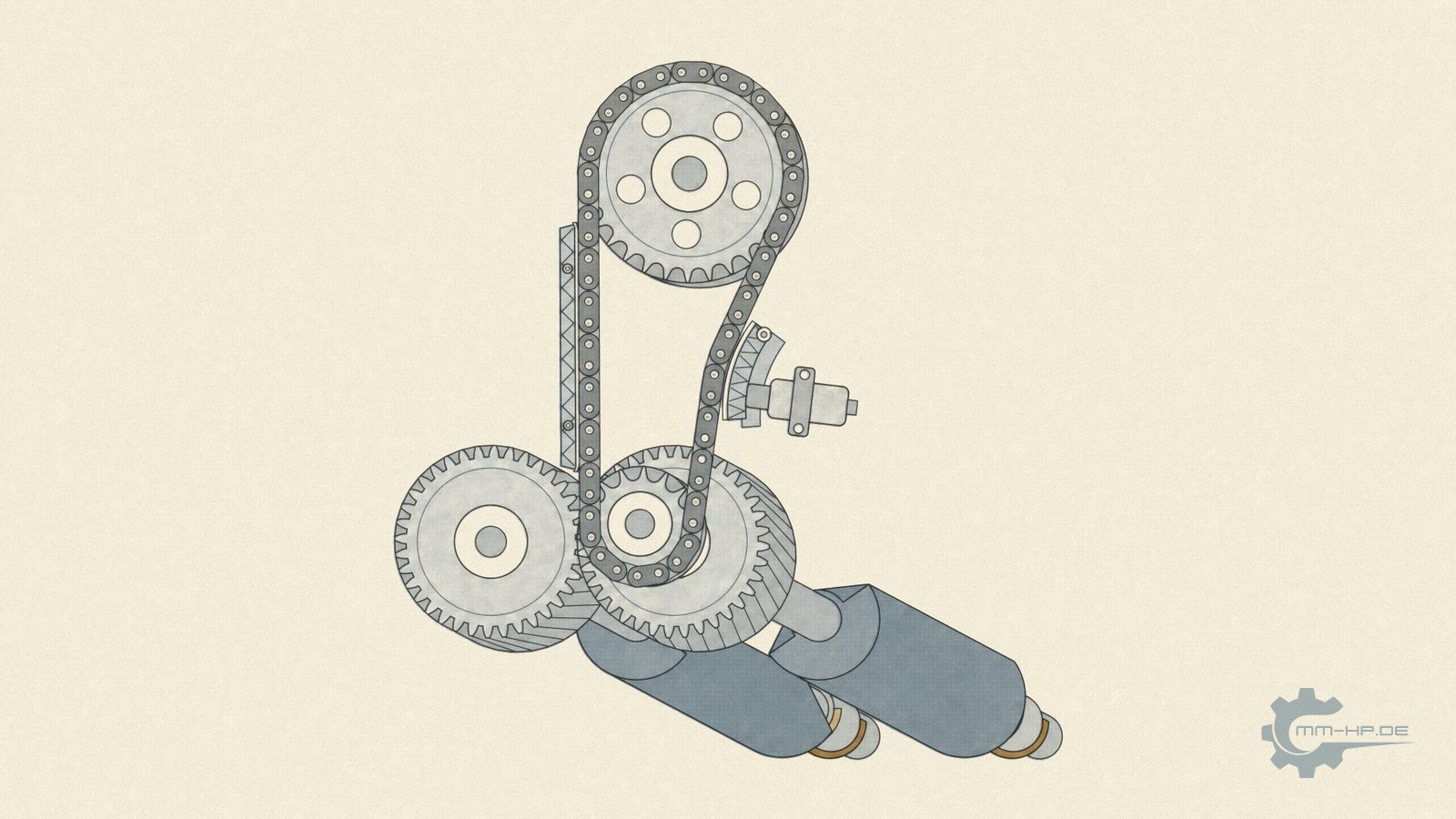
¶ The key points at a glance
Millions of 2.0 TDI engines from VW, Audi, Seat and Skoda carry an assembly in the oil pan that has, over the years, become the engine's best-known weak point: the balancer shaft module with an integrated oil pump. This pump is driven at the end of a long chain of gears and shafts via a hexagon drive dog just six millimetres across the flats. Due to manufacturing tolerances, this dog doesn't sit perfectly centred in its bushings, so it strikes their walls on every load change and wears itself round over tens of thousands of kilometres — a self-accelerating process. Eventually it spins freely, the oil pump stops, and without an immediate response the engine dies. Documented failures typically occur between roughly 100,000 and 160,000 kilometres — right in the middle of a normal car's life.
The manufacturer responded, but quietly: from around 2010, the drive dog was lengthened from 77 to 100 millimetres; there was never a comprehensive recall. Since then, the spare parts market has offered reproductions and repairs that nearly all do the same thing: repeat the original principle. What's regularly overlooked in the process is that even with a perfect drive, the pump in this design remains small — it was squeezed into an already packed module and operates without reserves.
There are therefore two honestly distinguishable ways out. Our reinforced drive dog defuses the most dangerous wear part — affordable and proven — but leaves the module and small pump in the vehicle. Our conversion to "without balancer shaft module" removes the entire assembly and replaces it with a directly driven, larger pump — the classic principle that most engines use anyway — in the field with us since 2015.
So much for the short answer. The long version takes the design apart piece by piece: why the module exists at all, how the wear mechanically unfolds, which engines are affected, what the market offers, and where most solutions fall short.
¶ Why balancer shafts at all?
An inline four-cylinder has a built-in comfort problem. Its pistons move in opposing pairs, which largely cancels out first-order mass forces, but the second-order forces, which occur at twice crankshaft frequency, remain. You feel them as a fine hum and vibration that increases with engine speed. In small engines, this is accepted. In a two-litre diesel with a healthy displacement per cylinder, intended for comfort-oriented vehicles like the Passat, A4 or A6, it was not something manufacturers wanted to accept.
The classic solution is two counter-rotating balancer shafts running at twice crankshaft speed, generating exactly the opposing forces needed. Where this principle comes from and why it has to look exactly this way is explained in the next chapter. For the story of this article, what matters first is the question of WHERE these shafts are housed and what else gets attached to them. And this is where the actual story of this article begins: in the EA189 with balancer shaft module, the engineers decided to pack both shafts into a shared housing in the oil pan, and because construction was already happening down there, the oil pump moved in as well.
From a manufacturing-cost perspective, this was elegant: one assembly, one operation, compact overall height. From the perspective of oil supply, it was the start of a chain of events rarely found in any other engine.
¶ The physics behind it: Mr Lanchester and the second order
Anyone who wants to understand why manufacturers go to this trouble at all needs a quick look inside the crank train, and the explanation is more elegant than you'd expect. The reason an inline four-cylinder has unbalanced second-order forces at all comes down to a geometric detail: the connecting rod sits at an angle to the cylinder axis during rotation. Because of this angle, the piston covers more distance in the upper half of the crank travel than in the lower half — meaning it accelerates more strongly at top dead centre than at bottom dead centre. This asymmetry produces a residual force that pulses at twice crankshaft frequency. And while the first-order forces in a four-cylinder cancel each other out through the paired, opposing pistons, the second-order forces add up in phase across all four cylinders. So the four-cylinder doesn't hum because it's badly built, but because its architecture dictates it. The technical literature puts the second order at roughly a third of the first — small enough to ignore in small engines, large enough to be felt in a comfort-oriented vehicle.
The solution is over 120 years old and carries the name of its inventor: British engineer Frederick Lanchester — incidentally the designer of one of the first British automobiles and holder of the patent for the disc brake — developed the balancing system named after him around 1904. Two shafts with counterweights rotate in opposite directions at twice crankshaft speed, their combined imbalance running exactly out of phase with the piston motion. There's an elegant reason it has to be two shafts and not one: with only one shaft, the centrifugal force would also act sideways and create a new kind of shaking. With two counter-rotating shafts, the sideways components cancel out, leaving exactly the vertical counterforce you want. A mechanically perfect principle, proven over generations.
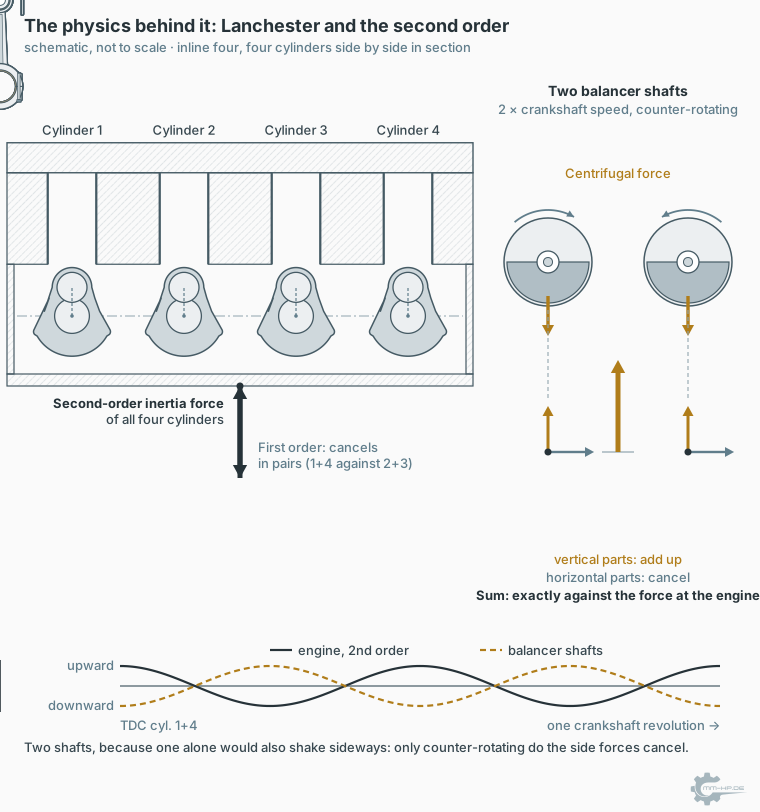
Second order: the pistons produce a force that pulses up and down twice per revolution. The two counter-rotating shafts deliver exactly the opposing force, and their side forces cancel.
Where the line between "needed" and "not needed" runs is shown by an example from a completely different shelf: Honda builds its 2.0-litre four-cylinder K20 as standard without balancer shafts, while the nearly identical 2.4-litre K24 gets them. Somewhere between these displacements lies the point, for the engineers, where the hum turns from character into flaw. The two-litre TDI sits right in this grey zone, and for the Passat-A4-A6 class, VW chose comfort. The decision itself was well founded. The story of this article isn't about THAT balancer shafts were fitted, but about HOW.
¶ A pump at the end of a long chain
Let's follow the drive path the oil pump's power takes in this design. The crankshaft drives the module — depending on model year, via a chain or a set of spur gears, more on that distinction in its own chapter shortly, because it matters. Inside the module, the first balancer shaft drives the second balancer shaft via further spur gears. And the second balancer shaft, via that small hexagon drive dog, finally drives the oil pump. The engine's most important auxiliary unit, the sole source of its oil pressure, hangs at the end of a chain made up of several gear meshes, two shafts, and one form-fit pin — every link of which has play, wears, and makes noise.
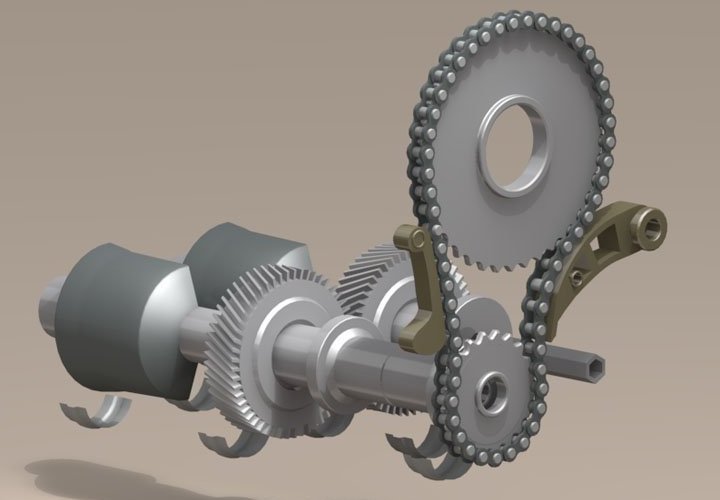
Series module with chain drive as a 3D model, without housing and without oil pump. From the crankshaft to the hexagon on the right, it takes one chain, two shafts and one gear pair.
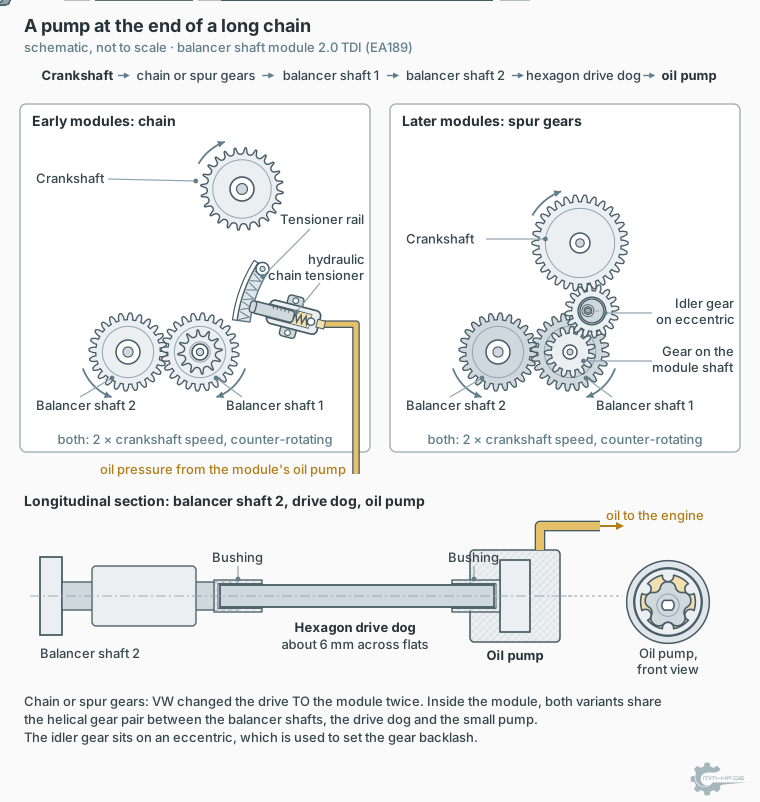
The path to the oil pump: on the left the early modules with chain and hydraulic tensioner, on the right the later ones with spur gears. Drive dog and pump sit in both variants.
On top of that comes a space problem with consequences. Because the pump had to fit inside the already-packed module, it ended up small. A small pump can only compensate its delivery volume through speed, so it was geared up and runs correspondingly fast. High speed means high stress right at the component that transmits the force — the drive dog — and it also means the pump, despite working hard, has little in reserve. According to our measurements and experience, this system operates in series condition with essentially no buffer, and of all places, at the rearmost stations of the supply chain, where the bearings sit (why the pressure there is a completely different matter than at the measurement point, read here).
Let's be clear: this design doesn't have ONE weak point, it has two, and they mask each other. The loud one is the drive dog. The quiet one is the pump itself.
¶ Two drives, one outcome: the chain and the spur gears
The drive from the crankshaft to the module exists in two production variants, and their history is a lesson in how a design problem can't be solved by swapping parts. We know both variants in detail from our own workshop and teardown practice.
The early modules were driven by a chain, and this variant developed a particularly vicious failure mechanism. The chain and sprockets often wore quickly, up to and including chain failure with correspondingly severe consequences. But the truly treacherous part was the interplay with the drive-dog problem: the balancer-shaft-module chain was tensioned by a hydraulic chain tensioner — a component that itself depends on oil pressure. If drive-dog play increased and the oil pump was no longer driven cleanly, oil pressure dropped, and with it the tensioner's clamping force. The slackening chain began to slap and gradually tore apart the entire drive unit. A perfect vicious circle: the wear of one component removed the operating basis of the other's protection system. Anyone who has read our chain tensioner article will recognise the textbook scenario of a hydraulic tensioner without oil pressure here — except not just for seconds after a cold start, but permanently. Why oil pump chains otherwise usually run with a mechanical spring-loaded tensioner, and why a hydraulic tensioner is precarious at this particular point, is explained in our overview of the timing chain drive.
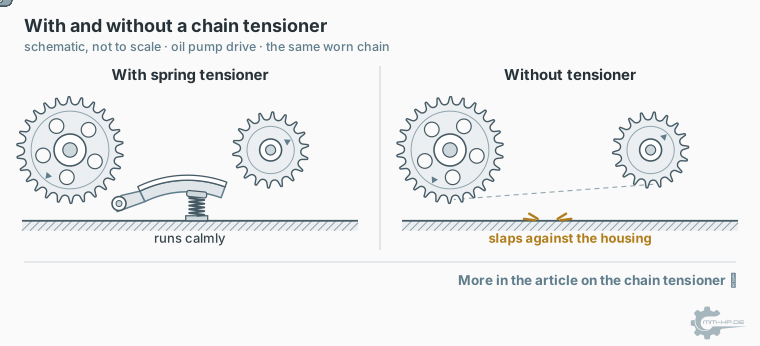
Preview from the article on the chain tensioner: the same elongated chain, once with and once without a tensioner.
➜ Why a chain drive without a tensioner destroys itself
Because this problem couldn't be brought under control, VW switched to spur gears: one gear on the crankshaft, an idler gear, and one gear on the module shaft. On paper, the more robust solution; in practice, a tricky one: the gears require precisely set backlash, the entire module has to be synchronised to the engine with special tooling during assembly, and in operation the backlash didn't stay where it belonged. Lubrication and thermal effects changed the gear backlash over the engine's service life, and the inherently never-quite-smooth running of a combustion engine subjected the gear contact to constant flank impacts. The result: the spur gears also failed frequently, and this problem has never been fundamentally resolved to this day.
The punchline of this two-part story: the drive dog and the undersized pump sit in both variants. VW changed the drive TO the module twice while leaving the problem INSIDE the module untouched. Anyone facing a repair decision today shouldn't ask which drive variant they have, but whether they want to renew, a third time, the design that wore out both variants. Our answer to that is below, and it has been unchanged since 2015: remove the module entirely.
¶ The hexagon: anatomy of a pre-programmed wear process
The drive dog is an unassuming hexagon pin, roughly six millimetres across the flats, that sits in bushings on the second balancer shaft and the oil pump and transmits the pump's entire drive torque — at twice crankshaft speed, meaning at motorway driving with five to six thousand revolutions per minute, hour after hour.
That could go on fine for a long time, if the form fit were perfect. It isn't. In technical discussions, eccentricities of the mounting bushing of up to 0.1 millimetres are documented, plus the manufacturing-related play between hexagon and bushing. The result: instead of bearing across its full surface, the pin runs on its edges and strikes the bushing walls with its flanks on every load change. Millions of times over.
Now a mechanism kicks in that makes this damage particularly insidious compared with all other engine wear processes: it accelerates itself. Every impact abrades material and deforms the flanks, and the play grows. More play means more run-up before each impact, meaning harder impacts, meaning faster wear, meaning even more play. An exponential process: unremarkable for years, then dramatic in a short space of time. Eventually the six edges are worn so round that the pin spins freely in the bushing like a stripped screw under a worn-out bit. The oil pump stops, oil pressure collapses, and what matters then is seconds (what to do in that moment).
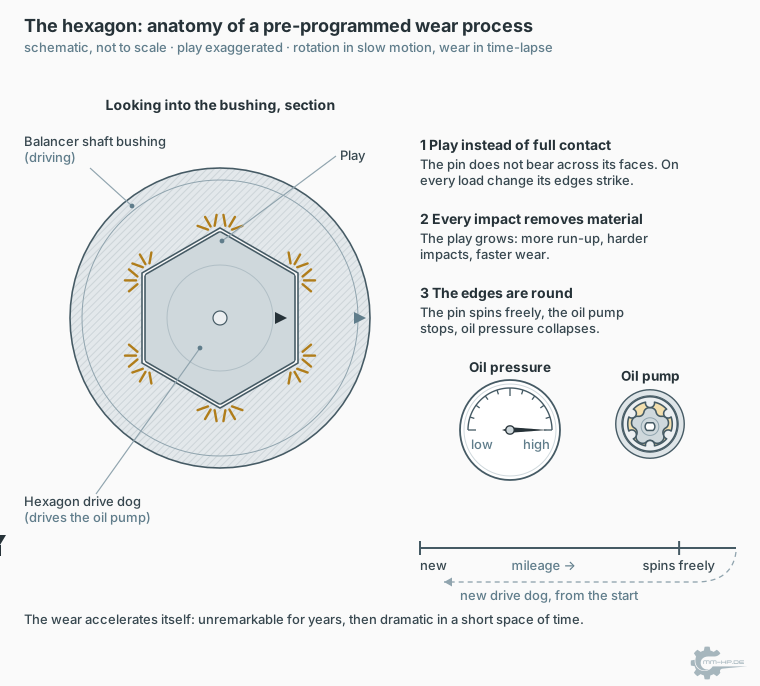
Looking into the bushing, play exaggerated: on every load change the pin strikes, its edges round off until it spins freely and the oil pump stops.
The treacherous part of the timeline: in owner reports, failures cluster between roughly 100,000 and 160,000 kilometres. That's not an old-car problem — that's the middle of a car's life, often shortly after a used-car purchase. And it barely announces itself, because this engine's oil-pressure warning is a simple switch with a low threshold that only triggers once it's practically too late.
The manufacturer knew about the problem and responded in its own way: from around 2010, the drive dog was lengthened from 77 to 100 millimetres to increase the engagement depth in the bushings — in other words, to reduce surface pressure. A genuine improvement, but not a fix for the underlying problem, and above all: no recall.
¶ What became public in 2013: the damage in the trade press
That this topic isn't a workshop myth can be backed up with a date: in May 2013, AUTO BILD made the 2.0 TDI's oil pump drive the cover story of a report, and the statements documented there remain, to this day, the most official record of the problem.
The key points from the report: VW told the editorial team that the cause was "tolerance deviations" in the oil pump drive — a remarkably honest phrasing that describes exactly the mechanism from the chapter above. The hexagon shaft could "wear round" and fail abruptly, often at high revs, with turbocharger damage up to total engine failure as a result. The affected model ranges named were the Passat and Sharan, Audi A4 and A6, Skoda Superb and Seat Alhambra from model years 2005 to 2009. VW and Skoda confirmed case numbers "in the three-digit range"; the number of unrecognised engine failures is likely higher, since an engine with destroyed bearings no longer reveals what triggered its death.
What's revealing is how the consequences were handled. A complete module replacement was quoted at 1,300 to 1,700 euros, while a pure drive repair at independent specialists started at around 650 euros. Goodwill was granted case by case after inspection; only Audi rolled out an official service action (reference 13D7). And perhaps the most notable sentence in the report: the manufacturer explicitly did not recommend preventive repair. You can understand this position from a business standpoint without having to share it technically: for a component with a documented, self-accelerating wear process and abrupt end-of-life failure, waiting is a strategy whose risk is borne solely by the owner. Anyone driving an early EA189 today is driving with the design of back then, and nobody makes the decision of whether to act preventively on their behalf.
¶ Which engines are affected, and which aren't
Hardly any topic generates as many enquiries in our support as this question, and hardly any causes as much confusion. So here is the classification everything hinges on, and it runs exclusively via the engine code letters (vehicle registration document, field D.2) — never via model, model year, or horsepower:
| Type | typical code letters (selection) | oil pump drive | covered by this article? |
|---|---|---|---|
| EA189 WITH balancer shaft module | BLB, BRE, BNA, BRD, BPW etc. (approx. 2005-2009, Passat, A4, A6, Superb ...) | chain/spur gear → module → hexagon drive dog | YES, core topic |
| EA189 WITHOUT module, older type | BKD, AZV, BMN etc. | direct chain drive | no, unremarkable on this point |
| EA189 WITHOUT module, later type | various | wet timing belt drives the pump | no, a separate problem with its own solution |
| EA189 BiTDI in the T5/Amarok | CFCA | like module type, plus its own failure pattern | partially, separate article |
| EA288 (successor generation) | CRB, DEZ, DAU and many others | wet timing belt | no, a separate topic |
| Special cases | e.g. CEGA (chain from the factory), BMM in the Caddy (different design) | various | no |
We deliberately name only example code letters here, not complete lists. The reason is honesty about upkeep: the complete, continuously updated vehicle and engine lists live in the fitment lists of the respective products in our shop — that's where the information is always current, and only there. A wiki article that maintains engine lists goes stale silently, and silent staleness is dangerous on this question.
From support, we know the classic mix-ups, and they regularly cost customers money: drive dogs get ordered for engines that don't even have a module. The EA288 chain-conversion kit gets confused with the EA189 conversion. And the wet-timing-belt oil pump issue (the belt runs in the oil, degrades, and its particles clog the oil strainer) gets mixed up with the drive-dog topic, even though cause and solution are completely different. When in doubt: note down the engine code letters and ask — that's sorted out in two minutes.
¶ A look over the fence: others are wrestling with the auxiliary drive too
Before the impression arises that a single manufacturer is being singled out here, it's worth looking at the neighbours, because it puts the problem in proper perspective: the auxiliary drive — meaning the drive train for balancer shafts, oil pump, and in some cases the injection pump — is a documented weak point in practically all two-litre diesel engines of this generation.
BMW N47: the direct competitor to the 2.0 TDI also got its balancer shafts as a purpose-built unit, and its Achilles' heel lies in the same packaging mindset: the timing chain moved to the rear of the engine, where it's hard to access and sees oil later after a cold start. When the chain jumps or guide rails break, plastic fragments end up in the oil circuit, and the actual engine failure then often doesn't come from the chain itself, but from the resulting contamination of the oil pump and bearings — a mechanism readers of our particle article will immediately recognise.
Mercedes OM651: the Stuttgart two-litre also drives its two needle-bearing Lanchester shafts and the high-pressure pump via a gear train at the rear of the engine, with the camshafts hanging off a short roller chain. Early model years showed elongated chains, worn gears, and an undersized chain tensioner, with cold-start rattling as a symptom and total failure as the end stage; in 2014, further tensioner defects due to manufacturing tolerances were added to the list.
The pattern is the same everywhere, and that's the real insight from this comparison: in the tightest of spaces, several mechanically highly stressed auxiliary units have to be driven in sync, and this is exactly where design compromises concentrate industry-wide. The EA189 isn't an outlier — it's VW's specific representative of a generational problem. What sets it apart is the combination: in its case, of all things, the oil pump — the most safety-critical auxiliary unit — hangs at the end of the longest chain, connected by the smallest component.
¶ The market of half-solutions
Anyone who has identified their module problem finds a well-stocked market waiting, and it's worth a critical look, because the paths on offer differ fundamentally, even if they sound similar.
Path one: the new original module. Cost in the four-digit range; documented figures run from 1,300 to 1,700 euros plus installation. What you get for that: exactly the same design all over again, drive-dog principle and small pump included. The clock gets turned back, not stopped.
Path two: reconditioning. Independent specialists regenerate the worn mounting bushing and fit the lengthened 100-millimetre hexagon, priced from a few hundred euros. Often solid workmanship, but conceptually the same applies: the weak point is renewed, not eliminated. And experience shows such a repair typically leaves undetected, worn neighbouring parts in the vehicle, which are next in line to fail.
Path three: reinforced aftermarket drive dogs. Various suppliers, mostly with the argument "like original, just more solid" or simply as a like-for-like replacement part.
What stands out when reviewing this market, and we've reviewed it thoroughly: the suppliers' reasoning operates almost entirely on the level of "we replace or improve the failed part." The question of whether the PUMP in this design is even properly sized is one nobody asks publicly. Yet according to everything our measurement series have shown over the years, that's the second half of the problem, and it remains even when the drive holds up. An engine with a freshly reconditioned module and a new drive dog still runs with a pump that has no reserves; against oil ageing, manufacturing variance, and the dilution and atomisation chains of modern diesels, it has nothing left to give.
¶ Our reinforced drive dog: the honest symptom treatment
Before we get to the conversion — full disclosure, with cards on the table: we also sell a reinforced drive dog, for many years now and in large numbers. We just classify it differently than the market does, namely as what it is: the best available treatment of the symptom, not a cure for the cause.
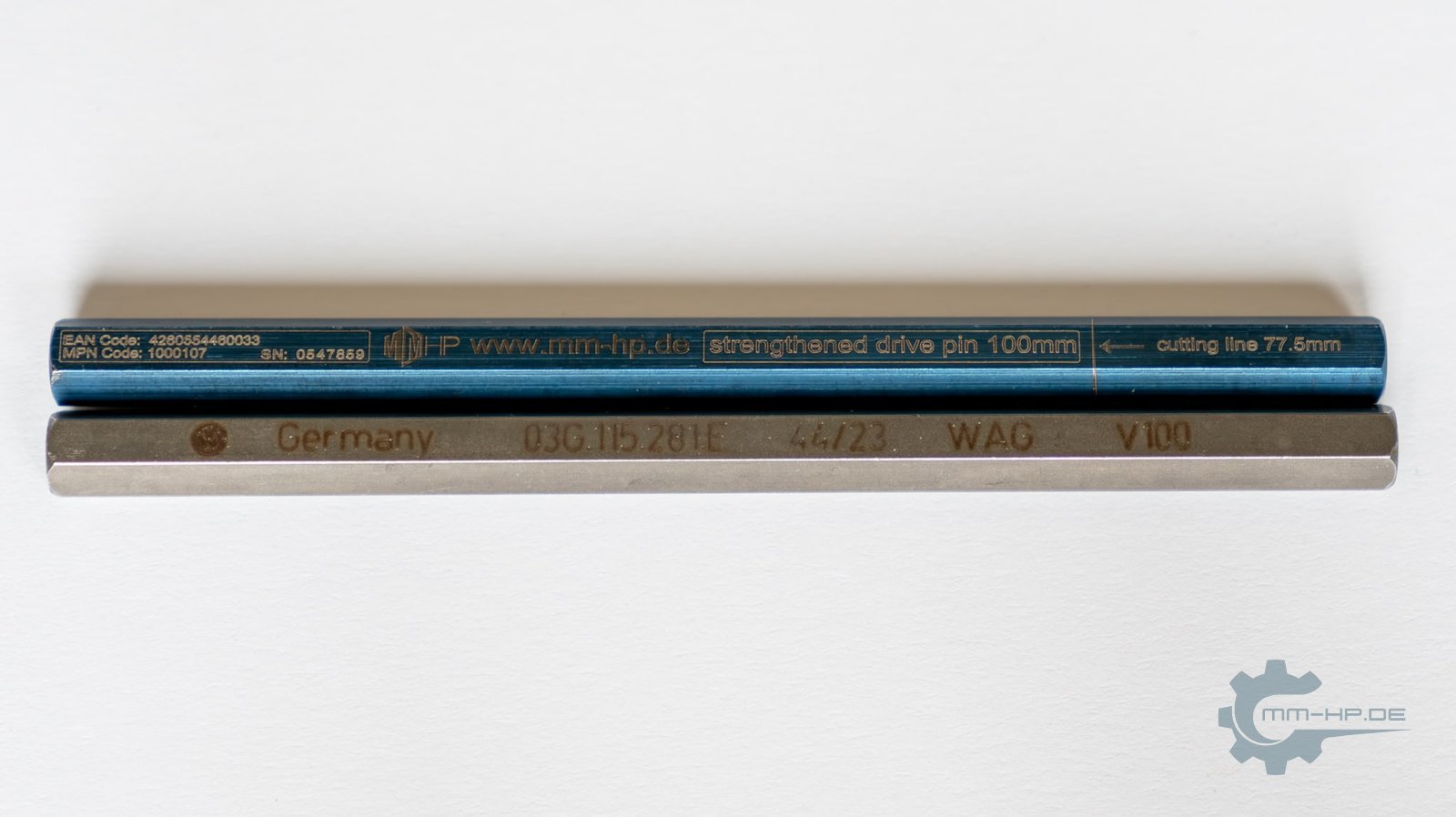
New part and stock part, own photo. Top: the reinforced drive pin; bottom: the stock drive pin.
What sets it apart from aftermarket parts is its development history. We've iterated the component through four generations, each one learning from documented returns and measurements of the previous:
| Version | Core changes |
|---|---|
| 1.0 | Hardened long version in original geometry |
| 2.0 | Dimension adjusted for a better fit, new hardening technology, additional protective coating |
| 3.0 | Dimension tolerance-optimised, revised hardening process, improved surface coating, precision increased for reduced bushing play |
| 3.1 (current) | Dimension and tolerances further refined, improved hardening, wear further reduced through more precise manufacturing |
The technical core lies in a detail you can barely see in product photos: the fit. We measured the real manufacturing tolerances of the bushings, in both the balancer shaft AND the oil pump, and designed the hexagon with a deliberately tight interference fit based on that data. This reduces the play that fuels the exponential wear to a minimum, while a load-bearing oil film can still work between the flanks. Add to that a harder base material than the original and a hard coating borrowed from the machining-tool world. It's supplied as the long 100-millimetre version with a cut-to-length marking for applications that need the short 77.5-millimetre variant.
Two honest limitations belong here. First: the tight fit assumes intact bushings. If the mount is already worn out of round or deformed, even the best drive dog won't seat properly any more — then there's no way around replacing the affected parts, or going straight to the conversion. Second, and we deliberately repeat this at every opportunity: even the best drive dog only slows the wear process, it doesn't eliminate it, and the small pump along with its long drive chain stays in the engine. If you want to cheaply defuse the single biggest risk, this is the right choice. If you want to close the topic for good, keep reading.
¶ The root-cause solution: the module disappears
Traditionally, a combustion engine's oil pump is driven directly by the crankshaft — short, robust, no intermediate stages. Our conversion restores exactly this principle: the entire balancer shaft module, including shafts, spur gears, drive dog and small pump, is removed, and a directly driven, larger-displacement high-performance oil pump takes its place. No more hexagon that can wear itself round, no more four-stage gear-mesh chain, and for the first time a pump that wasn't made small by lack of space. The system has been in the field since 2015 and has proven itself over the years in every installation position of this engine family, in two performance stages, whose selection is a story of its own (why we almost always recommend Stage 2, and why we don't ship anything else for the CFCA, and why we don't make bar-value promises for that).
The most common critical question deserves a direct answer: "But what about the vibrations? The balancer shafts are there for a reason." True, for comfort. The shafts don't provide any function without which the engine would suffer damage; they smooth out the system-inherent four-cylinder second-order hum. The best proof of this drives on the road by the million: numerous production engines in the same power class, including from the same corporate group, come from the factory without balancer shafts at all. After the conversion, the engine is acoustically a bit more honest — a four-cylinder, plain and simple — but mechanically a whole fault cascade lighter, and its oil balance gains twice over: the new pump delivers more, and the removed module was itself an oil consumer whose demand now benefits the rest of the system. Based on our long-standing experience, the removal is also unproblematic with automatic and DSG transmissions.
Which path is right for which situation can be summed up in one sentence: the reinforced drive dog is the choice when budget is tight and the engine is young and healthy; the conversion is the choice when you want peace of mind — and it's the obvious choice if the oil pan is open anyway. Both solutions come from us, we're upfront about that, and if anything, we advise against the quick sale: tell us the engine code letters and the history, and you'll get the technically appropriate recommendation, not the most expensive one.
How we design the conversion pump in detail, and which measurement series have shaped its gear ratio and geometry over the years, we keep to ourselves — this knowledge is the core of our work and an asset of our company. The result, on the other hand, is all the easier to verify: on tens of thousands of vehicles that have been running on it for years.
¶ Life without balancer shafts: the comfort balance, honestly calculated
Because the vibration question is by far the most common follow-up question about the conversion, it deserves its own chapter with full transparency, beyond the short answer above.
What happens physically: without balancer shafts, the second-order mass forces remain uncancelled — the hum at twice engine-speed frequency that Mr Lanchester wanted to tame 120 years ago is back. It was never gone, it was just being compensated. None of this is harmful to the engine's function; it's a comfort factor.
What drivers report: experience reports from forums and from our own customers paint a consistent picture. The engine runs "somewhat rougher" in the low and mid rev range, most people wouldn't even call it vibration, and drivers get used to it quickly. In everyday driving, at cruising speed, under load, the difference isn't worth mentioning for the vast majority. But we also relay the dissenting voices found in every forum discussion: anyone for whom maximum smoothness was a reason to buy their Passat or A6 will notice the difference, especially at idle. Everyone should know that beforehand, not afterwards.
The strongest evidence comes from the manufacturer itself: the successor generation, the EA288, exists as a two-litre variant both with and without balancer shafts, depending on power output and vehicle class, from the same plant, with the same basic architecture. VW itself therefore treats balancer shafts as exactly what they are: a comfort-class equipment option, not a functional requirement. This fits with the Honda example from the physics chapter — the K20 runs without them by the million. An engine without balancer shafts isn't a crippled engine; it's the base version of its own species.
One distinction to close, because it often gets muddled in forums: the dual-mass flywheel has only a tangential relationship to any of this. It dampens the crankshaft's rotational irregularity — the jerking from the individual combustion strokes — and naturally remains on board and in function after the conversion. Anyone trying to pin post-conversion vibrations on the dual-mass flywheel or the engine mounts is looking at the wrong component; both systems operate on a different frequency of the vibration problem than the shafts that were removed.
¶ See also
- VW T5 2.0 BiTDI (CFCA): the special case with its own rule
- Oil pressure isn't just oil pressure: why the measurement position matters
- The oil-pressure warning light: what it really tells you, and what it doesn't
- Every engine is a one-off: manufacturing tolerances and oil pressure
- Oil consumption in the 2.0 TDI: the blow-by chain reaction
Transparency note: MMHP develops and sells the reinforced drive dog as well as the "without balancer shaft module" conversion system. The technical descriptions are based on publicly documented sources and our own teardown and measurement work; market and cost figures are marked as reported and may change.